Mary’s Magnificat (Luke 1:46b-55)

The Magnificat, a woodcut by Sr. Mary Grace Thul

Mary said,

“With all my heart I glorify the Lord!
    In the depths of who I am I rejoice in God my savior.
He has looked with favor on the low status of his servant.
    Look! From now on, everyone will consider me highly favored
        because the mighty one has done great things for me.
Holy is his name.
    He shows mercy to everyone,
        from one generation to the next,
        who honors him as God.
He has shown strength with his arm.
    He has scattered those with arrogant thoughts and proud inclinations.
    He has pulled the powerful down from their thrones
        and lifted up the lowly.
He has filled the hungry with good things
    and sent the rich away empty-handed.
He has come to the aid of his servant Israel,
        remembering his mercy,
    just as he promised to our ancestors,
        to Abraham and to Abraham’s descendants forever.” (Common English Bible)

Mary, the mother of Jesus, was able to wrap both her head and heart around an incredible reality – that God had done great things for her. And it was enough for her to erupt into a great song of praise. Indeed, the Lord shows mercy to everyone who worships and adores the mighty acts of God.

It strikes me that Mary, instead of being full of worry and afraid of the future, and as an unmarried teen with child, is full of the Spirit and faith. Mary neither complained nor fretted for the nine months of her pregnancy; she praised God and was clear-headed about the grace shown to her.

Mary’s canticle gives us insight into the mystery of the incarnation: God chooses the weak, those of low esteem, and the powerless. Mary was quite ordinary for her day. She had no wealth and nothing which would cause anyone to pick her out of a crowd.

Yet, Mary is the one chosen by God. And her wonderful response to grace demonstrated that there is so much more to any person than what we can see with our eyes and perceive through our earthly glasses of high positions and strength of personalities.

What’s more, Mary had the wisdom to discern that her situation typified the Lord’s egalitarian work of leveling the field so that all persons have what they need. Her son, the Messiah, would carry this into his own life and ministry – declaring good news to the poor, comforting the brokenhearted, proclaiming freedom for captives, telling those who mourn that the time of the Lord’s favor has come.

We may tend to think that the work of God is surprising, only because we might often experience so little of grace and mercy in this old world. But God is always full of grace, mercy, and power to those who are powerless and in need of help. The Lord has our backs. 

Perhaps if we all, both individually and corporately, continually used our words to identify and declare the great things God has done, we would then realize the consistent blessing of the Lord. 

I encourage you to take some time today and either journal and/or speak with another about the ways in which God has been good to you in this Advent season, and like Mary, offer praise for each act of mercy. Mary exhibited no helplessness but had her heart calibrated to detect the grace of God when it was present.

May the joy of the angels, the eagerness of the shepherds, the perseverance of the wise, the obedience of Joseph and Mary, and the peace of the Christ child be yours this Christmas. And may the blessing of God almighty – Father, Son, and Spirit – be among you and remain with you always. Amen.

Christ Is Born (Luke 2:1-20)

Nativity, by He Qi, 1998

In those days Caesar Augustus declared that everyone throughout the empire should be enrolled in the tax lists. This first enrollment occurred when Quirinius governed Syria. Everyone went to their own cities to be enrolled. Since Joseph belonged to David’s house and family line, he went up from the city of Nazareth in Galilee to David’s city, called Bethlehem, in Judea. He went to be enrolled together with Mary, who was promised to him in marriage and who was pregnant. While they were there, the time came for Mary to have her baby. She gave birth to her firstborn child, a son, wrapped him snugly, and laid him in a manger, because there was no place for them in the guestroom.

Nearby shepherds were living in the fields, guarding their sheep at night. The Lord’s angel stood before them, the Lord’s glory shone around them, and they were terrified.

The angel said, “Don’t be afraid! Look! I bring good news to you—wonderful, joyous news for all people. Your savior is born today in David’s city. He is Christ the Lord. This is a sign for you: you will find a newborn baby wrapped snugly and lying in a manger.” Suddenly a great assembly of the heavenly forces was with the angel praising God. They said, “Glory to God in heaven, and on earth peace among those whom he favors.”

When the angels returned to heaven, the shepherds said to each other, “Let’s go right now to Bethlehem and see what’s happened. Let’s confirm what the Lord has revealed to us.” They went quickly and found Mary and Joseph, and the baby lying in the manger. When they saw this, they reported what they had been told about this child. Everyone who heard it was amazed at what the shepherds told them. Mary committed these things to memory and considered them carefully. The shepherds returned home, glorifying and praising God for all they had heard and seen. Everything happened just as they had been told. (Common English Bible)

Nacimiento (Nativity), by Leoncio Saenz, 1983

It is of significance – and not by accident – that Jesus had a humble birth in a lowly setting. All around was the backdrop of a powerful Roman Empire. Whereas Christ could have been born as the mighty king that he actually is, he instead was born and then laid in a feeding trough for animals.

Caesar Augustus — whose name means revered or exalted one — ended a long period of war in the Roman Empire and was hailed as a prince of peace, the savior of the world. With his reign began the Pax Romana (Roman Peace). Under the rule of Augustus, the economy was booming; culture, religion, and infrastructure were developed and prospered. He was hailed by many with the title “Ceasar is Lord.”

Yet, as with many powerful rulers in history, Augustus ruthlessly suppressed his enemies and limited their human rights. It was peace by totalitarian rule – which is really no peace, at all.

It was in those days that Augustus proclaimed his decree for a census of the entire Roman world, so that taxes could be collected from all the conquered peoples of the empire. And so, despite being very pregnant, Mary and her fiancé Joseph made the arduous 90-mile trek from Nazareth in Galilee to Bethlehem, the city of David. That was the only way they could be properly registered, to return to the ancestral home.

It’s no surprise that Mary ended up giving birth to Jesus, far from their actual home, in less than ideal circumstances, for a delivery of a baby.

It appeared Ceasar Augustus was the absolute ruler, and much too powerful for anyone to challenge him. It also seemed that Jesus, a vulnerable little infant with even smaller resources, could do anything but just try and survive. But appearances can be, and are often, quite deceiving.

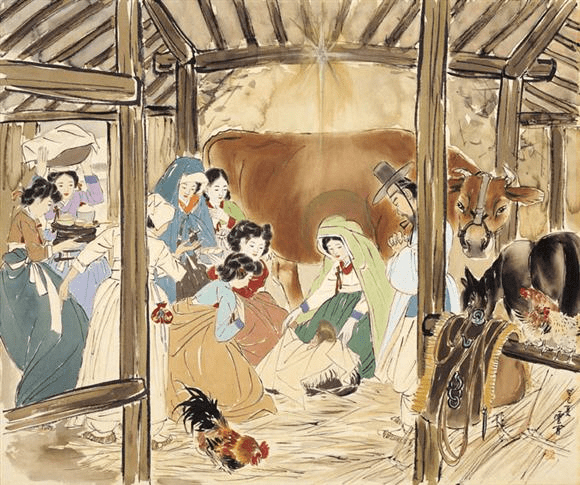
The Birth of Jesus Christ, by Woonbo Kim Ki-chang, 1952

In truth, Jesus is Lord, and Ceasar is not. Christ is the real Prince of Peace who brings God’s benevolent rule and reign to earth, as it is always done in heaven. And it will not be achieved through military power, but by the justice and mercy of God. Because, as it turns out, Love is a much greater force than any human authority or empire.

Considering God’s gracious kingdom – which turns all appearances on its head – it is quite appropriate that news of Christ’s royal birth comes first to a bunch of shepherds. They were among the lowliest of the emperor’s subjects.

Although we may tend to romanticize the shepherds keeping watch over their flocks by night, most people thought of shepherds as low class workers who nobody wanted to be around. They were poor, illiterate, and thought to be dishonorable drunks. Shepherds also had the reputation of being thieves because they grazed their flocks on other people’s property. In short, they were mostly the outcasts of society.

To this group of people the angel announces good news of great joy for all the people everywhere – and not just the powerful and the rich: To you is born this day in the city of David, a Savior, who is the Messiah, the Lord. The shepherds go to Bethlehem to find this baby, and become the first to share the good news of the Savior’s birth.

Today, we still live in a world dominated by people who desire power and privilege over others. We still live in a world enamored with wealth and resources, power and authority, military might and social control. In this world, much like the ancient world, the lowly still get trampled and the least among us get little if any attention.

Masters of both small and large worlds will eventually be toppled, not to mention our own personal petty empires we seek to build. All of our planning and scheming will never bring true peace and security. Jesus has arrived! Christ is born! All other empires are now on borrowed time.

Nativity, by Joseph Mulamba-Mandangi, 2001

The Savior is born for all the world, for us, even though we are separated from Christ’s birth by two millennia. Jesus still comes to bring peace on earth and goodwill to all humanity through the power of Love. He still casts out fear and relieves anxious hearts. And his reign will last forever and ever.

With Jesus Christ as Sovereign, outcasts are welcomed in; the hungry are fed; the poor are lifted up; captives are set free; enemies are reconciled. And wherever the good news is proclaimed, guilt and shame melts away, and lives are changed.

Today Christians all over the world celebrate the birth of Christ. And we also look forward to his coming again, when his reign of justice, mercy, and peace comes in all its fullness.

May God bless you this Christmas and always. May you be comforted by the Lord’s presence in your life, and always follow his guiding light. For Christ has come, the Immanuel, God with us. Amen.

Encouragement for Today (1 Thessalonians 4:13-18)

Brothers and sisters, we do not want you to be uninformed about those who sleep in death, so that you do not grieve like the rest of mankind, who have no hope. 

For we believe that Jesus died and rose again, and so we believe that God will bring with Jesus those who have fallen asleep in him. According to the Lord’s word, we tell you that we who are still alive, who are left until the coming of the Lord, will certainly not precede those who have fallen asleep. 

For the Lord himself will come down from heaven, with a loud command, with the voice of the archangel and with the trumpet call of God, and the dead in Christ will rise first. After that, we who are still alive and are left will be caught up together with them in the clouds to meet the Lord in the air. And so we will be with the Lord forever. Therefore encourage one another with these words. (New International Version)

Everyone needs encouragement. Everybody wants some good news in their lives. People must not only have food, drink, clothing, and shelter, but also words that they can live by – words that can sustain them and help to make ends meet for their daily lives.

The Thessalonian Christians needed some good words of encouragement. They believed the Lord Jesus was coming soon. Any day now, at any time, Christ will return and take us to be with him forever. And yet, day after day, there was nothing but the anticipation, along with the expectations that weren’t realized.

On top of it all, some of the believing brothers and sisters died. So, what happens to them when they die? Will they somehow be excluded from enjoying Christ’s return? And, by the way, are we missing out on something here? Did Jesus come, and we somehow missed it?

The believers in the Thessalonian Church were left with concerns – not only for those who had died, but for those who were still alive. Perhaps somebody, even themselves, were being excluded from the gracious visitation of God. They were curious, but most of all confused.

Hope needed to be clarified for the Christians. A confident expectation would help sustain them in this life. They can keep laboring in the Lord with faith, have hope for the future, and realize love in both this life and in the life to come.

Christ will descend from the clouds with a cry of command, the sound of a trumpet, and lift the faithful into heaven. In other words, for those people who were living in the Roman Empire, Christ will arrive with the fanfare and pageantry of any Roman Emperor. Peace and security are here – not from Ceasar – but from a Sovereign who is greater than any earthly ruler.

I realize that many believers today see this vision of the coming Christ as a literal description. Maybe it is, and maybe it isn’t. But whatever it is, the Apostle Paul intended to assure the Thessalonian faithful that the promises of God were backed up by a power even greater than that of Rome.

Furthermore, true peace, security, and hope are not found in the Pax Romana of Rome, but in the gracious rule and reign of God. Christ is the Lord; Ceasar is not. The Thessalonians, therefore, were encouraged to let God be the source of their peace. For the One who calls you is faithful.

The encouragement we need is really not so different from what the Thessalonians needed to hear. Two thousand years later, like them, we continue to look for signs that assure us that God has not forgotten us; that we will not be left behind; and that we will not be separated from those who have already died.

As world problems continue, and as time marches on, we may grow weary. We might then place more hope and confidence in the power of a national government that offers us peace and security, as we patiently wait for God. Like the Thessalonians, all we really need is the assurance that God’s power and God’s promise is real.

We might not see Christ coming down from the sky today, or even next week, or next year. But we can still embrace the hope we need in order to get by every single day.

Although an apocalypse is coming, it is actually in the little things of life that helps sustain us till then. An encouraging and timely word from a friend; praying with a fellow believer; giving thanks to God for all things; and living with an awareness of the spiritual throughout the world all these things strengthen us and enable us to see God at work.

Through a consistent walk with God, day after day, the power and presence of God becomes real to us – maybe just as real as a dramatic scene of Christ coming down from the clouds – and offers us hope to face each new day with courage and compassion for a world in desperate need of salvation.

Almighty and all-sufficient God, give me strength to live another day.

Let me not be a coward in difficult circumstances, or to turn tail and run in the face of hard responsibilities.

Help me not lose faith in other people.

Keep my heart tender and wise, in spite of others’ ingratitude, treachery, or meanness.

Preserve me from minding the little stings of life, or of giving them to others.

May my heart be pure; and may I live honestly and fearlessly, so that no outward failure can dishearten me or take away the joy of inward integrity.

Open wide the eyes of my soul that I may see good in all things.

Grant me today some new vision of your truth.

Inspire me with a spirit of joy and gladness.

Make me the cup of strength to suffering souls.

I ask all of this in the name of my Deliverer, Lord, and Friend, Jesus Christ. Amen.

The Radiant Face of Moses (Exodus 32:29-35)

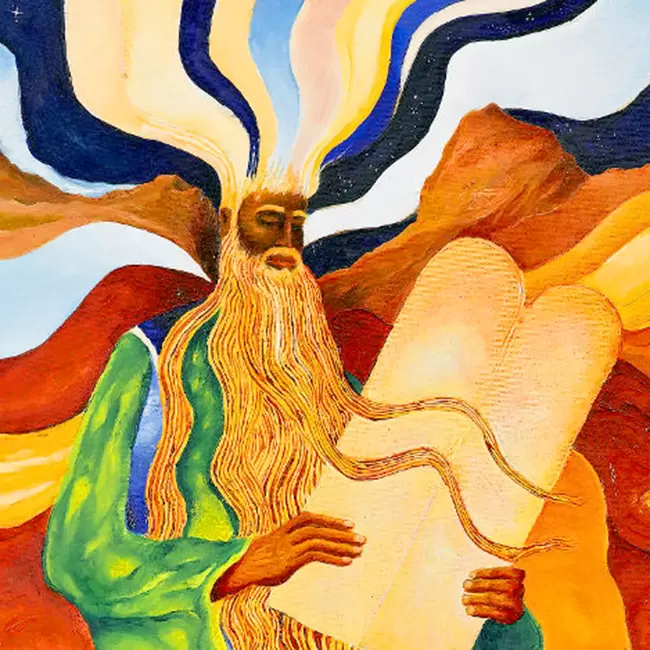
Moses and the Fire of Sinai, by Darius Gilmont

When Moses came down from Mount Sinai with the two tablets of the covenant law in his hands, he was not aware that his face was radiant because he had spoken with the Lord. When Aaron and all the Israelites saw Moses, his face was radiant, and they were afraid to come near him. But Moses called to them; so Aaron and all the leaders of the community came back to him, and he spoke to them. Afterward all the Israelites came near him, and he gave them all the commands the Lord had given him on Mount Sinai.

When Moses finished speaking to them, he put a veil over his face. But whenever he entered the Lord’s presence to speak with him, he removed the veil until he came out. And when he came out and told the Israelites what he had been commanded, they saw that his face was radiant. Then Moses would put the veil back over his face until he went in to speak with the Lord. (New International Version)

I’ve never seen anyone on Halloween dressed like Moses, complete with a shiny glowing face – even though the sight of Moses as he came down the mountain made the Israelites afraid to come near him. The face of Moses had been transformed in a way that made him appear haunted house scary to them.

Moses had actual face-to-face time with God on the mountain. And this seems to have changed his visage. Yet, Moses had stood before God previously without any change to his face. Moses had even interceded with God on other occasions with no special Halloween effect.

God made the new covenant and gave the new tablets because Moses smashed the old ones at the golden calf experience (see Exodus 32, especially verse 19). It could be that, with the radiant face of Moses, God was displaying before the people a tangible sign of God’s presence.

After all, the people had doubted God’s presence again and again during their time in the desert. So, when God’s seemingly ghostly presence was offered this time around, they were too afraid to be that closely connected to the divine.

Just as the loincloth that God made for the disobedient Adam and Eve in the Garden of Eden; and just as the sign of the rainbow God put in the sky after the world wide flood, so the Lord was making a new way for the people, a visible sign and demonstration of God’s presence – which was both reassuring and frightening.

It seems God wanted to show that Moses was still the leader, still God’s man, and that the people needed to not give him a hard time or rebel against God’s commands. At the same time, the Lord was assuring the Israelites that they were not abandoned, that Yahweh remains their God, full of mercy and grace, slow to anger, and abounding in steadfast love.

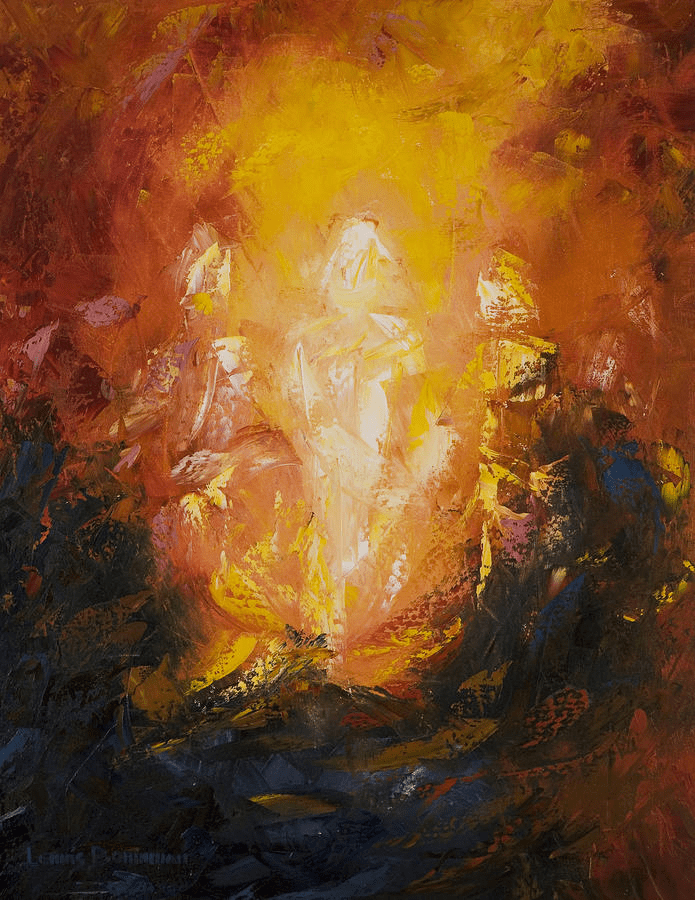
Transfiguration, by Lewis Bowman

In a similar way, the Transfiguration of Jesus in the New Testament Gospels does the same. The disciples were frightened on the mountain, seeing Jesus changed and probably much brighter than the face of Moses. And yet, they were also reassured that God was present with them in the person of Jesus Christ.

Just like the doubting people in Exodus, the disciples caught a glimpse of the great and awesome God, up close and personal. And like the people in the wilderness, the disciples did not understand everything that was going on. Both the ancient Israelites, and Christ’s disciples, did not fully comprehend what God was showing them. Each showed the fear of humanity, while God demonstrated God’s own character of love, faithfulness, and patience with frail humanity.

Certainly, when the face of Moses shone, it was an affirmation of the covenant’s renewal by God. The shiny face is also an indicator of the sort of relationship Moses had with God – and of his openness and vulnerability before God and before the community. It was a sign that Moses trusted God and that Israel, in turn, could trust God and Moses as their leader.

Whether veiled or unveiled, the face of Moses is a reminder of his unique relationship with God and with Israel. It’s a sign of God’s care and continual presence, and that God’s grace prevailed, even in the midst of Israel’s sin.

Another way of putting it, is that the radiant face of Moses represents a reversal of outcome concerning the golden calf idolatrous episode. It represents hope in the midst of a disaster in which all seemed hopeless.

In our own contemporary day and time of national upheavals and national disasters, it’s no wonder that many people would question whether there is any hope for our world, or not. Yet, no matter how dismal it may look; and no matter how unpromising the times we presently live in, today’s story about ancient Israel is a reminder to all of us to keep persevering and hold onto our confident hope that God is with us. There are better days ahead.

It might be Halloween, but the Advent of Christ is just around the corner.

Lord Jesus, Son of Man, Son of God, you encouraged us to come to you, all of us who labor and are heavy laden, and that you will give us rest. So, I now take your yoke upon myself, and learn from you because you are gentle and lowly in heart, and I know I will find rest for my soul. For your yoke is easy, and your burden is light. Help me to refocus from all that’s wrong in this old fallen world, and trust in you, through the enablement of the Holy Spirit. Amen.