Psalm 119:105-112 – Light for the Journey

Your Word is a Light

Your word is a lamp to guide my feet 
    and a light for my path. 
I’ve promised it once, and I’ll promise it again: 
    I will obey your righteous regulations. 
I have suffered much, O Lord; 
    restore my life again as you promised. 
Lord, accept my offering of praise, 
    and teach me your regulations. 
My life constantly hangs in the balance, 
    but I will not stop obeying your instructions. 
The wicked have set their traps for me, 
    but I will not turn from your commandments. 
Your laws are my treasure; 
    they are my heart’s delight. 
I am determined to keep your decrees 
    to the very end. (NLT) 

Two qualities which stand out to me in these verses are the psalmist’s attitude and affection. This is a person who is determined to hold onto God’s Word because it is his heart’s delight. Yes, our attitudes and our affections are meant to be like a hand in a glove. It is our attitudes which help us to push through the pain to realize better days. And it is our affections which drive us forward, allowing us to experience joy in the present moment as we await our hope of ultimate deliverance. 

Commitments are fluid, always moving – which means they need to be continually rehearsed and refreshed. We are constantly either fulfilling our promises or reneging on them. There is really no such thing as a one-time vow. Commitments must have reinforcement from our attitudes and our affections. Otherwise, they languish on the trash heap of good intentions. This is one reason why the psalms are designed for constant use. 

It is important to have spiritually healthy habits ensconced in our lives well before any suffering and hard times roll in. If we have been nourished and supported by a daily sustenance of God’s Word, then we have both a breadth and a depth of robust theology to draw upon when the going gets rough. In addition, the sheer force of habit brings us back again and again to the treasure chest of divine instruction which informs our decisions and illuminates the treacherous road ahead. 

All the psalms are designed to reframe our own difficult situations. Even and especially when a person’s life hangs in the balance, we have the opportunity of viewing such hard and awkward circumstances through the window of the psalmist. Although circumstances change and we never quite know what to expect, God’s Word remains as our ballast and our rock. Divine love and morality are unchanging. Jesus Christ is the same yesterday, today, and forever. The Spirit is always with us, through each wave of hardship. 

Life is a continual journey, an exploration into the unknown of the future. The path is shadowy and unclear. We are unsure of what is just around the bend. Yet, God’s Word is like a never-ending flashlight helping us navigate forward. Maybe Jesus had this psalm in mind when he said:  

“I am the light of the world. Whoever follows me will never walk in darkness but will have the light of life.” (John 8:12, NRSV) 

In the Christian tradition, the Word is embodied in Jesus Christ so that he is both example and fulfillment of all God’s promises. Within today’s psalm, a sequence of four metaphors runs through these verses: my feet (light for my feet to walk in the way of God); my mouth (deliberate verbal commitment to God’s words); my hands (doing God’s will despite the circumstances); and my heart (desiring God’s decrees and commands).

With Jesus as Word and Light we have a constant companion walking alongside us for the journey; we have an intercessor who takes our wordy or malformed prayers and presents them before our heavenly Father; we use our hands by observing the Master who washed the feet of others; and, our hearts find their rest in the One who loved us and gave himself for us. 

In sum, our attitudes and affections are transformed into sustainable faith for the long journey; our hope is made sure through the promises of God; and, our love finds a resting place in the person of Jesus. Faith, hope, and love are the shoes which enable us to walk the long hard road uphill, as well as absorbing the shock as we run with abandon downhill – into the loving arms of God. 

soap

Let us come to Holy Scripture and liberally digest its life-giving message. I encourage you to find what works best for you in developing helpful spiritual habits. In reading the Bible, I often take the following approach using the acronym S.O.A.P…. 

Scripture 

  • Open your Bible and slowly, meditatively, read the portion of Scripture in your reading plan for today.
  • Write the reference of what you read in a journal along with the date.
  • As you read, ask God’s Spirit to highlight the verse(s) that speak to your life and write it in your journal.

Observation 

  • Make observations about what you just read and write them in your journal.
  • Think about: What is going on? What is the context?  Who are the people being spoken to? What is the background or setting for this verse?
  • Paraphrase and write this scripture down in your journal, in your own words.
  • What do you think God is saying to you in this scripture?

Application 

  • Personalize what you have read by asking yourself how it relates to your life right now.
  • Ask yourself how you can apply what you just read to your own life and write it in your journal.
  • Ask yourself how your life will be different or changed as a result of God speaking to you in this Scripture.

Prayer 

  • Write out a prayer to God in your journal.
  • Your prayer should relate to the verse that you highlighted. It could be asking for help, thanking God, etc. Write down what your heart desires to say to God in response to his Word.

May the words of your mouth, the meditations of your heart, the work of your hands, and the movement of your feet be to the glory of Jesus Christ. Amen. 

John 13:1-17 – Do as I Have Done for You

Jesus washing feet

It was just before the Passover Festival. Jesus knew that the hour had come for him to leave this world and go to the Father. Having loved his own who were in the world, he loved them to the end.

The evening meal was in progress, and the devil had already prompted Judas, the son of Simon Iscariot, to betray Jesus. Jesus knew that the Father had put all things under his power, and that he had come from God and was returning to God; so he got up from the meal, took off his outer clothing, and wrapped a towel around his waist. After that, he poured water into a basin and began to wash his disciples’ feet, drying them with the towel that was wrapped around him.

He came to Simon Peter, who said to him, “Lord, are you going to wash my feet?”

Jesus replied, “You do not realize now what I am doing, but later you will understand.”

“No,” said Peter, “you shall never wash my feet.”

Jesus answered, “Unless I wash you, you have no part with me.”

 “Then, Lord,” Simon Peter replied, “not just my feet but my hands and my head as well!”

Jesus answered, “Those who have had a bath need only to wash their feet; their whole body is clean. And you are clean, though not every one of you.” For he knew who was going to betray him, and that was why he said not everyone was clean.

When he had finished washing their feet, he put on his clothes and returned to his place. “Do you understand what I have done for you?” he asked them. “You call me ‘Teacher’ and ‘Lord,’ and rightly so, for that is what I am. Now that I, your Lord and Teacher, have washed your feet, you also should wash one another’s feet. I have set you an example that you should do as I have done for you. Very truly I tell you, no servant is greater than his master, nor is a messenger greater than the one who sent him. Now that you know these things, you will be blessed if you do them. (NIV)

One of the reasons I like Jesus Christ so much is that he loves me as I am, and not as I should be. Jesus loves me even with my dirty stinky feet, my herky-jerky commitment to him, and my pre-meditated sin. Jesus loved even Judas and washed his feet. Jesus serves people because they need his love, and not so that they will love him back.

I recently read about a man who lives in Paris. His wife has Alzheimer’s. He was an important businessman and his life was filled with busyness. Yet, he said when his wife fell sick, “I just couldn’t put her into an institution, so I kept her. I fed her. I bathed her. Through the experience of serving my wife every day, I have changed. I have become more human. The other night, in the middle of the night, my wife woke me up. She came out of the fog for a moment, and she said, ‘Darling, I just want to say thank you for all you are doing for me.’ Then she fell back into the fog. I wept for hours to know this grace.”

Sometimes Christ calls me to love people who either cannot or will not love me in return. They live in the fog of some sort of disability, depression, poverty, or common spiritual blindness. As I serve them, I may only receive brief glimpses of gratitude. Just as Jesus loves me within my own spiritual confusion, so I desire to continue loving others as they walk through whatever fog they are in.

I can truthfully say that I have no interest in anything but the love of God which in Christ Jesus.  Lord willing, my life will be useful through my words and my witness. If God desires, my life will bear fruit through my prayers, my service, and my love. Yet, the usefulness of my life is God’s concern, not mine; it would be indecent of me to worry about that. I simply desire follow my Lord’s example.

dirty dishes

Neither many Christians nor churches wash feet anymore. So, the following is today’s Gospel lesson put in a slightly different context:

It was just before the biggest and most important feast of the year, Passover. Jesus knew that it was finally the time for him to face the cross and die for the world’s sins. Having spent the past three years loving his followers, he now wanted to leave them with a clear demonstration of his love that they would never forget.

The evening meal was being served, and the devil had already gotten a hold of Judas Iscariot to betray Jesus to those who wanted him dead and gone. But it was all according to plan. Jesus knew that his heavenly Father had given him all authority because he was his Son, and he was ready to do what needed to be done to secure salvation and return to his rightful place at his Father’s right hand.  So, Jesus got up from the meal, rolled up his sleeves, put an apron on, and ran a sink full of hot water.  Jesus told the servants to take the night off, and he began taking the dishes from the dinner table and started washing them, taking care to do all that waiters and dishwashers would do.

When Jesus came to take care of Simon Peter’s dishes and serve him dessert and coffee, Peter said to him, “Lord, are you going to serve me?” Jesus replied, “I know you do not understand why I am doing this since it seems like something that is beneath me to do, but later you will look back on this night and understand completely what I am doing.”

“No,” said Peter, “this is not right – you are the Master, and this is not what a well-respected rabbi does – you are only disrespecting yourself and making us all look foolish. You are not going to take my dishes and wash them.”

Jesus answered, “Unless I wash these dishes and serve you, you are not going to be able to follow me anymore and you will have no part of what I am doing in this world.”

“Well, then, Lord,” Simon Peter replied, “if that is the way it really is, then don’t just wash the dishes – come on over to my place and clean out the fridge and scrub the kitchen floor!”

Jesus answered, “A person who has had a decent meal needs only to wash the dishes so that he can enjoy the freedom of hospitable relationships with me and those around him.  And all of you here have had a decent meal, though not every one of you.”  For Jesus knew that Judas was only picking at his food in anticipation of betraying him.

When Jesus was all done washing the dishes and serving his disciples, he took his apron off, rolled his sleeves back down, and returned to the table.  He looked them all squarely in the eye and said, “Do you understand what I just did for you?  You call me ‘Teacher’ and ‘Master,’ and rightly so, for that is exactly what I am.  So, now that I, your Master, and your Teacher have washed your dishes, you also should wash one another’s dishes.  I have set you an example that you should do as I have done for you.  I am telling you the plain truth that no follower is greater than the one he follows, nor is a preacher greater than the one he preaches about.  Now that you know that it is your task in this life to provide humble loving service, you will have God’s stamp of approval on your life if you quit thinking about how to possess and use power for your own purposes, and start thinking about how to use the authority I am giving you to love other people into the kingdom of God.

Loving Lord Jesus, how shocking it was for your disciples to be served by you in such a humble manner.  But I cannot be spiritually cleansed unless I allow you to love me in an almost embarrassing fashion.  Help me not to be so proud that I neither refuse your humble loving service toward me, nor neglect to offer that same kind of service to others.  May love be the word, the idea, and the action that governs my every motivation and movement in your most gracious Name, I pray.  Amen.

Matthew 11:16-19, 20-25 – Following Jesus

Welcome, friends! Click the video below and let us consider the words of Jesus together.

You may also view this video on TimEhrhardtYouTube

Click Behold the Lamb (Communion Hymn) by Keith and Kristyn Getty, the song mentioned in the video.

May the grace of the Lord Jesus, the love of God the Father, and the fellowship of the Holy Spirit be with you, today and always. Amen.

Following Jesus

Walking with Jesus

The disciple and evangelist Matthew, the former tax collector, purposefully arranged his Gospel of Jesus to emphasize what it means to truly follow Christ. Matthew knew a thing or two about discipleship and following Jesus, having walked away from a lucrative business because Jesus called him. However, the hardest thing for Matthew was likely not giving up the money, as it was daily facing people who knew his past and many who held it over his head – except Jesus. Only grace has the power to change our lives and make us willing to face anything, for good or for ill.

For Matthew, the first sermon of Jesus, The Sermon on the Mount (Matthew 5-7), was meant to move the massive crowd of people physically following Christ to spiritually, ethically, and with heartfelt devotion following Jesus as committed disciples embracing the true way of righteousness – mercy, purity, and peacemaking.

In chapters 8-10 of his Gospel, Matthew narrates amazing events of miracles and healing including: the blind receiving sight; the lame getting on their own two feet and walking; those with leprosy being cured; the deaf hearing; the dead raised to life; and, the good news of God’s benevolent reign preached to the poor. Jesus was not only inviting people to be disciples; he was developing disciples through the sheer force of mercy. This was no sign-up sheet Christianity. This was deliverance from physical and spiritual oppression to a life of walking in the gracious way of Christ, no matter what the cost.

This was beautiful and wonderful ministry. It was life-changing and earth-shattering. However, most of the crowd who followed Jesus around observing the divine interventions were unfazed. In my mind, I picture the crowd like a bunch of social media followers who troll through others stuff and offer little except criticism when they see something that they do not like or agree with.

Jesus had his own comparison. He asked the crowd: To what can I compare this generation? Christ was angling for his listeners to consider the current state of the people and the society. He answered his own question with a saying that the people were familiar with: “We played the flute for you, and you did not dance; we sang a dirge, and you did not mourn.” (Matthew 11:17)

The saying Jesus quoted pertains to weddings and funerals. He was saying that the crowd standing right in front of him, seeing him and seeing his works up close and personal, are like people who have their backs against the wall during a celebration dance at weddings. They are also like people who show no grief and don’t cry at funerals.  In other words, they are dull. They have Jesus right in front of their faces, and they do not see him because they are expecting someone else.

Most of the people could not get over the fact that Jesus hung-out with people who were not like them and kept focusing his ministry on folks who need it the most. Jesus was giving a stinging rebuke – and they knew it. Jesus was essentially calling the unmoved crowd a bunch of bratty little kids who sit around waiting for their idea of Messiah to come along.

Bottom line: Jesus had no acceptance for them simply because they were not willing to accept him on his terms and in his way. So, Jesus then clearly communicated who is accepted with him: Those who need him. They are accepted because the Father has revealed Jesus and truth to the least and the lost. Little children were always overlooked and forgotten people in the ancient world – low on the totem pole of human hierarchy and viewed mostly as potential adults who would someday contribute to society.

Kids need to be cared for. And that is the key to why Jesus spoke of becoming like little children: kids need the care of others or they will not make it. They know it. The plan of God is to bless those who are poor in spirit, not those who think they “already know all that stuff” and have no need for a Messiah who only meets the needs of immigrants, people of color, the aged and the infirm. Those who know their need for a Savior come to Jesus asking for help and find the open arms of God. Those who only know their spiritual pedigree and how much others need them, are glad they are not like people beneath them, and ask for nothing – these are the people who will find themselves looking at God’s back.

The needy are accepted because they humble themselves and come to Jesus and exchange their yokes. Christ’s invitation goes out to all those for whom religion and church has become a grind, for whom trying to always be a good Christian is like carrying a heavy burden. We are invited to replace our heavy yoke with the yoke of Jesus.

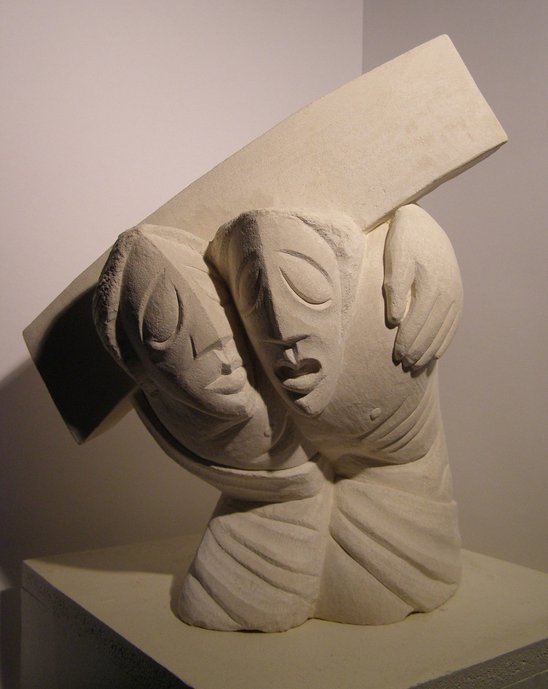
Simon and Jesus by Nicholas Mynheer
Jesus and Simon by Nicholas Mynheer

A “yoke” was a rabbi’s set of rules based in his interpretation of the Law. The disciples of a rabbi would follow him around everywhere and continually listen to his view of how to live the Scripture in everyday life. There were rabbis whose yoke weighed people down with endless rules on every detail of life. Jesus would later say about such teachers:

“They tell you to do things, but they themselves don’t do them. They make strict rules and try to force people to obey them, but they are unwilling to help those who struggle under the weight of their rules. They do good things so that other people will see them.” (Matthew 23:3-5)

Jesus, contrary to other rabbis, taught the Beatitudes and Sermon on the Mount as his yoke, which was a form of living from the heart, and not just to put on a good show for others.

Jesus said “learn from me” because he is gentle and humble in heart. Jesus is not going to turn us away when we sincerely and humbly come to him; in fact, he invites us to come so we might bask in God’s acceptance:

“Come to me, all of you who are tired and have heavy loads, and I will give you rest. Accept my teachings and learn from me, because I am gentle and humble in spirit, and you will find rest for your lives. The burden that I ask you to accept is easy; the load I give you to carry is light.” (Matthew 11:28-30, NCV)

If faith has become all too familiar, if you have lost your sense of awe and wonder about God, if you desire something more than just keeping up with the Christian Jones’s and fulfilling a checklist of Christian duty, then there is an invitation for you to come to Jesus – offered by Christ himself. We get to walk with Jesus.

3374b-thetable

For Christians everywhere throughout the world for two millennia the Table is the place to come in remembrance, communion, and hope. We remember the once for all sacrifice of Christ which unburdened us of our heavy load of sin. We commune with this same Christ now in the present. We anticipate our future hope with confident expectation that Christ is coming again. The Table is an invitation for us to eat and drink of Christ. The words of Keith and Kristyn Getty and Stuart Townsend’s “Communion Hymn” capture Christ’s acceptance of us and our need to receive such grace:

Behold the Lamb who bears our sins away,
Slain for us – and we remember
The promise made that all who come in faith
Find forgiveness at the cross.
So we share in this bread of life,
And we drink of His sacrifice
As a sign of our bonds of peace
Around the table of the King.

The body of our Savior Jesus Christ,
Torn for you – eat and remember
The wounds that heal, the death that brings us life
Paid the price to make us one.
So we share in this bread of life,
And we drink of His sacrifice
As a sign of our bonds of love
Around the table of the King.

The blood that cleanses every stain of sin,
Shed for you – drink and remember
He drained death’s cup that all may enter in
To receive the life of God.
So we share in this bread of life,
And we drink of His sacrifice
As a sign of our bonds of grace
Around the table of the King.

And so with thankfulness and faith we rise
To respond, – and to remember
Our call to follow in the steps of Christ
As His body here on earth.
As we share in His suffering
We proclaim Christ will come again!
And we’ll join in the feast of heaven
Around the table of the King.

Amen.