A Damaged People

Legacy Museum in Montgomery Alabama
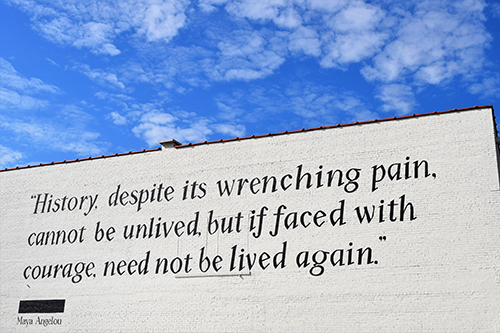
This verse of a Maya Angelou poem is on the outside of the Legacy Museum: From Enslavement to Mass Incarceration in Montgomery, Alabama

I am an aging white male Protestant minister. From the inception of colonial America through the first one-hundred years of the United States, my kind ruled the roost.[i] We established schools and universities, advised governors and presidents, and held the reins of power. We were at the vanguard of the nation’s spiritual and moral development.[ii] Even after much of American society became increasingly secularized and more pluralistic, we white men of the cloth wielded a great deal of influence. We still hold respect (albeit less respected than earlier times in American history) and are typically given the benefit of the doubt in most situations.

For all the good we have done throughout American history, we also turned a blind eye to the slave trade and even championed slavery as a good for black Africans throughout most of the United States. Even in the North, where abolitionists could be found, far too many of us preached against slavery not for the inherent evil it is but because of fear that blacks might integrate with the more enlightened white society. Using their influence, ministers got behind efforts to send blacks back to Africa. Hence, the modern-day country of Liberia.[iii] Although today’s white male ministers are more diverse than ever in their theology and practice, there yet remains for us all a collective wound, a putrid abscess of a racialized society.

Something else to know about me: I have two academic degrees in history and did my graduate thesis on slaveholder religion in the antebellum South. I continue to keep abreast of historical research pertaining to my own expertise.[iv] I am both a church pastor and a hospital chaplain. Spiritual and pastoral care of parishioners, patients, and their families are the stuff of my workaday world. I exist in the lived world of people’s struggles, joys, hopes, and desires – bearing witness to all their myriad experiences of heartbreak, miracle, and everything in between.[v]

As both an historian and ordained minister, I agree with religion and social history professor, D.G. Hart, when he said, “There is a long history going all the way back to slavery, of white Americans not trusting black perspectives as truthful.”[vi] Indeed, this has been my own experience in discussing racism. I have come to expect that if I am in a room full of white male ministers, the subject of racism will not be broached – unless I bring it up. I am usually met with defensiveness and an insistence about not being racist; and, a rebuke of bringing up politics in the august clerical group. The assumptions in the room are that we, ministers, are color-blind (“I don’t see a person’s color when I preach.”); and, that racism means a specific political agenda (“All lives matter, not only black ones….”).[vii]

It would be untenable and unethical if I entered a patient room as a chaplain and spent my time providing for the nurse’s emotional and spiritual well-being. Yes, she has needs, too, and a good chunk of my job involves care of staff. Yet, in this scenario, it is the sick person we are both attending to. It will not do for me to argue, “I don’t see a person’s health when I look at them – I am health-blind.” And it would be ludicrous for me to insist that “all lives matter, not just sick ones,” and nonsense to say, “healthy lives matter.”

Yet, this is happening every day. It is as if a person is struck by a car and lies bleeding in the street while the ambulance and first responders rush to the driver who hit the person saying, “Are you okay? That must have been traumatic running over a person!” Yes, the driver is in shock and will likely need therapy to deal with what happened. However, this is not the primary need and focus of the moment.

Black men die in our streets and we focus on the unruly aspects of demonstrations and riots. Black women disproportionately lose their lives in maternity wards, along with an infant mortality rate more than twice that of whites.[viii] Black families on average have ten times less the annual income than white families, with little to no inherited property or wealth (due in large degree to widespread twentieth century zoning laws which excluded blacks from certain geographic areas and neighborhoods).[ix]

We need not look to other nations of the world for human rights violations. “Physician, heal thyself,” comes from the Gospel of Luke. Immediately after Jesus proclaimed that the poor, the prisoner, the blind, and the oppressed matter, he received pushback from the establishment to maintain the status quo. The good news of freedom and recovery is still subversive and scandalous today as it was all those centuries ago. The gospel still elicits anger from the privileged when resources are focused toward the underprivileged.[x]

I once had a fellow old white Protestant minister throw up his hands in exasperation after speaking with him about race saying, “Well, what do you want me to do about it!?” Indeed, what shall you do? How then shall we live?

The short answer: care. The following are a potpourri of practices I have personally engaged over the past few decades. Perhaps and hopefully you will find some ways to put a voice and some hands and feet to the caring:

  • Seek first to understand rather than be understood. Be informed. Read. Listen to another, without mentally arming yourself with a response. If you cannot state to a person you disagree with their position in a way they would say, “Yep, that’s it, that’s my position,” then you have not done your due diligence in listening well. The bibliography below are just a few books I have found helpful for me as a white person seeking to understand.
  • Engage in self-awareness. Explore what implicit bias and microaggressions are and take a fierce moral inventory of your own life regarding them.
  • Find out what the needs are in your local community. Projecting what you think the needs are of a place or a people is not the same as discovering what the needs really are. Many of my fellow whites cannot see past the demonstrations of black folk on the streets to the needs behind those demonstrations. People demonstrate because they have legitimate needs which are not being fulfilled and they possess little power to change the system which keeps those needs unfulfilled.
  • Exercise humility and repentance. Have a teachable spirit. Be willing to say when you are wrong without beating up yourself. True repentance is not shame – it is changing course when you see your previous path was down a damaging road. More than once I have stuck my foot in my mouth and said something racist that, at the time, I did not realize.
  • Embrace your power, position, or privilege. Use what you have for the benefit of those without. And, more difficult to do for most of my white brothers and sisters, share your power. If a round table discussion of all nice old white male Protestant ministers talk about what to do about race, we will only get a nice old white male Protestant minister answer about how to deal with it. Furthermore, token procedures and policies, as well as token representation will do diddly squat.
  • Keep the main thing the main thing. There are many things which require our (white) attention, including talking to our kids about race, common decency, etc. Yet, when black lynching continues in more modern and sophisticated forms, this requires our immediate attention. The white lady in the car is not bleeding in the street, so keep focused on the main thing.
  • Dedicate effort and resources to dismantling systemic and structural racism. We white folk built it. We can destroy it. The only assumptions we ought to be making is that racism exists everywhere and in every institution in some way, shape, or form. I define racism as vastly more than overt individual discriminatory words or actions – racism primarily exists as covert inequities which maintain white control of institutional power and decision-making, thus, making it more difficult for people of color to have access and opportunity to quality education, jobs, housing, healthcare, and equal treatment in the criminal justice system.

When one of us is wounded, we are all wounded. It is unacceptable we would ever refuse to weep with our brothers and sisters of color who weep. Until we, whites, can individually and collectively find it within ourselves to grieve and lament the loss of human life beside people of color, then we shall continue to be damaged together as one people. Pastors and faith leaders can play a special role in healing our wounds if we find within ourselves a commitment to such a worthy task.

Bibliography of Selected Works

Brown, Austin Channing I’m Still Here: Black Dignity in a World Made for Whiteness, Colorado Springs, CO: Convergent Books, 2018.

Carter, J. Kameron Race: A Theological Account, New York: Oxford University Press, 2008.

Coates, Ta-Nehesi Between the World and Me, New York: One World Press, 2015.

Cone, James H. The Cross and the Lynching Tree, New York: Orbis Press, 2013.

DiAngelo, Robin White Fragility: Why It’s So Hard for White People to Talk About Racism, Boston: Beacon Press, 2018.

Douglass, Frederick The Complete Works of Frederick Douglass, Madison & Adams Press, 2018.

DuBois, W.E.B. The Souls of Black Folk, CreateSpace Independent Publishing Platform, 2014.

Glaude, Eddie S. Democracy in Black: How Race Still Enslaves the American Soul, New York: Broadway Books, 2017.

Guelzo, Allen C. Lincoln’s Emancipation Proclamation: The End of Slavery in America, New York: Simon & Schuster, 2006.

Kendi, Ibram X. How to Be an Antiracist, New York: One World Books, 2019.

Rah, Soong-Chan Many Colors: Cultural Intelligence for a Changing Church, Chicago: Moody Publishers, 2010.

Swanson, David W. Rediscipling the White Church: From Cheap Diversity to True Solidarity, Downers Grove, IL: InterVarsity Press, 2020.

Tisby, Jemar The Color of Compromise: The Truth about the American Church’s Complicity in Racism, Grand Rapids, MI: Zondervan Publishing, 2019.

Endnotes

[i] E. Brooks Holifield, Theology in America: Christian Thought from the Age of the Puritans to the Civil War (New Haven, CT: Yale University Press, 2003): 1-4.

[ii] Sydney Ahlstrom, A Religious History of the American People (New Haven, CT: Yale University Press, 1972): xiii-xvi.

[iii] Edwin S. Gaustad, ed. A Documentary History of Religion in America to the Civil War (Grand Rapids, MI: William B. Eerdmans Publishing, 1982): 485-490.

[iv] I have a B.A. in history from the University of Northern Iowa and an M.A. in 19th Century American Religious History from Western Michigan University – as well as an M.Div. from Grand Rapids Theological Seminary.  For a survey of recent historical research approaches, see Jay D. Green, Christian Historiography: Five Rival Trends (Waco, TX: Baylor University Press, 2015).

[v] I am the Staff Chaplain at Aurora St. Luke’s South Shore Medical Center and the Pastor of the New Life Community Church, both in Milwaukee, Wisconsin.

[vi] D.G. Hart, The Trouble I’ve Seen: Changing the Way the Church Views Racism (Harrisonburg, VA: Herald Press, 2016): 46.

[vii] These statements have been said to me by several white ministers in the past ten years from various denominations, theological traditions, and geographical locales – enough for me to form anecdotal evidence regarding common presuppositions of race.

[viii] Cigna Health and Life Insurance Co., Report on African American Health Disparities, 2016.

[ix] Kriston McIntosh, Emily Moss, Ryan Nunn, and Jay Shambaugh, Examining the Black-White Wealth Gap (The Brookings Institute, 2020).

[x] Luke 4:14-30 in The Holy Bible.

Matthew 12:38-42 – The Sign

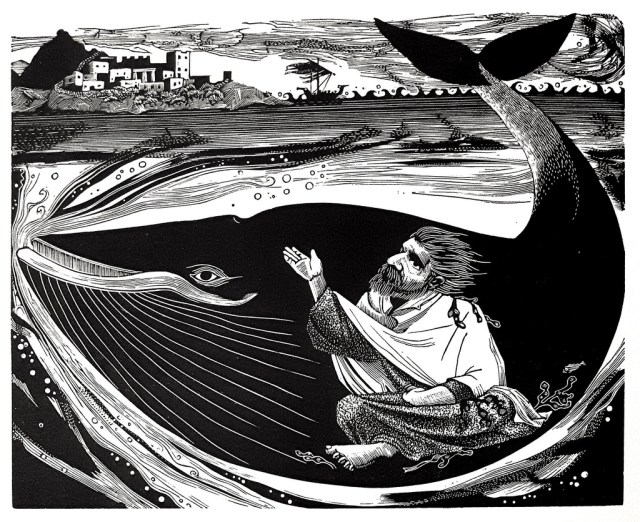
Jonah in the belly

One day some teachers of religious law and Pharisees came to Jesus and said, “Teacher, we want you to show us a miraculous sign to prove your authority.”

But Jesus replied, “Only an evil, adulterous generation would demand a miraculous sign; but the only sign I will give them is the sign of the prophet Jonah. For as Jonah was in the belly of the great fish for three days and three nights, so will the Son of Man be in the heart of the earth for three days and three nights.

“The people of Nineveh will stand up against this generation on judgment day and condemn it, for they repented of their sins at the preaching of Jonah. Now someone greater than Jonah is here—but you refuse to repent. The queen of Sheba will also stand up against this generation on judgment day and condemn it, for she came from a distant land to hear the wisdom of Solomon. Now someone greater than Solomon is here—but you refuse to listen. (NLT)

We often must unlearn before we learn. We need to let go so that we can take on. Repentance is the key to transformation. To repent is to change; and, change involves the humility to admit when we are lost, ask for help, and go in a different direction. The greatest miracle, the best evidence of God’s work in the world, is a changed life – both personal and corporate transformation. Genuine change is not a minor tweak of habits; it is a wholesale reorientation of the heart. New life is not re-branding oneself but is akin to being born again.

For many folks, when it comes to change and transformation, the focus is on others changing – other people need to bend their lives and organizations to how I believe things need to be. As you can tell, this sounds an awful lot like pride and hubris. And, it is.

Repentance and new life is for everyone, not just a select few or others for whom we believe need to change.

Jesus made waves with lots of people by hobnobbing with the least, the lost, and the lowly. Christ actively sought such people out, and healed many of them from sickness, disease, and sin so that they would be united with God and no longer remain on the fringes of society.

Some within the religious establishment of the day did not take the healing ministry of Jesus into consideration because they themselves were not in the transformation business. So, healing miracles which created new life meant nothing for them. For them, Jesus was not flexing any real Messiah muscle and improving their designs to see Gentiles kicked out of Palestine. They even went so far as to ascribe the healing ministry as the work of the devil. They wanted a sign from heaven that would authenticate proper Messiah credentials.

Jonah sign

Jesus said there is already an existing sign: Jonah. As Jonah was three days and three nights in the belly of a whale, so Jesus would be in the earth for three days and nights. The death and resurrection of Jesus is needed, and when faced with this information, the only appropriate response is repentance, a complete U-turn, to a changed life.

Jesus mentioned the Queen of the South to make the same point. When the ancient Ninevites, who were a sinful people, encountered the person of Jonah, they repented; when the Queen encountered the person of Solomon, she changed.  Therefore, how much more ought we to change when encountering the person of Christ?

Jesus himself is the sign. Jonah was in the belly of a whale. He was all but dead. But God caused the whale to belch up Jonah, and he went out as a changed man. The experience of having stomach fluids work on a person for three days and nights would have changed a person both spiritually and physically – bleached completely white and an incredible sight to see!

The whole point of bringing up Jonah was to communicate the great need for repentance when faced with Jesus, his life, his teaching, his ministry. The appropriate response to Jesus is a changed life. Jesus was looking for status quo malcontents, and a desire for transformation and new life. The process of change is hardwired into all creation – from seasons of the year to the seasons of people’s lives – all are designed for a sustained process of time to renew and revolutionize us.

Jesus modeled this for us. He switched his address of heaven and moved into our neighborhood to bring us new life. As the Master of conversion, Jesus extends the invitation to change. All he asks is to let God do the work of change within us, be patient with the construction of the soul he is doing and persist with daily routines of faith individually and with one another.

It pleases Jesus and it is the heart of God to realize new life. Change for change’s sake is not the point. Change that reflects the values of God is. So, we must hear the Scriptures, and we must pray to seek the mind and heart of God.

God Almighty, we desire to be transformed by you and allow the life of Jesus to be expressed through us. We desire to walk in the light of your spirit. Reveal to us those things in our life that need to be made anew. Allow us to discern between flesh and spirit so that we can choose a healthy holy path. Continue to give us spiritual awareness. Transform us into something new altogether. May our old life and way disappear, and our new life emerge for the blessing of the world, through Jesus Christ our Lord in the power of the Holy Spirit. Amen.

Matthew 12:15-21 – The Servant of the Lord

Jesus the Liberator
Jesus the Liberator by Argentine artist Adolfo Perez Esquivel

Aware of this, Jesus withdrew from that place. A large crowd followed him, and he healed all who were ill. He warned them not to tell others about him. This was to fulfill what was spoken through the prophet Isaiah:

“Here is my servant whom I have chosen,
the one I love, in whom I delight;
I will put my Spirit on him,
and he will proclaim justice to the nations.
He will not quarrel or cry out;
no one will hear his voice in the streets.
A bruised reed he will not break,
and a smoldering wick he will not snuff out,
till he has brought justice through to victory.
    In his name the nations will put their hope.” (NIV)

It is important to say the words, “I love you.” It is also significant how we say it. If our tone of voice is monotone and our affect flat, then the incongruent words of love will go unrequited. If, however, our tone is soothing and excited and our face beaming as if starstruck, then the love expressed will likely be received and stick.

Christians have a message of love to the world; it is a message of Jesus Christ and his love for humanity. Both the content of our message and the way we communicate it are vitally significant. For if the words we speak are grotesquely mismatched with our tone of voice and affect, then love is not what we convey. Yet, if we have been profoundly and meaningfully touched by the love of God in Christ, then that love cannot be constrained and will find a way to express itself with appropriate mannerisms.

Both the message of Jesus, and the way he proclaimed it, testified that he was, indeed, the promised Savior and the rightful King for God’s world.

The message of Jesus was to proclaim justice to the nations. The disciple Matthew used a quote from the prophet Isaiah to explain the reason why Jesus withdrew, and told people not to make him known.  This was a curious act for a Messiah, to say the least.  After all, we might believe Jesus should loudly proclaim who he is and what he is doing. Human ingenuity might say he should be advancing, not retreating – getting his name out with some notoriety in a slick marketing message so people will come running into the kingdom of God!

Nope, Jesus goes a different direction. Matthew quoted the prophet Isaiah to make it clear who Jesus is and what he is all about. Jesus is God’s servant. Jesus is God’s beloved Son with whom he is well-pleased. The Holy Spirit came on him in his baptism. Jesus became a teacher of justice to the nations, that is, to all kinds of people – even the ones we do not like.

I personally find it strange that there are folks who seem to think justice is something which is not part of the Gospel, as if it were nice, but optional.  However much they believe it is important to engage in some sort of social justice toward the downtrodden, some believers want to put it on a secondary shelf that bends to the primary initiative of speaking, as if we could or should separate the message from the messenger. However, we can no more divide the good news of forgiveness in Christ from social justice any more than can neatly separate the cross and resurrection. It is all redeeming work, and it all goes together.

Matthew’s Gospel of Jesus Christ emphasizes the kingdom of God. The Sovereign of the universe desires all things and all people to be redeemed and come under the Lordship of Christ with the practice of justice as central to making redemption a reality for humanity.

“And what does the LORD require of you?  To act justly and to love mercy and to walk humbly with your God.” (Micah 6:8, NIV)

Mercy and justice go together like corn on the cob and butter, and like pork ribs with barbeque sauce (okay, so I’m from Iowa).  Mercy is God’s unconditional grace and compassion.  Justice is treating all people with equality without favoritism. Biblical justice is not primarily punishment for wrongdoing; it is to give people their rights – and this concept is overwhelmingly taught in the Scriptures, over 200 times in the Old Testament alone. Christ’s back to the Bible movement rightly emphasized justice.

God loves and defends the weak, the poor, and the powerless:

He gives justice to the oppressed
and food to the hungry.
The Lord frees the prisoners.
The Lord opens the eyes of the blind.
The Lord lifts up those who are weighed down.
The Lord loves the godly.
The Lord protects the foreigners among us.
He cares for the orphans and widows,
but he frustrates the plans of the wicked. (Psalm 146:7-9, NLT)

We, as God’s people, are to share his passion for justice:

Speak out on behalf of the voiceless,
and for the rights of all who are vulnerable. (Proverbs 31:8, CEB)

“Cursed is anyone who obstructs the legal rights of immigrants, orphans, or widows.”  All the people will reply: “We agree!” (Deuteronomy 27:19, CEB)

Since believers are justified by faith in Christ, we must in both word and deed bring justice to our communities by advocating for the least, the lost, the last, and anyone else without social or economic power in this world.

If we have a voice, we must use it both for ourselves and for those who have no voice.  The voice of justice is the voice of action.  To be concerned for the justice of God is to actively work for the kingdom of God to enter every inch of this world, and every nook and cranny of our homes, neighborhoods, and schools.

The Christian life is much more than avoiding sin; it is about actively pursuing God’s will through words and acts of justice on behalf of the needy.  Jesus came to this earth to proclaim justice, and, as his followers, he expects us to do it, too. For this to happen we must overcome our own prejudices toward anybody unlike us so that we will stand with the weak, the poor, the oppressed, the lowly, and the hurting among us.

The probing question for all of us is: Am I able to see the image of God in someone different from me?

Jesus did. The quote referencing that Jesus “will not quarrel or cry out; no one will hear his voice” is referring to the way of Christ – gentle, humble, and meek.  Jesus did not look for dramatic confrontations with others but instead went quietly about his Father’s business.  Jesus was not bullhorn guy, who loudly proclaimed his message on the street corner.  He interacted with and ministered to the lowliest people of society who had no power and nothing to give in return. Jesus did everything to connect with them and not avoid them.

Along the Jordan River in Israel, reeds grew by the millions in Jesus’ day.  They were of little value because there were so many.  Reeds were used to make baskets, pens, flutes, and a variety of other things.  A perfect reed is fragile, and a bruised one is useless.  When the text says that God’s servant will not break a bruised reed, it means that he will treat the weak with sensitivity.  A smoldering wick is also not worth much; if it is damaged, we would just get another one.  A contemporary example might be a paper clip; it is not worth much to us, and a damaged one we would just discard and get another.  The point is that Jesus handles hurting people with care. Society’s poor, disadvantaged, and struggling will not be callously overlooked and tossed aside by Jesus.

Jesus Christ discovered his own island of misfit toys and demonstrated to the world that they were a needed part of society. Small wonder, then, that droves of the lowliest people throughout history have come to Jesus, placing their hope in him.

“For we do not have a high priest who is unable to sympathize with our weaknesses, but we have one who has been tempted in every way, just as we are – yet was without sin.  Let us then approach the throne of grace with confidence, so that we may receive mercy and find grace to help us in our time of need.” (Hebrews 4:15-16, NIV)

My hope is in the name of Lord who made heaven and earth. May you also find Christ as your anchor and hope in the world.

Holy Father, you have given all peoples one common origin. It is your will that they be gathered as one family in yourself. Fill the hearts of humanity with the fire of your love and the desire to ensure justice for all. Through sharing your goodness, may we secure equality for all our brothers and sisters throughout the world. May there be an end to division, hatred, and war. May there be a dawning of a truly human society built on love and peace. We ask this in the name of Jesus, our Lord. Amen.

Matthew 13:24-30, 36-43 – The Parable of the Weeds

Welcome friends! Click the video below and let us gather together around the teaching of Jesus:

You may also view this video at TimEhrhardtYouTube

Click Be Thou My Vision sung by Nathan Pacheco as we seek to grow in the soil of God’s grace through Jesus Christ our Lord in the power of the Holy Spirit.

Soli Deo Gloria.