John 11:45-57 – Against Fear and Worry

Therefore, many of the Jews who had come to visit Mary, and had seen what Jesus did, believed in him. But some of them went to the Pharisees and told them what Jesus had done. Then the chief priests and the Pharisees called a meeting of the Sanhedrin.

“What are we accomplishing?” they asked. “Here is this man performing many signs. If we let him go on like this, everyone will believe in him, and then the Romans will come and take away both our temple and our nation.”

Then one of them, named Caiaphas, who was high priest that year, spoke up, “You know nothing at all! You do not realize that it is better for you that one man die for the people than that the whole nation perish.”

He did not say this on his own, but as high priest that year he prophesied that Jesus would die for the Jewish nation, and not only for that nation but also for the scattered children of God, to bring them together and make them one. So, from that day on they plotted to take his life.

Therefore, Jesus no longer moved about publicly among the people of Judea. Instead he withdrew to a region near the wilderness, to a village called Ephraim, where he stayed with his disciples.

When it was almost time for the Jewish Passover, many went up from the country to Jerusalem for their ceremonial cleansing before the Passover. They kept looking for Jesus, and as they stood in the temple courts, they asked one another, “What do you think? Isn’t he coming to the festival at all?” But the chief priests and the Pharisees had given orders that anyone who found out where Jesus was should report it so that they might arrest him. (NIV)

Effective ministry and service is risky business. Just ask Jesus. The Jewish ruling council (Sanhedrin) was deeply disturbed by all the hubbub Jesus was stirring. Rather than celebrating the healing of many people in both body and soul, the rulers were anxious, worried, and afraid. They feared the worst: The Romans will obliterate both temple and nation.

Wherever you find a group of folks living in continual fear that something awful is going to happen, there you will find a strict code of conformity and no allowances for difference. After all, rocking the boat only draws attention. If anything, or anyone, deviates from established protocol, the voice of fear says, the entire religious system and even its people will be destroyed.

Well, my goodness, Jesus was anything but a conformist to the status quo. He frequently operated outside of established religious norms. Thus, Christ was viewed by many religious leaders as a loose cannon that was making too much noise and needed to be silenced before something terrible happened.

One of the problems with living in the fearful worry of what horrible thing may occur is that we play an ignorant game of prognostication. We simply do not know the future. We can predict. We can become full-time pundits. Yet, when all is said and done, the future is not ours to see. Only God is privy to standing above time and space.

Churches, Christian organizations, and really any institution whose chief focus is keeping everyone in line out of a fear of losing influence, power, privilege, money, devotion, buildings, or people will likely experience a self-fulfilled prophecy of doom. It is necessary we define our ministries, services, and actions by who we are and not by what we don’t do.

Today’s Gospel lesson chronicles the forward progress to the ultimate suffering and death of Jesus. Within the Apostle John’s account, two streams run parallel with one another. There is a group of Jews who observed Jesus, listened to his teaching, saw his miraculous works, and believed in him.  Alongside them is another group of Jews who experienced all the same events and heard all the same words of Jesus – yet responded in a quite different manner by plotting how Jesus might be arrested and killed.

Fear can take such a tight hold on some that premeditated murder is planned and executed without any moral misgivings. Worry can worm its way so deeply into a group that verbal assassinations seem both justified and necessary. Anxiety can overwhelm an institution to such a degree that rationalizations for unethical behavior are rife. People cease to be looked at as people. They are referred to as threats, demonized as monsters who are trying to take away a way of life.

Christ before Caiaphas by Dutch artist Gerrit van Honthorst, c.1617

Caiaphas, the high priest, spoke to his fellow religious leaders, perhaps without even knowing the truth and deep import of his prophetic words: “You know nothing at all.  Nor do you understand that it is better for you that one man should die for the people, not that the whole nation should perish.” Indeed, not only did Jesus die for the nation of Israel, but on behalf of all nations, and all people. 

The implications of Christ’s death are magnanimous. The extent of his atonement for the people includes redemption from the bondage of sin; reconciliation between us and God; satisfaction of God’s wrath against the sin of the world; and, victory over the demonic realm, death, and hell. With all this incredible work of restoration and renewal, fear and worry take a back seat. Courage and confidence take the wheel.

Merciful Jesus, you are my guide, the joy of my heart, the author of my hope, and the object of my love. I come seeking refreshment and peace. Show me your mercy, relieve my fears and anxieties, and grant me a quiet mind and an expectant heart, that by the assurance of your presence I may learn to abide in you, who is my Lord and my God. Amen.

Deuteronomy 5:1-21 – Ten Basic Rules for Life

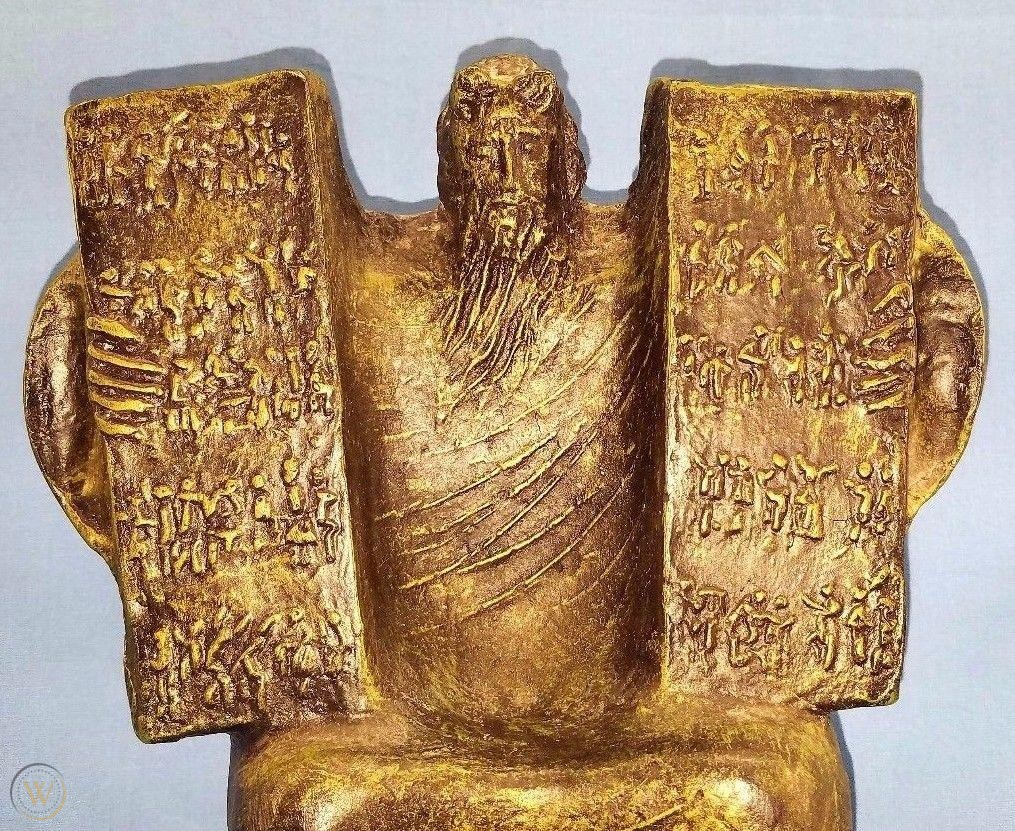
Invitation to the Decalogue by Romanian sculptor Liviu Mocan

Moses called out to all Israel, saying to them: “Israel! Listen to the regulations and the case laws that I’m recounting in your hearing right now. Learn them and carefully do them. The Lord our God made a covenant with us at Mount Horeb. The Lord didn’t make this covenant with our ancestors but with us—all of us who are here and alive right now. The Lord spoke with you face-to-face on the mountain from the very fire itself. At that time, I was standing between the Lord and you, declaring to you the Lord’s word, because you were terrified of the fire and didn’t go up on the mountain.”

The Lord said:

I am the Lord your God, who brought you out of Egypt, out of the house of slavery.

You must have no other gods before me. Do not make an idol for yourself—no form whatsoever—of anything in the sky above or on the earth below or in the waters under the earth. Do not bow down to them or worship them because I, the Lord your God, am a passionate God. I punish children for their parents’ sins—even to the third and fourth generations of those who hate me. But I am loyal and gracious to the thousandth generation of those who love me and keep my commandments.

Do not use the Lord your God’s name as if it were of no significance; the Lord won’t forgive anyone who uses his name that way.

Keep the Sabbath day and treat it as holy, exactly as the Lord your God commanded: Six days you may work and do all your tasks, but the seventh day is a Sabbath to the Lord your God. Don’t do any work on it—not you, your sons or daughters, your male or female servants, your oxen or donkeys or any of your animals, or the immigrant who is living among you—so that your male and female servants can rest just like you. Remember that you were a slave in Egypt, but the Lord your God brought you out of there with a strong hand and an outstretched arm. That’s why the Lord your God commands you to keep the Sabbath day.

Honor your father and your mother, exactly as the Lord your God requires, so that your life will be long and so that things will go well for you on the fertile land that the Lord your God is giving you.

Do not kill.

Do not commit adultery.

Do not steal.

Do not testify falsely against your neighbor.

Do not desire and try to take your neighbor’s wife.

Do not crave your neighbor’s house, field, male or female servant, ox, donkey, or anything else that belongs to your neighbor. (CEB)

Whenever I take my wife’s pooch to our local spacious dog park, he knows he will need to stick to just a few of my basic rules. Although he doesn’t need the leash and is free to roam, he understands not to bark at people or approach them and other dogs without my permission. Those few simple rules are for both his well-being, and others.

We as people are free to live our lives as creatures in God’s image. The Lord has just a few basic rules for us to live by to honor both divinity and humanity, as well as to protect others and ourselves. Most folks know them as “The Ten Commandments.”

The Ten Commandments (The Decalogue or The Ten Words) were given to the ancient Israelites nearly 3,500 years ago. These words have stood the test of time and continue to be understood as a universal standard of morality and relational interactions.

There are hundreds of commands in Holy Scripture – approximately 613 in the Old Testament, and 437 in the New Testament – a whopping 1,050 total commands throughout the entirety of the Bible. So, what, then, makes these Ten so special?  Why do we stick to The Ten Words?

Moses and the Ten Commandments by Italian sculptor Giuseppe Macri (1913-1991)

The reason The Ten Commandments have endured and continue to be learned, spoken, and adhered is that they are foundational commands. Following the Ten Words in the Old Testament are a string of specific commands from God to Moses and then to the people (Exodus 21-23 and Deuteronomy 6-26). Those commands are all a fleshing-out of how to live the basic Decalogue in the Israelites’ context of entering and being in the Promised Land.

In short, every single command of Holy Scripture can be ethically and morally tied back to The Ten Commandments in some way. Whereas many Old Testament laws were given to the Israelites in their ancient Middle Eastern socio-economic culture, The Decalogue was designed to be universal and flexible for every culture and society everywhere, for any time, and every generation.

Therefore, we need to distinguish between The Law (capital “L”) and the law (little “l”). God’s fundamental and foundational ethical Law has always existed and continues to exist – and it is encapsulated in ten short and simple commands which everyone everywhere can obey, whether they are at their jobs, at home, church, or out having fun.

In fact, these ten basic commands are so important that Jesus restated them for us in his Sermon on the Mount (Matthew 5-7). Christ got down to the heart of the commands and let everyone know what it truly means to hold, keep, and obey The Ten Words. For example, Jesus said concerning the seventh command:

“You have heard that it was said to our people long ago, ‘You must not murder anyone. Anyone who murders another will be judged.’ But I tell you, if you are angry with a brother or sister, you will be judged. If you say bad things to a brother or sister, you will be judged by the council. And if you call someone a fool, you will be in danger of the fire of hell” (Matthew 5:21-22, NCV).

It had become easy over the centuries for people to think everything was jim-dandy if they didn’t physically kill anyone. Yet, Jesus knew that well before any person is murdered by another that anger has been nursed through bitter grudges toward another. 

The Ten Words are the very heart of God’s desire for all humanity, and this is precisely why it is important to know and obey them in their full intent. They contain how to relate to God (Commands 1-4); and, how to relate to one another (Commands 5-10).  Jesus would later say, in response to what is the greatest command of all:

“Love the Lord your God with all your heart, all your soul, and all your mind. This is the first and most important command. And the second command is like the first: ‘Love your neighbor as you love yourself.  All the law and the writings of the prophets depend on these two commands.” (Matthew 22:36-40, NCV)

Question and answer 115 of the Heidelberg Catechism, a Confession of Faith crafted by Protestant Reformers in the sixteenth century, addresses a significant issue:

Question: Since no one in this life can obey the Ten Commandments perfectly, why does God want them preached so pointedly? 
Answer: First, so that the longer we live the more we may come to know our sinfulness and the more eagerly look to Christ for forgiveness of sins and righteousness.

Second, so that we may never stop striving, and never stop praying to God for the grace of the Holy Spirit, to be renewed more and more after God’s image, until after this life we reach our goal: perfection.

When all is said and done, grace will have the last word. Yes, none of us will ever perfectly live-out and embody The Ten Words in their entirety all the time. Yet, the grace of God in Jesus Christ does for us what we cannot do for ourselves: deliver us from the realm of sin, death, and hell.

Stuff happens. We often fail to live-into the ways of God for our lives through The Decalogue. However, God, always the hound of heaven, will track us down and mercifully redeem us.

So, embrace The Ten Words. Know them, memorize them, and understand them. Post them on the wall of your office or in your house. Most of all, seek to practice them, obey them, and embody them so that you can enjoy all the freedom of God’s big world.

And you just gotta love it that Johnny Cash once sang about them…

Philippians 3:4-14 – On Knowing Christ

Welcome, friends! It is a privilege to be with you on this World Communion Sunday. We gather around Jesus, our highest joy, as Christians unite in the surpassing value of knowing Christ. Click the video below and let us discover together the heartbeat of the Church everywhere…

Let us partake of Christ together in heartfelt worship.

I pray that the Lord Jesus Christ will bless you and be kind to you! May God bless you with his love, and may the Holy Spirit join all your hearts together. Amen.

On Knowing Christ

Pietà by Elisabeth Frink

The ancient Philippian church had lost sight of their purpose, of what is the primary reason for their being in existence. Simply put, they needed to unify around what is the central and most valuable core of Christianity: knowing Jesus Christ. For the Apostle Paul, in his letter to the Church at Philippi, Jesus was so valuable that he literally gave up everything to become a Christian and follow Jesus. (Philippians 3:4-14)

It was no little thing that Paul did, converting in such a completely life-altering way to Christ. Paul had everything going for him. He was the up and coming star in Judaism. Paul had the Jewish pedigree, the intelligence, the personality, and the drive to become one of the greatest Pharisees of all time. And yet he forsook it all to pursue and know Christ. 

It might be hard for us to imagine just how significant Paul’s turn around was. On a much smaller scale, it would be like Green Bay Packer quarterback, Aaron Rodgers, at the height of his career, leaving football altogether to become a missionary to some remote place few people have ever heard of. Most might likely think he lost his marbles and was throwing away (pun intended) something valuable and important. So, it was with Paul.  Everyone thought he was nuts for becoming a Christian.

However, this would be to misunderstand what is really of greatest value. There are plenty of people in our society telling us what we need. With all the noisy rhetoric, from political pundits to commercial marketers, the person and work of Jesus can easily get lost in an ocean of competing voices. On a practical level, it can be far too easy to simply toss Christian discipleship on the smorgasbord of good ideas we get handed each day. Jesus might get misplaced and forgotten on our plate of life because of the mass of other food that is piled alongside him.

World Communion Sunday (always the first Sunday in October each year) reminds Christians that Jesus is our surpassing greatness, the highest and most worthy asset we possess. When we come to the Lord’s Table, there is nothing else to feast upon except Jesus, and Jesus alone. In the act of receiving the common elements of bread and cup, we proclaim that we need no one else and no other thing to make us happy in this life. Jesus is enough for us. What is more, we stand united with our brothers and sisters in Christ throughout the world in a common purpose and value of knowing Jesus Christ, and him crucified.

The Elements of Holy Communion by Jacques Iselin

The core value and heart of Christianity is a faith and love relationship with Jesus, to know him. This was the heartfelt cry of the Apostle Paul, and it was so meaningful to him that he gave up everything to pursue Christ and follow Jesus.  If we ever strip Christianity of this core value and stray from knowing Christ, the vacuum will be quickly filled with all kinds of other stuff, like the sheer duty of perfunctory prayers, clean living, and dispassionate robotic service. 

Paul longed to know Christ better. There are two words in the Greek language for “know.” One word refers to information; the other refers to an experiential knowledge – and that is the word Paul used with the Philippians. He deeply desired an intimate experience of Jesus. And Paul craved this so much that literally everything, when compared to Jesus, was “rubbish” to him. 

In the ancient world there were no landfills and dumps – the street served as the place people threw their garbage. The trash then got trampled into the ground, along with the generous amounts of animal dung. That is how Paul thought of even the best things in life as compared to knowing Jesus. 

There is no comparison between a freshly grilled T-bone steak and microwaved liverwurst. There is no comparison between a billion dollars and a penny. There is no comparison between the Green Bay Packers and the Chicago Bears (sorry Chi-Town). And there is no comparison between Jesus and anyone or anything else, no matter whom or what it is. 

Saint Augustine, Bishop of Hippo, in the fifth century, described life apart from Jesus as “disordered love.” By that he meant we pursue whatever our affections are set upon. One might love family, friends, job, and hobbies, yet if Jesus is absent or must compete for our affections in the middle of those things, then it is a disordered love. The solution, for Augustine, is to rightly order our love by having Jesus as the premier object of our affection. The New Testament frames it this way: Repent and believe the gospel.

To have “disordered love” is a nicer way of saying “spiritual adultery.” Using this metaphor, the appropriate response is to return to our first love. “You have forsaken your first love,” said Jesus to the church in Ephesus.  “Remember the height from which you have fallen!  Repent and do the things you did at first” (Revelation 2:4-5). 

Christianity is not some religion in which we strike a deal with God to go to heaven if we accept Jesus. Rather, Christianity centers all of life in the person and work of Jesus. The Lord is a jealous God, feeling slighted when Christians moonlight with the world at night while acknowledging Jesus during the day.

Specifically, Paul wanted to know the power of Christ’s resurrection. He yearned to experience a supernatural change from the inside-out – to be a new person in Christ. Paul did not simply turn over a new leaf; he did a dramatic 180 degree turn and went hard after Jesus. A desire and/or decision to know Christ is to be more than a milquetoast “I’ll try to do better.” Christianity, at its core, is dying to self and being reborn in Jesus with new life.

Furthermore, Paul wanted to know Christ and the fellowship of sharing in his sufferings. Paul ached to know Jesus so much that he embraced suffering, just as his Lord did. Paul was not some spiritual masochist; he rightly recognized that spiritual growth and intimacy with Jesus largely comes from the harsh realities of life’s trials and difficulties, as faith is stretched.  We would not know Christ the healer if we were not broken; Christ the provider if we were not in want; and, Jesus Christ and him crucified unless we were aware of sin in the world along with our own personal sin.

Each time a Christian approaches the Lord’s Table, they set aside competing voices and forsake rival gods to have Jesus. For us who believe, let the ingesting of the elements be an act of fellowship with God. May we, along with Paul, Augustine, and all past saints desire to have Jesus completely take over our lives because he is so valuable to us. We never need to be perfect to partake of bread and cup. Instead, we only need to strive toward what is ahead and decide that today we will press on toward the higher goal of knowing Christ.