John 6:25-35 – The Bread of Life

The Breaking of the Bread by Sr. Mary Stephen

When they found him on the other side of the lake, they asked him, “Rabbi, when did you get here?”

Jesus answered, “Very truly I tell you, you are looking for me, not because you saw the signs I performed but because you ate the loaves and had your fill. Do not work for food that spoils, but for food that endures to eternal life, which the Son of Man will give you. For on him God the Father has placed his seal of approval.”

Then they asked him, “What must we do to do the works God requires?”

Jesus answered, “The work of God is this: to believe in the one he has sent.”

So, they asked him, “What sign then will you give that we may see it and believe you? What will you do? Our ancestors ate the manna in the wilderness; as it is written: ‘He gave them bread from heaven to eat.’”

Jesus said to them, “Very truly I tell you, it is not Moses who has given you the bread from heaven, but it is my Father who gives you the true bread from heaven. For the bread of God is the bread that comes down from heaven and gives life to the world.”

“Sir,” they said, “always give us this bread.”

Then Jesus declared, “I am the bread of life. Whoever comes to me will never go hungry, and whoever believes in me will never be thirsty. (NIV)

Christians everywhere hold to Jesus as the Son of God, Lord of the universe, and Savior of all. However, for most people who were following Jesus around in the first century, this was not their understanding of Christ.  In his earthly ministry, Jesus spoke in ways that introduced people to who he really was and sought to bring them to a point of following him based on his identity. 

Jesus wanted the crowds to him for who he really is – themselves for what they really needed – and follow him based on the deepest needs of their lives. I believe Jesus is the hope of all nations and all people, and in him humanity’s most basic and profound needs are met for forgiveness, love, and purpose in life. To address this, I ask three basic philosophical and theological questions of life:

What should human beings seek the most and work the hardest for in life?

The responses in history are legion. The ancient Greek philosopher Aristotle thought a proper appreciation for an ethical and virtuous life found in practical wisdom was where people’s most concerted efforts should be.  Karl Marx, the father of communism and socialism believed the proletariat should use their heads and their hands to rise above their economic conditions and oppression. In the late 1960’s, Bobby Kennedy said we ought to be working the hardest to achieve justice and not advance ourselves on the misfortunes of others. In more recent times, the Harvard Business Review is continually on the lookout for the best ways of being efficient, productive, and making the most of time because work itself is paramount.

Jesus said people are not to work for food that spoils, but for food that endures to eternal life.

He said this coming off one of his most famous miracles of all, the feeding of the five thousand.  Afterward, Jesus withdrew overnight to a place of solitude and prayer. He did another miraculous event by walking on water out to his disciples in a boat. In the morning, he and they were on the other side of the lake. The crowd did not know where he was and went looking for him.

Jesus knew the crowd of people wanted more. What they got was perhaps unexpected. Jesus told them to put their efforts into getting the bread that keeps on feeding. Jesus wanted the people to pursue and follow him not only for the things he could do for them, but to seek him for who he is. 

Jesus had further aspirations for the people beyond providing a supper – he desired the people to feast on himself – to ingest him, to take him into their lives in a deep and profound way as the fulfillment of all the hope and promises of the Old Testament. 
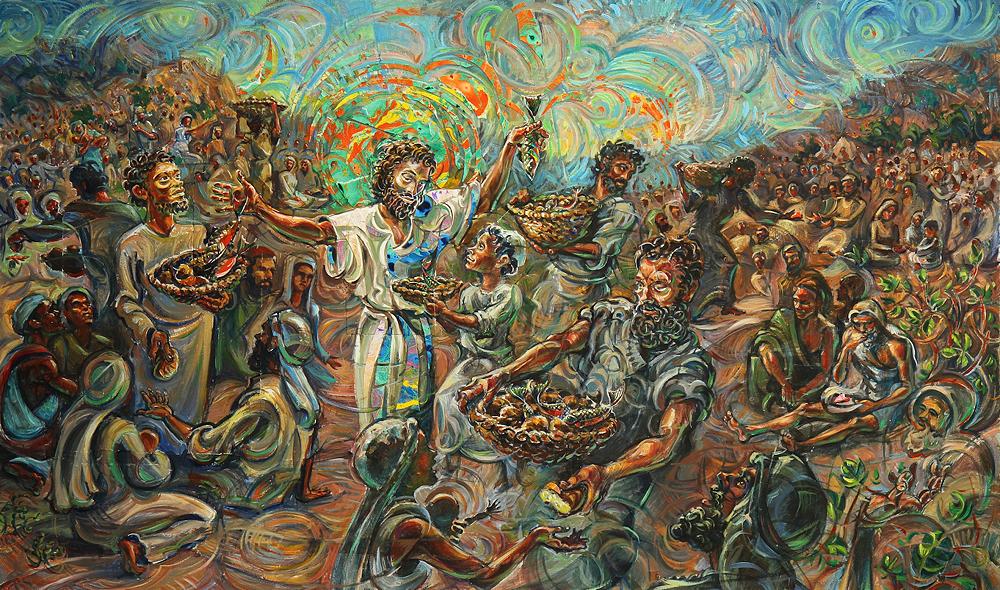
Jesus Feeds the Crowd by American artist Eric Feather

Jesus is the bread, the basic staple of life, that meets the cravings and needs of all people everywhere. Starving people, both in body and spirit, find in Jesus a meal which keeps on giving, a feast of grace that is both delectable and unending.

The answer to my own question is that, for me, one’s highest pursuit and greatest quest is Jesus. Apart from Christ, I will starve. Furthermore, Jesus is not some cheap fast food off a value menu; he is real soul food to be ingested and enjoyed with others.

I believe people need Jesus. A passionate seeking of Jesus, to follow him, live for him, center life around him, is my most ardent desire. I do not simply desire Jesus for what he can do for me; I vigorously chase after him because if I do not have Jesus, I will die, I will starve to death. 

For me, Jesus is so much more than a nice addition to my life, like a new puppy; Jesus is Lord and Savior. I must consume him, or I will be completely undone, and I will not survive! Jesus is my bread, my food, my life!  I cannot survive on a daily crumb, but I feast on every word that comes from the mouth of Jesus because in Christ there is the life that is truly life.

What should human beings be doing to do the works of God?

The short answer: believe. To have and keep faith in the One God has sent, Jesus, is the primary “work” that pleases God. Jesus communicated to the crowd that they can do so much more than follow him for another earthly meal – they can place their faith and hope in him for food that will last, food that will transcend the three-dimensional world.

Faith is more than an intellectual recognition to some facts about Christianity. And belief is not about always having clarity and certainty to every facet and loci of Christian doctrine. No, Christian faith is complete trust in Jesus as our hope and our life. Education, economic uplift, political stability, and institutional peace and justice are important activities for this world. For the Christian, the accomplishment of these and so much more comes from the grace of God in Christ. As people come to the end of themselves with their homebrewed and half-baked attempts at being satisfied, Jesus stands at the door and knocks, the Living Bread who offers himself for humanity’s deepest needs.

Giving kudos to Jesus might be nice, yet Christ himself cares about folks placing their trust in him for grace, forgiveness, and hope in their world. Jesus longs to reconnect people with God through giving himself as the means of making that happen. All the works we do in this life, every good deed we accomplish, and each positive action we do are all helpful and necessary… and they all pale in comparison to the greatest work of all, to believe in Jesus Christ as the hope of this world, the hope of your family, the hope of the church, and the hope of your life and mine. And it is all accessed by faith in the Son of God who loved me and gave himself for me.

Who really does the will of God?

Answer: Those who come to God through Christ. The person who comes to Jesus will never go hungry, and the one who believes in Christ will never be thirsty. Such persons do the will of God. They do not settle for signs of Jesus but desire him and find their ultimate satisfaction in him.

Yet far too many people settle for signs of Jesus rather than Jesus himself. It would be silly if I drove to a sign on Interstate 94 that said, “Milwaukee” and sat there under it, believing I was really in the city of Milwaukee. And it would be weird if I looked around for the art museum or other places underneath the sign.

Church buildings and furniture, stained-glass windows, pews, and even the Bible are not Jesus – they are simply and hopefully signs which point to him. They are all designed to lead us to Christ so that we may come to him. And coming to Christ is what the Lord’s Supper, Holy Communion, the Eucharist, and any other description you want to give about ingesting Jesus is about. The elements of bread and cup bring us to Christ so that we can experience Jesus and be joined to him by faith in a mystical union of human and divine in the unseen heaven.

Conclusion

Where will you find true satisfaction and hope? Probably not in the clearance aisle at Wal-Mart. Likely not in conforming to cultural Christianity or embracing generic forms of Jesus as merely good teacher and moral example. Furthermore, life’s ultimate satisfaction and hope are not to be found in a spotless house and perfect kids; in working more hours and making more money. Nor will we find contentment and peace in the radical independence of doing things my way.

Jesus is the Bread of Life. Through ingesting him, passionately pursuing him, believing in him, and coming to him in everything, we find the life that is truly life. Do not settle for any substitutes to Jesus. Come to the real person.

Lord God, you said that when we seek you with all our hearts, you will be found.  As the deer pants for streams of water, so we, your people, long for you in a dry and weary land.  We hunger and thirst for your righteousness.  We deeply desire your presence in all things. So, we die to ourselves and surrender to your will and way for us, by faith trusting you will come into our lives and completely take over. May your blessing rest upon us as we seek Jesus. Amen.


By Forever Be Sure

Philippians 3:13-4:1 – Follow My Example

Brothers and sisters, I do not consider myself yet to have taken hold of it. But one thing I do: Forgetting what is behind and straining toward what is ahead, I press on toward the goal to win the prize for which God has called me heavenward in Christ Jesus.

All of us, then, who are mature should take such a view of things. And if on some point you think differently that too God will make clear to you. Only let us live up to what we have already attained.

Join in following my example, brothers and sisters, and just as you have us as a model, keep your eyes on those who live as we do. For, as I have often told you before and now tell you again even with tears, many live as enemies of the cross of Christ. Their destiny is destruction, their god is their stomach, and their glory is in their shame. Their mind is set on earthly things. But our citizenship is in heaven. And we eagerly await a Savior from there, the Lord Jesus Christ, who, by the power that enables him to bring everything under his control, will transform our lowly bodies so that they will be like his glorious body.

Therefore, my brothers and sisters, you whom I love and long for, my joy and crown, stand firm in the Lord in this way, dear friends! (NIV)

Many years ago, while driving through an intersection, a car turned in front of me and caused me to slam my brakes. After getting on my way (and proud of myself for not saying a word) my daughter, who was five years old at the time, leaned forward from the back seat and asked me, “Dad, is that guy an idiot?” 

Kids often imitate their parents in everything, whether good or bad. This is no less true for adults. When it comes to Christianity, faith is passed on not just from individuals reading their bibles in seclusion; it is handed down from person to person. Christians learn from leaders and respected persons how faith is lived out and practiced – and this comes primarily through imitating what they see. 

Therefore, it is good for us to ask the question: “Who do I imitate?” because we mimic and pass on things we learn from others. So, it is imperative we learn from people who demonstrate the values and ideals we aspire to possess ourselves. In the people we listen to either virtually or in person, as well as the authors we read, we are to walk according to the example of virtue, sacrifice, and commitment.

We must imitate those Christian leaders who have a proven character in persevering in faith in the face of pain and suffering and have done it with great humility. This does not necessarily mean we emulate those who eruditely speak the Word of God, have superior gifts and abilities, and enjoy success in ministry. It does mean, however, we ought to imitate, and have as mentors, those persons who imitate Christ. We can leave behind those who are self-promoting peacocks and pursue admiration and praise. 

We are to mimic those who have proved themselves in hardship. A Christian leader who has not undergone fiery trials and been purged of sinful pride are more easily seduced by their own importance. However, leaders who have seen their share of hard circumstances, pain, and suffering, and have come through it loving God and serving others out of grace and humility, are leaders worth imitating. They will likely serve well as good models of faith and ministry.

It is also good to consider the kind of example we ourselves are displaying for others. In all our words and behaviors, whether we recognize it or not, we are modeling what is genuinely important to us. And sometimes what we do not say, or choose not to do, says as much or more about our character, beliefs, and ethics.

It takes a lot of confidence in our way of life to say to another, like the Apostle Paul did, “follow my example.” If we have learned with humility and curiosity the words and ways of Jesus, and lovingly put them into practice, then we can be emboldened to mentor others in the faith and demonstrate for them what laboring for justice, righteousness, holiness, and godliness looks like in this fallen world.

More than ever we need a cadre of solidly committed folks who have been mentored well in the ways of grace to serve as a beacon of light in the darkness of this world’s besetting sins of structural racism, hedonistic consumerism, discriminatory ageism, oppressive patriarchalism, biased hierarchism, disparity classism, religious anarchism, and a hundred other “isms” which keep people from flourishing in this life as God intended.

It is vital we learn from and emulate others who have a proven track record of promoting the common good of all persons. And it is equally important we become part of the ranks of those who are good examples of citizens in God’s benevolent and ethical kingdom.

Almighty God, may I stand firm in faith through all the challenges and travails of this life. Enable me to incorporate the love of Christ in my life to such a degree that it proves to be an example of grace and peace. Give me a heart willing to sacrifice and serve the common good of all. Give me a broader and deeper understanding of the lessons I need to discover from others wiser than myself. Allow me to learn all I must from this painful, yet blissful life, through Jesus Christ my Lord, in the power of your Holy Spirit. Amen.

The Way of Peace

Peace is neither merely the absence of conflict nor simply tolerating each other. Peace in Holy Scripture is cooperative fellowship, a harmonious way of living with God and one another based in the person and work of Jesus Christ. Peace is simultaneously a virtue we already possess and an ideal we need to obtain and live into.

In writing to the Church at Philippi, the Apostle Paul strung together several verbs to make it clear how to achieve peace on the practical level. Six of the verbs are in the imperative form, that is, they are commands.  Paul gave these imperatives to the Church because they were in danger of a breakdown in their fellowship. Embedded within Paul’s message is a deep Christian spirituality based in knowing Christ, with an overall message and imperative to keep persevering and not give up on peace or on one another.

  • Stand firm in the Lord. (Philippians 4:1) 

Standing firm in faith is a function of knowing Jesus Christ – an experiential knowledge beyond mere mental acknowledgement (Philippians 3:7-10). Our feet are to be firmly planted and rooted in the soil of Jesus Christ as our highest value and our surpassing greatness over and above anyone or anything else. 

This first command is a bedrock imperative. We cannot really move to the other five imperatives until we ensure our foundation is solid. In other words, there will be no peace in our personal lives or in our corporate life together unless we embrace Jesus as our most precious relationship.

If our god is our stomach and we do not take charge and own our Christian walk through spiritual practices that connect us with Jesus, then peace will be elusive. We must patiently, deliberately, and slowly plod along with Jesus and follow him as our highest priority in every sphere of our lives.

  • Help resolve disagreements. (Philippians 4:2-3) 

Euodia and Syntyche were two prominent women leaders in the Philippian Church. Whatever their differences were, Paul made it clear to them that they must agree and be like-minded concerning the issue. 

This second imperative goes beyond telling two persons to work out their differences; the church was called upon to help do the work of peacemaking. Because peace characterizes the triune God, and Jesus Christ came to achieve peace on our behalf, God’s people are to be peacemakers.

Many differences are resolved with far fewer disagreements when we abide in Christ. If folks immerse themselves in Scripture and in knowing Christ, instead of taking the stance of being right despite any evidence to the contrary, then a lot less peacemaking would even need to take place.

New Testament scholar D.A. Carson has said, “Personal differences should never become an occasion for advancing your party, for stroking bruised egos, for resorting to cheap triumphalism, for trimming the gospel by appealing to pragmatics.  Focus on what unites you: the gospel. Be like-minded; think the same things; agree with one another. Work hard and humbly on these central issues, and in most instances the peripheral matters will take care of themselves. Resolve to pursue like-mindedness with other believers. This will ennoble and strengthen all sides, so that you will never abandon the Christian walk.”

  • Let your gentleness be evident to all. (Philippians 4:4-5) 

The Christian is to have a basic disposition of humility and meekness. There is to be gracious forbearance with others that is publicly observable. Rejoicing in the Lord need not be a command when we are truly pursuing the experiential knowledge of Christ (because joy then just spills out of us). Gentleness is the fruit of a meek and humble spirit, a direct result of knowing the gentle Savior.

A solid building block of conflict intervention and resolution is a humble and gentle spirit – which goes beyond personal holiness. It is being close enough to rub shoulders with others so that the gentleness can be experienced by another. This will sometimes require getting graciously involved in the interpersonal affairs of others. 

Getting involved does not mean dipping into other people’s business with unsolicited advice, angry diatribes, nor taking sides. It means, rather, extending basic human kindness in all affairs of group life, being part of the solution instead of adding to the problem.

  • Do not be anxious about anything. (Philippians 4:6a)

Where disharmony exists, anxiety is not far behind. Worry about the future only obfuscates a way forward. Sometimes anxiety is rooted in our theology. If we fundamentally view God as a stern Being whose chief activity is dispensing disapproval and wrath, then we will likely live with an underlying sense of anxiety and fear of upsetting such a God. Performance-based living comes from trying to pull ourselves up by our spiritual bootstraps to placate a hard-to-please God who is always looking over our shoulder to make sure we do not mess up.

On the other hand, if our theology has God as a loving Being who is pained by the damage sin does to the souls of people, then we become open to the gracious mending of broken spirits. In the Christian tradition, the death of Christ is the ultimate act of love in handling the sin issue once for all. God in Christ did for us what we could do for ourselves.

Chronic spiritual anxiety usually arises from the inability to perceive a generous and hospitable God having our backs and working on our behalf. Knowing God, who is gracious and compassionate, slow to anger and abounding in steadfast love, leads to peace and rest.  This logically leads to the fifth imperative….

  • Present your requests to God (Philippians 4:6b-7) 

Prayer naturally arises from a heart that knows God is listening. Prayers, petitions, and thanksgivings are all congruent actions stemming from an experiential knowledge of God’s grace.

Having the peace of God which transcends all understanding is a beautiful thing. If our theological view is of God playing games with us, holding out a carrot stick we can never quite reach, then peace will be elusive. Conversely, if we have confidence to present our requests to God and have the discipline to slow down long enough to do it, this inevitably leads to peace.

We are to pray about everything, in all circumstances with all kinds of prayers. Spontaneous prayers, written prayers, heartfelt prayers, silent prayers, and loud prayers are all encouraged. We are to pray without ceasing, praying for everyone – for rulers and all those in authority so that we may live peaceful and quiet lives in all godliness and holiness. Pray, then pray some more. If we struggle to pray, perhaps we struggle with our view of God.

  • Put it into practice (Philippians 4:8-9) 

Armed with a vigorous theology, the task of spiritual formation is unlearning harmful theological approaches and discovering new and helpful ways of the Divine. This requires some basic spiritual disciplines of Scripture reading and prayer (both individually and communally), and practices of silence and solitude which put us in a position to connect with God and self.

Conclusion

Healthy spiritual rhythms help us know God and God’s peace. To put the six imperatives into practice, a plan is needed which translates good intentions into good habits. We need a rule of life. God may be opposed to earning salvation but is not opposed to sanctified effort – and effort is necessary for effective spiritual practices.

Do you have a method for being a peacemaker? Are you developing ways for making gentleness evident? Is there a plan in place for avoiding anxiety? What is your agenda for structuring consistent prayer?

Experiencing peace does not spontaneously materialize. Peace occurs through tapping into the spiritual resources we have in Jesus Christ. Realizing practical peace is rolling up our spiritual sleeves and working on the biblical imperatives Paul provided for us. It is everyone’s job, and not only the job of a few. 

May you know the peace of Christ this day.

May you experience God as your refuge and strength.

May God hasten the day when wars shall cease, and poverty and pain shall end so that the earth may know and experience the peace of heaven through Jesus Christ our Lord.  Amen.

Mark 2:18-22 – Structuring for Mission

Now John’s disciples and the Pharisees were fasting. Some people came and asked Jesus, “How is it that John’s disciples and the disciples of the Pharisees are fasting, but yours are not?”

Jesus answered, “How can the guests of the bridegroom fast while he is with them? They cannot, so long as they have him with them. But the time will come when the bridegroom will be taken from them, and on that day they will fast.

“No one sews a patch of unshrunk cloth on an old garment. Otherwise, the new piece will pull away from the old, making the tear worse. And no one pours new wine into old wineskins. Otherwise, the wine will burst the skins, and both the wine and the wineskins will be ruined. No, they pour new wine into new wineskins.” (NIV)

The late newspaper columnist, Abigail Van Buren, better known as “Dear Abby,” made famous the phrase, “The church is a hospital for sinners, not a museum of saints.” We occasionally need words like Dear Abby’s to remind, reorient, and reframe our call in this world and our charge for the church. Christ’s Church does not exist on this earth primarily for the healthy Christian’s benefit, any more than a hospital exists for the welfare of doctors or insurance companies.

The Church exists to extend the mission of Jesus through proclamation of the good news of God’s kingdom in both word and deed. Jesus came to restore lost sinners, redeem wayward sons and daughters, renew bodies and souls, and reform calcified religion with grace and truth.

Physical, spiritual, and emotional sickness is ubiquitous throughout the world and even the church. Many people are just not healthy. Some are sick because of destructive coping strategies; some are brokenhearted and dispirited; others are plain sick and tired of being sick and tired. Jesus is the source of healing and change and he invites us to admit our needs and come to him. Conversely, others are healthy, spiritually alive, and well. For those folks, now is the time to roll up our sleeves and participate fully in the mission of Jesus for the church and the world.

Jesus came to this earth to set up a new structure that could embrace his mission. Christ used the occasion of John the Baptist’s disciples asking him about fasting to communicate that his mission of reaching people through mercy and forgiveness will need a significant structural change. 

Jesus was letting his followers know that after he leaves this earth, things will need to change for the mission to continue. For example, when my wife and I raised our girls, our family dynamic was a certain way because we had them in the house. But when the empty nest phase of our lives finally came, I can tell you there was plenty of fasting that went on in our home. We live differently now, just the two of us. Our daily life structures have changed significantly.

The two illustrations Jesus used, of cloth and of wineskins, emphasize that old and new wineskins are incompatible – old and new pieces of cloth do not go together. I frame it this way with my own metaphor: You don’t put a new collar on a dead dog.

The incarnation of Christ was neither about perpetuating the status quo, nor to make a few cosmetic changes and minor adjustments to what was already going on. Instead, Christ came to fulfill the old and do something new so that it could accommodate his mission on this earth.

The perspective from the New Testament book of Hebrews is that the entire sacrificial system and ritual laws of the Old Testament were:

“…superficial regulations that are only about food, drink, and various ritual ways to wash with water. They are regulations that have been imposed until the time of the new order.” (Hebrews 9:10, CEB)

“Because Christ offered himself to God, he is able to bring a new promise from God. Through his death he paid the price to set people free from the sins they committed under the first promise. He did this so that those who are called can be guaranteed an inheritance that will last forever.” (Hebrews 9:15, GW)

First, Christ said, “You did not want animal sacrifices or sin offerings or burnt offerings or other offerings for sin, nor were you pleased with them” (though they are required by the law of Moses). Then he said, “Look, I have come to do your will.” He cancels the first covenant in order to put the second into effect. (Hebrews 10:8-9, NLT)

“When it says new, it makes the first obsolete. And if something is old and outdated, it’s close to disappearing.” (Hebrews 8:13, CEB)

The following three activities are necessary for Christians if the mission of Jesus is to occur:

  1. Develop intimacy with Jesus. Engaging in the spiritual disciplines of prayer, giving, fasting, reading, and meditating on Holy Scripture puts us in a position to know Christ better and affords the ability to know and respond to what is important to Jesus.
  2. Establish relationships with one another. That is, relations which avoid shallow interactions and instead help each other to spiritually grow, thrive, and flourish by holding one another accountable for the mission of Jesus.
  3. Build new relationships with those on the rim of society. People on the outside of power structures and lacking any leverage toward advancing their own needs could use some connections. Our world and our communities are filled with sick, underprivileged, hurting, lonely, oppressed, forgotten, and unhealthy persons. They don’t need slight alterations to their lives but the kind of radical change that comes from the strong meat-and-potatoes of God’s gospel of grace working through a wild bunch of sold-out-to-Jesus Christians. 

Are there any structural things we need to let go so that mission and care can happen in this world? How might the structure of our prayers change if we were to focus on what is important to Christ’s mission? In what ways will we work toward a structurally just and right society which champions the common good of all persons?

Gracious God of all creation, create generations of people transformed into wholehearted lovers of God, encountered by the living Christ, and empowered by the Holy Spirit. Contend with those who oppress others and multiply the good and the beautiful in us all. Bring the fullness of your benevolent rule and reign to this world. May we exist for the purpose of enjoying God, loving others, and joining Jesus in the restoration of all things. Amen.