We prepare for things we really care about; we anticipate things that are important to us. This was the point of Christ’s parable about ten bridesmaids. (Matthew 25:1-13)
People who really care about hunting make careful preparations for the season and anticipate opening day. Those who care about Green Bay Packers football look forward to game-day, plan for special food to eat, and set aside normal activities to watch them play. And, of course, weddings are events which take lots of preparation because families care about the upcoming marriage. Since I have raised three girls, I can testify first-hand that wedding plans begin in third grade for many females.
Some folks show up to things late and unprepared because they simply do not value the event enough to be ready for it. Casual hunters and fair-weather football fans go home when it gets too cold because they are not adequately prepared for the conditions. Quickie weddings happen in Las Vegas when two people are not prepared to have a marriage for a lifetime. People drop out of impromptu events when there is no fun or gets too hard. However, if they really care about it, they prepare for it, have patience through it, and persevere in it when things get tough.
The true test of authentic commitment comes when things are not easy and it takes blood, sweat, and tears to see something through. A Christian is one who professes Christ as Lord and Savior, and backs the words up with a resolve to live into their baptism; to avail themselves of Holy Communion; to plan and prepare for both personal and public worship; and to make it their aim to love God, one another, and neighbor.
There are few human events more freighted with emotion and preparation than weddings. Parents invest a lot of time, energy, resources, and love to have a meaningful wedding for their kids. There is also the potential for disaster at a wedding. Since I have done my share of weddings, I can tell you that a lot of things go sideways in the preparation process and even at the wedding itself. I have seen bridesmaids pass out, grooms forget the ring, and families fight like cats and dogs in the narthex just as the bride is ready to come down the aisle. All kinds of crazy stuff can happen with a wedding.
At my own wedding, the bridesmaids were literally sown into their dresses by the seamstress just hours before the wedding; one of my groomsman did not show up because, I later found out, he was in jail; and, we were married on the hottest and most humid day of the year – 100 degrees – which did not go so well for a bunch of women trying to have their best ever hair day.
Yet, we got married anyway. The wedding happened because it was important to us. I think it is interesting that Jesus chose to tell a parable using a wedding to tell us what the kingdom of God is like. Weddings in Christ’s day were just as prone to mishap, maybe even more so, than weddings today.
In ancient Israel, a couple would become engaged but not set a wedding date. The groom took the time to busily prepare a home for himself and his bride to live. It might take days, or weeks, or months, even years. It is this imagery that Jesus picked up to communicate his point of being prepared for things we care about.
No one knew when the groom would be finished with preparations. (Note: Jesus the bridegroom is busy making preparations for a great wedding feast at the end of the age when he will come back and take us to be with him forever, John 14:1-4). When the groom was ready, he left the home he had prepared and went to the bride’s house. Then, the two of them, along with their wedding party, would have a grand procession through the streets of the town, almost always after dark, and then back to the home of the groom. So, oil lamps were important to have ready and on standby.
Ten Bridesmaids by Dinah Rau, 20
Here is the parable of the bridesmaid’s setting: The groom has left his house and begun his trek through town. He might come right away, and he might not, depending on what route he takes. The bridesmaids (or virgins) have their oil lamps ready. Five of them have plenty of oil, and five of them do not. The groom took a circuitous route, so the virgins fell asleep waiting. At midnight, the groom finally showed up at the bride’s house. Five virgins were ready and five were not ready.
The five bridesmaids without enough oil went to find or buy some more, while the five virgins with plenty of oil joined the celebration. The procession returned to the groom’s house, posthaste, before the five bridesmaids who were not part of the procession finally caught up to them at the house. They knocked on the door and expected to get in. But the door was shut and was not going to be opened. The marriage happened without them.
Bottom line of the story: The five foolish bridesmaids were not ready because they did not care enough to be prepared. This, at face value, might seem harsh. Yet, in Christ’s time, not having the oil needed for the lamps would be akin, in our day, to half the bridesmaids showing up at the wedding at the last minute in jeans and t-shirts without having done their hair and expecting to stand up with the bride. No bride or groom and their family in our culture is going to roll with that kind of behavior because it is deeply offensive.
As in all of Christ’s parables, the characters represent the people listening. The five wise and five foolish bridesmaids point to the various characters who were following Jesus. Those folks consisted of both faithful disciples of Jesus, as well as wedding crashers who were not there because they valued and respected Jesus.
Jesus told us to keep watch, because we do not know the day or the hour when he will return. So, the big question for every professing believer in Jesus is: Are you prepared? We are to maintain constant vigilance, being always alert for Jesus to show up. It is one thing to profess Christ; it is quite another thing to live each day doing God’s will and being prepared for Jesus to return. In short, Jesus wants more than fair-weather Christians.
We cannot assume someone else will give us oil, or simply rely on another person to have everything we need to live the Christian life. Each one of us must listen and learn from God’s Word for ourselves; cultivate a life of prayer; serve the church and the world in ways God has called us to, without relying on someone else to do the work I should be doing.
For those whom Jesus is the most important person in their lives, you will see preparations to serve him every day. It is my personal practice to rise each morning by 5:00am. I light a candle and spend some quiet unhindered time reading Scripture, reflecting on it, and praying. Throughout the day I pause to intentionally connect with God in prayer and worship (Yes, even a Pastor must do this!).
I get up early in the morning regardless of how I feel. I engage in spiritual disciplines even when it does not strike my fancy. I go to work and do what it takes to get myself in a position to be a blessing to others, despite the times when I am less than 100%. I do it because God has called me, and I care about that.
Let us come back to Christ’s message of the parable: We prepare for things we really care about, and we anticipate things that are important to us. For the first three hundred years of the church, believers in Jesus met in cramped places with few resources other than the Holy Spirit of God. When Christianity became the official religion of the Roman Empire under Constantine, everything literally changed overnight. Emperor Constantine built St. Peter’s Basilica and instituted state-funded support for bishops. Suddenly, Christianity was cool. At this point, the church began a moral and spiritual slide into worldliness and decadence.
It seems throughout the history of Christianity that the church flourishes most when it is under some sort of persecution or adversity. And when it is not, it flounders and lapses into worldliness. Sometimes, the primary values and goals of Christians are ensuring that we get our way through politicians, as if our hope is ultimately tied to political elections. Instead, our goal must be to live for Jesus, no matter the circumstances. In fact, the church’s faith grows more genuine when it is proven through great trials.
The return of Jesus is a future reality which needs to be constantly on our spiritual radars. Jesus wants us to watch and pray, to be prepared, because it could be today that the bridegroom shows up at our house!
In all times and every place throughout history God has specialized in taking imperfect or broken people and transforming their lives. On the Christian Calendar, November 1 is the day each year to remember the saints who have gone before us. This day is meant to be a way of not forgetting the people, friends, and family, as well as long-dead historical saints, who have made a significant impact in our spiritual lives.
All Saints Day is much more than a focus on extraordinary persons; it highlights the work of ordinary Christians who faithfully lived their lives and persevered to the end. We give thanks for the gift of how they daily lived their faith. We also remember that all believers in Jesus are united and connected.
Remembering is a prominent theme in Holy Scripture. Over a hundred times we are told to remember God’s covenant with people and redemptive actions on their behalf; to remember the needy and those less fortunate; and, to remember the significant persons who influenced us in our journey of faith.
“Remember your leaders, who spoke the word of God to you. Consider the outcome of their way of life and imitate their faith.” (Hebrews 13:7, NIV)
The saints of the past are an inspiration to us in the present. They serve us as a model of faithfulness in persevering in our Christian lives. Through biblical stories of very human persons being used of God, as well as reading biographies of godly people who were dedicated to God in service, we gain motivation and patience until Jesus returns.
Who were the people in your life that went out of their way to communicate God’s love to you with both words and actions? Who were those persons who labored behind the scenes in prayer so that you and others would know Jesus?
If any of those persons are still around, and you know where they are, remember them. Drop them a note. Express to them a simple thank you for their influence in your life. You will not only encourage that person – it will help you remember and re-engage with something in your life you may have forgotten or have just taken for granted for too long.
Gordon McDonald, a Christian pastor and writer, at the passing of a lifelong mentor, recalled his loyalty and the crucial counsel he gave in a crisis: “He was there when, many years later, my life fell apart because of a failure for which I was totally responsible. In our worst moments of shame and humiliation, he came and lived in my home for a week and helped me do a searing examination of my wife. I will always remember his words: ‘You are momentarily in a great darkness. You have a choice to make. You can—as do so many—deny this terrible pain, or blame it on others, or run away from it. Or you can embrace this pain and let it do its purifying work as you hear the things God means to whisper into your heart during the process. If you choose the latter, I expect you will have an adventurous future modeling what true repentance and grace is all about.’”
We truly stand on the shoulders of those who have gone before us in faith and patience. We will continue to persevere and thrive in faith when we remember them and allow those here in the present to journey with us along this road of faith.
Today is an intentional day of remembrance. We remember answered prayer and salvation. We recollect the people who gave us the life-giving gospel message in both word and deed. We remember the death of Christ and recall that he said he is coming back.
All Saints Day by Kandinsky, 1913
It is sage to recall events of rescue and pull them forward into the present so that all God’s worshipers can taste and see that the Lord is good. This is exactly what the Apostle Peter did for a church which needed to recall and remember the mighty acts of God:
Like newborn babies, crave pure spiritual milk, so that by it you may grow up in your salvation, now that you have tasted that the Lord is good. As you come to him, the living Stone—rejected by humans but chosen by God and precious to him—you also, like living stones, are being built into a spiritual house to be a holy priesthood, offering spiritual sacrifices acceptable to God through Jesus Christ. (1 Peter 2:2-5, NIV)
Our memories are accessed through symbols and with taste and sight. God uses symbols as a means of revelation. For example, when the Lord wanted to demonstrate the ugliness of sin and the cost of forgiveness, he told the Israelites to kill an animal and sprinkle its blood on their clothing and on the altar. It sounds awful. Yet, the worshiper never walked away from the experience scratching his head and wondering what it was all about because he encountered and tasted the drama of sin and redemption. His senses saw it, felt it, smelled it, and tasted the meat from it.
Symbols have the power to access other parts of our being in knowing God. We are more than thinking beings; we are also emotional and sensory creatures. We need ordinary events, like shared meals, that include symbols and rituals. Every year faithful Jews gather to remember and re-enact the Passover – the story of how they were enslaved in Egypt, oppressed by Pharaoh, and set free by God. To this day pious Jews still remember the Passover by eating and drinking together and telling stories.
We need both words and sacraments. Therefore, holidays like Thanksgiving and Christmas involve both verbal expressions of gratitude and love, and particular actions of kindness and gratitude in giving gifts and sharing food. Together, it all connects us to God, to one another, and to a history of God’s people. Jesus met his disciples in the Upper Room to celebrate Passover together. Jesus energized their time together by filling it with words and symbols of care and redemption. Jesus told the disciples about his upcoming death and provided symbols which reinforced the words.
“Take and eat – this is my body…. Take this cup – drink from it, all of you” (Luke 22:7-20). Rather than analyzing the bread and discussing the wine’s vintage, the disciples simply ate and drank. They tasted real food and drink. They also tasted real spiritual food. It is one thing to speak of God’s presence, and it is another to experience that presence through an ordinary shared ritual of bread and cup.
God is good, all the time; and, all the time, God is good. Jesus is our Emmanuel, God with us. Christ is present with us through our ritual of fellowship and food. When the sixteenth-century Reformer John Calvin was asked how Jesus is present to us at the Lord’s Supper he explained, “Now if anyone asks me how this takes place, I shall not be ashamed to confess that it is a secret too lofty for either the mind to comprehend or my words to declare…. I rather experience it than understand it.”
The taste of real bread reminds us of the physical incarnation of Christ, and Christ’s humiliation and death. Drinking from the tangible cup reminds us of the bodily sacrifice of Christ, the drops of blood which Jesus sweat in Gethsemane, and the beatings, floggings, nails, and crown of thorns that caused the bleeding. Tasting the bread and cup when celebrating communion reminds us that our sins are forgiven, we are united to Christ, and we are united together.
There are historical events which happened and are forgotten. Then, there are past actions which linger with continual results into the present. The incarnation, life, death, resurrection, ascension, and glorification of the Lord Jesus are past redemptive events which continue to exert powerful force into the here and now.
Saints throughout church history moved the message of Christ along and demonstrated for us that the past is alive in the person of Jesus Christ. Along with them we proclaim that Christ has died, Christ has risen, Christ is coming again. And God has something planned for those who have gone before us, along with us, so that together we will experience the perfect righteousness of Christ forever. (Hebrews 11:39-40)
Believers are encouraged through word and sacrament to proclaim the good news of Jesus Christ until he comes again. So, let us respond to God’s wooing invitation to eat and drink, to taste and see that the Lord is good through faith, hope, and love. For God is our refuge and strength, our ever-present help.
Pharisees by German painter Karl Schmidt-Rottluff, 1912
“Woe to you, teachers of the law and Pharisees, you hypocrites! You shut the door of the kingdom of heaven in people’s faces. You yourselves do not enter, nor will you let those enter who are trying to.
“Woe to you, teachers of the law and Pharisees, you hypocrites! You travel over land and sea to win a single convert, and when you have succeeded, you make them twice as much a child of hell as you are.
“Woe to you, blind guides! You say, ‘If anyone swears by the temple, it means nothing; but anyone who swears by the gold of the temple is bound by that oath.’ You blind fools! Which is greater: the gold, or the temple that makes the gold sacred? You also say, ‘If anyone swears by the altar, it means nothing; but anyone who swears by the gift on the altar is bound by that oath.’ You blind men! Which is greater: the gift, or the altar that makes the gift sacred? Therefore, anyone who swears by the altar swears by it and by everything on it. And anyone who swears by the temple swears by it and by the one who dwells in it. And anyone who swears by heaven swears by God’s throne and by the one who sits on it.
“Woe to you, teachers of the law and Pharisees, you hypocrites! You give a tenth of your spices—mint, dill, and cumin. But you have neglected the more important matters of the law—justice, mercy, and faithfulness. You should have practiced the latter, without neglecting the former. You blind guides! You strain out a gnat but swallow a camel.
“Woe to you, teachers of the law and Pharisees, you hypocrites! You clean the outside of the cup and dish, but inside they are full of greed and self-indulgence. Blind Pharisee! First clean the inside of the cup and dish, and then the outside also will be clean.
“Woe to you, teachers of the law and Pharisees, you hypocrites! You are like whitewashed tombs, which look beautiful on the outside but on the inside are full of the bones of the dead and everything unclean. In the same way, on the outside you appear to people as righteous but, on the inside, you are full of hypocrisy and wickedness. (NIV)
I am not sure if today’s Gospel lesson was purposefully designed to fall on Halloween, or not. If it was, I guess the compilers of the Daily Lectionary wanted to scare the bejabbers out of us with Christ’s chilling pronouncement of woes upon hypocritical religious folk.
Christ’s scathing critique was directed against a distorted spirituality, a false Christianity, and a controlling religious leadership that stifled the true worship of God. The word “woe” literally means “disaster” “calamity” or “misery.” Jesus leveled seven of them squarely at the religiously committed who had an incongruent faith in which the outside did not match the inside.
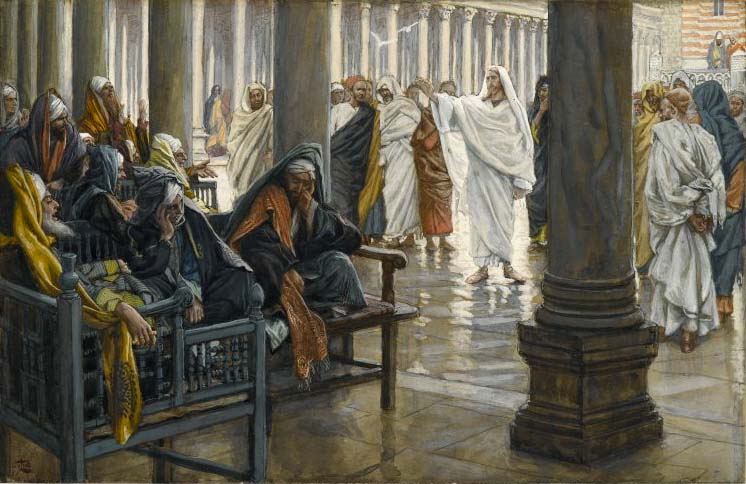
“Woe unto You, Scribes and Pharisees” by French painter James Tissot (1836-1902)
Woe to the Door Slammers
Jesus wanted no slamming the door of God’s kingdom in the faces of ordinary people. The Lord has a zero-tolerance policy for keeping others on the margins and out of the reach of resources and people who could help them.
Several years ago, while working on my graduate thesis in American religious history, I read hundreds of sermons from antebellum southern preachers. Most of them had a uniform biblical defense of the institution of black chattel slavery. Many of the clergymen pastored large churches and led many white people to Christ. Yet, they slammed the door of God’s kingdom smack in the faces of African American slaves, and taught others to do the same.
We might unwittingly door-slam people when we say God’s grace is for all, and then turn around and use policies and procedures to exclude certain people. Typically, behind it all, is a commitment to old-fogy-ism instead of Holy Scripture.
Woe to the Exporters of Hell
The religious insiders were mission-oriented and wanted to make disciples just like themselves, which unfortunately meant loading others down with a heavy burden of legalistic mumbo-jumbo. In doing so, they were exporting their brand of religion which weighed people down instead of uplifting them.
In contrast to this, Jesus was concerned to form followers in and around the biblical virtues of humility, sensitivity to sin, meekness, purity, mercy, and peace-making.
Woe to the Misguided Oath-Takers
Oath-taking was an art form with the religious authorities. There was so much complexity with their rules regarding oaths that it was common to make lots of promises to God which were never kept. Chiefly because there was no real intention of keeping them from the get-go. So, Jesus called them on it and railed about their blindness of truth.
The leaders had lost sight of what is important to God. They either could not or would not distinguish between important and unimportant matters. In Christ’s Sermon on the Mount, Jesus addressed the issue of truth and oath-taking by saying, in essence, that if you’re going to play these games about promise-making and promise-keeping, then don’t swear or make promises at all. Just say “yes” or “no.” This was Christ’s way of saying that lies and liars come from Satan, not God. (Matthew 5:33-37)
Woe to Those Who Give to Get
It is good to give – not so good to give from selfish motives and as a means of avoiding other matters. The religious leaders neglected weightier issues of the law while focusing on their superb 10% giving skills.
The way it worked was this: “Well, I do my part and give 10%, then I get to do whatever the heck I want with the other 90%.” Meanwhile, the things which God passionately cares about, like justice, mercy, and faith, took a back seat. Focusing on frivolous pennies instead of precious life is going to raise the ire of Jesus every time.
Life is supremely important to God. The Lord sees the single mom who struggles to make it; the lonely person who wonders if there is any worth to her existence; and the poor worker who is stuck in a job without a living wage. God cares about the needy persons around us:
This is what the Lord of Armies says: “Administer real justice and be compassionate and kind to each other. Do not oppress widows, orphans, foreigners, and poor people. And do not even think of doing evil to each other.” (Zechariah 7:9-10, GW)
He has shown you, O mortal, what is good. And what does the Lord require of you? To act justly and to love mercy and to walk humbly with your God. (Micah 6:8, NIV)
Speak out for those who cannot speak, for the rights of all the destitute. (Proverbs 31:8, NRSV)
Justice, mercy, and faithfulness all have to do with neighbor love. It is easy to love those who love us back. Yet, the one who loves another, the outsider, the person for whom no one else cares or loves is the one whom Jesus is looking for. We are to have a spiritual vision of living in the world for the sake of the world, without being of the world. Apart from this vision, there is blindness.
Woe to the Squeaky Clean
The teachers of the law had a compulsion for ritual cleanliness. For Jesus, it was an inner issue of the heart, and not about outward washings. For example, having a polished and immaculately clean church building means little if the parishioners within are full of greed and self-indulgence. Christian ministry ought to be centered in cleaning up the human heart, and not just making sure the outside looks good.
The ancient leaders were obsessed with not making a mistake and becoming impure. In a strict legalistic system, making a mistake equals the unpardonable sin. However, in a system of grace, people are encouraged to freely pursue God, and if they fail, are allowed the grace to try something different or try again.
Woe to Perfect Hair
Okay, that is not quite what the text says, but it is darned close. At Passover, when multiple thousands of people came to Jerusalem, the Pharisees whitewashed all the tombstones to make sure no one would inadvertently step on a grave. Because if someone did, they became unclean and unable to celebrate Passover.
Jesus said the perfect hair people were like those tombstones – all nice, clean, spiffy, and looking good on the outside, but on the inside full of death.
Inordinate focus on the outside only prevents one from hearing the cries of people all around us and responding with justice. On the farm, we would say, if there is no manure in the barn, there is no life.
Conclusion
Jesus gave us some telltale signs of the hypocrite:
Fails to practice what they preach.
Keeps other people out of God’s kingdom.
Focuses on externals.
Majors on the minors.
The final word, however, is not hypocrisy but grace. At the end of his tirade, Jesus broke into a tear-filled, heart-rending love song for his wayward people. The set of woes from Jesus, then, are not just blast-the-bad-guys. Jesus has a very deep concern for all people to know the true worship of God.





 Rev. Tim Ehrhardt