Welcome, friends. Although we are socially distanced, let us be spiritually connected through our worldwide communion with all the saints. Click the video below and, by God’s grace, we will be linked with the blessing of Christ…
The following is an animated take on Christ’s parable of the talents…
The Parables of Jesus by Argentine artist Jorge Cocco Santiago, 2018
What would you do with a million dollars?… Maybe you would pay off some debts, finish some work on your house, or quit your job and take a vacation. Perhaps you might invest a good portion of it. However, your investment is only as good as your level of trust.
When I worked at a senior citizen healthcare facility, there was a resident with an apartment in independent living, but he still owned his house. During one conversation, the old man admitted to me that over the past sixty years he owned his house, he had secretly bored holes in every door jamb of the house and had stuffed away $100,000 dollars in cash! This dear resident had personally experienced the run on banks which began the Great Depression in 1929. He had zero trust for investment banking.
A “talent” in Christ’s day was a monetary denomination. A talent was worth 6,000 denarii, and one denarius was worth a day’s wage. So, in Christ’s parable of the talents, Jesus was talking about millions of dollars (in today’s money) with the master who gave his servants five talents, two talents, and one talent. (Matthew 25:14-30)
As Jesus was telling his parable, one of his chief points was to communicate that God is gracious and generous. The three servants responded their master’s generosity according to their view of him. Two of the servants regarded the master as gracious and generous, and so, freely took their talents and confidently invested them to create even more money.
The two faithful servants took risks and acted with the idea that they were secure in their relationship with their master. However, the third servant’s perception of his master was different. This servant discerned his master as stern, serious, and angry, so therefore, he did nothing with his talent – he was afraid.
The man was fearful because his view of the master was off. If we consider God as primarily an angry Being, then we will almost certainly not use the gifts he has given us, for fear of messing up and experiencing his wrath.
However, the truth is, God is gracious and generous. The Lord has mercifully gifted everyone and expects us to use those gifts and not hide them away in a door jamb! God wants us to actively display grace and generosity – which will require addressing our fears. If we want to hear the Lord Jesus say, “Well done, good and faithful servant,” then taking initiative is necessary.
Fear is perhaps the greatest block in preventing God’s people from being productive Christians in serving the church and the world. Beneath our fears are powerful feelings of inferiority, inadequacy, and an inner conviction that we are not enough. Oftentimes, a low view of self can come from a low view of God.
Fear paralyzes our potential to serve God’s kingdom.
Being continually afraid, drains our energy and lessens whatever impact we could have for God in the world, diminishing our resolve to act and leaving us ineffective in service.
Fear destroys our dreams and godly desires.
We are meant to enjoy the gracious and generous God, and in our enjoyment of the Lord, godly dreams will be placed within us that God is pleased to fulfill:
Take delight in the Lord, and he will give you the desires of your heart. (Psalm 37:4, NLT)
Our enjoyment of God gives us the security and confidence to act upon godly desires and produces a generous harvest of righteousness and peace. We then can share the bounty with others, as a way of giving back to God.
Yet, if fear gets thrown into the mix, it dilutes and destroys everything. Fear paralyzes us, and we do nothing, like the third servant in the parable. What is more, fear can force us into hiding, just like the servant hid and buried his talent.
In the Old Testament book of Numbers, the Israelites were immobilized by fear. God had a grand vision and a big dream for the people to enter the Promised Land. But ten of the twelve spies who came back after checking out the land were paralyzed by fear. “The land has giants, and we are like grasshoppers!” they nervously said.
Caleb and Joshua, however, had a different view of taking the land because they had a different view of God. They didn’t see giants – they saw a gracious and generous God who could easily take care of whoever might be in the land, and they wanted to act on the faith they had in a mighty and merciful God. The God of the other spies wasn’t big enough to handle the giants. Their low view of themselves as grasshoppers betrayed their low view of God. (Numbers 13:26-33)
We might wrap a lot of our fears in morbidly sanctified self-belittling. That is, we might feel good about feeling bad and wrap ourselves with a blanket of secret shame. As a result, those self-deprecating feelings stop us from exploring God’s dream and vision for us.
We could use some bold God-sized dreams! We can speak and act in the world with confidence because we serve a God who sees giants as gnats.
Some of the greatest fears that hold back people from exploring their faith is:
Fear of criticism – being afraid of what others may think or say.
Fear of taking a risk – being afraid of going outside the comfort zone of how something has always been done.
Fear of ourselves – being afraid to explore our vast inner world with its guilt, shame, insecurity, and mixed motives.
Fear snatches away God’s dreams for us. If you once had a dream and you think that dream is dead because of your sins and bad habits, you are misguided. Dreams evaporate because of fear, by being duped into believing that we are not enough, and never will be. So, we end up doing nothing.
Fear ruins our relationship with God and others.
Living a spiritual life, meanwhile always looking over our shoulder to see if God is going to sneak up on us and rap our knuckles with a ruler, is no way to live. I think the hardest people to get along with are those who have a low view themselves. Because they do not like themselves, they do not like others. They continually wonder if God is upset with them about something. The man in the parable blamed God for his own lack of investment. Yet, blame shifting is really our own fear and insecurity seeping through onto others – it helps no one, especially ourselves.
God wants us to bloom with the talents given us. God wants us to shine and succeed. God is on our side, has our backs, and wants us to live a good life.
Fear sabotages our service.
“I can’t!” is the cry of the person locked in fear. I cannot stand up in front of people, meet strangers, sing, serve like that other person can or love like Jesus did. I cannot because I am afraid, and I only have one talent!
Perhaps you have observed that God typically uses tongue-tied people, worriers, and those with a sordid past – and not superstars – as servants commissioned with a set of talents. The less a person has, the more God shows up and shows off with generous power and gracious ability through that person.
Nothing sabotages serving more than being afraid, worried, and believing we have so little. Give God a chance! Step out. Take a risk. Act on that dream.
Conclusion
Once in a small village in India, a farmer brought to the open-air market a whole covey of quail, with a string tied around a foot of each bird. The other end of the string was tied to a ring on a central stick. The quail were all walking in a circle because of the strings on their feet. As the day went on no one seemed interested in buying the farmer’s quail.
Finally, an old man came and bought every one of the quail. After he bought the quail, the old man told the farmer to cut the strings and set all the quail free. So, the farmer did. But none of the quail flew away. They kept marching around in a circle as if they were still tied to the string. Finally, the farmer had to shoo them away to get them to move, and even then, the quail landed somewhere else and just started marching in a circle again.
God has freed and forgiven us. Yet, we can so easily remain tethered to imaginary strings and march around in vicious circles of fear, afraid to venture into the unexplored world God has for us, to spread our wings and be free.
God loves you. God has wonderful plans for you. God created you with your unique personality, gave you unparalleled experiences, and gifted you with uncommon abilities. God wants you to tap into that passion and dream placed down deep in your heart to serve the world.
What would you do with a million dollars? You already have it. Now, go and invest it.
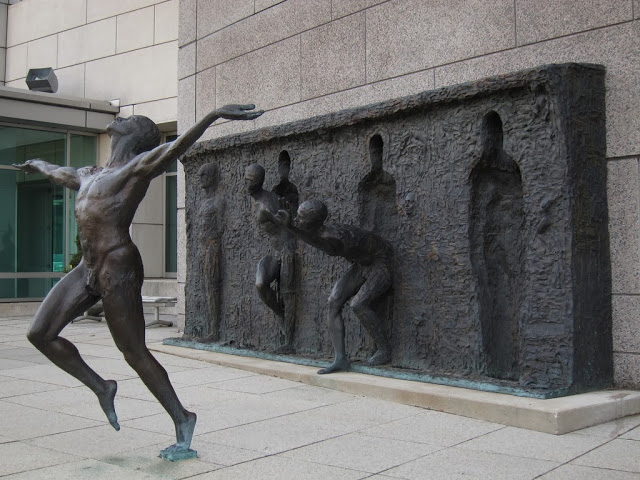
Freedom by Zenos Frudakis in Philiadelphia, Pennsylvania
Jesus said, “When an evil spirit comes out of a person, it travels through dry places looking for a place to rest, but it finds none. So, it says, ‘I will go back to the home I left.’ When it comes back, it finds that home still empty. It is all neat and clean. Then the evil spirit goes out and brings seven other spirits more evil than itself. They all go and live there, and that person has even more trouble than before. It is the same way with the evil people who live today.” (ERV)
Nature abhors a vacuum. A tilled plot of soil will be overtaken with weeds if nothing is planted and nurtured in the turned-over dirt. The pecking order of a brood of chickens cannot handle the death of the top hen without filling the position almost immediately. And, in the spiritual realm, the exorcising of a demon will not simply leave a person empty of evil – his/her life will be filled with something in its place.
Today’s Gospel story, told by Jesus, about the man who is delivered from an unclean spirit, is a powerful and simple narrative on the necessity of true repentance. Genuine freedom is more than getting rid of something bad and destructive; the evil must be replaced with something good and useful. That is, biblical repentance is both a turning away from ungodliness and an embrace of righteousness.
We are delivered from evil so that we can start living into the righteousness and peace intended for us.
For example, the Apostle Paul exhorted the Ephesian believers to not only stop stealing but also to get a job and start sharing with others. They were not only to stop lying and using their tongues for gossip and slander and start using their words to speak truth that builds up others. (Ephesians 4:25-32)
The spiritual principle is the same as the nature principle: A empty vacuum will always be filled. The man who did not fill his life with God ended up having a problem with evil seven times greater than when he started.
If anything, or anyone, is emptied of its unhealthy elements and practices, it is imperative that the hole be immediately filled with healthy disciplines for life.
Whether dealing with addictions, bad habits, or any kind of evil influence, a two-pronged approach is needed for its eradication. We expel the evil by replacing it with godliness. The man struggling with pornography or adultery must not only stop the behavior but take up the mantle of being a champion for women’s issues. The woman who has no healthy boundaries and allows herself to be used and abused must not only separate from the problem or person but adopt her identity in Christ as a precious child of God and enforce righteous limitations.
None of these examples are meant to be simplistic answers to complex situations. Rather, they illustrate why so many people do not experience freedom and continue to have even greater enslavement to their passions and sufferings.
Freedom is realized through replacing old practices with new disciplines that directly attack the old.
We all have needs. How we get those needs met is often a mixed bag of both legitimate and illegitimate ways. In a perfect world, everyone would be aware of their needs and be able to express them to one another without shame, anxiety, or anger. Since we live on a blemished fallen planet, we end up trying to meet our needs indirectly through hustling for love, hoarding resources, and controlling others – all harmful ways which destroys souls and relationships.
So, unless we focus on positively meeting our needs, we must go a step beyond dropping a toxic relationship, cutting up a credit card, or saying “no” to another responsibility. We often get into our mess to begin with because we are out of touch with ourselves and our needs. We need affection and encouragement, and there is no shame in needing this. We need security and safety, and there is no problem in acquiring this. There are some things we need to control, and that is okay.
If we fail to address our needs, we might do the necessary work of deliverance, then turn right around and become worse off than before by filling the empty place of our lives with:
Being all things to all people, as if we were the Messiah.
Being successful so that we stay ahead of being needy.
Pulling inside ourselves and trusting nobody.
Distancing from our needs and pretending they are not there.
Being continually vigilant so that we are never hurt that way again.
Keeping a positive spin on everything, as if there is no negative stuff in the world.
Challenging other’s opinions and behaviors to keep the focus off our needs.
Becoming a wallflower so that we can never be the brunt of someone else’s vitriol or evil.
Instead, we can let Jesus fill the emptiness with love, purpose, peace, joy, attention, and grace. Christ is the Savior who delivers us from evil, and the Holy Spirit is the Sanctifier who carefully applies the work of salvation to our lives.
When our hearts and minds are full of God, there is no place for the demons to get in.
True repentance equally forsakes evil and embraces righteousness; replaces the unhealthy with the healthy; jettisons the illegitimate and seeks the legitimate; and puts away unnecessary suffering and pursues peace and joy in the Spirit.
O God, I no longer want to live with saying I’m sorry and going right back to the old pig slop of sin. I cannot change on my own. I need Jesus to both take away the sin and give me a new life of living for him. Lead me not into temptation but deliver me from evil Help me to make choices that put to death the old way of life, and the courage to live into my forgiveness in the power of the Holy Spirit. Amen.
“The day is coming,” says the Lord, “when I will make a new covenant with the people of Israel and Judah. This covenant will not be like the one I made with their ancestors when I took them by the hand and brought them out of the land of Egypt. They broke that covenant, though I loved them as a husband loves his wife,” says the Lord.
“But this is the new covenant I will make with the people of Israel after those days,” says the Lord. “I will put my instructions deep within them, and I will write them on their hearts. I will be their God, and they will be my people. And they will not need to teach their neighbors, nor will they need to teach their relatives, saying, ‘You should know the Lord.’ For everyone, from the least to the greatest, will know me already,” says the Lord. “And I will forgive their wickedness, and I will never again remember their sins.” (NLT)
For the past few weeks, the Daily Lectionary readings brought us steady admonitions of passing faith onto future generations, with obedience as the key to it all. However, God’s ancient people kept going through significant times of unfaithfulness, infidelity, and disobedience. As if they had some sort of spiritual A.D.D., the people could not seem to keep their eyes off the glittering gods from the surrounding nations.
For certain, God has always possessed a faithful remnant of people devoted to observing the covenant. Yet, the nation in the prophet Jeremiah’s day floundered and broke faith with the teaching given to them.
Since God’s grace has the last word, the sins and shortcomings of the backslidden people who failed to pass on the covenant teachings to their progeny would have a better ending than judgment.
God’s answer to repeated human failings was to establish a new covenant, unprecedented in its audacious mercy.
Rather than rewriting commands on stone tablets (as with Moses on Mount Sinai) and having a remedial class on covenant, God would instead do the extraordinary by writing the law on human hearts – that way they would know the Lord in a direct and immediate way. What is more, it would be for everybody, neither only for the remnant nor for the spiritual elite.
From the least to the greatest, from young to old, even from Jew to Gentile, God would forgive once and for all.
If that is not the most gracious act ever decreed, I do not know what is. This was a radical move of spiritual amnesty which was completely undeserved and most definitely not something any other god from any other nation would ever do. It was unthinkable – completely off everyone’s radar. Yet, that is exactly what grace does.
From a New Testament (New Covenant) perspective, Jesus is the fulfillment of all God’s good covenant promises to the people. Furthermore, God’s Holy Spirit serves as the continuing presence of Jesus within us, teaching us and guiding us in the ways of God. Our only task, then, is to live into those promises – to know them, claim them, and bank on them.
We are most obedient when we believe the promises of God and throw all our hope in them.
The implications of this divine decree are enormous. It means:
I cannot do a dang thing to earn God’s acceptance because I already have it! (John 6:37; Colossians 1:21-22; Romans 8:33-39, 15:7-12)
I need not fear judgment because Jesus has already taken care of the sin issue, once for all! (Romans 6:5-10; Hebrews 7:27-28, 10:5-10; 1 John 4:17-18)
I lack nothing because God has already given me everything I need for life and godliness in this present evil age! (Philippians 4:19; 2 Peter 1:3-4)
I can know God, right now, without jumping through spiritual hoops or over imposed hurdles because Jesus leveled the way and made it clear! (John 14:6; Ephesians 2:8-9; Hebrews 2:9-18)
I can enjoy forgiveness and a clean heart because God has decreed it to be so! (Psalm 103:8-12; Ezekiel 36:25-27; Luke 22:20; Hebrews 8:7-13, 10:14-18)
If this were not enough, Jesus has sent the Spirit to be with us forever, to guide us and lead us into realizing the law written on our hearts. We are never alone. God is with us.
Jesus said, “The Companion, the Holy Spirit, whom the Father sends, will teach you everything and will remind you of everything I told you. Peace I leave with you. My peace I give you. I give to you not as the world gives. Do not be troubled or afraid.” (John 14:26-27, CEB)
In this world of trepidation, fear, uncertainty, and unrest, there is peace, grace, and love because of Father, Son, and Spirit, the one true God, the Blessed Holy Trinity, the Divine Warrior who fights our battles, the Lord of Hosts who has our backs. Yes, this God, and no other god, has the chutzpah to make promises to us and the power to back them up.
Our Father in heaven, Reveal who you are. Set the world right; Do what’s best—as above, so below. Keep us alive with three square meals. Keep us forgiven with you and forgiving others. Keep us safe from ourselves and the Devil. You’re in charge! You can do anything you want! You’re ablaze in beauty! Yes! Yes! Amen!







 Rev. Tim Ehrhardt