Fourth Sunday of Advent – Mary and Elizabeth (Luke 1:39-55)

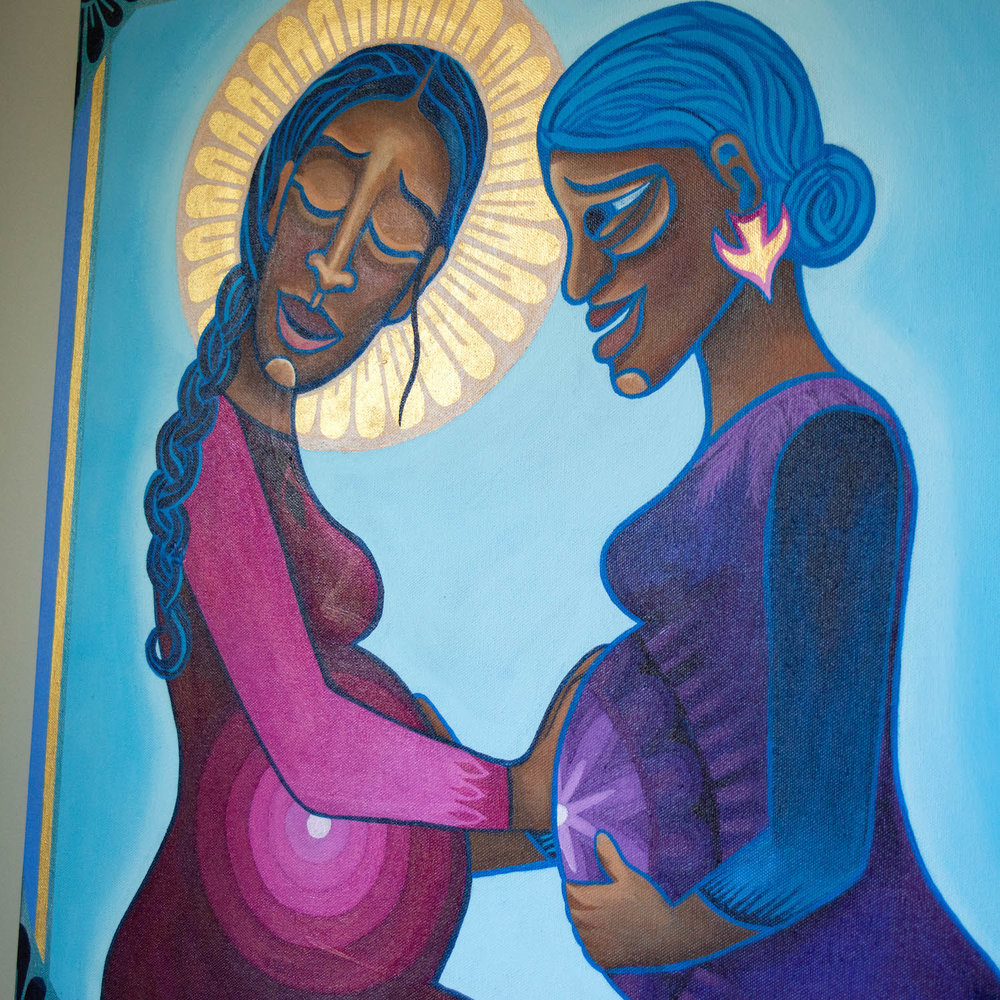
Mary and Elizabeth, by Lauren Wright Pittman

In those days Mary set out and went with haste to a Judean town in the hill country, where she entered the house of Zechariah and greeted Elizabeth. When Elizabeth heard Mary’s greeting, the child leaped in her womb. And Elizabeth was filled with the Holy Spirit and exclaimed with a loud cry, “Blessed are you among women, and blessed is the fruit of your womb. And why has this happened to me that the mother of my Lord comes to me? For as soon as I heard the sound of your greeting, the child in my womb leaped for joy. And blessed is she who believed that there would be a fulfillment of what was spoken to her by the Lord.”

And Mary said,

“My soul magnifies the Lord,
    and my spirit rejoices in God my Savior,
for he has looked with favor on the lowly state of his servant.
    Surely from now on all generations will call me blessed,
for the Mighty One has done great things for me,
    and holy is his name;
indeed, his mercy is for those who fear him
    from generation to generation.
He has shown strength with his arm;
    he has scattered the proud in the imagination of their hearts.
He has brought down the powerful from their thrones
    and lifted up the lowly;
he has filled the hungry with good things
    and sent the rich away empty.
He has come to the aid of his child Israel,
    in remembrance of his mercy,
according to the promise he made to our ancestors,
    to Abraham and to his descendants forever.” (New Revised Standard Version)

Mary had a visitation by an angel, informing her that she would give birth to the Son of God. She immediately hurried to visit her relative Elizabeth, who was pregnant with the forerunner to the Son of God.

In the two women’s encounter, the baby within Mary is portrayed as of greater significance than the one within Elizabeth. And that was not because of the adults, but because of the babies themselves.

Something amazing and spectacular was about to occur in history. It would be so cataclysmic that these two babies, especially the one within Mary, would change the world in profound ways.

There was nothing particularly special about either Mary or Elizabeth – which is probably why they were perfect for the jobs of raising the Messiah and the Prophet.

The lowly non-descript persons are usually favored by God, even though the world knows nothing about them. After all, the kingdom of God knows nothing of billionaires and those in high places, even though the world knows nearly everything about them.

Throughout the history of the world, women have often been overlooked and underrated. Even in today’s Western world, even though it’s better than it was, women are still viewed not as qualified like men are. But that’s a topic for another time.

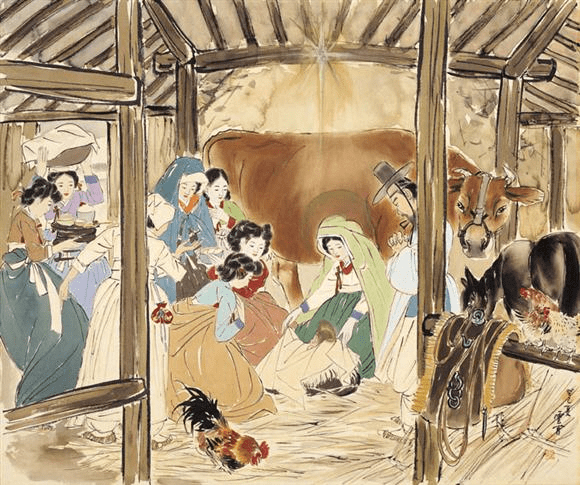
The Visitation, by Sadao Watanabe (1913-1996)

The most obvious observation from today’s Gospel story is that we wouldn’t have babies born without women. There were two in utero babies that had responses, because of two women.

Inside of Elizabeth’s womb, John leaped at the voice of Mary carrying his new cousin. Indeed, even before birth, John was filled with the Holy Spirit and began pointing to Jesus. (Luke 1:15)

John, although getting his prophetic leap from the Spirit, also got some significant prophetic oomph from his mother. Elizabeth spoke the prophetic word about Mary, who is “the mother of my Lord.”

Good people bestow blessing on others. And that is what Elizabeth did for Mary. This then, enabled Mary to express her own inspired blessing to God. To bless and be blessed means, on the practical level, that spiritual eyes are opened to see what is truly there.

Mary is a blessed person, not only because she is the Lord’s mother, but more fundamentally because she is faithful, and trusted in the promise of God to her.

To be blessed is to have God’s stamp of approval on your life. It has little to do with wealth or abundant resources. But it does have a lot to do with living a life of godly virtue and values.

So, again, it only makes sense that God used Mary and Elizabeth, two women who embodied being poor in spirit (humble) as the divine conduits for blessing the world.

Both Mary and Elizabeth believed. Elizabeth believed the words of the angel to her husband Zechariah. And Mary believed the angel’s direct words to her when she heard them. Without hesitation or any ambiguity.

Faith accepts what it cannot see; and when faith does see with actual eyes, it can see what is underneath the physical appearance.

Let’s also make sure to observe that this sort of faith, this particular way of seeing, has its consequences. Elizabeth and Mary both knew quite well that one of them was an unmarried pregnant woman.

They understood the social judgments to come, along with the shaming, and perhaps even the ostracism that would likely occur – even though all of this is divine through and through.

But grace can always use the eyes of faith to see beyond social status and convention in order to do what is right, just, and good. Mercy can always see what is truly honorable.

Elizabeth was perfectly comfortable extending hospitality to a person for whom others were likely to whisper, judge, and reject. Which is why I like Elizabeth. Every generation needs more women like her.

The welcome and love of Elizabeth is of the same sort that Jesus would show to prostitutes, tax collectors, and sinners. Like Elizabeth, Jesus could see beyond any societal shame to what was divinely happening in front of him.

Mary magnified the Lord with immortal words infused from the blessing bestowed upon her by Elizabeth. To bless another person is to open them to the possibilities of God’s actions in them and through them to the world.

That is the real gift that keeps on giving. And it is the most appropriate and valuable gift that we can give to another this season.

O God of Elizabeth and Mary, you visited your servants with news of the world’s redemption in the coming of the Savior. Make our hearts leap with joy, and fill our mouths with songs of praise, so that we may announce glad tidings of peace, and welcome Christ in our midst. Open our souls to receive the One who came to love your flock. Amen.

Christ Is Effective (Hebrews 10:10-18)

Orthodox icon of Jesus Christ

Day after day every priest stands and performs his religious duties; again and again he offers the same sacrifices, which can never take away sins. But when this priest had offered for all time one sacrifice for sins, he sat down at the right hand of God, and since that time he waits for his enemies to be made his footstool. For by one sacrifice he has made perfect forever those who are being made holy.

The Holy Spirit also testifies to us about this. First he says:

“This is the covenant I will make with them
    after that time, says the Lord.
I will put my laws in their hearts,
    and I will write them on their minds.”

Then he adds:

“Their sins and lawless acts
    I will remember no more.”

And where these have been forgiven, sacrifice for sin is no longer necessary. (New International Version)

We are reminded in this Advent season of the Christian Year, that the coming of Christ had a purpose: Offering himself for all of the guilt and shame of the world.

Through the incarnation of Christ, God entered the world in order to deliver all creation from the power of evil, to give freedom from sin, death, and hell, so that people could come to God.

The old sacrificial system of Levitical priests offering sacrifices was good, but it was not effective. Jesus, as both priest and offering, is infinitely better. Christ’s offering was so superior that it was the sacrifice to end all sacrifices.

Jesus Christ was willing to do the work of offering himself, and was the perfect person to do it. No other could have done it.

In the Christian religious tradition, Jesus is the logical, reasonable, and promised way of reversing the curse upon humanity and doing away with sin forever.

The person and work of Christ is both a simple project to understand, as well as so complex that we will spend an eternity exploring Jesus and his ministry.

So, let’s make sure to maintain the tension of a message everyone can understand, as well as a message so deep and wide that we need to keep discovering how it continues to unfold, even up to this day and beyond.

The priest in the old covenant made daily offerings. The sacrifices were a reminder of guilt; none of them could take away sins. But Christ made one offering that potently took care of the sin issue once and for all.

The offerings of the Levitical priests in the old system were repeated because they were insufficient to take away human shame. But Jesus “endured the cross, scorning its shame, and sat down at the right hand of the throne of God.” (Hebrews 12:2)

The author of Hebrews tells us that the once-for-all offering of Jesus made the worshiper perfect. It makes sense that a perfect Savior offered a perfect sacrifice, with the effect of making perfect those who are coming to God.

“Perfect” does not mean that the worshiper is now completely without sin, as if an instant moral and ethical perfection occurred. The author was not communicating that Christians are completely unblemished, pure, and never error in their ways.

Rather, the Book of Hebrews has the message that we can come to God without any obstacles. Worshipers are now in a situation where they can engage in the project of Christian maturity without any hindrances to access with God.

Even death will not stop the believer from coming to God. Death, hell, and sin have been conquered by Christ’s offering of himself. We can now spiritually grow, instead of spiritually wither. The way is open to God.

For we do not have a high priest who is unable to empathize with our weaknesses, but we have one who has been tempted in every way, just as we are—yet he did not sin. Let us then approach God’s throne of grace with confidence, so that we may receive mercy and find grace to help us in our time of need. (Hebrews 4:15-16, NIV)

In Christ, we have shed our human weakness and have obtained an indestructible life. (Hebrews 7:16)

The “perfection” or maturity and full realization of God’s promises in Christ will culminate at the end of the age. So, it is theologically (doctrine of God) and anthropologically (doctrine of humanity) appropriate to say that we are perfect and not yet perfect.

Put a different way, in the context of soteriology (doctrine of salvation), we have been saved, are being saved, and will be saved. The Cross of Christ has secured perfect deliverance for us.

Yet, we must live into that deliverance, which is what we call “sanctification” or the process of being made holy, pure, and mature as Christians.

And we will not be completely free of the world’s evil machinations, our own sinful proclivities, and the devil’s stratagems against us until the second advent when Christ returns to judge the living and the dead.

For now, we are in the process of being made perfect. We struggle daily with the tension between good and bad, right and wrong, justice and injustice.

Its as if the offering of Jesus, the Cross of Christ, made the largest splash in history, with ripples still extending out in all directions into the past and the future that keep making significant waves.

Thank you, Jesus. Praise the Lord.

Heavenly Father, in you we live and move and have our being: We humbly pray you so to guide and govern us by your Holy Spirit, that in all the cares and occupations of our life we may not forget you, but may remember that we are ever walking in your sight; through Jesus Christ our Lord. Amen.

I Want To Know Christ (Philippians 3:7-11)

Jesus Christ and the Apostles, by Nikolas Martínez Ortiz de Zarate (1907-1990)

But whatever were gains to me I now consider loss for the sake of Christ. What is more, I consider everything a loss because of the surpassing worth of knowing Christ Jesus my Lord, for whose sake I have lost all things. I consider them garbage, that I may gain Christ and be found in him, not having a righteousness of my own that comes from the law, but that which is through faith in Christ—the righteousness that comes from God on the basis of faith. 

I want to know Christ—yes, to know the power of his resurrection and participation in his sufferings, becoming like him in his death, and so, somehow, attaining to the resurrection from the dead. (New International Version)

Whenever someone asks me what my favorite portion of Holy Scripture is, I reflexively turn to these verses in our New Testament lesson for today.

I resonate with these words from the Apostle Paul to the Church at Philippi, because they match what I truly believe, and how I really feel about Jesus.

We go through a lot of loss in this earthly life. We experience hardship and adversity. We grieve and lament.

Some of the losses in this life, we are okay with, or at least, we come around to being okay with them after a bit of time. Yet, there are other losses that are heartrending.

On the flipside, there are many gains we experience in this life. Some of them we worked very hard for, and others came to us as gifts.

Oftentimes, our gains and our losses are inextricably bound with each other. Something we consider precious is lost. We may even choose to set aside or give up something we have – we allow it become lost – so that we can gain something even better.

At other times, the process of gaining, losing, then gaining something good was not purposed by us, but by God.

And, to me, that’s probably the best sort of good there is.

Another way of putting the matter is: We must let go and accept how something or someone is, before we can experience what a truly good life really is.

Jesus, by Ghanshyam Gupta

Allow me, or please indulge me, as I frame the Apostle’s words in my own sort of language:

Anything in this life that I have achieved; anything I have come to possess; any sort of position or title I hold or have held; any kind of identification I have, or prestige  I have gained, is of no value. In reality, it’s all rather worthless.

If you will let me take it even further, compared to having an authentic, real, and experiential relationship with Jesus as my Savior, my Lord, and my Friend, everything else is like a bunch of garbage. That’s how much I value Jesus. There’s no other thing, no other relationship, that comes remotely close to knowing Christ.

It isn’t so much that I found Jesus, but that he found me. So, I have a faith that’s got nothing to do with keeping up appearances or rule-keeping, or keeping ahold of anything. I have the life that is truly life.

But, oh my, there is so much more to experience and to know with Jesus! I want to experientially know the power of Christ’s mighty resurrection. I  want to be like him, and participate with him, as if Jesus were living his life through me.

And, I must tell you, I know that this sort of life means suffering. But I also know that this suffering puts me in solidarity with my Lord – which is exactly where I want to be.

I only want to live up to who I’m supposed to be in Christ, to be my true self, and not some faux Christian living according to mere rules and regulations. The only thing that counts to me is faith expressing itself through love.

I understand that I took a lot of liberties with the text, and elaborated on it in order to make it my own. But, truth be told, we all need to find ways to make scripture as our own.

We all must let go of some old ways and unlearn a lot of things, in order to discover new life and be united with Christ. Everyone needs to learn from the past, so that we can live a new life here in the present.

If you don’t like my words, that’s fine. You aren’t under any obligation to read them. Yet, I do believe we have an obligation to Holy Scripture, and specifically, to ingest it as if it were the best meal you’ve ever eaten.

Indeed, we end up experiencing a lot of losses in this life. Yet, with Jesus, we will never lose him, because he will never forsake us. Christ is our eternal gain. He’s alive, always living, so that we need never be concerned about him not existing anymore.

That’s my faith. That’s what I trust in, or rather whom I put my faith in, and my trust upon. It’s all about Jesus. Anything less will not stand the test of time, nor of satisfaction in life.

What will you do with Jesus?

Christ isn’t going to strongarm you into the kingdom of God. But he will doggedly go after you, and be a pester pup in your ears and an ever-present sense in your heart.

You might as well go ahead and consider him, or perhaps reconsider him, like you’ve never done before.

After all, you’ve really got nothing to lose.

We believe in one Lord, Jesus Christ,

the only Son of God,
eternally begotten of the Father,
God from God, Light from Light,
true God from true God,
begotten, not made,
of one being with the Father;
through him all things were made.
For us and for our salvation
he came down from heaven:
was incarnate of the Holy Spirit and the Virgin Mary,
and became truly human.
For our sake he was crucified under Pontius Pilate;
he suffered death and was buried.
On the third day he rose again
in accordance with the Scriptures;
he ascended into heaven
and is seated at the right hand of the Father.
He will come again in glory to judge the living and the dead,
and his kingdom will have no end. – The Nicene Creed, on Jesus Christ

Second Sunday of Advent – Prepare the Way (Luke 3:1-6)

The Call from John the Baptist to Repent, by Renier de Huy, 12th century

In the fifteenth year of the reign of Tiberius Caesar, when Pontius Pilate was governor of Judea, and Herod was ruler of Galilee, and his brother Philip ruler of the region of Ituraea and Trachonitis, and Lysanias ruler of Abilene, during the high priesthood of Annas and Caiaphas, the word of God came to John son of Zechariah in the wilderness. He went into all the region around the Jordan, proclaiming a baptism of repentance for the forgiveness of sins, as it is written in the book of the words of the prophet Isaiah,

“The voice of one crying out in the wilderness:
‘Prepare the way of the Lord;
    make his paths straight.
Every valley shall be filled,
    and every mountain and hill shall be made low,
and the crooked shall be made straight,
    and the rough ways made smooth,
and all flesh shall see the salvation of God.’ ” (New Revised Standard Bible)

In this Christian season of Advent, we are reminded that God is not only high above us, transcendent, far away; God is also close to us, immanent, and with us.

We remember at this time of year that God does not remain distant, but entered our time and space at a particular moment in history, for a distinct purpose.

The Roman Empire was powerful, large, and very much in control of every place where it existed. The litany of imperial rulers and authorities which the Gospel writer Luke listed is meant to give us a feel of the Roman weight, and how much Roman might was ensconced in Judea.

The world at the turn of the common era was under the dominion of powerful people with lots of influence. But God did not come to any of them. Instead, God came to a loner – a man who spent his time out in the wilderness. His name was John, the son of Zechariah. We know him as John the Baptist.

With God coming to John at a precise point of time in a particular place, that made John a prophet with a singular message. John was born for this. (Luke 1:76)

It is fitting that a man hanging out on the fringes of society all by himself would be the one to prepare the way for Messiah.

After all, Messiah’s message would be one of bringing good news to the poor, proclaiming release to prisoners, and freeing those who are oppressed. (Luke 4:18-19; Isaiah 61:1-2)

God’s prophetic calling for John was one of preparation. John was to prepare the way of the Lord. He was to get the people ready to receive Messiah.

John went about his ministry of preparation by calling folks to repent, to change their minds and amend their ways, so that there might be forgiveness.

In a reference from the prophet Isaiah, Luke alluded to Jewish exiles returning from their Babylonian captivity. The actual physical road from Babylon to Jerusalem was a hard journey due to the distance and topography.

The “road” or the “way” in Holy Scripture is also a metaphor for the spiritual journey we take in this life. And that road has a lot of challenges to it. The very act of walking as a pilgrim over a long arduous journey changes a person.

It is rarely the destination that makes a person; it’s the journey itself which leads one to a changed life of thinking differently, and seeing things from a perspective we’ve never seen before.

The smoothing out of the road is a way of saying God is making it easier for people to return to the Lord, to get them ready for a new life with promises fulfilled and unexpected joy.

In other words, valleys raised and mountains flattened represent God’s efforts at helping us experience a complete transformation of life. The Lord will do everything possible to make renewal and restoration happen for us.

The Lord will set things right. In our contemporary world that is now largely controlled by powerful oligarchs and the super-rich, God will turn it upside-down. All of the world’s current powerful people will find themselves looking up, not down.

It would be nice and reassuring if I could give you certainty about the journey ahead. But I cannot do that. Yet, what I can do is assure us of what is at the end of the road. Look beyond the current days of self-centered leadership and popular ignorance, and understand that all flesh shall see the salvation of God.

Prepare the way of the Lord. We do that by how we go about walking the road. Each step we take every day is important and makes a difference. And when we stumble, there is plenty of grace to help get us back on our feet and moving forward.

We are all collectively journeying together to Bethlehem. And as we daily move and walk, at the end of our journey, Jesus is there.

But when the fullness of time had come, God sent his Son, born of a woman, born under the law, in order to redeem those who were under the law, so that we might receive adoption as children. (Galatians 4:4, NRSV)

And nothing can stop us or separate us from the love of God that is in Jesus Christ our Lord.

For I am convinced that neither death, nor life, nor angels, nor rulers, nor things present, nor things to come, nor powers, nor height, nor depth, nor anything else in all creation will be able to separate us from the love of God in Christ Jesus our Lord. (Romans 8:38-39, NRSV)

The journey may be arduous. You might feel like giving up. But Jesus is our Immanuel, God with us. In him, is our hope and our joy.

O Holy One of Israel, out of the embrace of mercy and righteousness, you have brought forth joy and dignity for your people. Remember now your ancient promise; make straight the paths that lead to you, and smooth the rough ways, so that in our day we might bring forth your compassion for all humanity. Amen.