Follow Me (Mark 1:14-20)

Come Follow Me, by Jorge Cocco Santángelo 

Now after John was arrested, Jesus came to Galilee proclaiming the good news of God and saying, “The time is fulfilled, and the kingdom of God has come near; repent, and believe in the good news.”

As Jesus passed along the Sea of Galilee, he saw Simon and his brother Andrew casting a net into the sea, for they were fishers. And Jesus said to them, “Follow me, and I will make you fishers of people.” And immediately they left their nets and followed him. As he went a little farther, he saw James son of Zebedee and his brother John, who were in their boat mending the nets. Immediately he called them, and they left their father Zebedee in the boat with the hired men and followed him. (New Revised Standard Version)

For all the talk of leadership, developing leaders, and being a leader, there is precious little conversation these days about becoming a follower. Perhaps we have such a dearth of leadership for this very reason, because one can only become a good leader if they experientially know what being a follower is.

The Call of Jesus

The call of Jesus is to pursue him, and he will develop us. Follow Jesus, and he’ll show you how to fish for people. All of Christ’s original disciples listened to Jesus, dropped everything they were doing, and immediately followed him.

I am wondering what would make you drop literally everything you are presently doing to pursue an entirely new life. I am curious what would cause you to follow Jesus without any conditions attached whatsoever. 

I am impressed that Peter and Andrew immediately responded to Jesus. They didn’t question Jesus as to whether this was a short term project or a long term assignment he was calling them to. They did not seek a contract with Jesus or ask how he would impact their stock portfolio. 

The first disciples simply dropped everything and left with Jesus.

I suspect they followed Jesus for the same reason I originally decided to follow him – because Jesus is such a compelling person, so gracious, interesting, and loving, that it was really no decision at all. Everything else pales in comparison with Jesus.

Read all four Gospels and the book of Acts and you will find that believers in Jesus follow Jesus; and those who do not follow Jesus are not believers. Followers follow, and those who do not follow are not Christ’s followers.

Jesus still calls people. He calls us to follow him and he will make us fishers of humanity. Maybe you are concerned about this and say, “I have no idea how to fish for people.” The good news is that Jesus said he would make us fishers of people. Jesus is not looking for people with skills he can use; instead, he calls, then develops people into fishers.

Christ always forms people with the ability to follow his call. Jesus will train us; we only need to answer the call to follow. 

When I was five years old my Dad took the training wheels off my bike and told me to ride it. I told him I couldn’t. He told me to get on the bike and he would run beside me. I got on the bike and started to ride with him holding it. When I began to panic, approaching a tree, I started talking to my Dad. But he didn’t answer… because he wasn’t beside me. He dropped out from shagging me a long way back.

We are not called to follow Jesus based on our skills, but on the lack of them so that Jesus will do in us a work of total allegiance and loyalty to the kingdom of God. 

Jesus will make sure to develop the skills we need in order to do what he has called us to do. We only need to hear and answer the call of Jesus to follow. The following is a parable about the church and being fishers of people: 

“Now it came to pass that a group existed who called themselves fishermen. Week after week those who called themselves fishermen met in meetings and talked about their call to fish, the abundance of fish, and how they might go about fishing. They discussed the importance of fishing and that fishing is the task of every fisherman.  They listened to special speakers talk about fishing and they promoted fishing and looked at all the latest equipment for fishing. They built large buildings called ‘Fishing Headquarters’ so that they could tell as many people as possible about fishing. They organized boards of people to send out fishermen to other places. They offered teaching and classes on how to fish and the best and latest fishing methods. With much training a good many persons got their fishing licenses and became upstanding members of Fishing Headquarters. There was just one thing that they did not do: They didn’t fish. When one person dared to suggest that those who do not catch fish are really not fishermen, the group became angry and kicked that crazy person out their group.”

The Message of Jesus

Jesus said the kingdom of God is near, so repent and believe the good news. For Jesus, the word “kingdom” means God’s intentions and will for this world to come true. Jesus was saying that he is creating a new society – which meant Caesar was not Lord and that people’s loyalty was not ultimately to the Roman Empire. 

The kingdom of heaven, God’s dream society, will eventually spread across the entire earth so that the whole world is God’s sacred space, devoted to love, shaped by justice, living in peace, and abounding with wisdom.  Jesus encouraged us to pray consistent with this idea saying, “May your kingdom come and your will be done on earth as it is in heaven.” (Matthew 6:10)

If we find ourselves not really working toward Christ’s idea of kingdom, then we need to “repent and believe the good news” that God is working toward restoring all things to their original beauty and luster. The word “repent” means a change of mind which leads to a change of behavior. And “believe” means to put all your eggs in God’s kingdom basket.

None of this is a suggestion, but is rather a straightforward call to follow Jesus in his kingdom building enterprise on this earth. It would, therefore, be a travesty to simply think about the message for a while and follow Jesus if we feel like it, or get around to it.

Jesus wants to make fishers within family systems, workplaces, neighborhoods, and all the places within a typical sphere of living: This requires the following:

  1. Go where the fish are. Fishing would be easy if we could put a basket by the water and have the fish jump into them! But that is not how it works. Rather, it takes intentional activities that connect people together.
  2. Cast the nets. Peter and Andrew did more than take their boat out to the middle of the lake. To catch fish, they threw their nets into the water. Here is what I believe this means for us: We do what is fair and just to our neighbors. We extend compassion to them and are steadfast in our love, even when others are unlovely. And we do not take ourselves too seriously.
  3. Obey Jesus and walk with him. After Christ’s resurrection, Jesus came to some of the disciples, who had fished unsuccessfully all night. He told them to throw their nets on the other side of the boat – which seemed like nonsense, but they did it anyway. It resulted in a great catch (John 21:1-14). During the three years of Christ’s earthly ministry, the disciples did everything with him – they walked, talked, and ate with Jesus. And when he ascended to heaven, they acted on the Great Commission given to them by Jesus to make other disciples.

May God cleanse our lips and our lives so that we might proclaim the good news of Christ’s kingdom with glad and sincere hearts to the glory of Father, Son, and Spirit.

Eternal God, the refuge and help of all your children, we praise you for all you have given us, for all you have done for us, for all that you are to us. In our weakness, you are strength, in our darkness, you are light, in our sorrow, you are comfort and peace. We cannot number your blessings; we cannot declare your love: For all your blessings we bless you. May we live as in your presence, and love the things that you love, and serve you in our daily lives, through Jesus Christ our Lord. Amen.

Christ Is Born (Luke 2:1-20)

Nativity, by He Qi, 1998

In those days Caesar Augustus declared that everyone throughout the empire should be enrolled in the tax lists. This first enrollment occurred when Quirinius governed Syria. Everyone went to their own cities to be enrolled. Since Joseph belonged to David’s house and family line, he went up from the city of Nazareth in Galilee to David’s city, called Bethlehem, in Judea. He went to be enrolled together with Mary, who was promised to him in marriage and who was pregnant. While they were there, the time came for Mary to have her baby. She gave birth to her firstborn child, a son, wrapped him snugly, and laid him in a manger, because there was no place for them in the guestroom.

Nearby shepherds were living in the fields, guarding their sheep at night. The Lord’s angel stood before them, the Lord’s glory shone around them, and they were terrified.

The angel said, “Don’t be afraid! Look! I bring good news to you—wonderful, joyous news for all people. Your savior is born today in David’s city. He is Christ the Lord. This is a sign for you: you will find a newborn baby wrapped snugly and lying in a manger.” Suddenly a great assembly of the heavenly forces was with the angel praising God. They said, “Glory to God in heaven, and on earth peace among those whom he favors.”

When the angels returned to heaven, the shepherds said to each other, “Let’s go right now to Bethlehem and see what’s happened. Let’s confirm what the Lord has revealed to us.” They went quickly and found Mary and Joseph, and the baby lying in the manger. When they saw this, they reported what they had been told about this child. Everyone who heard it was amazed at what the shepherds told them. Mary committed these things to memory and considered them carefully. The shepherds returned home, glorifying and praising God for all they had heard and seen. Everything happened just as they had been told. (Common English Bible)

Nacimiento (Nativity), by Leoncio Saenz, 1983

It is of significance – and not by accident – that Jesus had a humble birth in a lowly setting. All around was the backdrop of a powerful Roman Empire. Whereas Christ could have been born as the mighty king that he actually is, he instead was born and then laid in a feeding trough for animals.

Caesar Augustus — whose name means revered or exalted one — ended a long period of war in the Roman Empire and was hailed as a prince of peace, the savior of the world. With his reign began the Pax Romana (Roman Peace). Under the rule of Augustus, the economy was booming; culture, religion, and infrastructure were developed and prospered. He was hailed by many with the title “Ceasar is Lord.”

Yet, as with many powerful rulers in history, Augustus ruthlessly suppressed his enemies and limited their human rights. It was peace by totalitarian rule – which is really no peace, at all.

It was in those days that Augustus proclaimed his decree for a census of the entire Roman world, so that taxes could be collected from all the conquered peoples of the empire. And so, despite being very pregnant, Mary and her fiancé Joseph made the arduous 90-mile trek from Nazareth in Galilee to Bethlehem, the city of David. That was the only way they could be properly registered, to return to the ancestral home.

It’s no surprise that Mary ended up giving birth to Jesus, far from their actual home, in less than ideal circumstances, for a delivery of a baby.

It appeared Ceasar Augustus was the absolute ruler, and much too powerful for anyone to challenge him. It also seemed that Jesus, a vulnerable little infant with even smaller resources, could do anything but just try and survive. But appearances can be, and are often, quite deceiving.

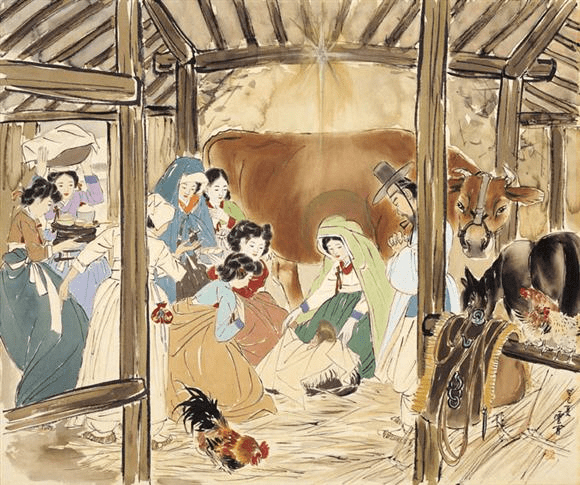
The Birth of Jesus Christ, by Woonbo Kim Ki-chang, 1952

In truth, Jesus is Lord, and Ceasar is not. Christ is the real Prince of Peace who brings God’s benevolent rule and reign to earth, as it is always done in heaven. And it will not be achieved through military power, but by the justice and mercy of God. Because, as it turns out, Love is a much greater force than any human authority or empire.

Considering God’s gracious kingdom – which turns all appearances on its head – it is quite appropriate that news of Christ’s royal birth comes first to a bunch of shepherds. They were among the lowliest of the emperor’s subjects.

Although we may tend to romanticize the shepherds keeping watch over their flocks by night, most people thought of shepherds as low class workers who nobody wanted to be around. They were poor, illiterate, and thought to be dishonorable drunks. Shepherds also had the reputation of being thieves because they grazed their flocks on other people’s property. In short, they were mostly the outcasts of society.

To this group of people the angel announces good news of great joy for all the people everywhere – and not just the powerful and the rich: To you is born this day in the city of David, a Savior, who is the Messiah, the Lord. The shepherds go to Bethlehem to find this baby, and become the first to share the good news of the Savior’s birth.

Today, we still live in a world dominated by people who desire power and privilege over others. We still live in a world enamored with wealth and resources, power and authority, military might and social control. In this world, much like the ancient world, the lowly still get trampled and the least among us get little if any attention.

Masters of both small and large worlds will eventually be toppled, not to mention our own personal petty empires we seek to build. All of our planning and scheming will never bring true peace and security. Jesus has arrived! Christ is born! All other empires are now on borrowed time.

Nativity, by Joseph Mulamba-Mandangi, 2001

The Savior is born for all the world, for us, even though we are separated from Christ’s birth by two millennia. Jesus still comes to bring peace on earth and goodwill to all humanity through the power of Love. He still casts out fear and relieves anxious hearts. And his reign will last forever and ever.

With Jesus Christ as Sovereign, outcasts are welcomed in; the hungry are fed; the poor are lifted up; captives are set free; enemies are reconciled. And wherever the good news is proclaimed, guilt and shame melts away, and lives are changed.

Today Christians all over the world celebrate the birth of Christ. And we also look forward to his coming again, when his reign of justice, mercy, and peace comes in all its fullness.

May God bless you this Christmas and always. May you be comforted by the Lord’s presence in your life, and always follow his guiding light. For Christ has come, the Immanuel, God with us. Amen.

Jesus Is Lord (Revelation 21:5-27)

“The Risen Lord” by Chinese artist He Qi, 2001

Then the one who sits on the throne said, “And now I make all things new!” He also said to me, “Write this, because these words are true and can be trusted.” And he said, “It is done! I am the first and the last, the beginning and the end. To anyone who is thirsty I will give the right to drink from the spring of the water of life without paying for it. Those who win the victory will receive this from me: I will be their God, and they will be my children. But cowards, traitors, perverts, murderers, the immoral, those who practice magic, those who worship idols, and all liars—the place for them is the lake burning with fire and sulfur, which is the second death.”

One of the seven angels who had the seven bowls full of the seven last plagues came to me and said, “Come, and I will show you the Bride, the wife of the Lamb.” The Spirit took control of me, and the angel carried me to the top of a very high mountain. He showed me Jerusalem, the Holy City, coming down out of heaven from God and shining with the glory of God.

The city shone like a precious stone, like a jasper, clear as crystal. It had a great, high wall with twelve gates and with twelve angels in charge of the gates. On the gates were written the names of the twelve tribes of the people of Israel. There were three gates on each side: three on the east, three on the south, three on the north, and three on the west. 

The city’s wall was built on twelve foundation stones, on which were written the names of the twelve apostles of the Lamb. The angel who spoke to me had a gold measuring stick to measure the city, its gates, and its wall. The city was perfectly square, as wide as it was long. The angel measured the city with his measuring stick: it was fifteen hundred miles long and was as wide and as high as it was long. The angel also measured the wall, and it was 216 feet high, according to the standard unit of measure which he was using. The wall was made of jasper, and the city itself was made of pure gold, as clear as glass. 

The foundation stones of the city wall were adorned with all kinds of precious stones. The first foundation stone was jasper, the second sapphire, the third agate, the fourth emerald, the fifth onyx, the sixth carnelian, the seventh yellow quartz, the eighth beryl, the ninth topaz, the tenth chalcedony, the eleventh turquoise, the twelfth amethyst. The twelve gates were twelve pearls; each gate was made from a single pearl. The street of the city was of pure gold, transparent as glass.

I did not see a temple in the city, because its temple is the Lord God Almighty and the Lamb. The city has no need of the sun or the moon to shine on it, because the glory of God shines on it, and the Lamb is its lamp. The peoples of the world will walk by its light, and the kings of the earth will bring their wealth into it. 

The gates of the city will stand open all day; they will never be closed, because there will be no night there. The greatness and the wealth of the nations will be brought into the city. But nothing that is impure will enter the city, nor anyone who does shameful things or tells lies. Only those whose names are written in the Lamb’s book of the living will enter the city. (Good News Translation)

“The Risen Christ” by He Qi, 2004

So, I’m just going to put something out there and see if you resonate with it, or not:

Sometimes we long for Christ’s return, the end of time, and eternal bliss because we don’t want to deal with being our true selves right now in this present moment in time. We just want out of our current reality.

At times, we take ourselves so darned seriously that the true self never comes through to others. Yet, when I’m real, authentic, and genuine, I connect with others from the very core of my being, and not from some contrived self that I’ve put up for others to see.

I say all this because, if we want to see the New Jerusalem, the heavenly city, and experience the very presence of God and the Lamb, then it comes because you and me are being our real selves. Only the true, the brave, and the vulnerable shall have their names written in the Lamb’s Book of Life.

I think the reason why we have such a detailed description of the New Jerusalem is that this is a sure thing; it’s real, man. And only real authentic people can inhabit the city.

Please know that, even though we may want things to change from the way they are now, things will not always be this way. Life will not always consist of heartache, suffering, and tears. The world, as we now know it, will eventually pass away with its constant barrage of war, famine, hunger, sickness, misunderstanding, conflict, and pain. 

There is a coming a day when Jesus will return and make everything new. The vision of this next-to-last chapter of the Bible portrays a sovereign Lord who is in charge, and whose authority, in the end, shall be seen for what it truly is. 

Everything wrong will be made right; all that is crooked shall be made straight; and the endless struggle to do what is right and just will prevail once and for all.

Whenever we get caught in some seemingly endless cycle of addiction, or insecurity, or fear; whenever we find ourselves having to endure yet another day of undeserved backtalk; and whenever we see that perseverance has become our abiding companion; it is in those times – much like the original recipients of the Apostle John’s vision of the final apocalypse – that we are strengthened and encouraged with the truth that Jesus is Lord. 

Jesus Christ reigns as King over all creation; his rule will be revealed to all nations. In Christ’s benevolent kingdom, everyone who is thirsty for justice will receive from a life-giving fountain; and all who hunger for righteousness will be filled and satisfied.

Yet, until that time comes, we hold to our hope that Jesus shall return to judge the living and the dead. 

For righteous persons, this is truly good news. For the wicked, not so much. 

Only those whose names are written in the Lamb’s Book of Life will be in the celestial city. 

So, today is the day to be a real, authentic, vulnerable Christian who puts on words and deeds that are appropriate for God’s kingdom.

Lord Jesus, you are making everything new. You are the Alpha and Omega, the beginning and the end. All things hinge on your gracious rule in this world. Help me to so embrace your kingdom ethics that every word I say and each deed I do is consistent with your divine justice and mercy through the power of the Holy Spirit, to the glory of God. Amen.

Worship That Is Fit For a King (Colossians 1:11-20)

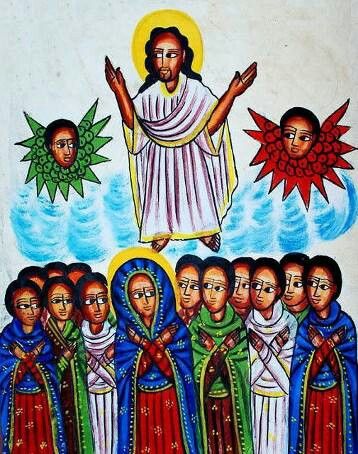
17th century Ethiopian Orthodox depiction of the glorified Christ

[May you be] strengthened with all power according to his glorious might so that you may have great endurance and patience, and giving joyful thanks to the Father, who has qualified you to share in the inheritance of his holy people in the kingdom of light. For he has rescued us from the dominion of darkness and brought us into the kingdom of the Son he loves, in whom we have redemption, the forgiveness of sins.

The Son is the image of the invisible God, the firstborn over all creation. For in him all things were created: things in heaven and on earth, visible and invisible, whether thrones or powers or rulers or authorities; all things have been created through him and for him. He is before all things, and in him all things hold together. 

And he is the head of the body, the church; he is the beginning and the firstborn from among the dead, so that in everything he might have the supremacy. For God was pleased to have all his fullness dwell in him, and through him to reconcile to himself all things, whether things on earth or things in heaven, by making peace through his blood, shed on the cross. (New International Version)

Today is Christ the King Sunday. It is intended to help us see the cosmic reality that Jesus reigns over all creation as the only rightful Sovereign of the universe. This particular Sunday always comes just before Advent so that we remember to anticipate both a baby and a king.

Christ as Lord of all exposes three problems humanity faces:

  1. Building our own petty kingdoms and setting ourselves up as masters over our own small worlds.  People who have been hurt (all of us) often attempt to seize power for themselves in order to avoid ever being hurt again, or in the belief that wielding power could have prevented others from being hurt. The classic villains of movies and literature are ones who seek to destroy the current establishment so that they can rebuild it in their own idea of how the world should operate. The destruction is motivated by protecting loved ones from pain. The irony is that a lot of hurt is inflicted on the protagonists in order to alleviate the antagonist’s pain.
  2. Bowing to other kings besides King Jesus. When distressed, we might rely on alternative authorities to address our hard circumstances – expecting another to give us what only Jesus can. Instead of running to Christ, there is a fleeing to politicians or pundits or pastors. And we rely on them to cope with whatever is going on in our lives.
  3. Lacking awareness of the power we have as subjects of King Jesus. Christians possess authority in Jesus Christ. As believers in Jesus, we reign with him and can exercise authority over every dominion that exists, especially the dominion of darkness.

Jesus is King. Neither you, nor I, are. 

A simple statement; yet, not easily engrafted into daily life. 

Part of the original sin of Adam and Even was rebellion – to break the bonds of loving authority God provided for them. Westerners, especially, tend to have an anti-authoritarian strain which runs rather deep in us.

When my middle daughter was a child and grappling with the implications of faith in Christ, she blurted out an honest cry that we can likely resonate with: “I just don’t want another person in my life telling me what to do!” 

Indeed, Jesus is King; we are not.

Christ the King Sunday reminds us of the pre-eminence and lordship of Jesus Christ: 

  • All things were created through Jesus and for him. 
  • Everything in all creation is held together by Jesus. 
  • Christ is the head of the church. 
  • In Jesus Christ, complete divinity exists and reigns. 
  • Jesus made peace through the cross because he had the authority and the qualifications to do so. 
  • Broken relationships and proper lines of authority are now restored and redeemed in Christ.
Ethiopian Orthodox depiction of the glorified Christ

We can also likely relate to, at times, indulging in the illusion (and delusion!) of being in control and independently dictating the course of our lives. Yet, mercifully, Jesus is the great sovereign King, and this is a good thing – because in Christ we find authority to redeem and reconcile. 

Because Christ is King, we really ought to submit to him. In fact, we need to pay some attention to how our bodies are to submit to his lordship.

When the body moves to animating physical actions of submission, this helps the heart to follow. Whole person worship involves engaging the mind, spirit, emotions, and, yes, the body. To neglect the body in worship is to truncate the ability to connect with God in Christ.

A typical metaphor for the Church is the “Body of Christ.” We can live into that phrase through an embodied spirituality of submission. Our individual bodies are temples of the Holy Spirit, important for expressing worship. (1 Corinthians 3:16)

God created us with literal physical bodies. And Jesus has a literal physical body. Bodies are important for whole person worship. This means the physical postures we take in worshiping King Jesus are significant. We need to pay attention to them.  

A healthy practice for Christians is to kneel in the presence of the Lord. I realize some Christian traditions do it as a part of their worship, and some do not. Some like it, some don’t. Yet, bowing, even prostrating oneself (if you are physically able!) can be a powerful symbol of the heart’s desire and disposition to submit to the lordship and authority of Jesus Christ. 

Crawling out of bed in the morning getting on your knees and beginning the day with submission to live into the will of God; and also ending the day in the same manner, is a practical way of remembering who Jesus is and who we are.

I believe all Christians need to feel free in adopting a physical posture of worship which helps them connect with God in Christ. For some, that will be sitting in a comfortable position in contemplation. Others will want to stand, raise their hands, even dance in praise.

It also behooves us to let our bodies respond to whatever is happening with us spiritually. Exuberant praise needs the expression of hand clapping and toe tapping. Confession of sin needs a bit of bowing, kneeling, even prostrating. For prayer, hands open and palms facing up to receive blessing from God is a good bodily position of worship.

You get the idea. Just remember we need to strive for congruence in our worship, that is, what is happening with our outward bodily movements needs to match what is occurring inward with our spirits. And when the two are in sync, meaningful worship can happen – worship of submission fit for a king.

Sovereign God, in your mercy you have sent your Son, the Lord Jesus, who has brought reconciliation to a once broken relationship. I bow before you in obedience, submission, and worship. Let me live a cross-shaped life through enjoying the peace you have given me in Christ in both body and soul. Amen.