Matthew 10:34-42 – The Trouble with Jesus

Jesus teaching the disciples, from the Catacombs of Domitilla, Rome

Jesus said, “Do not suppose that I have come to bring peace to the earth. I did not come to bring peace, but a sword. For I have come to turn

‘a man against his father,
    a daughter against her mother,
a daughter-in-law against her mother-in-law—
    a man’s enemies will be the members of his own household.’

Anyone who loves their father or mother more than me is not worthy of me; anyone who loves their son or daughter more than me is not worthy of me. Whoever does not take up their cross and follow me is not worthy of me. Whoever finds their life will lose it, and whoever loses their life for my sake will find it.

Anyone who welcomes you welcomes me, and anyone who welcomes me welcomes the one who sent me. Whoever welcomes a prophet as a prophet will receive a prophet’s reward, and whoever welcomes a righteous person as a righteous person will receive a righteous person’s reward. And if anyone gives even a cup of cold water to one of these little ones who is my disciple, truly I tell you, that person will certainly not lose their reward.” (New International Version)

Jesus is the sort of guy that gets up in our grill and confronts us with this: All of life centers in him. That may sound incredibly narcissistic. For Christians, it isn’t, because we discern and confess along with the Apostle Paul:

“The Son is the image of the invisible God, the firstborn over all creation. For in him all things were created: things in heaven and on earth, visible and invisible, whether thrones or powers or rulers or authorities; all things have been created through him and for him. He is before all things, and in him all things hold together. And he is the head of the body, the church; he is the beginning and the firstborn from among the dead, so that in everything he might have the supremacy. For God was pleased to have all his fullness dwell in him, and through him to reconcile to himself all things, whether things on earth or things in heaven, by making peace through his blood, shed on the cross.” (Colossians 1:15-20, NIV)

The Christian’s confession of centrality in Christ means that we believe Jesus is the most important person there is. That confession often makes us troublemakers, as we follow in the footsteps of the Lord who was himself a troublemaker.

That may also sound like something that happens when a narcissist is in control. Again, for Christians, it isn’t, because we realize that trouble is central to Christian mission; the way of the resurrection comes through the cross; the way to succeed is to fail; and whoever loses their life will find it.

We Should Expect Opposition

We should not be obstinate, pigheaded, short-sighted, legalistic, or use the Bible as a brick to throw at people who disagree with us. That will certainly bring opposition and trouble. But this is not the kind of opposition we’re talking about. Being a jerk is antithetical to the gospel. Don’t be a jerk.

The opposition Jesus experienced came through being humble, meek, just, merciful, pure, and peace-loving. According to Christ’s Beatitudes, embracing these values will smack against their opposites. Pride, criticism, judgmentalism, and selfishness are ensconced everywhere throughout this fallen world.

The virtues of Jesus are counter-cultural; they’re different than how the world typically operates. 

As people who must live in this world, we need to avoid the extremes of simple assimilation into the culture, or an outright rejection of the culture. Blending into culture, and separating from it, are both ways of avoiding opposition and trouble. 

Instead, there is a third way that encompasses both shrewdness and innocence. And it is faithful to the way of Jesus. We need to interact with and engage the culture as salt and light. 

Assimilation means that we lose our saltiness. Isolation means that we hide our light.

But interaction means that we are discerning and seek to apply understanding and truth in the concrete situations of life in the world.

It means that we learn critical thinking skills. It involves listening to others and discovering their values. It requires speaking into another’s life with grace and truth. It is a matter of following the words and ways of Jesus, the center of all things.

Any fool can stand against something and complain about it – shouting from afar about what they don’t like. It’s also foolish to accept everything without question. As followers of Jesus, opposition and trouble is going to come when you rub shoulders with the world. If we never experience opposition, it’s probably because we have either succumbed to the culture or have removed ourselves from it.

We Will Inevitably Upset Our Family

Trouble will likely come from family. In many countries of this world, a family member who becomes a Christian has brought shame upon the entire family and, so, is in jeopardy of being shunned, rejected, or worse. That sort of trouble may be foreign to many, but family separations certainly occur in our own culture because of faith commitments to Jesus. 

Jesus stated that anyone who takes the easy way of loving family more than him is not worthy of him. Anyone who does not take up their cross and follow Jesus, even if it means trouble, is not worthy of following him. 

Each one must die to self. Let… it… go….

Die to the old life; take up a new life – a life dedicated wholeheartedly to Christ.

The old life involves holding onto a spirit of unforgiveness and bitterness; avoiding certain people; refusing to make things right with others. The new life entails keeping steadfast love, caring for others, embracing humility, being self-less, thinking the best of others, forgiving others, taking pleasure in truth, remaining patient, and always trusting God, no matter what.

We Are Going to Feel Afraid

Fear has to do with the unknown. If we expect opposition and trouble, then we won’t live in dread of what might happen. The early Christians even rejoiced in their suffering because they considered it a privilege to be walking in the way of Jesus. (Acts 5:41)

God has generously granted you the privilege, not only of believing in Christ but also of suffering for Christ’s sake. (Philippians 1:29, CEB)

We will receive special help in times of trouble and fear. We have the Holy Spirit, given to us to be our Helper for such a time as this. God is with us.

When you go through deep waters,
    I will be with you.
When you go through rivers of difficulty,
    you will not drown.
When you walk through the fire of oppression,
    you will not be burned up;
    the flames will not consume you. (Isaiah 43:2, NLT)

God sees everything and isn’t taken by surprise by your hardship; the Lord will eventually deal with all that is wrong in this world.

Jesus said, “In this world you will have trouble. But take heart! I have overcome the world.” (John 16:33, NIV)

It is a privilege to follow Jesus into trouble. This is “upside-down” theology. In giving my life away to Jesus, I find it. In getting into trouble, I find peace. In taking up my cross, I find purpose and joy. 

The flooding of thousands of square kilometers of rain forest in Brazil has given birth to an unusual industry – the extraction of underwater wood. Millions of tree trunks, below the waters of a lake formed by the 1980 construction of a hydro-electric dam, captured the entrepreneurial vision of Juarez Cristiano Gomes.

He invented an electric saw that works underwater and set up a company to extract this wood. Lumberjacks equipped with air tanks go down as far as 164 feet but are never in danger of being smashed by trees they cut since they “fall” upward to the surface.

The kingdom of God is upside-down. Facing trouble and opposition doesn’t make us fall; it actually lifts us up.

So, count the cost. Give your life away. In doing so, you will certainly not lose your reward from God.

Luke 14:15-24 – The Parable of the Great Banquet

When one of those at the table with him heard this, he said to Jesus, “Blessed is the one who will eat at the feast in the kingdom of God.”

Jesus replied: “A certain man was preparing a great banquet and invited many guests. At the time of the banquet, he sent his servant to tell those who had been invited, ‘Come, for everything is now ready.’

“But they all alike began to make excuses. The first said, ‘I have just bought a field, and I must go and see it. Please excuse me.’

“Another said, ‘I have just bought five yoke of oxen, and I’m on my way to try them out. Please excuse me.’

“Still another said, ‘I just got married, so I can’t come.’

“The servant came back and reported this to his master. Then the owner of the house became angry and ordered his servant, ‘Go out quickly into the streets and alleys of the town and bring in the poor, the crippled, the blind and the lame.’

“‘Sir,’ the servant said, ‘what you ordered has been done, but there is still room.’

“Then the master told his servant, ‘Go out to the roads and country lanes and compel them to come in, so that my house will be full. I tell you, not one of those who were invited will get a taste of my banquet.’” (New International Version)

If the gospel of forgiveness in Jesus Christ is such good news, and God is so good, then why aren’t people breaking the door down to get into the Church? 

Today’s Gospel lesson gives us one reason why: They just aren’t interested. The parable Jesus told was of people, when invited to come to the great banquet, kept making one excuse after the other why they couldn’t come.

Keep in mind that Jesus wasn’t talking to sinful outsiders, but the religious insiders – they were the ones making the excuses why they could not participate. 

Let’s cut to the chase: If professing believers in Jesus Christ are not excited about the gospel… If Christians are not enthused over what they possess in the gospel… If the Church is content to go through the motions of Christianity without a concern to be with Jesus… If we are simply too busy to come and attend God’s banquet of grace…

Then, why in the world would any Christian or any Church believe that others ought to show up and be a part of their fellowship, that they would even remotely entertain a thought to profess Christ as Savior and break down the door to get into Christianity?

Jesus was offering a penetrating warning: The unresponsive religious insiders will be replaced by the responsive sinful outsiders. 

If the insiders take for granted what they possess and have better things to do, then God is going to call people who will hear, listen, and respond to the gracious invitation.

The deeply probing question for every believer in Christ today is: Are we so familiar with Jesus, and so content with the way things are that when God breaks into our lives in the form of an invitation that we refuse to respond because we are not interested in going to some stupid banquet? 

There is an incredible abundant feast for us – in fact, Jesus said that his food and drink was to do the Father’s will, that Scripture was his bread. (John 4:34) 

It’s much too easy to take the spiritual abundance of grace and mercy – as well as our physical abundance of food and water – for granted. After all,…

  • Being well-fed, it’s easy to assume that everyone else is, too.
  • Enjoying good health, it’s easy to forget that others are hurting and in pain.
  • Having money and the ability to work hard, it’s easy to think that there are not many poor people around.
  • Living around other Christians all the time, it’s natural to assume that everyone knows the gospel of Jesus – but they don’t!

In Christ’s story, the people making excuses see no real importance to take the invitation to the banquet seriously. And so, they go off to take care of their business and their family.

Like them, we can be much too busy with mundane activities to notice that people need the Lord. And then, when we get around to acknowledging that there are people who need Jesus, we keep devising ways to reach them without having to change our own lives to do it.

Jesus has no intention of calling and inviting us to a discipleship that requires no change on our part. The refusal to alter our lives to accommodate God’s invitation will result in the invitation going out to others. 

So, the master’s servant in the parable goes out into the roads and country lanes and invites any common person to come – anyone he can find.

And that is the scandal of Christ’s gospel – that the invitation to God’s abundant mercy is open to outcasts and failures, to problem people and unimpressive low-life’s, to backwater rednecks and uneducated hicks, to the jobless and the needy, to all sorts of people who are not like your circle of friends. 

People who are flawed are especially dear to Jesus, and not just people who have it all together. It’s the people who outwardly have it all together that are being replaced wholesale with those who admit their guilt, shame, and brokenness. 

Lord, have mercy. Christ, have mercy. Lord, have mercy upon us sinners.

Gracious God, forgive me for wasting time in things that just don’t matter in the scope of eternity. I choose to go out and compel outsiders to come in, so that your house will be full for the great feast at the end of the age. Through Jesus, in the power of the Holy Spirit, I pray. Amen.

Luke 14:1, 7-14 – How Can I Be Blessed?

Jesus eating with “sinners.”

One Sabbath, when Jesus went to eat in the house of a prominent Pharisee, he was being carefully watched….

When he noticed how the guests picked the places of honor at the table, he told them this parable:“When someone invites you to a wedding feast, do not take the place of honor, for a person more distinguished than you may have been invited. If so, the host who invited both of you will come and say to you, ‘Give this person your seat.’ Then, humiliated, you will have to take the least important place. But when you are invited, take the lowest place, so that when your host comes, he will say to you, ‘Friend, move up to a better place.’ Then you will be honored in the presence of all the other guests. For all those who exalt themselves will be humbled, and those who humble themselves will be exalted.”

Then Jesus said to his host, “When you give a luncheon or dinner, do not invite your friends, your brothers or sisters, your relatives, or your rich neighbors; if you do, they may invite you back and so you will be repaid. But when you give a banquet, invite the poor, the crippled, the lame, the blind, and you will be blessed. Although they cannot repay you, you will be repaid at the resurrection of the righteous.” (New International Version)

A lot of people live by the old adage, “You scratch my back and I’ll scratch yours.” It’s a phrase referring to reciprocity. In other words, if you give me something I want, I will then respond by giving you something you want.

That old adage works fine, that is, unless you have no ability to give or give back to another. If we only operate by the principle of reciprocity, a large chunk of people automatically get left out. And this situation is untenable and unacceptable to Jesus.

Christ observed that the religious insiders of his day were keeping entire groups of people on the outside through their practice of scratching one another’s backs.

We need to get ahold of the reality that God loves us, as well as everyone else – even the people we may not give the time of day to. God so loved the world that he sent his Son. Jesus has come to feed us all, not just some.

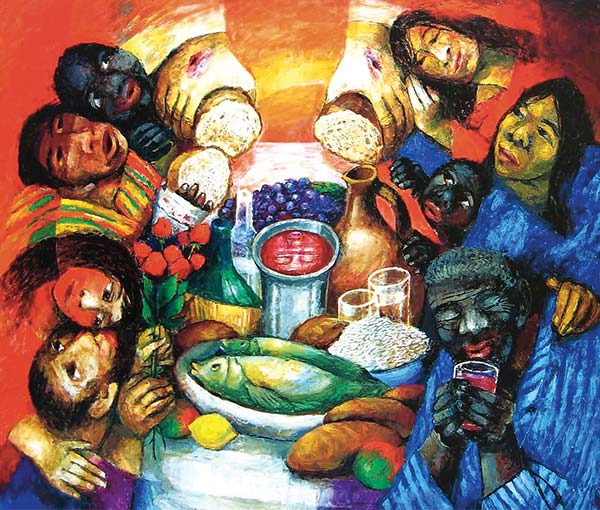
Jesus eats with sinners by Sieger Köder (1925-2015)

The kingdom of God is about food. The food given by Jesus is to feed the hungry by staging a banquet. It is a feast of God’s abundance. Yet, many seem to hoard the resources they have, only thinking about their friends, family, and people just like them. They act as if there is no need to invite outsiders, consumed as they are with their own daily lives.

We have an incredible abundant feast contained in Scripture – in fact, Jesus said that his food and drink was to do the Father’s will, that Scripture was his bread. (Matthew 4:4; John 4:34) 

It’s much too easy to take our blessings of food for granted. After all, when we are well-fed, it’s easy to assume that everyone else is, too. Feeling healthy, it’s easy to forget that others are hurting. Making money, it’s easy to think there are not many poor people around. Living in a community with plenty of churches and more bibles than people, it’s natural to assume that everyone knows the gospel of Jesus – but they don’t!

Then, whenever we get around to acknowledging there are people who need Jesus, we keep devising ways to reach them without having to change or accommodate our own lives to do it.

Christ’s call to faithful discipleship requires people to change from having a narrow focus on our small circle of friends, to including those who have no means to pay us back.

Table fellowship by Sieger Köder 

The gospel of Jesus Christ is open to outcasts and failures, to problem people and unimpressive persons. People with needs and flaws are especially dear to Jesus. It’s the people who outwardly have it all together who are being replaced wholesale with those who admit their need. 

We must not be picky about who we invite to participate in the largess of abundance we possess. We are to avoid the spiritual snobbery of looking down our noses at the needy and less fortunate, who have nothing to offer us in return.

Those who give need to do so without prejudice or favoritism. Even the lazy, the fool, and the sinner still need basic resources to live. By opening our hearts in almsgiving, we open ourselves to Christ, who is present in the least of those among us.

Refusing mercy to people deemed as unworthy, givers then actually shut themselves off from the very mercy God desires for them. There is no reward from God when there is only reward from others.

“If we are going to examine lives, we will never have mercy upon any human being; rather, hindered by this inopportune meddlesomeness, we will remain fruitless and destitute of all help ourselves.”

St. John Chrysostom, On Repentance and Almsgiving

It’s not only the poor who suffer when the rich fail to give. In judging whether or not a particular person is worthy of love and aid, the wealthy person rejects the spiritual fruit that he would have received by giving with humility.

Giving to the poor, simply to relieve our own conscience, is not real charity; it doesn’t consider the other. We attend fully to the other by observing their spiritual and holistic needs for community, purpose, respect, and dignity. Dispassionate giving from a distance, without relationship, refuses to acknowledge the whole person. It exploits the poor for the mental comfort of the rich.

We need to be involved in people’s lives, and that takes a lot of blood, sweat, and tears. There are too many lost people who need Jesus – and, I may add, too many Christians who are the walking wounded and need the healing touch of Jesus – for us to pay scant attention to the call of Jesus to invite the needy into our lives. 

Seeing people come into God’s great banquet, and into a joyous and vital relationship with Christ, will likely take ten times more work than what you are thinking it does right now. Yet, this is the pathway of true blessing – to having God’s stamp of approval on our lives.

How can I be blessed? Not by posturing for the best place in the room but by being a blessing to the most vulnerable and needy amongst us.

Merciful God, thank you for the abundance of life, relationships, health, comfort, and wealth you have provided to so many. Thank you that, even in times of need, despair, and brokenness, you are there. Please, put your arms around children and families in  poverty and disability so that they feel your comfort and hope. Meet their needs both physically and spiritually. And guide me so I can be your hands and feet pursuing justice for the poor and upholding the cause of the needy, in the way of Jesus Christ our Lord. Amen.

Luke 6:6-11 – Every Day is Meant for Doing Good

On another Sabbath, Jesus went into the synagogue and was teaching, and a man was there whose right hand was shriveled. The Pharisees and the teachers of the law were looking for a reason to accuse Jesus, so they watched him closely to see if he would heal on the Sabbath. But Jesus knew what they were thinking and said to the man with the shriveled hand, “Get up and stand in front of everyone.” So, he got up and stood there.

Then Jesus said to them, “I ask you, which is lawful on the Sabbath: to do good or to do evil, to save life or to destroy it?”

He looked around at them all, and then said to the man, “Stretch out your hand.” He did so, and his hand was completely restored. But the Pharisees and the teachers of the law were furious and began to discuss with one another what they might do to Jesus. (New International Version)

Lectio Divina is an ancient Latin term which means “spiritual reading.”  It means to read Holy Scripture not just to know its contents, but to experience its power to restore, heal, transform, and draw close to God.

Lectio Divina is a simple way to prayerfully read Scripture, meditate on its message, and listen for what God may be saying for us to do. It can be done privately, or with a small group of people. The goal is to become more Christ-like.

Lectio Divina is based upon reading a selected text of Scripture three times. Each reading is followed by a period of silence after which each person is given the opportunity to briefly share what they are hearing as they listen to God (if done in a group).

For today’s Gospel lesson, I invite you to give it three different readings, as is common to a Lectio Divina approach:

  1. In the first reading, read the text aloud slowly and carefully. Listen for a word, phrase or idea that captures you attention. As you recognize a word, phrase or idea, focus your attention on it, repeating it several times.
  2. In the second reading, focus your attention on how the selected word, phrase or idea speaks to your life right now. What does it mean for you today? How is Christ speaking to you about your life through this word, phrase or idea?
  3. In the third reading, focus on what God is calling you to do or to become. Experiencing God’s presence changes us. It calls us to something. What is that something?

So, here are my reflections from reading today’s Gospel lesson three times:

  1. In my first reading, the phrase “watched him closely” stood out to me. As I sat and pondered this phrase, I thought about how there are always people watching us. How I live my life, and what I say, are continually on display. Mostly, this is a good thing, because I believe that modeling an authentic and devout life to Christ is important. Yet, whenever someone is watching us closely, in the sense of continually looking over our shoulder, or scrutinizing every word and action so as to find fault, this is a very bad thing.
  2. In my second reading, I hear God speaking to me about how Jesus experienced this bad sort of watching, and yet, he did not let it deter him from doing good and following through on what is right by healing a man on the Sabbath. In fact, Christ confidently had the man with the shriveled hand stand up in front of everyone. He wanted the entire congregation, including those who were watching him with judgmental eyes, to see exactly what he was doing. Jesus neither healed him quietly nor waited till after the synagogue service was over; he was very open about what was happening.
  3. In my third reading, I felt Jesus beside me – not looking for something to correct or chastise me about – but rather putting his arm around my shoulder, knowing exactly what it feels like to be the object of criticism, scorn, and malevolent plotting against. I sense my solidarity with Christ, my union with him, believing that nothing can separate me from the love of God in Christ, my Savior and Lord, who always has my back. I hear Jesus graciously calling me to stand firm and openly do what is good and right, every day, no matter who is watching or why they are watching.

Today’s Gospel lesson shows us Christ’s disapproval of those who focus so narrowly on the traditions and laws of religion that they end up losing sight of God’s message.

For the Christian, the message is a gospel of grace, not condemnation. Jesus challenges the legalistic way of keeping the Sabbath holy by asking a penetrating question: “Is it lawful to do good on the Sabbath rather than to do evil, to save life rather than to destroy it?”

By showing compassion to the man with the withered hand, Jesus points us to a way of holiness that’s a whole lot more than keeping the law and performing rituals.

By healing the man, Jesus teaches us to respond to God’s call to do good and save lives. Traditions should never interfere with our compassion for those in need.

“If anyone, then, knows the good they ought to do and doesn’t do it, it is sin for them.”

James 4:17

If you haven’t already done so, give the Lectio Divina a healthy try – because God is always speaking to us; we just need to be still and silent in order to hear.

Lord Jesus Christ, Son of God, have mercy on me, and grant me your peace. Amen.