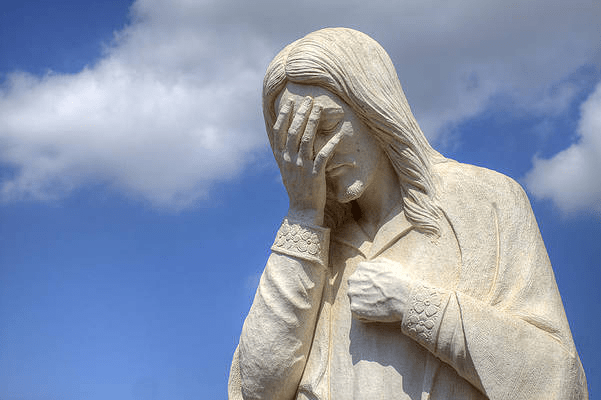
Like Father Like Son (John 5:19-29)

The Trinity, by Ukrainian painter Feodosiy Humeniuk, 1981

Jesus responded to the Jewish leaders: 

“I assure you that the Son can’t do anything by himself except what he sees the Father doing. Whatever the Father does, the Son does likewise. The Father loves the Son and shows him everything that he does. He will show him greater works than these so that you will marvel. 

As the Father raises the dead and gives life, so too does the Son give life to whomever he wishes. The Father doesn’t judge anyone, but he has given all judgment to the Son so that everyone will honor the Son just as they honor the Father. Whoever doesn’t honor the Son doesn’t honor the Father who sent him.

I assure you that whoever hears my word and believes in the one who sent me has eternal life and won’t come under judgment but has passed from death into life.

I assure you that the time is coming—and is here!—when the dead will hear the voice of God’s Son, and those who hear it will live. Just as the Father has life in himself, so he has granted the Son to have life in himself. He gives the Son authority to judge because he is the Human One.

Don’t be surprised by this, because the time is coming when all who are in their graves will hear his voice. Those who did good things will come out into the resurrection of life, and those who did wicked things into the resurrection of judgment.”

(Common English Bible)

So goes the parent, so goes the child. Sons look and act a great deal like their fathers. And there is no mistaking the resemblance between Father of the heavens and Son of the incarnation.

In Christianity, to see Jesus is to see God. To know Christ is to know the Lord. They are distinct, yet inextricably linked as one; each is differentiated from the other in personhood, yet united with the same divine substance.

The deity of the Father and the deity of the Son is one, equal in glory, co-eternal in majesty.

What the Father is, the Son is.

Uncreated, eternal, almighty, and sovereign is the Father; uncreated, eternal, almighty, and sovereign is the Son.

The Father and the Son are not two gods but one God.

There is only one Father; there is only one Son. Each is neither greater nor lesser than the other.

Whoever wants to be saved from guilt, shame, sin, death, and hell – and to be delivered from the injustice of the world, the failings of oneself, and the machinations of evil, should think about the Father and the Son and the Spirit, the Holy Trinity, one God.

– Athanasian Creed

So, why is all this creedal Christian doctrine of any importance? Why pay attention to such things?

Because there are many issues and problems in this world of great importance which must be addressed and dealt with. We need to have some idea of how to go about: 

  • Governing ourselves as a free people
  • Eradicating poverty and disease
  • Educating our children
  • Paying taxes
  • Providing excellent and cost effective healthcare for everyone
  • Dismantling racism
  • Seeking peaceful international relations
  • Building responsible and accountable local community relationships
  • Supporting small businesses
  • Helping workers make a decent contributive living
  • Loving our families and faith communities 

It is my unshakable conviction that all these issues, and many others, need more than our collective mental attention and physical resources; these problems also need spiritual resolutions and solutions.

Seasons, years, centuries, and millennia come and go. People are born, live, and die. Generations exist and then are no more. Civilizations rise and fall. Through it all and above it all is the person of Jesus.

Christ is alive. He brings breath from dust, beauty from ashes, order from chaos, stability from insecurity, dignity from disrespect, and meaning from uncertainty. Jesus gives life, abundant and to the full.

Christ the King, San Miniato al Monte Church, Florence, Italy

Today, this very moment, Christ is still on the throne of all creation. 

Human elections and institutions only have authority as given by Jesus, the Ruler of all.

Presently, Jesus is attentive and vigilant to people, actively interceding for us at the right hand of his Father in heaven. At this very moment, the Holy Spirit is the continuing presence of Christ on this earth, applying Christ’s redemption of humanity to the lives of millions. 

Sometimes we need to remember how important our spiritual resources are to living in this world – and to clarify what’s really of ultimate significance in this old broken world. 

My unwavering spiritual persuasion is this: People need the Lord. Therefore, it only makes good spiritual sense to live in ways that foster a connection with Jesus. 

This morning, I did what I do every morning – whether I’m sick or well, sad or happy, facing a busy day or a relaxed day – I began my day with Scripture reading, prayer, reflection, and gratitude. And I do it with the realization that Christ is King, that as the divine/human Lord of all, his:

  • authority is real
  • rule is benevolent
  • sovereignty is ubiquitous
  • reign is supreme
  • judgments are right and good
  • power is mighty enough to raise the dead

The Christian tradition holds that Jesus Christ is the exalted and glorified Son of God, the Sovereign authority over every dominion. The works of Jesus bear testimony to the cosmic reality that he is Lord of all. And, if that were not enough, Jesus shares his divine power with us, his people.

In the face of Christ’s majesty, the valid and appropriate response is sheer submission to Christ’s authority. 

Just as Jesus listened to the Father and obeyed the Father’s will, so we need to listen to Jesus and carry out his will. 

Just as Jesus enjoyed his relationship with the Father, so we are to bask in our wonderful relationship with Jesus. 

Since Jesus submitted to death on a cross and rose from the dead through God’s power, we now have access to that power by God’s grace through faith in Christ. And we are to use that divine power to take up our own cross and bear the great issues and problems of our day with all the spiritual resources granted to us in Christ Jesus.

Like Father, like Son. Like Christ, like Christians. May all followers of Jesus resemble their Lord in each word and in every way.

Almighty God, to you all hearts are open, all desires known, and from you no secrets are hid: Cleanse the thoughts of our hearts by the inspiration of your Holy Spirit, that we may perfectly love you, and worthily magnify your holy Name; through Christ our Lord. Amen.

Pay Attention to the Word (2 Peter 1:16-21)

For we did not follow cleverly devised stories when we told you about the coming of our Lord Jesus Christ in power, but we were eyewitnesses of his majesty. He received honor and glory from God the Father when the voice came to him from the Majestic Glory, saying, “This is my Son, whom I love; with him I am well pleased.” We ourselves heard this voice that came from heaven when we were with him on the sacred mountain.

We also have the prophetic message as something completely reliable, and you will do well to pay attention to it, as to a light shining in a dark place, until the day dawns and the morning star rises in your hearts. Above all, you must understand that no prophecy of Scripture came about by the prophet’s own interpretation of things. For prophecy never had its origin in the human will, but prophets, though human, spoke from God as they were carried along by the Holy Spirit. (New International Version)

The Bible is a set of living documents. It breathes with a revitalizing and reliable message about Jesus Christ.

Rather than being merely an ancient book to be displayed as some sort of museum artifact on a coffee table, Holy Scripture has demonstrated amazing resilience of use and pertinence throughout the ages.

Millions of people have discovered it’s riches; and have found the Bible’s message of knowing Christ and him crucified, died, risen, and coming again as their hope and salvation. Indeed, God’s Word to people is a gracious revealing of God to humanity so that all persons may reconnect with divinity.

The earthly ministry of Christ had eyewitnesses and earwitnesses. The witness above all witnesses was the Most High who audibly affirmed Jesus with a voice from heaven:

“This is my dearly loved Son, who brings me great joy.” (Matthew 3:17, NLT)

Baptism of Christ, by Vitaly Melnichuk, 2009

Christianity is a religion of the book. Scripture unites us with believers across the world and throughout history. The Bible is to the Christian what weights and barbells are to a bodybuilder. 

The people of God need Holy Scripture, God’s Word, in order to spiritually grow and become mature. Christian character formation cannot truly occur apart from the continuous repetitions of reading the text of Scripture, and letting it build strength into the muscles of the soul.

Scripture is a powerful unifying force within the life of God’s people. We may not all explain every Bible verse in exactly the same way (hence the many different Christian traditions) but believers share a common desire to honor, apply, and obey God’s Word. Ultimately, a passion to listen, talk about, and apply God’s Word brings believers in Jesus together, rather than separates us. 

Perhaps because the average American household today has at least three or four Bibles, we take for granted the availability of God’s Word. It is always at our fingertips, on our smartphones and computers. Yet, because it is always present and available, we may let the busyness and business of life keep us from paying attention to it. 

A commitment to reading and listening to Holy Scripture ought not be done quickly or mechanically, and certainly not half-heartedly. For the Word to penetrate and seep into our souls, we must take the time to listen carefully and slowly.

A first century rabbi, Akiva, once noticed a tiny stream trickling down a hillside, dripping over a ledge on its way toward the river below. Below was a massive boulder. The rock bore a deep impression. The drip, drip, drip of water over the centuries had hollowed away the stone. Rabbi Akiva commented, “If mere water can do this to hard rock, how much more can God’s Word carve a way into my heart of flesh?”

Water flowing over a rock, all at once, leaves it unchanged. It is the slow but steady impact of each small droplet, year after year, decade after decade, that completely reforms the stone.

O how we desire quick answers to our questions! Yet we must take the time to prayerfully listen and reflect on God’s Word and allow it to do it’s work on us and in us. Truth is revealed over many days, months, and years. Big splashes aren’t usually God’s way of doing things. Instead, the slow drip of careful study, contemplative prayer, and meditative reflection, day after day, year after year, shapes us and spiritually forms us into the likeness of Christ.

Thus, a patient, humble, and teachable spirit is necessary. Sometimes the Bible is not apparently relevant. We oftentimes need others to help us and to encourage one another to stick with reading and learning, even when we aren’t sure about what it is saying. 

Rightly interpreting Scripture happens in community, both in present local churches and small groups and in the community of saints who have gone before us. It doesn’t occur in isolation.

Always an appropriate response to hearing God’s Word is to address and the problems of others and the issues of our day. That’s because God is not just concerned about you and me, but about other people, as well. 

What do you suppose would happen if we all committed to carefully reading and listening and meditating, even memorizing God’s Word on a daily basis? Would it transform our worship? Make a difference in our relationships? Change how we do life together?

Attention, people of God and of the Book! God is our God, the One and only!

Love the Lord your God with your whole heart:

Love God with all that is in you; love the Lord with all you’ve got! 

Write these foundational commands I’ve given you on your hearts. Get them inside of you. Then, get them inside your children. 

For this to happen, talk about God’s Word at home when you are eating supper together and when you are working or playing with each other. Start your day with God’s Word when you get up in the morning and end your day with God’s Word when you go to bed at night. 

Put God’s Word on your refrigerator and your car’s dashboard; have it on your smartphones and let it be available to you anywhere and anytime. Use every opportunity you have to incessantly chatter about God’s Holy Word.

(Deuteronomy 6:4-9, contemporary paraphrase)

Pay attention to the Word made flesh and the written Word proclaimed. It makes all the difference.

Our Great Physician, Your Word is like alcohol – when poured on an infected wound, it burns and stings, but only then can it kill germs. If it doesn’t burn, it doesn’t do any good. 

Father, we are all hungry baby birds this morning. Our heart-mouths are gaping wide, waiting for you to fill us. A cold wind seems to have chilled us. Wrap us in the blanket of your Word and warm us up. 

Lord, we find your Word like cabbage. As we pull down the leaves, we get closer to the heart. And as we get closer to the heart, it is sweeter.

–Daily Prayers of Haitian Christians, translated by Eleanor Turnbull (1924-2020) missionary to Haiti for over 50 years

A Parable about Faithfulness (Luke 19:11-27)

Parable of the Ten Minas, by Dutch painter Willem de Poorter (1608-1668)

The crowd was listening to everything Jesus said. And because he was nearing Jerusalem, he told them a story to correct the impression that the Kingdom of God would begin right away. 

He said, “A nobleman was called away to a distant empire to be crowned king and then return. Before he left, he called together ten of his servants and divided among them ten pounds of silver, saying, ‘Invest this for me while I am gone.’ But his people hated him and sent a delegation after him to say, ‘We do not want him to be our king.’

“After he was crowned king, he returned and called in the servants to whom he had given the money. He wanted to find out what their profits were. The first servant reported, ‘Master, I invested your money and made ten times the original amount!’

“‘Well done!’ the king exclaimed. ‘You are a good servant. You have been faithful with the little I entrusted to you, so you will be governor of ten cities as your reward.’

“The next servant reported, ‘Master, I invested your money and made five times the original amount.’

“‘Well done!’ the king said. ‘You will be governor over five cities.’

“But the third servant brought back only the original amount of money and said, ‘Master, I hid your money and kept it safe. I was afraid because you are a hard man to deal with, taking what isn’t yours and harvesting crops you didn’t plant.’

“‘You wicked servant!’ the king roared. ‘Your own words condemn you. If you knew that I’m a hard man who takes what isn’t mine and harvests crops I didn’t plant, why didn’t you deposit my money in the bank? At least I could have gotten some interest on it.’

“Then, turning to the others standing nearby, the king ordered, ‘Take the money from this servant, and give it to the one who has ten pounds.’

“‘But, master,’ they said, ‘he already has ten pounds!’

“‘Yes,’ the king replied, ‘and to those who use well what they are given, even more will be given. But from those who do nothing, even what little they have will be taken away. And as for these enemies of mine who didn’t want me to be their king—bring them in and execute them right here in front of me.’” (New Living Translation)

The great humanitarian issues of this world are not only individual concerns but are also systemic problems.

And the majority of those troubles are us climbing the wrong ladder. It’s a booger to get to the top and find out all that energy was expended for a worthless chamber pot full of $%&!.

So, whenever we examine Holy Scripture, especially the words of Jesus, it’s necessary to pay attention and hear both the responsibility of individuals and the accountability which human culture has to ensure a just society and equitable structural systems.

In other words, evil resides in both the individual human heart and in the world’s operating system. Corporations, communities, and churches not only have sinful persons within them; sin also resides in the very ways we about business, interactions, even worship.

Westerners tend to read a story, like today’s Gospel parable from Jesus, with individualist eyes. Yes, it is about individual servants; and it’s also about community and culture – and ultimately about the kingdom of God.

The cost of Christian discipleship is high, demanding both personal and communal faithfulness to Jesus Christ.

Christianity is concerned for all of life – not just the religious parts but all the parts – both body and soul, personal and communal, church and workplace, individual minds and institutional education, healthy emotional selves and healthy public discourse. It all matters to God.

Whoever’s in charge makes a big difference as to whether right and just systems are followed, or whether corrupt and oppressive operations are the chief mode of ruling.

To illustrate the contrast, Jesus told a parable about systemic evil and whether one will be faithful to that or some other way of operating.

In the parable, the nobleman becoming the king is a reference to an earthly ruler, not Jesus. Before this worldly prince takes off to obtain more authority, he summons ten of his servants and gives them each ten pounds, or coins.

As the sort of person who rules in standard worldly ways, the nobleman fully expects the servants to operate just as he himself would: collect unfair taxes, squeeze the poor of what little they have, and generally do whatever it takes to make a profit. This, of course, is why the story tells us that the general populace hate the guy in charge.

Parable of the Ten Minas, by Unknown 16th century artist

This is not a parable about rejecting the Messiah or God; it is about authority and government, economics and politics, systemic oppression and structural evil. It’s about where our faith and commitment is truly placed.

The ruler is quite pleased when the first and second servants faithfully invest in the politics and economics of his worldly kingdom. So, the servants are rewarded for abiding by the system.

However, if you buck the system, like the third servant did, you’ll get condemned. That servant knew the sort of ruler he was dealing with and the kind of cutthroat system which was in place. And he wanted nothing to do with it.

The third servant in the parable is unfaithful to the unjust ruler and oppressive system because he is faithful to another lord with a different kind of system. This servant was prepared to accept the consequences of his convictions and his inaction. In a way, he was practicing civil disobedience.

As servants under God’s rule and reign, we are not to play along with worldly systems of injustice and oppression. If we want to be faithful Christian disciples, then we must live into the words and ways of Jesus; we must be prepared to pay the price for our commitment to an alternative kingdom.

Everyone has faith. It’s just a matter of whom and what we place that faith in.

Perhaps Jesus had the words of his mother, Mary, in his mind when he told the story. She was willing to accept whatever happens in a complete commitment and faith in God:

“Here am I, the servant of the Lord; let it be with me according to your word.” (Luke 1:38, NRSV)

Jesus was unlike any earthly ruler. Christ operated very differently than any worldly government. He and his teaching were in stark contrast to others:

God will bless you people
who are poor.
    His kingdom belongs to you!

God will bless
    you hungry people.
You will have plenty
    to eat!
God will bless you people
who are now crying.
    You will laugh!

God will bless you when others hate you and won’t have anything to do with you. God will bless you when people insult you and say cruel things about you, all because you are a follower of the Son of Man…. So when this happens to you, be happy and jump for joy! You will have a great reward in heaven.

But you rich people
    are in for trouble.
You have already had
    an easy life!

You well-fed people
are in for trouble.
    You will go hungry!
You people
who are laughing now
    are in for trouble.
You are going to cry
    and weep!

You are in for trouble when everyone says good things about you. (Luke 6:20-26, CEV)

In order to embrace Christian ethics, worldly practices have got to be jettisoned. To make room for the good, the just, and the right, we must let go of any and all ways contrary to our Christian commitment of following Jesus.

Are you willing to be the third servant?

Gracious and sovereign Lord God of all, in your mercy, hear our prayers:

Help us to be understanding and forgiving of all those we encounter.

Show us how to serve one another, to offer love, care and support.

Guide all those who are called to lead and advocate in the world.

Inspire our leaders, teachers, doctors, social workers and counsellors to be bringers of hope in all situations.

Protect all those who carry peace to other nations. Bless the food, care and shelter they provide.

Comfort those who live with grief. Help them see the light of heaven.

Heal all the broken-hearted and those with broken bodies and spirits.

Embrace those in pain and physical suffering. May they feel your abiding and close presence.

Watch over all who feel isolated and alone. Calm their fears and lead them into peace and freedom.

Strengthen and encourage all those who seek to serve and protect the vulnerable.

Lead us to be generous with our time, possessions and money.

Lord, in your mercy, hear our prayers, and answer them according to your good grace and in your good time. Amen.

“I Want to See Jesus!” (Luke 19:1-10)

Zacchaeus, by Ira Thomas

Jesus entered Jericho and was passing through. A man was there by the name of Zacchaeus; he was a chief tax collector and was wealthy. He wanted to see who Jesus was, but because he was short he could not see over the crowd. So he ran ahead and climbed a sycamore-fig tree to see him, since Jesus was coming that way.

When Jesus reached the spot, he looked up and said to him, “Zacchaeus, come down immediately. I must stay at your house today.” So he came down at once and welcomed him gladly.

All the people saw this and began to mutter, “He has gone to be the guest of a sinner.”

But Zacchaeus stood up and said to the Lord, “Look, Lord! Here and now I give half of my possessions to the poor, and if I have cheated anybody out of anything, I will pay back four times the amount.”

Jesus said to him, “Today salvation has come to this house, because this man, too, is a son of Abraham. For the Son of Man came to seek and to save the lost.” (New International Version)

Every time I read this story about Zacchaeus climbing up the sycamore tree to see Jesus because he was a short man, I think of the old ‘70s song Short People by Randy Newman. The song was (and still is) criticized by some as being prejudiced against short people. 

Indeed, the criticism seems justified with lyrics such as “short people got no reason to live.” Yet, the song’s intended purpose was really the opposite – to be an attack on the pervasive prejudice of the day, and an attempt to “heighten” (pun intended) awareness of other people’s importance. 

“Short people are the same as you and I. All men are brothers until the day they die” are the lyrics containing the real message within the song.

At first glance, the story of the short Zacchaeus seems to be about his inability to see. Yet the real heart of the story is that:

Zacchaeus is unable to see because the other people are obstacles to his sight. 

In turns out that Jesus is the only person who truly sees Zacchaeus. No one else sees him. No one else seems to care. While everyone else is busy with their own line of sight, Jesus is concerned to see the one person who is unseen: Zacchaeus. 

And here’s the reason why Jesus had his radar attuned to picking up Zacchaeus: Because Jesus came to see people like Zacchaeus; Christ came to seek and to save the lost.

One of the most pertinent applications of this story for us, is that we must not be an obstacle for others coming to Jesus – and instead be a conduit for others to meet Jesus. For that to happen, we need a reformation of both attitude and our action.

Our chief obstacle to realizing a reformation is the sort of hindrance that Zacchaeus overcame in order to see Jesus and experience him:

Zacchaeus did not take himself so seriously.

A very serious Zacchaeus would not have been playful enough and much too respectable to climb a tree. Maybe he was used to living with short jokes all his life; I don’t know. I just see a rich businessman who was lighthearted enough to climb a tree; and who lightened up enough to give a big pile of money away.

As a tax collector, metrics and measurements and figures were his world. All of that accounting can create a serious and sterile environment – concerned with doing more, being more, and getting more.

Reformation – reforming oneself, one’s culture, and one’s institutions – comes through the disposition and willingness of not being so doggone serious all the time.

“Jesus and Zacchaeus” by Soichi Watanabe

Hanging one’s happiness and well-being on other people adopting my opinions, my plans, and my way is a surefire prescription for getting knocked down several pegs by both others and God.

A reformation comes through collegiality, cooperation, and collaboration with others. To acknowledge that God is God, and I am not, and that all people (even the ones I don’t like) are just as important as me, is to see with new eyes. This is the way of seeing Jesus because it’s the willingness to climb trees and to not care how it makes me look to do it.

People short on faith, short on hope, and short on love desperately need the love of God in the gracious person of Jesus Christ. 

Let us then, help, and not hinder, people’s ability to see Jesus.

Jesus said, “You are the light of the world. A town built on a hill cannot be hidden. Neither do people light a lamp and put it under a bowl. Instead they put it on its stand, and it gives light to everyone in the house. In the same way, let your light shine before others, that they may see your good deeds and glorify your Father in heaven.” (Matthew 5:14-16, NIV)

Let us not become discouraged when our expectations obscure our sight.

When John, who was in prison, heard about the deeds of the Messiah, he sent his disciples to ask him, “Are you the one who is to come, or should we expect someone else?”

Jesus replied, “Go back and report to John what you hear and see: The blind receive sight, the lame walk, those who have leprosy are cleansed, the deaf hear, the dead are raised, and the good news is proclaimed to the poor. (Matthew 11:2-5, NIV)

Let us have eyes to see and not be blinded by our own seriousness.

Jesus said, “For judgment I have come into this world, so that the blind will see and those who see will become blind.” (John 9:39, NIV)

Anyone who has seen me has seen the Father. (John 14:9, NIV)

Let us humble ourselves and stoop to see the incredible reality in front of us.

As they entered the tomb, they saw a young man dressed in a white robe sitting on the right side, and they were alarmed.

“Don’t be alarmed,” he said. “You are looking for Jesus the Nazarene, who was crucified. He has risen! He is not here. See the place where they laid him. But go, tell his disciples and Peter, ‘He is going ahead of you into Galilee. There you will see him, just as he told you.’” (Mark 16:5-7, NIV)

Let us see and believe.

“What is mankind that you are mindful of them,
    a son of man that you care for him?
You made them a little lower than the angels;
    you crowned them with glory and honor
    and put everything under their feet.”

In putting everything under them, God left nothing that is not subject to them. Yet at present we do not see everything subject to them. But we do see Jesus, who was made lower than the angels for a little while, now crowned with glory and honor because he suffered death, so that by the grace of God he might taste death for everyone. (Hebrews 2:6-9, NIV)

In God’s kingdom, the tall are short, and the short are tall. And there are plenty of trees to climb so that everyone can see Jesus.

Loving Lord Jesus, give me the grace to see you in all things throughout my days on this earth. Help me to see your benevolent kingdom come and see your ethical will be done, here on earth, as it is always done in heaven. Amen.