Covenant Promises (2 Samuel 7:1-17)

Jerusalem. Photo by Anton Petrus

After the king was settled in his palace and the Lord had given him rest from all his enemies around him, he said to Nathan the prophet, “Here I am, living in a house of cedar, while the ark of God remains in a tent.”

Nathan replied to the king, “Whatever you have in mind, go ahead and do it, for the Lord is with you.”

But that night the word of the Lord came to Nathan, saying:

“Go and tell my servant David, ‘This is what the Lord says: Are you the one to build me a house to dwell in? I have not dwelt in a house from the day I brought the Israelites up out of Egypt to this day. I have been moving from place to place with a tent as my dwelling. Wherever I have moved with all the Israelites, did I ever say to any of their rulers whom I commanded to shepherd my people Israel, “Why have you not built me a house of cedar?”’

“Now then, tell my servant David, ‘This is what the Lord Almighty says: I took you from the pasture, from tending the flock, and appointed you ruler over my people Israel. I have been with you wherever you have gone, and I have cut off all your enemies from before you. Now I will make your name great, like the names of the greatest men on earth. And I will provide a place for my people Israel and will plant them so that they can have a home of their own and no longer be disturbed. Wicked people will not oppress them anymore, as they did at the beginning and have done ever since the time I appointed leaders over my people Israel. I will also give you rest from all your enemies.

“‘The Lord declares to you that the Lord himself will establish a house for you: When your days are over and you rest with your ancestors, I will raise up your offspring to succeed you, your own flesh and blood, and I will establish his kingdom. He is the one who will build a house for my Name, and I will establish the throne of his kingdom forever. I will be his father, and he will be my son. When he does wrong, I will punish him with a rod wielded by men, with floggings inflicted by human hands. But my love will never be taken away from him, as I took it away from Saul, whom I removed from before you. Your house and your kingdom will endure forever before me; your throne will be established forever.’”

Nathan reported to David all the words of this entire revelation. (New International Version)

What is a covenant?

A covenant is simply a contract or agreement between two or more parties. The Bible is a covenant document. The Old and New Testaments are really Old and New Covenants. The word “testament” is Latin for “covenant.” When God makes a covenant with people, it means they receive divine promises of what God will do; and, in response, the people have moral expectations or ethical responsibilities to follow. 

The ancient world operated on a covenant system. A nation or empire would conquer a city or territory and set up a covenant in which the conqueror promised protection, certain provisions, and left a military presence among them. In response, the conquered people were required to offer their allegiance and some of the goods and services of the land. 

God made a covenant with Abraham and promised that all the nations of the earth would be blessed through him. The only stipulation that God gave to Abraham was to leave and begin a new life in the land he would show him. (Genesis 12:1-3)

The Lord continued to work through Abraham’s descendants, the Israelites. They would be a kingdom of priests, testifying to the nations through a lifestyle of having God at the center of all they do. The people were expected to embody the Ten Commandments and be holy, thus reflecting the holiness of God.

The difference between earthly covenants and God’s covenant is that God saturates the divine covenant in love and grace – because the Lord cares about the divine/human relationship.

What do we learn about God through a covenant?

First and foremost: God never forgets nor reneges on divine promises. God was faithful to David by establishing a covenant, yet also spoke to him about his descendants. The Lord promised David a dynasty, a kingdom that would never end, a temple, and a father/son relationship with his progeny. 

Furthermore, God promised that divine love would never be taken away. The Lord shows continuous love to people, even when they go astray. Unlike the nations of the earth, the fickle nature of people, and the inconsistent commitment of others, God is a Being whose very nature is love.

In a world of broken families and severed relationships; of selfishness and trying to impose one’s will on another; of taking advantage of others; and in a world that is messed up and depraved because of sin and unfaithfulness, God stands as the consistent, never-changing Sovereign of Love who graciously blesses people. 

What sort of covenant is this?

Short answer: a covenant of grace. It’s demonstrated in how the tables are turned on David with grace. David intended on doing something for God. But the Lord completely turned it around and blessed him abundantly beyond what David could even ask or think. David had it in his heart to build a house for God, but God comes back and says that an enduring house (household and dynasty) will be built for David.

How does this covenant apply to Christians?

All the good and gracious promises given to Abraham, Moses, and David are all fulfilled in the person of Jesus Christ.  

The New Testament Gospels are steeped in the language and explanation that Jesus is the Son of David, the Promised One, Savior, Lord, Teacher, and Healer. He will save the people from their sins and bring them to a spacious kingdom full of the grace and love. 

Through the cross and resurrection of Jesus Christ we are brought into union with God and participate fully in all the promises of the New Covenant of love. Love the Lord your God with all your heart, soul, mind, and strength. Love your neighbor as yourself. All this love is personified in Christ.

Where is the covenant?

The Davidic Covenant is not limited to a specific place or a building. God is present with people wherever they go. 

A common understanding in the ancient world was that there were local gods, not a universal God over all the earth. The Jews were unique in the belief that there is not one square inch of this entire earth where God is not present. The Lord does not need a permanent structure because God is everywhere. 

We, as New Covenant people, are God’s temple. The Lord takes up residence within our lives. We possess covenant loyalty and faithfulness, continually, in the person of the Holy Spirit.

What do we learn about ourselves?

Timing is important. David had a good idea and good motives for wanting to house the Ark of the Covenant in a temple. Yet, God let David know that the timing was off. So, David would need to be patient and let his vision of a temple come to fruition with his son. 

However, that didn’t mean David was idle. By the time he died, his son Solomon had most of the building materials already stockpiled and ready for the temple construction. Waiting does not necessarily mean passivity. 

A vision for life or for ministry rarely is implemented quickly. It needs to grow and mature before it will bear fruit. Two sage questions to ask, therefore, are:

  1. Is the future I am imagining, a future that God desires, or do I have my ladder leaning on the wrong building?
  2. If I am imagining a good and gracious future, is it the right time for it to happen? 

We also learn about ourselves that we must bank on the promises of God – and trust in the person and work of Jesus because all of God’s promises are fulfilled in Christ. In Christ we are taught how to live, and by his wounds we are healed. Jesus is the hope of the world. 

There is grace to be found; forgiveness to be had; and dreams to be realized, if we are attentive to the promises given to us in Holy Scripture. Do not let your sanctified dreams die, because they might not yet have come to full term.

God’s direction for our lives is needed. We have responsibilities as God’s covenant people to be faithful and uphold the ethics of the kingdom, as expressed by Jesus in his Sermon on the Mount. (Matthew 5-7)

Perhaps what we learn most about ourselves is to surrender our plans to God. My life is not all about me. Most of the Christian life is about weaning ourselves away from our own thoughts and ingenuity, learning to submit to God’s plans for our lives. We must pray and not make assumptions, because after a night of prayer, the prophet Nathan withdrew his building permit for David.

Unless the Lord builds the house, those who build it labor in vain.

Psalm 127:1, NIV

The Lord is gracious, loving, and loyal to covenant promises. We are to live into what God is building on this earth: an ethical kingdom with people characterized by mercy, purity, and peace-making. 

Soli Deo Gloria.

Water Is Life (Ezekiel 47:1-12)

Now he brought me back to the entrance to the Temple. I saw water pouring out from under the Temple porch to the east (the Temple faced east). The water poured from the south side of the Temple, south of the altar. He then took me out through the north gate and led me around the outside to the gate complex on the east. The water was gushing from under the south front of the Temple.

He walked to the east with a measuring tape and measured off fifteen hundred feet, leading me through water that was ankle-deep. He measured off another fifteen hundred feet, leading me through water that was knee-deep. He measured off another fifteen hundred feet, leading me through water waist deep. He measured off another fifteen hundred feet. By now it was a river over my head, water to swim in, water no one could possibly walk through.

He said, “Son of man, have you had a good look?”

Then he took me back to the riverbank. While sitting on the bank, I noticed a lot of trees on both sides of the river.

He told me, “This water flows east, descends to the Arabah and then into the sea, the sea of stagnant waters. When it empties into those waters, the sea will become fresh. Wherever the river flows, life will flourish—great schools of fish—because the river is turning the salt sea into fresh water. Where the river flows, life abounds. Fishermen will stand shoulder to shoulder along the shore from En Gedi all the way north to En-eglaim, casting their nets. The sea will teem with fish of all kinds, like the fish of the Great Mediterranean.

“The swamps and marshes won’t become fresh. They’ll stay salty.

“But the river itself, on both banks, will grow fruit trees of all kinds. Their leaves won’t wither, the fruit won’t fail. Every month they’ll bear fresh fruit because the river from the Sanctuary flows to them. Their fruit will be for food and their leaves for healing.” (The Message)

Jesus said, “Let the one who believes in me drink. As the Scripture has said, ‘Out of the believer’s heart shall flow rivers of living water.’”

John 7:38, NRSV

The coming of the Lord is what Advent is all about. It means that God is about to show up. And when God shows up, there are rivers of blessing and an abundance of salvation.

We need water

Just as we need water to survive, so we also need the living water which grants us eternal life.

Every living cell of our body contains water. 65% of your body is water. Up to 90% of plant tissue is water. Water defines our environment and shapes our landscape. We need at least two liters of fresh water to drink every day to stay healthy.

Just as each person on earth ought to have clean, safe, fresh water each day, but don’t, so every person also should have the living water of salvation and blessing flowing from God, yet they don’t.

Water constantly moves around the planet – on, above and below the earth’s surface. The cycle from rainfall to evaporation to rainfall is powered by energy from the sun. Water falls as rain, snow, and sleet. It collects in ice, rivers, groundwater, and the oceans. The water cycle naturally cleans the water.

Just as the natural processes of the water cycle give life and health to the planet, so the unseen spiritual processes working above, below, and on the earth exist to provide the life that is truly life.

Water in the Bible

Water is mentioned 722 times in the Bible. Water flows throughout Holy Scripture, reminding us of its importance, both spiritually and physically. Water is such an essential component of life that God created it on the very first day (Genesis 1:2). And water shows up at the very end of the Bible:

The Spirit and the bride say, “Come!” And let the one who hears say, “Come!” Let the one who is thirsty come; and let the one who wishes, take the free gift of the water of life. (Revelation 22:17, NIV)

Naaman the Syrian was cured from his leprosy in the waters of Jordan River (2 Kings 5:1-14). Water is used as a sign and a seal to purify and provide deliverance, as in Christian baptism (Romans 6:3-4; 1 Peter 3:18-22). And the power of water can also be a destructive force (Genesis 6:17; Exodus 14:1-15:21).

Living Water

Jesus, the source of Living Water, extends an invitation to all who thirst.

“But those who drink the water I give will never be thirsty again. It becomes a fresh, bubbling spring within them, giving them eternal life.” (John 4:14, NLT)

Christ uses water for redemptive purposes, to bring comfort and help.

Jesus got up from the meal, took off his outer clothing, and wrapped a towel around his waist. After that, he poured water into a basin and began to wash his disciples’ feet, drying them with the towel that was wrapped around him. (John 13:4-5, NIV)

“O Christ, He is the fountain,

The deep, sweet well of love;

The streams on earth I’ve tasted

More deep I’ll drink above.

There to an ocean fullness

His mercy doth expand,

And glory, glory dwelleth

In Immanuel’s land.”

The Sands of Time Are Sinking by Sam Rutherford and Anne Cousin

From a Christian perspective, the water flowing from the temple finds its fulfillment in the person and work of Jesus Christ. He is the living water that gives eternal life. We would do well to ensure that all people have access to clean physical water, as well as access to purified spiritual water.

Lord Jesus, Son of God, Savior of humanity, there is a river flowing straight from your heart into mine — replenishing, renewing, sustaining. 

May you, as Living Water, be persistent in me, breaking through every barrier in its path.

Send this hydropower through the dark crevices of my heart like a mighty flood overcoming and pushing everything out of the way that blocks its path.

I want my heart to be washed clean of any debris cluttering and blocking your life-giving flow.

May your love overflow onto your people — your grace, your mercy — into the lives of those we encounter, to your glory and honor, in spirit, and in truth. Amen.

The Shepherds’ Candle of Joy (Luke 2:8-20)

The Shepherds by Malaysian artist Hanna Varghese (1938-2009)

And there were shepherds living out in the fields nearby, keeping watch over their flocks at night. An angel of the Lord appeared to them, and the glory of the Lord shone around them, and they were terrified. But the angel said to them, “Do not be afraid. I bring you good news that will cause great joy for all the people. Today in the town of David a Savior has been born to you; he is the Messiah, the Lord. This will be a sign to you: You will find a baby wrapped in cloths and lying in a manger.”

Suddenly a great company of the heavenly host appeared with the angel, praising God and saying,

“Glory to God in the highest heaven,
    and on earth peace to those on whom his favor rests.”

When the angels had left them and gone into heaven, the shepherds said to one another, “Let’s go to Bethlehem and see this thing that has happened, which the Lord has told us about.”

So they hurried off and found Mary and Joseph, and the baby, who was lying in the manger. When they had seen him, they spread the word concerning what had been told them about this child, and all who heard it were amazed at what the shepherds said to them. But Mary treasured up all these things and pondered them in her heart. The shepherds returned, glorifying and praising God for all the things they had heard and seen, which were just as they had been told. (New International Version)

We Are Meant For Joy

The past 10-20 years have seen an explosion of understanding concerning the brain. Even though there is so much we still do not know, what we do know is that our brains cannot survive, let alone thrive, without emotions like joy. The frontal lobe of the brain monitors our emotional state, while the thalamus (the information center that regulates consciousness) helps determine how to express our feelings.

We feel joy in our bodies because of the release of the neurotransmitters dopamine and serotonin in the brain. Both of these chemicals are associated with happiness (in fact, people with clinical depression often have lower levels of serotonin).

So, simple activities like going for a walk in nature, petting a dog or cat, kissing a loved one, standing and sitting in a worship service, and yes, even forcing yourself to smile, can help those neurotransmitters do their job and raise your mood.

Neurologists and scientists have also discovered that practices of mindfulness, silence, contemplation, and meditation stimulate the brain’s cortex and create a state of happiness, contentment, and joy. And those practices also enable individuals to become more self-aware, more aware of others and what is happening around them, as well as a heightened awareness of unseen realities, like God and angels.

God with Us

The way that God has wired us means that joy does not come from getting all the presents we want for Christmas or having everything go our way. Instead,  joy is the fruit of meaningful movement of the body and relational interactions with God and others. We do not need to look for joy in a store because joy comes being with God, God’s creation, and God’s people.

The good news of a Savior coming to this earth means God is coming to be with us. This is good news of great joy! We are loved because God is good, not because we are good. And because God is good, and we are a mess of humanity, there is joy that the Lord is coming to save us!

Seeing Shepherds by American painter Daniel Bonnell

The Shepherds

The reason Christ’s birth was good news of great joy to the shepherds is that they were shepherds.  Shepherds in the ancient world were generally looked on with contempt. In fact, the ancient Egyptians refused to eat with Jews because they were mostly shepherds (Genesis 46:31-34). 

  • Shepherds spent most of their time living with their sheep outdoors, to protect the flock. 
  • Shepherds were not dressed well, not culturally refined, and smelled like sheep poop. 
  • Shepherds also had the notoriety of being drinkers. Because they slept with the sheep, many shepherds would pass the time and deal with the chilly air by taking a nip of alcohol. We do not really know whether most shepherds were drunkards, or not; but we do know they had a bad reputation.

So, becoming a shepherd was not a profession any young person aspired to. Nobody took out a student loan to major in shepherding at the University of Jerusalem. King David started out as a shepherd. He was the runt in his family and got stuck with the job nobody else wanted. Out of all the persons and people-groups the heavenly angels could have come to announce the birth of Christ, it was shepherds.

Grace

The good news of great joy for all the people is truly a gospel of grace. The announcement to a bunch of stinky shepherds is profoundly significant and cannot be overstated. It is important because grace is being shown to the lowliest of society. A lowly Savior, born to a lowly family, and placed in a lowly feeding trough, came to reach the lowly, common, ordinary person.

To have this kind of attention from the sovereign almighty God is like the owner of a dog coming home at the end of the day. We, as the common, ordinary mutts of society, are beside ourselves with joy, feeling privileged to be in the same room as Jesus.

It is only the lowly and humble in heart who will see God and enjoy the Lord’s presence. That is because God opposes the proud but gives grace to the humble. It is why the angels came to the shepherds and not the religious leaders. It is good news of great joy for all the people. The gospel is not limited to those who are the most educated, the wealthiest, or from the most prominent of families – it is for everyone.

Worry and Anxiety

Yet, many people still live their lives primarily in fear, worry, and anxiety, instead of joy, not getting the message of joy firmly pressed into their minds and hearts. Even though a Savior is born, we still experience the harshness of a world under the dominion of darkness.  We worry about constant disease, financial difficulties, and the daily stresses of life.  We fret about dealing with ornery people, hard circumstances, family members who go astray, and the little plastic things on our shoelaces coming off leaving the shoestrings frayed! 

Sometimes, we strain to see much joy. Jesus is the son of David, born in the town of David – both were anointed as kings but had to go through a lot of hardship before realizing their kingships. We live in the time between the two advents of Christ in which the kingdom is already here but not yet here. It is a time characterized by a weird mix of sinners and saints, despair and joy, adversity, and comfort.

Joy is not found in having every circumstance go our way and having everyone like us all the time. Joy comes from the gospel of grace, from God coming down and being with us.  Being in the presence of the Master makes all the difference. If joy comes from being with God in Christ, then cultivating and practicing the presence of Jesus in our daily lives is important.

Solitude and Silence

Another reason the angels came to the shepherds is that the shepherds were away from the growing crowd that was swelling in Bethlehem due to the Roman census. The shepherds were out in the sticks, by themselves, experiencing a silent night. And so, they were able to hear the message of God when it came.

Noise comes in various forms, both around us and within us. Sometimes we even create noise on the outside so that the noisy racing thoughts on the inside will get drowned. To be quiet is to be able to listen. To listen is to receive another’s voice. And receiving the voice of the angels, their message, and their praise to God, is the pathway to joy and the way out of unhappy inner noise.

Freedom

We need deliverance primarily from ourselves, from our own brokenness, and from unhealthy ways of coping with hard circumstances. There is far too much unhappiness in this world. For example:

  • One in every two-hundred teenage American girls cut themselves on a regular basis.
  • More than half of people in the United States with serious depression do not receive or will not get adequate help. 
  • Anxiety disorders affect nearly sixty million adults in the United States. 

The coming of Jesus into this world makes a difference. Christ’s incarnation means that God has come to meet the deepest needs of our lives. Our deliverance is realized by eagerly anticipating the Lord, spending time with him, and allowing his loving presence and compassionate voice to transform our hearts, changing us from the inside-out. 

Christianity is not a magic happy pill to swallow; it is a relationship with God that is to be cultivated and which grows over time.

Joy is relational. No amount of positive thinking, buying new stuff, or good situations will create it or sustain it. Christianity offers joy in Jesus – not a cheap sentimental happiness of having every prayer answered or each situation go our way – but the settled joy of God with us.

Neither worry nor fret. Do not be afraid. I bring you good news of great joy that will be for all the people. In the town of David, a Savior has been born to you. He is Christ the Lord. 

What can I give him, poor as I am? If I were a shepherd, I would bring a lamb. If I were a wise man, I would give him frankincense or gold.

Yet, what can I give him? I can give him my heart.

Repent! (Luke 3:1-18)

John the Baptist Preaching by Frank Brangwyn (1867-1956)

In the fifteenth year of the reign of Tiberius Caesar—when Pontius Pilate was governor of Judea, Herod tetrarch of Galilee, his brother Philip tetrarch of Iturea and Traconitis, and Lysanias tetrarch of Abilene—during the high-priesthood of Annas and Caiaphas, the word of God came to John son of Zechariah in the wilderness. He went into all the country around the Jordan, preaching a baptism of repentance for the forgiveness of sins. As it is written in the book of the words of Isaiah the prophet:

“A voice of one calling in the wilderness,
‘Prepare the way for the Lord,
    make straight paths for him.
Every valley shall be filled in,
    every mountain and hill made low.
The crooked roads shall become straight,
    the rough ways smooth.
And all people will see God’s salvation.’”

John said to the crowds coming out to be baptized by him, “You brood of vipers! Who warned you to flee from the coming wrath? Produce fruit in keeping with repentance. And do not begin to say to yourselves, ‘We have Abraham as our father.’ For I tell you that out of these stones God can raise up children for Abraham. The ax is already at the root of the trees, and every tree that does not produce good fruit will be cut down and thrown into the fire.”

“What should we do then?” the crowd asked.

John answered, “Anyone who has two shirts should share with the one who has none, and anyone who has food should do the same.”

Even tax collectors came to be baptized. “Teacher,” they asked, “what should we do?”

“Don’t collect any more than you are required to,” he told them.

Then some soldiers asked him, “And what should we do?”

He replied, “Don’t extort money and don’t accuse people falsely—be content with your pay.”

The people were waiting expectantly and were all wondering in their hearts if John might possibly be the Messiah. John answered them all, “I baptize you with water. But one who is more powerful than I will come, the straps of whose sandals I am not worthy to untie. He will baptize you with the Holy Spirit and fire. His winnowing fork is in his hand to clear his threshing floor and to gather the wheat into his barn, but he will burn up the chaff with unquenchable fire.” And with many other words John exhorted the people and proclaimed the good news to them. (New International Version)

John the Baptist was the sort of guy that people either loved or hated. When I think of John, I picture a hippy driving a Volkswagen bus with bumper stickers plastered everywhere with sayings like, “Get Right or Get Left,” “Turn or Burn,” “Repent or Regret,” “Jesus Is Coming to Take Over,” “Here Comes the Judge,” “Armageddon Outta Here!” and “Axe Me What’s Next.”

He tended toward seeing things as black and white. John wasn’t much of a gray area sort of dude.

Yet, no matter what one things of John the Baptist, he was affirmed by Jesus as doing exactly what he was supposed to do: Prepare for the coming of the Lord. (Matthew 3:13-17, 11:1-19)

And the best way to prepare, as John pointed out, is to repent.

Repentance is one of those big biblical words that sometimes gets lost as being archaic and out of touch – sort of like a hippy John the Baptist. Yet, without repentance, nobody becomes a Christian and no one lives a fruitful life following Jesus. 

To “repent” simply means to change our minds – to stop doing one thing, and to start doing another. 

Orthodox icon of John the Baptist

Throughout Holy Scripture, repentance means to stop sinning and start worshiping God. “Sin” and “worship” are also words that don’t get used a lot and tend to get relegated as antiquated language.

To “sin” is to say and do things which harm others, or to fail to say and do things which are helpful. (Deuteronomy 15:9; Proverbs 10:19; Romans 14:23; James 4:17; 1 John 3:4, 5:17)

To “worship” means to bend the knee, to submit and honor a deity. (Psalm 95:6; Matthew 4:8-10; Revelation 4:10, 5:14, 7:11, 11:16, 19:10,

The prophet Isaiah saw a vision of God in the temple, a self-revealing of the One true God that caused him to be completely unraveled with repentance.

The Apostle Peter saw the Lord Jesus in his immensity and power through a miraculous catch of fish. He then fell at the Lord’s feet and said, “Go away from me, Lord; I am a sinful man.” (Luke 5:8) 

John the Apostle had a vision of Jesus Christ in all his glory and heard his voice. John fell at the Lord’s feet as though dead. (Revelation 1:12-17) 

Ezekiel the prophet had a vision of God and saw the appearance of God’s glory. Then, he fell facedown. (Ezekiel 1:25-28) 

Even Daniel, perhaps the most righteous person of all time, saw a vision of God in all his glory and fell prostrate with his face to the ground, totally overwhelmed with God’s holiness and human sinfulness. (Daniel 8:15-18)

Methinks there is so much sin in the world and so much indifference in the church because people are not seeing a vision of a glorious and holy God. Because if they did, they would be completely beside themselves and see sin’s terrible foulness and degradation; they would repent from all the ways in which they have been apathetic and complacent in living their lives.

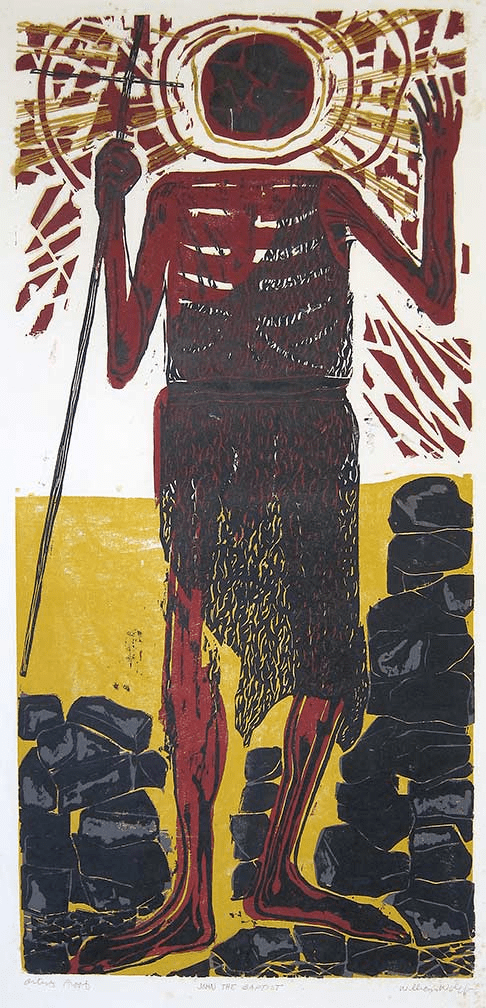
John the Baptist by William Wolff, 1968

We must, therefore, put ourselves in a position to see and hear God so that we can turn from all the obstacles that prevent us from experiencing Father, Son, and Spirit. 

And those hindrances to experiencing God are legion, including: 

  • Passiveness toward God’s Word and God’s creation, thus causing a lack of mindfulness and attention to the Holy Spirit.
  • Preoccupations and daydreams that prevents availability to the words and ways of Jesus.
  • Poverty of sleep, healthy habits, and an overall poor well-being that dulls the spiritual senses and prevents awareness of God.
  • Paucity of spiritual practices and disciplines that would put us in a position to experience a vision of God.

We must repent of all the ways we do not pay attention to God. The Lord is coming but we don’t perceive it.

  1. What, then, must we do to put ourselves in a position to see and hear God?
  2. In what ways might we corporately foster a sense of the holy God? 
  3. How will repentance fit into both our personal and corporate worship? 
  4. Have we identified and named the things that grieve the heart of God so that we can repent of them? 
  5. What is one action step you will take in response to this blog post?

None of us need to be like John the Baptist in order to be godly. We don’t have to eat locusts and be black-and-white thinkers. But we do all have to repent of the ways we make the road difficult by placing obstacles in the way of experiencing Jesus.

Most merciful God, we confess that we have sinned against you in thought, word, and deed, by what we have done, and by what we have left undone. We have not loved you with our whole heart; we have not loved our neighbors as ourselves. We are truly sorry and we humbly repent. For the sake of your Son Jesus Christ, have mercy on us and forgive us; that we may delight in your will, and walk in your ways, to the glory of your Name. Amen.