The Mighty God (Isaiah 9:2-7)

The people walking in darkness
    have seen a great light;
on those living in the land of deep darkness
    a light has dawned.
You have enlarged the nation
    and increased their joy;
they rejoice before you
    as people rejoice at the harvest,
as warriors rejoice
    when dividing the plunder.
For as in the day of Midian’s defeat,
    you have shattered
the yoke that burdens them,
    the bar across their shoulders,
    the rod of their oppressor.
Every warrior’s boot used in battle
    and every garment rolled in blood
will be destined for burning,
    will be fuel for the fire.
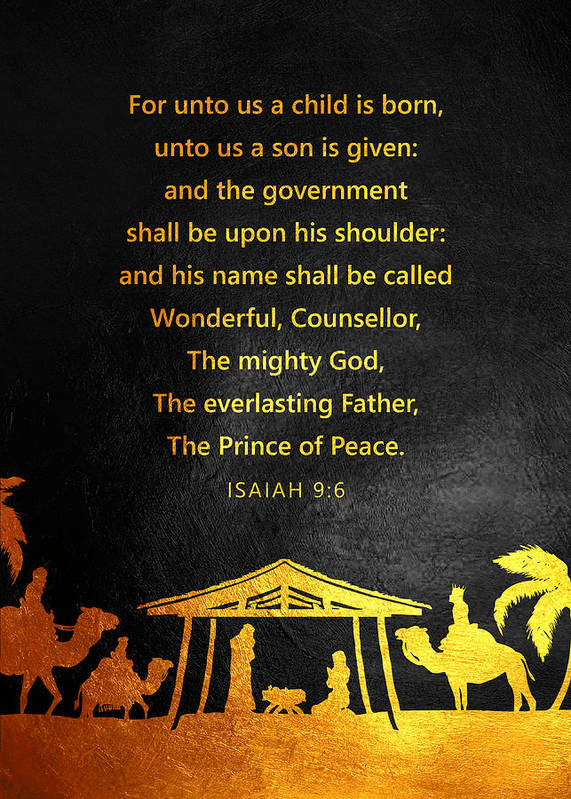
For to us a child is born,
    to us a son is given,
    and the government will be on his shoulders.
And he will be called
    Wonderful Counselor, Mighty God,
    Everlasting Father, Prince of Peace.
Of the greatness of his government and peace
    there will be no end.
He will reign on David’s throne
    and over his kingdom,
establishing and upholding it
    with justice and righteousness
    from that time on and forever.
The zeal of the Lord Almighty
    will accomplish this. (New International Version)

Bully-Buster

I am the youngest of five siblings. I have a brother two years older than me. When he was younger, my brother spent summers doing bench press contests, and won most of them. This kind of big brother in very handy all through school growing up because, believe it or not, I could sometimes be mouthy toward kids I thought were jerks, who were much bigger and stronger than me. On more than one occasion, my big brother became my bully-buster.

Sometimes we all need a warrior who will take care of the enemy, the bully, who is too big and strong for us to handle on our own.

On this final day of Advent, Christmas Eve, let’s consider one of the titles in today’s Old Testament lesson: “Mighty God.” 

The prophet Isaiah spoke to the spiritually backslidden nation of Judah. They faced continual war, not always looking to God to handle their predicament. Yet, despite the people’s failings, the Lord is a God of grace and hope. Conflict and war won’t always exist; hope will come, not by a larger military or more weapons, but through a child.

Jesus has become our warrior, our bully-buster, defeating the powers of sin, death, and hell, and bringing salvation to us.

El Gibbor

The adjective “mighty” comes from the noun form of the Hebrew word “gibbor” which means “warrior.” In other words, God in Christ is our Warrior. 

God is the One who fights our battles. This reality has a rich history in the Old Testament, beginning with the Exodus of the Israelites from Egypt: 

Moses answered the people, “Do not be afraid. Stand firm and you will see the deliverance the Lord will bring you today. The Egyptians you see today you will never see again. 14 The Lord will fight for you; you need only to be still.” (Exodus 14:13-14, NIV)

God in Christ fights to uphold justice and righteousness, using divine power to do for us what we cannot do for ourselves. 

The ultimate “bully” is the devil himself, and Christ has defeated him on the cross and brought victory and deliverance from sin to our lives.

“With good reason does Isaiah call him strong or mighty, because our contest is with the devil, death, and sin, enemies too powerful and strong, by whom we would be immediately vanquished, if the strength of Christ had not rendered us invincible. Thus we learn from this title that there is in Christ abundance of protection for defending our salvation, so that we desire nothing beyond him; for he is God, who is pleased to show himself strong on our behalf.”

John Calvin

While we were yet 90-poiund weaklings, the cross of Christ became our strength and our hope: 

When you were dead in your sins and in the uncircumcision of your flesh, God made you alive with Christ. He forgave us all our sins, having canceled the charge of our legal indebtedness, which stood against us and condemned us; he has taken it away, nailing it to the cross. And having disarmed the powers and authorities, he made a public spectacle of them, triumphing over them by the cross. (Colossians 2:13-15, NIV)

Jesus is our Victor. Christ’s vicarious atonement for humanity brought victory over sin and evil through the cross. Thus, the devil is defeated; the prince of this world cast out. Jesus has brought a great moral triumph over the powers of darkness. The evil yoke of slavery to sin has been broken through the blood of Christ. The Son overcame the tyrant of our souls and secured liberty and salvation from the dogged effects of Satan upon us. 

Jesus as our Warrior, the Mighty God, brings a big dose of hope and confidence to our lives. 

I walked the halls of my school without fear because of my big brother. So, how much more can we move about our lives, not cringing in fear, but confident and full of hope because we have Jesus the Warrior who has taken care of the sin issue once for all, and puts the devil in his place?

The Divine Warrior

Righteousness will be his belt and faithfulness the sash around his waist. (Isaiah 11:5, NIV)

He put on righteousness as his breastplate,
    and the helmet of salvation on his head;
he put on the garments of vengeance
    and wrapped himself in zeal as in a cloak. (Isaiah 59:17, NIV)

If those verses sound familiar to Christians, it’s because the Apostle Paul had them in mind when he wrote to the church at Ephesus:

Finally, be strong in the Lord and in his mighty power. Put on the full armor of God, so that you can take your stand against the devil’s schemes. For our struggle is not against flesh and blood, but against the rulers, against the authorities, against the powers of this dark world and against the spiritual forces of evil in the heavenly realms. 

Therefore put on the full armor of God, so that when the day of evil comes, you may be able to stand your ground, and after you have done everything, to stand. Stand firm then, with the belt of truth buckled around your waist, with the breastplate of righteousness in place, and with your feet fitted with the readiness that comes from the gospel of peace. In addition to all this, take up the shield of faith, with which you can extinguish all the flaming arrows of the evil one. Take the helmet of salvation and the sword of the Spirit, which is the word of God. (Ephesians 6:10-17, NIV)

Our response and responsibility, in light of Jesus as our Victor and Divine Warrior, is to take our stand as we continually deal with the world, the flesh, and the devil. 

Jesus has won the war, yet there are still mop up operations that need to take place, that is, pockets of resistance which must be dealt with. 

We face the enemies of our souls with the equipment given us and move ahead with confidence – and not fear – because we have protection from God. We have all we need, because we have Jesus, the bully busting, divine deliverer who is working on our behalf and growing his church.
Conclusion

Jesus is the Mighty God, the Divine Warrior, the powerful One who has conquered sin and death. Christ’s divine power was evident from the very beginning of his birth: conceived by the power of the Spirit; led by the Spirit; living, teaching, and healing in the Spirit; and resurrected with divine spiritual power.

Therefore, put your trust in Christ.  

Are you carrying a heavy yoke of trouble? Give your troubles to him because he is “the mighty God.” 

Do you have burdens that weigh you down? Cast all your anxiety on him; he is “the mighty God.” 

Is someone oppressing you? Go to Jesus in all your dilemmas; when the enemy comes in like a flood, this mighty God shall make a way for your deliverance. 

Are you overcome with grief and sorrow over a situation? The mighty God can deal with it. Tell him everything. He’ll handle all the bullies.  

If you have royally messed-up or feel as though you have screwed-up everything, then go to Christ because he is “the mighty God.” Fall on your knees. Confess your guilt and shame. Lay bare your poor, guilty, helpless, naked, and defenseless soul before his mighty power. For the Lord is able to save completely all those that come to God by him.  

Silent night. Holy night. The Prince of Peace is entering this world. The Mighty God is our joy and our song of deliverance, now and forever. Amen.

Law and Gospel (Galatians 3:6-14)

Nativity by He Qi

The Scriptures say that God accepted Abraham because Abraham had faith. And so, you should understand that everyone who has faith is a child of Abraham. Long ago the Scriptures said God would accept the Gentiles because of their faith. This is why God told Abraham the good news that all nations would be blessed because of him. This means everyone who has faith will share in the blessings given to Abraham because of his faith.

Anyone who tries to please God by obeying the Law is under a curse. The Scriptures say, “Everyone who doesn’t obey everything in the Law is under a curse.” No one can please God by obeying the Law. The Scriptures also say, “The people God accepts because of their faith will live.”

The Law isn’t based on faith. It promises life only to people who obey its commands. But Christ rescued us from the Law’s curse, when he became a curse in our place. This is because the Scriptures say that anyone who is nailed to a tree is under a curse. And because of what Jesus Christ has done, the blessing promised to Abraham was taken to the Gentiles. This happened so that by faith we would be given the promised Holy Spirit. (Contemporary English Version)

We are just a day away from the Nativity of the Lord, Christmas Eve, the night Christians everywhere observe the birth of Christ.

And just two days from now Christians throughout the world will have a grand celebration of Christ’s incarnation – God breaking into this old fallen world to be with us and redeem us.

Many will be show up at a church worship service on that day, perhaps especially because Christmas Day falls on a Sunday, in the year of 2022. All might be in the same place; yet they’re there for different reasons.

Some come to the worship service because that’s what they have done every Sunday throughout the year – and they wouldn’t think of being anywhere else.

Others choose to be a part of the gathering because they enjoy the specialness of the day, the beauty of the celebration, and the traditions which surround it all.

There are also those who show up because the season has been hard; while others may bask in the joy of Christmas, they’re just looking for something positive to get them through for a while.

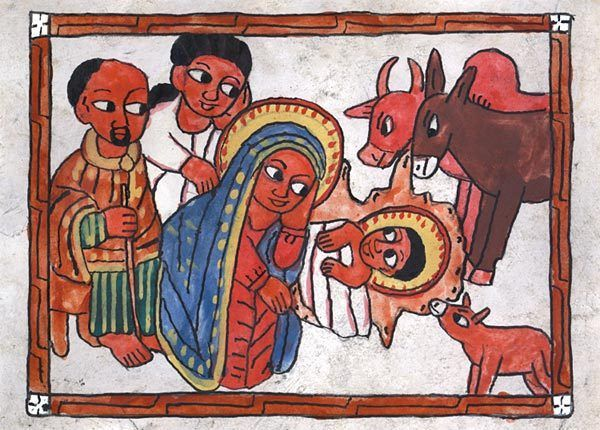
Ethiopian Orthodox icon of the Nativity of the Lord

And then there are those who enter the day for none of the previous mentioned reasons. No, they simply show up because they feel it is their duty to do so, or at the least, because they might receive some special spiritual Brownie points from God. In other words, they gather with the rest with the sheer motivation of Law.

Such an approach illustrates the “curse” of the Law. The Law itself is not bad. But if the rest of the equation isn’t factored into life, Law becomes a hard taskmaster and keeps the law-keeper in a terrible bondage without any delight to go with the duty.

People also need Gospel, the good news which fulfills all the requirements and demands of Law. Law is good, but by itself, apart from Gospel, it becomes an insidious tool of evil.

Whereas Law focuses solely on what we do, Gospel homes in on why we do it.

Law bosses us around and tells us what to do. Gospel frees us to embrace the spirit of Law to love God and neighbor.

It doesn’t take faith to obey the rules and regulations of Law. Gospel, however, can only be realized, internalized, and lived by faith.

It takes faith to receive grace and forgiveness – and to give it. Faith requires an acceptance of spiritual realities. It is the key to tapping into the power of love in the universe.

By faith, people throughout history, like Abraham, have listened with spiritual ears to the God of all. They step out, not merely because of Law, but because they rely on divine promises. Such faith enables them to wait patiently for the coming of eternal forces to take permanent residence on earth. Law can’t do that; only Gospel can.

Faith in the Bible is a complete trust in God, in who God is and what God has done. Because God has demonstrated faithfulness through steadfast love, people are gifted with faith to know the Lord and exhibit love through good works. 

God Is with Us by Hanna Varghese

In Christianity, the height of faith is to place one’s life completely in God’s hands, believing in the person and work of Jesus Christ.

Jesus said, “I assure you that if you have faith the size of a mustard seed, you could say to this mountain, ‘Go from here to there,’ and it will go. There will be nothing that you can’t do.” (Matthew 17:20, CEV)

The size of faith isn’t the issue – it’s in whom that faith is placed. The littlest of faith in Jesus can have massive results, whereas the biggest of faith in someone who cannot get you to where you need to go, is useless.

Outward rituals and observance of Law have their place; but they don’t deliver anyone from sin, death, or hell. Only faith can do that.

If you are a follower of Christ Jesus, it makes no difference whether you are circumcised or not. All that matters is your faith that makes you love others. (Galatians 5:6, CEV)

It’s one thing to be kind and love others during a holiday season; it’s quite another thing to have that be your default character throughout the entire year. Love for a season comes merely from Law. But Love for a lifetime grows from the rich soil of the Gospel.

And it’s the Gospel of Jesus Christ which we celebrate and give thanks.

Gracious God, we thank you for sending your Son. Even before we loved you, you loved us and gave us the gift of faith. Help us to love one another and to see all people in the same way you do – to love them even when they don’t love us back. Enable us by your Spirit to show continual love throughout the entire year, for the sake of Jesus Christ our Savior. Amen.

Mary’s Song of Praise (Luke 1:46b-55)

The Magnificat, a woodcut by Sr. Mary Grace Thul

Mary said,

“My heart praises the Lord;
    my soul is glad because of God my Savior,
    for he has remembered me, his lowly servant!
From now on all people will call me happy,
    because of the great things the Mighty God has done for me.
His name is holy;
    from one generation to another
    he shows mercy to those who honor him.
He has stretched out his mighty arm
    and scattered the proud with all their plans.
He has brought down mighty kings from their thrones,
    and lifted up the lowly.
He has filled the hungry with good things,
    and sent the rich away with empty hands.
He has kept the promise he made to our ancestors,
    and has come to the help of his servant Israel.
He has remembered to show mercy to Abraham
    and to all his descendants forever!” (Good News Translation)

It strikes me that Mary, instead of being full of worry and afraid of the future, and as an unmarried teen with child, is full of the Spirit and faith. Mary neither complained nor fretted for the nine months of her pregnancy; she praised God and was clear-headed about the grace shown to her.

Mary’s canticle gives us insight into the mystery of the incarnation: God chooses the weak, those of low esteem, and the powerless.

Mary was rather ordinary. She had no wealth. She possessed nothing which would cause anyone to pick her out of a crowd. Yet, she is the one chosen by God. And her wonderful response to grace demonstrated that there is so much more to any person than what we can see with our eyes and perceive through our earthly glasses of high positions and strength of personalities.

The mother of Jesus had the wisdom to discern that her situation typified the Lord’s egalitarian work of leveling the field. Mary’s pregnancy normalized the needs of all people. Her son, the Deliverer, would carry this understanding into his own life and ministry – declaring good news to the poor, comforting the brokenhearted, proclaiming freedom for captives, telling those who mourn that the time of the Lord’s favor has come.

Mary’s is the kind of song that has been sung by people of faith throughout the ages. It’s not only a song of faith but a declaration of resistance, in defiance of all evil powers which ignore the poor, such as Mary.

It was not a completely new sort of song; it’s in harmony with songs that other faithful followers of the Lord have sung in past generations.

Moses and Miriam sang a song to the Lord of freedom from powerful Egyptian bondage and oppression:

“I will sing to the Lord, because he has won a glorious victory;
    he has thrown the horses and their riders into the sea.
The Lord is my strong defender;
    he is the one who has saved me.
He is my God, and I will praise him,
    my father’s God, and I will sing about his greatness.
The Lord is a warrior;
    the Lord is his name.” (Exodus 15:1-3, 21, GNT)

Hannah, unable to conceive and have children, endured a long stretch of affliction from her rival – that is, until the Lord stepped in and opened her womb:

“No one is holy like the Lord;
    there is none like him,
    no protector like our God.
Stop your loud boasting;
    silence your proud words.
For the Lord is a God who knows,
    and he judges all that people do.
The bows of strong soldiers are broken,
    but the weak grow strong.
The people who once were well fed
    now hire themselves out to get food,
    but the hungry are hungry no more.
The childless wife has borne seven children,
    but the mother of many is left with none.
The Lord kills and restores to life;
    he sends people to the world of the dead
    and brings them back again.
He makes some people poor and others rich;
    he humbles some and makes others great.
He lifts the poor from the dust
    and raises the needy from their misery.
He makes them companions of princes
    and puts them in places of honor.
The foundations of the earth belong to the Lord;
    on them he has built the world. (1 Samuel 2:2-8, GNT)

Stained glass window of Hannah offering her son Samuel to the Lord by Phil Watkins

The psalmist declares his song about the Lord who turns the tables on the unfortunate and brings them privilege:

He always keeps his promises;
    he judges in favor of the oppressed
    and gives food to the hungry.

The Lord sets prisoners free
    and gives sight to the blind.
He lifts those who have fallen;
    he loves his righteous people.
He protects the strangers who live in our land;
    he helps widows and orphans,
    but takes the wicked to their ruin. (Psalm 146:6b-9, GNT)

God’s people throughout history have faced oppression. And, when in the teeth of that adversity, they have sung God’s songs of resistance against the evil powers of this world.

Along with Holy Scripture, let us also in these days of Advent just before Christmas Day, sing our traditional songs of resistance, deliverance, and hope:

“Come, Thou Long Expected Jesus”

By Charles Wesley

Come, thou long expected Jesus,
born to set thy people free;
from our fears and sins release us,
let us find our rest in thee.
Israel’s strength and consolation,
hope of all the earth thou art;
dear desire of every nation,
joy of every longing heart.

Born thy people to deliver,
born a child and yet a King,
born to reign in us forever,
now thy gracious kingdom bring.
By thine own eternal spirit
rule in all our hearts alone;
by thine all sufficient merit,
raise us to thy glorious throne.

“It Came upon the Midnight Clear” (vs.3-4)

By Edmund Sears

And ye, beneath life’s crushing load,
whose forms are bending low,
who toil along the climbing way
with painful steps and slow,
look now! for glad and golden hours
come swiftly on the wing.
O rest beside the weary road,
and hear the angels sing!

For lo! the days are hastening on,
by prophet seen of old,
when with the ever-circling years
shall come the time foretold
when peace shall over all the earth
its ancient splendors fling,
and the whole world send back the song
which now the angels sing.

“O Come, O Come, Emmanuel” (vs.1, 4, 6)

By J.M. Neale

O come, O come, Immanuel,
and ransom captive Israel
that mourns in lonely exile here
until the Son of God appear.

O come, O Branch of Jesse’s stem,
unto your own and rescue them!
From depths of hell your people save,
and give them victory o’er the grave.

O come, O Bright and Morning Star,
and bring us comfort from afar!
Dispel the shadows of the night
and turn our darkness into light.

Christ came to stand against sin, death, and the power of the Devil.

God is full of grace, mercy, and power to the powerless and the needy. The Lord has our backs. Perhaps if we all, both individually and corporately, continually used our words to identify and declare the great things God has done we would realize the consistent blessing of the Lord. 

As we near the night of our Lord’s birth, take some time to reflect on the ways God has been good to you in this Advent season, and like Mary, offer praise for each act of mercy. Mary exhibited no helplessness but had her heart calibrated to detect the grace of God when it was present – and to resist the injustice of this world.

Soli Deo Gloria

Jesus the Messiah (Matthew 1:1-17)

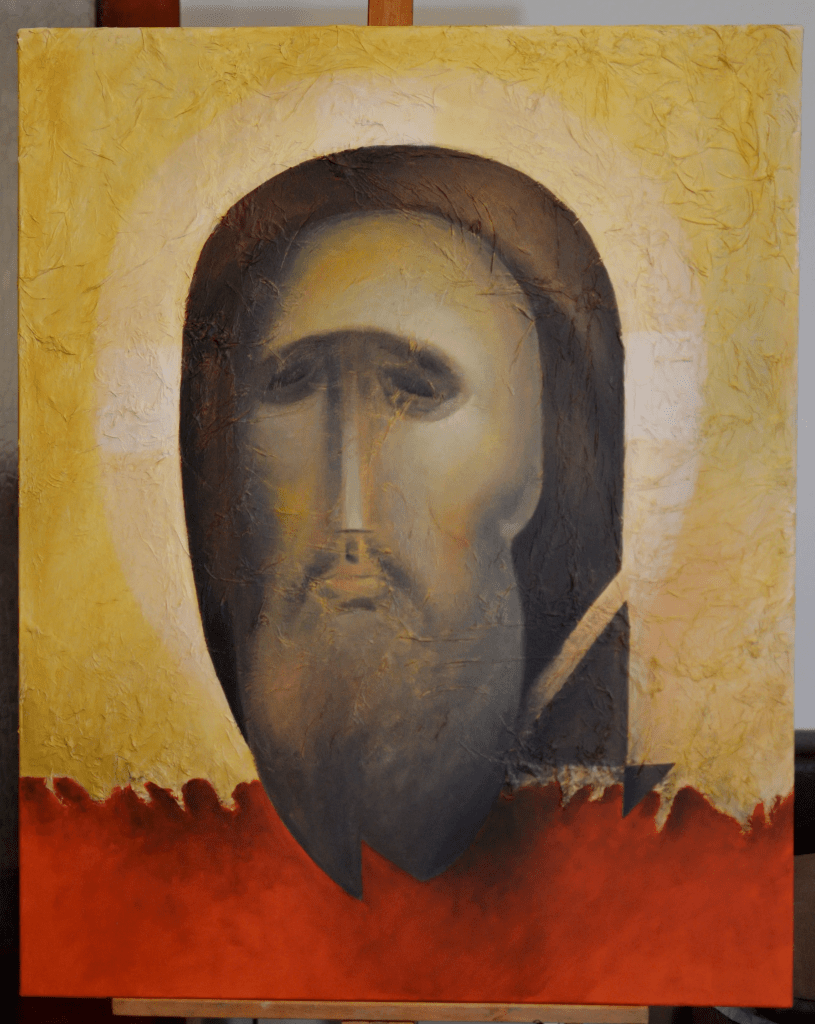
Jesus Christ by Liviu Dumitrescu, 2017

This is the genealogy of Jesus the Messiah the son of David, the son of Abraham:

Abraham was the father of Isaac,

Isaac the father of Jacob,

Jacob the father of Judah and his brothers,

Judah the father of Perez and Zerah, whose mother was Tamar,

Perez the father of Hezron,

Hezron the father of Ram,

Ram the father of Amminadab,

Amminadab the father of Nahshon,

Nahshon the father of Salmon,

Salmon the father of Boaz, whose mother was Rahab,

Boaz the father of Obed, whose mother was Ruth,

Obed the father of Jesse,

and Jesse the father of King David.

David was the father of Solomon, whose mother had been Uriah’s wife,

Solomon the father of Rehoboam,

Rehoboam the father of Abijah,

Abijah the father of Asa,

Asa the father of Jehoshaphat,

Jehoshaphat the father of Jehoram,

Jehoram the father of Uzziah,

Uzziah the father of Jotham,

Jotham the father of Ahaz,

Ahaz the father of Hezekiah,

Hezekiah the father of Manasseh,

Manasseh the father of Amon,

Amon the father of Josiah,

and Josiah the father of Jeconiah and his brothers at the time of the exile to Babylon.

After the exile to Babylon:

Jeconiah was the father of Shealtiel,

Shealtiel the father of Zerubbabel,

Zerubbabel the father of Abihud,

Abihud the father of Eliakim,

Eliakim the father of Azor,

Azor the father of Zadok,

Zadok the father of Akim,

Akim the father of Elihud,

Elihud the father of Eleazar,

Eleazar the father of Matthan,

Matthan the father of Jacob,

and Jacob the father of Joseph, the husband of Mary, and Mary was the mother of Jesus who is called the Messiah.

Thus there were fourteen generations in all from Abraham to David, fourteen from David to the exile to Babylon, and fourteen from the exile to the Messiah. (New International Version)

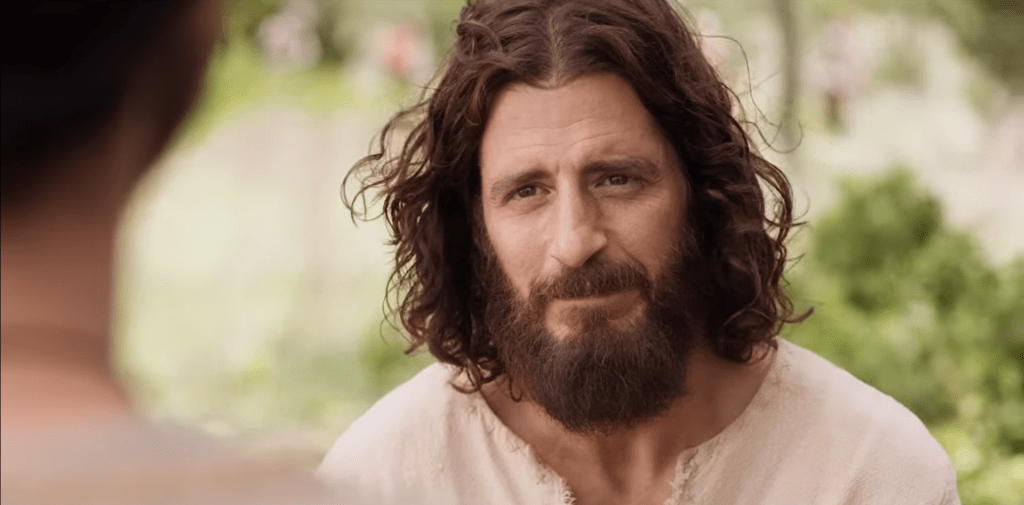
Jonathan Roumie as Jesus in the series “The Chosen”

You might be saying to yourself, “Really? You’re doing a reflection on this, a genealogy? Are you kidding?”

Why? Because all of Holy Scripture drips with grace, including genealogies.

The gospel of grace is the good news of Jesus; and, through the genealogy, we have the opportunity to understand and appreciate Christ better.

At the heart of Matthew’s gospel is a presentation of Jesus and Christ’s teaching which centers on the kingdom of God. Jesus is the King who fulfills all Old Testament promises. The genealogy is more than a chronicle of Christ’s lineage; it is a theological statement that Jesus is the promised Messiah, the anointed King of Israel, and the Savior of the world.

Who is Jesus?

Jesus is the Christ. The name “Jesus” means “God is salvation.” And “Christ” means “anointed one” (king). The name “Jesus Christ” communicates his person and his mission; he is the sovereign king who brings deliverance. 

Matthew, throughout his Gospel, takes pain to convey that Jesus is the King over an ethical kingdom of righteousness, and not a political kingdom. Therefore, Jesus is unlike King Herod or any other earthly king who seeks to have power and serve his own interests. Instead, Jesus uses his authority to serve others through love and grace; he doesn’t make subjects by coercion.

Jesus is the son of David 

Matthew establishes Christ’s pedigree by saying that Jesus was not some new kid on the block; he was anticipated for centuries. Jesus is the fulfillment of the covenant given to King David by God:

When the time comes for you to die, I will raise up a descendant of yours after you, one of your own sons, to succeed you, and I will establish his kingship. He is the one who will build me a temple, and I will establish his throne forever. I will become his father and he will become my son, and I’ll never withdraw my faithful love from him as I did from the one before you. I’ll install him in my house and in my kingdom forever, and his throne will be established forever. (1 Chronicles 17:11-14, CEB)

Jesus is a king in the same line and spirit of David. For example, when David became king, he didn’t immediately set out to annihilate all of the previous king’s (Saul) sons. That’s often how kings did it back then. Instead, David used his power to scan the land and show kindness to them. (2 Samuel 9:1-16)

Jesus is the son of Abraham

Matthew also establishes Christ’s pedigree as the rightful king of the universe by saying that Jesus is the fulfillment of the covenant given to Abraham:

I will make you a great nation,
I will bless you.
I will make your name great,
and you will be a blessing.
I will bless those who bless you,
and whoever curses you, I will curse.
Through you every family on earth will be blessed.” (Genesis 12:2-3, GW)
                 

Abraham was called by God because of sheer grace. There was nothing special about Abraham, other than the fact that God called him out of a pagan land to create a people for God’s own possession. Jesus is the fulfillment of that promise; all nations are blessed by coming to Christ the Lord and King.

From Abraham to David

Matthew made a statement about God through the genealogy: the Lord is merciful and full of grace. Grace is seen in the inclusion of four women: Tamar, Rahab, Ruth, and Bathsheba. 

The use of genealogy was a conventional form in the ancient world for establishing the credibility of a king’s right to rule. What was highly unconventional was including women. Matthew purposefully included them for two reasons:

  1. Women are central to the kingdom of God and play a pivotal role in the New Covenant.
  2. The women in the genealogy are Gentiles and were all notorious for their sexual exploits. 

Matthew highlighted a gospel of grace. No matter your gender, race, or even sordid past, the kingdom message is for everyone and is not an exclusive club. 

God is acting to redeem and reconcile the world. The gospel is not bound in any way by scandal, race, or gender. Jesus is the Savior and uses whomever he wants to extend his gospel of grace. 

From Solomon to the Exile

The men listed in this part of the genealogy are all kings; most of them not very good kings; and many of them downright evil. Because of this, God’s wrath was aroused, and the people were expelled from the land for following the unrighteous kings. 

However, grace overcomes everything. God’s purposes are still providentially accomplished despite human failure and sin. The lineage of Jesus was neither cut off nor thwarted because of powerful men who went in the wrong direction. In the end, God’s promises prevail.

Though the mountains be shaken
    and the hills be removed,
yet my unfailing love for you will not be shaken
    nor my covenant of peace be removed,”
    says the Lord, who has compassion on you. (Isaiah 54:10, NIV)

From the Exile to Christ

God is faithful, despite human unfaithfulness. Even though the people didn’t listen to the prophets during the reign of the earthly kings, the Lord quietly preserved a remnant who carried on the kingdom ethic. 

“I myself will gather the remnant of my flock out of all the lands where I have driven them, and I will bring them back to their fold, and they shall be fruitful and multiply.” (Jeremiah 23:3, NRSV)

Instead of extermination, God sent a Savior to settle the sin issue once for all. God’s grace and providence reign supreme in the universe.

Jesus is the Promised King

Matthew’s genealogy is presented with 3 sets of 14. The number 14 is symbolic: the name “David” has three consonants in Hebrew, and the number value of that name is 4+6+4=14. By modern standards, this doesn’t make much sense. However, by ancient standards, this was a conventional use of genealogy. And so, Matthew’s original readers got the point that David is the center of the genealogy; and Jesus is the promised king to come. It’s a creative way of pointing to Jesus, which connected to people accustomed to using numerology for making arguments.

It’s good to think about avenues of communication that speak to the people we want to reach. For example, in raising three girls, playing tea party with dolls was a way to love them and have a conversation on their level.  

In other words, we must ask: How do I need to change in order to reach the people I want to reach? (and not how others need to conform to what I’m doing).

Conclusion

God acted in history by sending Jesus, who is the rightful king of the universe. Christ is the Anointed One, sent to restore people to God. He is our peace, and our hope. To walk in the footsteps of Jesus is to walk in grace, not self-serving, but looking to use what has been given us to live as God’s subjects in the kingdom. 

May we make our own theological statement of who God is by the manner in which we live and speak, truly having Jesus at the center of all we do and say.

Soli Deo Gloria