Why Did Jesus Come? (Matthew 9:14-17)

Then John’s disciples came and asked him, “How is it that we and the Pharisees fast often, but your disciples do not fast?”

Jesus answered, “How can the guests of the bridegroom mourn while he is with them? The time will come when the bridegroom will be taken from them; then they will fast.

“No one sews a patch of unshrunk cloth on an old garment, for the patch will pull away from the garment, making the tear worse. Neither do people pour new wine into old wineskins. If they do, the skins will burst; the wine will run out and the wineskins will be ruined. No, they pour new wine into new wineskins, and both are preserved.” (New International Version)

The late Abigail Van Buren, better known in her day as the columnist, “Dear Abby,” was the person who made famous the phrase, “The church is a hospital for sinners, not a museum of saints.”

We occasionally need words like Dear Abby’s that are reminders of why Christians and Churches exist in the first place. The Church does not remain on this earth solely for its own benefit, any more than a hospital exists for the benefit of doctors or insurance companies. 

The Church exists to extend the mission of Jesus through proclamation of the gospel, the good news of forgiveness and new life in Christ. The Church calls people who are ensnared, entrapped, and in bondage to guilt and shame, and who need the restorative touch of grace. 

Our calling is not to find out what others can do for us (e.g. tithing and attendance) but what we can do for others. That’s why we are the continuing presence of Jesus on this earth as the temple of the Holy Spirit. 

Even though I am a church pastor, it is not my church. The church is not your church. It is Christ’s Church and we are to act in accordance with that truth.

Some of you reading this blog post are unhealthy. Some of you are sick with sin; some are heart-sick; others are just plain sick and tired of being sick and tired. Jesus (nor me!) is not looking to heap on you a load of expectations and guilt for things you are not doing; but instead is pointing you to the source of healing and change and inviting you to admit your need and come to him. 

Conversely, you may be healthy, spiritually alive and well. Therefore, it’s your job to roll up your sleeves and serve, to participate fully in the mission of Jesus for the church and the world.

Why did Jesus come? 

Jesus came to set up a new structure that could embrace his mission of bringing new life to people.

Christ used the occasion of John’s disciples asking him about fasting to communicate that his mission of reaching people through mercy and forgiveness will need a significant structural change. 

The two illustrations Jesus used – cloth and wineskins – is to simply point out that old and new wineskins are incompatible; and old and new pieces of cloth don’t go together. I would put it this way: You don’t put a new collar on a dead dog.

The Lord Jesus didn’t come to this earth just to perpetuate the status quo; he didn’t enter this world through the incarnation to simply dress up the Jewish religion, or to make a few minor adjustments to what already is going on. No! Christ came to change the old and do something new so that his mission could go forward through us.

We need a structural system which can accommodate the finished work of Jesus on the cross.

The entire sacrificial system and ritual laws of the Old Testament were only a matter of food and drink and various ceremonial washings – external regulations applying until the time of the new order.(Hebrews 9:10)

Christ is the one who arranges a new covenant, so that those who have been called by God may receive the eternal blessings that God has promised. This can be done because there has been a death which sets people free from the wrongs they did while the first covenant was in effect. (Hebrews 9:15, GNT)

Jesus canceled the first covenant in order to put the second into effect; the old is obsolete and has served it’s purpose. Now, Christ’s new covenant is in effect – a system big enough to hold the mission of the Church. (Hebrews 8:13; 10:9)

I wonder:

  • Is there anything in your life or in your church that is obsolete?
  • Is there a practice, ministry, system, or structure that is ineffective and not contributing to the mission that Jesus has for us in reaching others? 
  • Are there any dead dogs you keep trying to prop up on its legs?
  • Are you focused on what is important to Jesus? Do you know what’s important to him?
  • Do you keep performing the same rituals over and over because that is what you’ve always done?
  • What needs to change in your life to accommodate the mission of Jesus?

If the mission of Jesus is to occur we must develop:

  1. A relationship with Jesus. Engaging in spiritual disciplines of prayer, giving, fasting, reading and meditating on Scripture, are activities that put us in a position to know Christ better and respond to what is important to him.
  2. Relationships with each other that are not superficial but help one another to grow in Christ. We need to hold one another accountable for how the mission of Jesus is being accomplished, or not.
  3. Relationships with those outside of the church. This world is filled with sick, needy, hurting, lonely, unhealthy people who are stuck. They need a major change of life that can come from Jesus working through his followers. 

May it be so. Soli Deo Gloria.

A Reality Check (Hebrews 10:1-4)

The law is only a shadow of the good things that are coming—not the realities themselves. For this reason it can never, by the same sacrifices repeated endlessly year after year, make perfect those who draw near to worship. Otherwise, would they not have stopped being offered? For the worshipers would have been cleansed once for all and would no longer have felt guilty for their sins. But those sacrifices are an annual reminder of sins. It is impossible for the blood of bulls and goats to take away sins. (New International Version)

Sometimes, we silly people confuse the sign for the real deal. It’s important to distinguish between the two. We discern the difference all the time when it comes to more mundane affairs.

People generally know that looking at a movie poster is not watching the actual film; that wearing a string of cheap pearls is only mimicking the real and expensive ones; or that sitting in a doctor’s waiting room isn’t the same thing as being in the appointment.

However, when it comes to our religion, we seem to blur the lines between sign and substance. Praying a “sinners prayer” or making a profession of faith isn’t the same as growing, maturing, following, and living a committed Christianity.

Knowing some Christian lingo and/or going with the flow of cultural Christianity doesn’t necessarily mean that Christ’s words and ways are being followed.

And today’s New Testament lesson is a reminder, and not a guilt trip, that the law points to the actual substance of religious life – and is not life itself.

The laws surrounding the old system of animal sacrifice were never meant to be an end in itself. It pointed forward to the real deal and was, therefore, completely inadequate to bring deliverance from sin, death, and hell to anyone.

The very fact that sacrifices needed to be repeated year and after year demonstrated that they were ineffectual in saving a person. Rather, those sacrifices were designed to cause the worshiper to long for a sacrifice to end all sacrifices – to anticipate that the sin issue would be settled once and for all.

The only thing the sacrifices did was remind people they were sinners in need of a savior. Just as a slap on the hand is grossly inadequate for handling a murderer, so offering an animal was never going to do the trick in taking care of divine justice.

And besides, God has never been pleased with a bunch of sacrifices anyway. So, what is God really pleased with? The Lord is pleased with a heart devoted to obedience and fealty to Jesus Christ; God cares about inner attitudes and dispositions of the spirit which are inclined toward righteousness, holiness, mercy, humility, and justice for all.

Sacrifices, in and of themselves, have no power; they are like a toothless lion who couldn’t bite into you if he tried. The way to set things right is through the once for all mighty sacrifice of the Son – an offering to end all offerings.

God doesn’t want a checklist of daily sacrifices, any more than a spouse only wants supper on the table at night, or a paycheck every month. It’s nice but falls short of the full scope of marital interactions and relations. A marriage built on law won’t stand. It needs real flesh and blood relationship, complete with a devoted heart, sincere attitudes, and loving words and actions.

Since Christ has ably and permanently taken care of the sin issue, what sort of impact ought that to have on the Christian’s life? What kind of people are we to be?

To begin listing things to do is to go back to law and fail to grasp the gospel. And that’s where many churches and believers get tripped up and miss the grace of God altogether. Observing rules of cultural Christian activities or holding to some accepted Christian norms isn’t going to cut it.

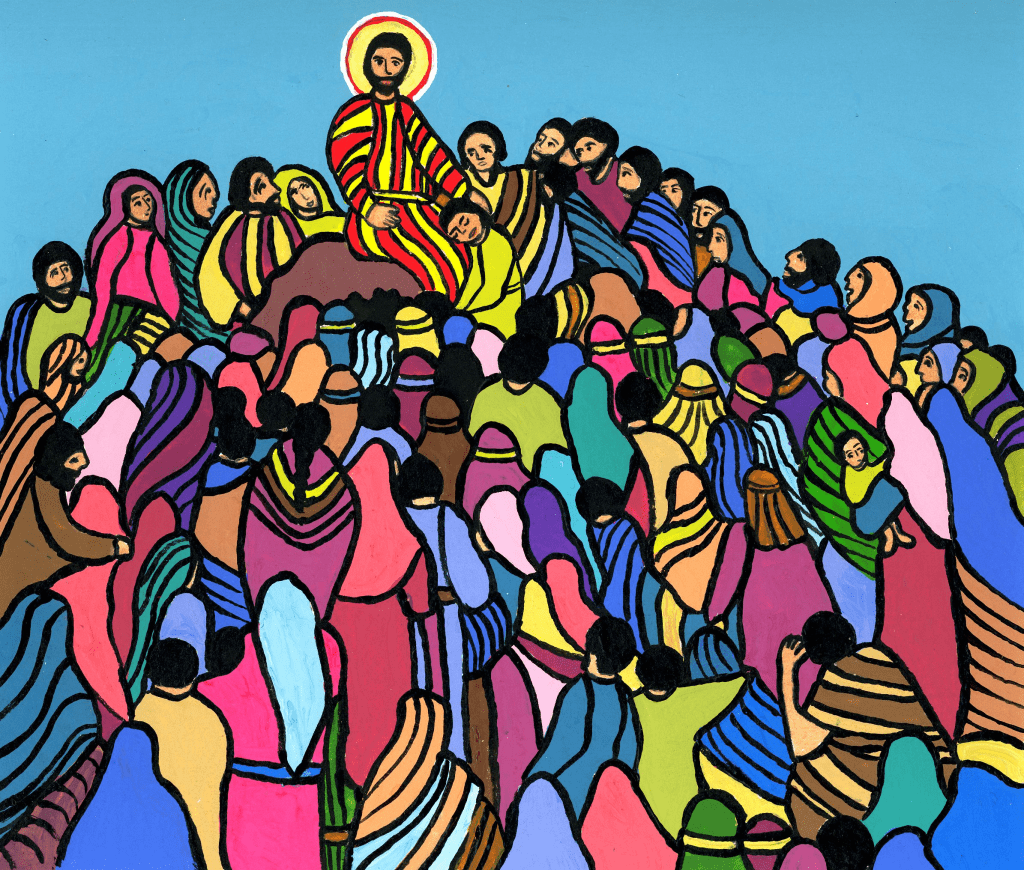
Christ’s Sermon on the Mount by Jorge Cocco Santángelo

Jesus described the sort of people who go beyond ritual regulations and rules to embrace the true spirit and end of the law:

“You’re blessed when you’re at the end of your rope. With less of you there is more of God and his rule.

“You’re blessed when you feel you’ve lost what is most dear to you. Only then can you be embraced by the One most dear to you.

“You’re blessed when you’re content with just who you are—no more, no less. That’s the moment you find yourselves proud owners of everything that can’t be bought.

“You’re blessed when you’ve worked up a good appetite for God. He’s food and drink in the best meal you’ll ever eat.

“You’re blessed when you care. At the moment of being ‘care-full,’ you find yourselves cared for.

“You’re blessed when you get your inside world—your mind and heart—put right. Then you can see God in the outside world.

“You’re blessed when you can show people how to cooperate instead of competing or fight. That’s when you discover who you really are, and your place in God’s family.

“You’re blessed when your commitment to God provokes persecution. The persecution drives you even deeper into God’s kingdom. (Matthew 5:3-10, MSG)

That describes folk who have embraced faith as the fulfillment of law. It’s a summary of the law’s intended purpose and end.

So, let’s worship Christ; and not some caricature of him. Maybe carefully reading through the entire book of Hebrews in one sitting will help.

Blessed God, purify your people by your abiding presence. Enlighten the minds of your people with the light of your good news. Bring wandering souls to an awareness and knowledge of Jesus Christ; and those who are walking in the way of life, keep them steadfast to the end. Guard those who are strong and prosperous from forgetting you. Increase in us your many gifts of grace and make us all fruitful in good works for the sake of Christ in the power of the Holy Spirit. Amen.

Good News for All (Acts 8:26-40)

11th century Byzantine depiction of Philip and the Ethiopian eunuch

An angel from the Lord said to Philip, “Get up, and take the desert road that goes south from Jerusalem to Gaza.” So Philip went.

An Ethiopian man who had come to Jerusalem to worship was on his way home. The man was a eunuch, a high-ranking official in charge of all the treasures of Queen Candace of Ethiopia. As the official rode along in his carriage, he was reading the prophet Isaiah out loud.

The Spirit said to Philip, “Go to that carriage, and stay close to it.”

Philip ran to the carriage and could hear the official reading the prophet Isaiah out loud. Philip asked him, “Do you understand what you’re reading?”

The official answered, “How can I understand unless someone guides me?” So he invited Philip to sit with him in his carriage.

This was the part of the Scriptures that the official was reading:

“He was led like a lamb to the slaughter.
He was like a sheep that is silent
when its wool is cut off.
He didn’t open his mouth.
When he humbled himself,
he was not judged fairly.
Who from his generation
will talk about his life on earth being cut short?”

The official said to Philip, “I would like to know who the prophet is talking about. Is he talking about himself or someone else?” Then Philip spoke. Starting with that passage, Philip told the official the Good News about Jesus.

As they were going along the road, they came to some water. The official said to Philip, “Look, there’s some water. What can keep me from being baptized?”  The official ordered the carriage to stop. He and Philip stepped into the water, and Philip baptized him. When they had stepped out of the water, the Spirit of the Lord suddenly took Philip away. The official joyfully continued on his way and didn’t see Philip again.

Philip found himself in the city of Azotus. He traveled through all the cities and spread the Good News until he came to the city of Caesarea. (God’s Word Translation)

We are in the Christian season of Epiphany – a time of celebrating that the light of the Lord has been given not only to Jews but to Gentiles, as well. The good news of mercy, forgiveness, salvation, and peace in Jesus Christ is for everyone, and not just some.

So, we have a very appropriate story in today’s New Testament lesson illustrating God’s grace for those who have been typically the “outsiders” when it comes to the worship of God.

God’s grace is really a merciful divine intervention into another’s life, providing something a person or group needs, yet cannot obtain on their own.

Philip, one of the original twelve disciples of Jesus, received instructions from the angel of the Lord. Take a certain road. That’s it. No other explanation. The command is, however, full of grace. Most of us don’t do all that well with multiple instructions given at once. We do much better with a single imperative at a time.

And so, the next piece of guidance came as Philip was taking the road from Jerusalem south to Gaza. Go hang out around a certain carriage. Philip needed no more direction after that; he took to what was happening.

Philip and the Ethiopian Eunuch by Herbert Boeckl

Maybe reading the story from our contemporary perspective hinders us from seeing just how scandalous and unthinkable the story was for people in the first century. Jews and Gentiles didn’t hang out with each other; and, if they did, there were all sorts of rules regulating how the interaction would go.

We really don’t have any of this with Philip. He simply emulates his Lord and ignores societal and cultural mores to meet the need of someone very different than himself.

An Ethiopian man was in Jerusalem and heading back home. He was an official in the Queen of Ethiopia’s court, and a eunuch (a castrated official). He was a person of color with a mutilated body and could have very well been of a different gender than Philip was used to. In other words, he was about as foreign from Philip as one can get.

Yet, what better way to communicate that the gospel is for everyone? Philip had learned from Jesus not to adopt the divisions of race, religion, and gender that others did. See, instead, with spiritual eyes to the heart of a person.

And this Ethiopian eunuch had a heart curious about God, a mind trying to understand God’s words, and a gut that told him this guy approaching me for whom I don’t know and isn’t from my country is perhaps God’s messenger to me.

That’s what I call a divine appointment.

Those divine encounters always result in changed lives. I believe both the Ethiopian and Philip were changed that day. The only way that any of us truly changes is through the interaction with others different from ourselves.

The good news of Jesus is for all. If, however, we remain in a closed system which is not open to others of differing cultures and communities, then we harden into believing the gospel is for us, and not them.

Christianity is not, therefore, an exclusive club made up of insiders who demonize outsiders as not looking, acting, or thinking like we do. We already have plenty of that insidious junk in the world. At its inception, Christianity was different. And, I believe, it needs to keep that edge of reaching out to all persons with a life-giving message of salvation and peace – not a death-dealing sermon of Christian cultural hegemony.

Good news for all people everywhere means that proclamation of the gospel of Jesus Christ needs to occur for all nations and ethnic peoples. It’s a message of grace, not judgment; of mercy, not threats; of open love, not closed hate.

Philip and the Ethiopian show us the way through their sensitivity to the divine, their open dialogue with one another, and their shared commitment to doing what is right and serving the Lord. Philip was a guide, not a conqueror. And the Ethiopian became a follower of Jesus, not Philip.

Let’s make sure to keep it straight; and to keep reaching out.

Lord God, thank you that in love and mercy, you reached out to us – and that when we were dead in our sins, you sent Jesus to make us alive. Thank you that you have a heart that seeks the lost. Thank you for saving us.

Give us hearts that care for the people who are in darkness and need the light of Christ. Teach us to care for them as you do. Grow us to care for the common good of all humanity. 

Help your Church everywhere to know and love you; and to invite others into your divine dance. May our conversations with others be seasoned with salt and full of grace; may our relationships show people the love of Jesus. May our hearts reflect your own heart, through Jesus Christ our Lord, in the strength of the Holy Spirit. Amen.

The Church Playground (Galatians 1:6-12)

I’m surprised that you’re so quickly deserting Christ, who called you in his kindness, to follow a different kind of good news. But what some people are calling good news is not really good news at all. They are confusing you. They want to distort the Good News about Christ. Whoever tells you good news that is different from the Good News we gave you should be condemned to hell, even if he is one of us or an angel from heaven. I’m now telling you again what we’ve told you in the past: If anyone tells you good news that is different from the Good News you received, that person should be condemned to hell.

Am I saying this now to win the approval of people or God? Am I trying to please people? If I were still trying to please people, I would not be Christ’s servant.

I want you to know, brothers and sisters, that the Good News I have spread is not a human message. I didn’t receive it from any person. I wasn’t taught it, but Jesus Christ revealed it to me. (God’s Word Translation)

At first glance, driving by any school at recess, the whole thing looks like a bunch of random kids descending into chaos bordered by a fence to keep it all from spilling out into the streets. But there’s more going on than the quick peek tells you. There are all kinds of petty little groups that make up the playground. 

It kind of reminds me of church.

The Presbyterians head outside to recess and cannot believe the lack of order going on. They try their darnedest to get some organized games happening.

But the Baptists aren’t having it. They’re too far separated from all the other kids to care about playing with any of them. Besides, nobody is playing by the rules and if there’s one thing Baptists can’t stand, it’s a lack of legalism. 

The Pentecostals all seem completely oblivious to anything that’s going on. They’re just having too much fun going as fast as they can on the merry-go-round to see that the Catholics are totally aghast at their lack of guilt feelings over hogging the equipment.

The little group of Episcopalians are lost in some morbid inferiority complex and retreat into their liturgical games.

Meanwhile the popular kids, the Non-denominational group, break out singing Chris Tomlin songs so loud that the Methodists go scrambling for their Book of Discipline to see what to do about it. 

The Lutheran kids are so busy fighting each other about who is the true Lutheran that they don’t hear any of the kids anyway. 

And the Reformed are those annoying kids who keep acting like the teacher instead of just enjoying being a kid on the playground.

The Church playground includes:

  • Groups of kids who don’t seem to play very well together; they all think they’re better than the other group.
  • Cliques who believe they’re the only playground in town; they don’t realize there are other playgrounds with all kinds of other kids.

How we interact with others in the world is going to determine if the school gets shut down, with no more playground. After all, what parent wants to send their kid to the school where nobody gets along with each other?

How we interact with each other on the playground of Christianity says a lot about our view of God. For many, God is the high and lofty Principal who’s only seen when something goes wrong, not realizing that God is really the encouraging teacher who’s daily in the classroom offering kind words and self-sacrifice that changes your life forever.

Instead of lamenting that Christendom has vanished from its grand position in society and that the moral fabric of our country is down the toilet along with the janitor’s cigarette butt, maybe we should stop giving the other kid a swirlie long enough to see that our bullying and belligerent ways are anything but the words and ways of Jesus to a world who needs spiritual care, not spiritual abuse.

I’d suggest we use our detention time to think about what we’ve done. And the Apostle Paul is here to help us do just that.

Paul was willing to tolerate a lot, but when it came to taking good news and twisting it into bad news, he was downright beside himself with shock and anger about the entire situation.

The Apostle had absolutely no tolerance for a bunch of honyocks who take spiritual deliverance and turn it back into spiritual bondage. It’s as if a group of immigrant refugees have been rescued from their terrible plight of homelessness and poverty to another gracious country; and then are deceitfully convinced to return to that previous state and leave the good confines of their new home.

It’s so appalling to Paul that he pronounced a severe curse upon them for doing such a thing. To emphasize his point, he belches out the curse a second time.

The good news of Jesus Christ is that there is forgiveness and deliverance from sin, death, and hell. It’s a gospel of grace that mercifully gives to us – a spiritual amnesty declaring us new citizens of God’s benevolent country of love.

Yet, many people are deceived with the legalist’s bargain from the devil: Take a nice handy list of do’s and don’ts and you will become godly. he false teacher is quite glad to provide the list so that there’s no guessing about what to do. And, for some reason, it seems it’s that teacher who always has playground duty at recess.

The list is presented as either principles to change your life; or rules to follow; or particular prayers to pray; or an approved list of things to give your money to. In other words, check off the items on the list and all will be well.

In reality, however, it’s a highway to the grave. And those who lead the way to death with their accursed legalistic ways will find themselves condemned by their own words and actions. In the end, the teacher will be dismissed to a very different school.

There is a need to repent of religious lists, political agendas, and teachings which ignore and demean the gracious good news of Christ’s person and work.

One telltale sign of holding to a conjured list is not being honest with one another about our struggles. The bald fact of list-living is that we cannot fulfill it. So, when we know we are not measuring up to the list, the temptation is to keep up appearances as if we are.

List-living eschews showing any weakness or imperfection and creates unholy disconnections between people:

  • I cannot admit my sin to anyone because the list pronounces me a failure if I do. 
  • I cannot enter a deep and prolonged grief over my loss because the list says I need to stay strong. 
  • I cannot profess my doubts about God because the list says if I doubt, I am not a real Christian.

The Apostle Paul’s (and mine, too!) response to the legalistic list-living is this: To hell with the list! 

Instead, give praise to Jesus Christ who has given us the way of freedom and peace! It’s grace which transforms hearts, turns lives around, and provides genuine joy and satisfaction. If grace is not the answer, we aren’t asking the right question.

I’ll take Jesus the Teacher any day over the list-loving false teacher.