Exposing Hypocrisy (Mark 7:1-8)

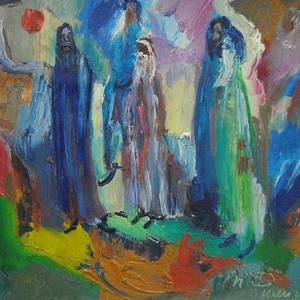
Old Men and Christ by Ivan Filichev, 1992

The Pharisees and some of the teachers of the law who had come from Jerusalem gathered around Jesus and saw some of his disciples eating food with hands that were defiled, that is, unwashed. (The Pharisees and all the Jews do not eat unless they give their hands a ceremonial washing, holding to the tradition of the elders. When they come from the marketplace they do not eat unless they wash. And they observe many other traditions, such as the washing of cups, pitchers and kettles.)

So the Pharisees and teachers of the law asked Jesus, “Why don’t your disciples live according to the tradition of the elders instead of eating their food with defiled hands?”

He replied, “Isaiah was right when he prophesied about you hypocrites; as it is written:

“‘These people honor me with their lips,
    but their hearts are far from me.
They worship me in vain;
    their teachings are merely human rules.’

You have let go of the commands of God and are holding on to human traditions.” (New International Version)

Reading the Gospel text for today, I try to imagine what emotions Jesus might have experienced when confronted by some religious leaders about his lack of attention to traditional and ritual hand washings – maybe frustration, anger, sadness, exasperation, disappointment, irritation, aggravation, or discouragement.

Perhaps Christ felt all those emotions. Whatever Jesus was feeling at the time, I can easily see him taking a deep breath and exhaling a great big *sigh* over the hypocrisy displayed in front of him.

Hypocrisy is a disconnect between espoused values and actual behavior. Whenever there is an incongruence between what we say is important and how we really live, this is being two-faced and duplicitous.

The men who came to see Jesus were plain old insincere hacks who practiced religious quackery. And Jesus saw right through their fake pretention of righteousness.

First off, this narrative is neither a blanket condemnation of Pharisees nor a dig on rituals themselves. Instead, Christ’s words were directed to specific persons using their rituals to leverage an appearance of religious superiority over others.

That type of motivation for engaging traditional rituals completely ignores the ethical and moral intention of those practices.

Sometimes folks can get so doggone wrapped up in how faith is represented that they lose sight of the faith itself.

Jesus and Old Men by Ivan Filichev, 1993

Hypocrisy has to do with our motives – not so much what we do but why we do it. Rituals themselves are good. Why we do them, or not, or how we go about doing them, gets at the heart of our objectives for engaging religious practices.

We need to ask ourselves:

Are our spiritual practices truly a worship offering to God, or are they merely mechanisms for keeping up the appearance of holiness?

Hypocrisy is acting a part which is not our true self. It is, instead, to live from the false self through the attempt of providing an idealized person to the public. What we ought to be doing is embracing the true self and realizing our common humanity with one another in genuine devotion to God and service to others.

Religious hypocrisy is particularly insidious because it uses what is sacred for selfish purposes. It damages the credibility of the religion, creates idolatry, and papers over hate with a veneer of pretentious piety.

The hypocrite is one who is a bundle of disparate parts. They have a massive need of integration to a whole and real self. The cost to facing this is the vulnerability of exposing oneself as flawed, imperfect, even ugly. Many persons have no willingness to be viewed by others as such, and so they maintain their play-acting and continue to seek the attention and accolades as a model religious person.

We all must come to grips with the reality that God cares a whole lot about why we do what we do.

If and when the forms of faith become tools of oppression to place heavy burdens upon others backs, then those forms have supplanted the faith itself.

Out of the overflow of the heart the mouth speaks, and from the heart the hands and feet move. Whenever we care more about being and appearing right than getting it right and becoming better, then we have a heart problem. The heart of the issue is the heart itself. Clean up the heart, and everything else follows – not the other way around.

The probity of today’s Gospel lesson is that we might misinterpret what is important to God. We may be playing the hypocrite yet have the belief we are genuine. The capacity for our hearts to enlarge with love is in direct relation to an awareness of the hidden motives buried within those hearts.

Evil intentions and motivations are what separate us from God – not our race, class, age, gender, religion, ethnicity, behavior, rituals, or anything else on the outside.

If we find ourselves being nit-picky of others, this is usually a clue that the unconscious self is trying to protect us from facing the pain of our own sins by projecting and focusing on another’s supposed missteps with tradition or ritual.

Fortunately, Jesus came to this earth full of grace and truth. There were times that Christ set aside niceness and decorum to go for the heart. In shining a light on the motives behind the deeds of people, some repented and received the good news of the kingdom of God; and others resisted to maintain their illusion of control and superiority.

Nobody could ride the fence with Jesus around. You either loved him or hated him.

The beauty of grace is that when we squarely and uncompromisingly face our sins and let go of the things we consider so important, and turn to God with authenticity, we are welcome at his Table.

Most holy and merciful Father, we acknowledge and confess before you our sinful nature, prone to evil and slow to do good, and all our shortcomings, offenses, and malevolent motives. You alone know how often we have sinned in wandering from Christ’s way of grace and truth, in wasting your gifts of compassion and justice, and in forgetting your love.

O Lord have mercy on us. We are ashamed and sorry for all the ways we have displeased you. Teach us to hate our errors; cleanse us from our secret faults; and forgive us our sins; for the sake of your dear Son, our Lord, Jesus Christ. Amen.

Receiving Blessings or Woes? (Luke 6:17-26)

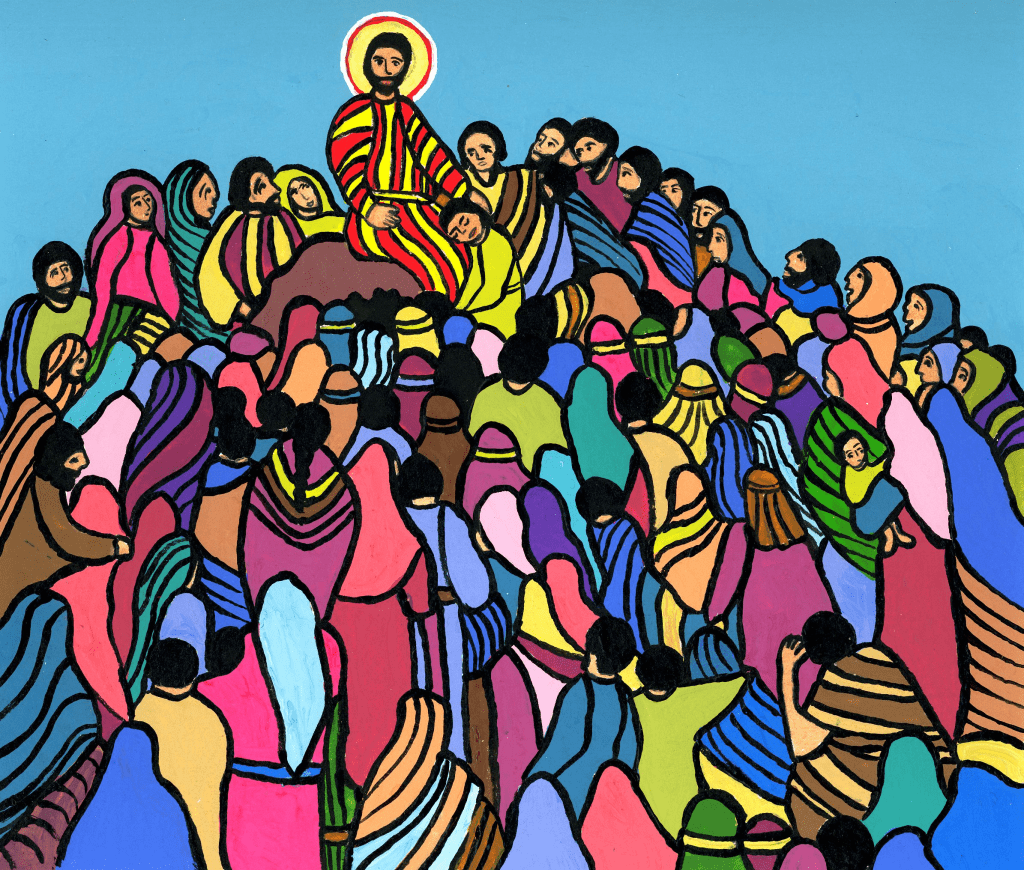
Ethiopian artist depiction of Jesus teaching

He went down with them and stood on a level place. A large crowd of his disciples was there and a great number of people from all over Judea, from Jerusalem, and from the coastal region around Tyre and Sidon, who had come to hear him and to be healed of their diseases. Those troubled by impure spirits were cured, and the people all tried to touch him, because power was coming from him and healing them all.

Looking at his disciples, he said:

“Blessed are you who are poor,
    for yours is the kingdom of God.
Blessed are you who hunger now,
    for you will be satisfied.
Blessed are you who weep now,
    for you will laugh.
Blessed are you when people hate you,
    when they exclude you and insult you
    and reject your name as evil,
        because of the Son of Man.

“Rejoice in that day and leap for joy, because great is your reward in heaven. For that is how their ancestors treated the prophets.

“But woe to you who are rich,
    for you have already received your comfort.
Woe to you who are well fed now,
    for you will go hungry.
Woe to you who laugh now,
    for you will mourn and weep.
Woe to you when everyone speaks well of you,
    for that is how their ancestors treated the false prophets. (New International Version)

There are double meanings throughout these words of Christ for us today; the expressions used by Jesus are specifically meant to be understood in two ways.

In order to speak to the people, Jesus went down with them and stood on a level place. In other words, the actual act of doing this is also to be understood as a means of identifying with others and getting on their level. The Lord intends not to speak down to people but to relate with folks alongside them.

The blessing of God is provided, up close and personal, not from afar. The word “blessed” is much more than a reference to physical health and wealth; it also refers to enjoying God’s stamp of approval on the whole of your life – body, mind, emotions, and spirit. And that is also what healing does for us; it effects the entirety of our being and not just one dimension of it.

To be “blessed” does not mean an absence of struggle. Indeed, blessings can and do rest upon us, even though we may be on the unfortunate end of someone’s hatred, exclusion, and defamation. It is to live through opposition, aware that our struggles are temporary and that our reward is great in heaven.

To have a “woe” pronounced means the opposite of blessing – to have God’s disapproval. It is to experience a curse – body, mind, emotions, and spirit – in the holistic sense.

The woeful may not experience apparent discomfort during this life. They mistake their wealth, their stuff, and their high connections as approval from God. However, they will find a fiery existence awaiting them. Apart from repentance and faith in becoming poor in spirit, their end is sure.

We are being led and guided to choose the way of blessing – and to avoid the path of woe.

Poverty, hunger, and weeping, on one level, are broad social categories. At another level, they are spiritual categories which describe the true follower of Jesus.

Christ’s church includes people who are poor, hungry, and weeping – in the full sense of the term. They, therefore, rely upon the community of the redeemed sharing all things in common as their means of provision. (Acts 2:44-45; 4:34)

We really need to avoid the temptation to make complex situations simple. To look upon those who now have wealth, eat well, laugh, and enjoy high standing, as under a curse from God, makes us simpletons who likely don’t understand what’s going on.

Others may make direct associations with wealth as blessing, which it may or may not be. And the same can be said for poverty and hunger – the presence of it doesn’t necessarily mean either blessing or woe.

The watershed issue is what we do with the life we have been given. Do the rich rely upon wealth or on God? Do the poor seek the Lord or just try to look for patrons who will help them? And do we all accept where we are right now and look to use whatever we have, and whoever we are, to benefit the benevolent and gracious kingdom of God?

We all may come from different places, have differing experiences, and be at various points along the continuum of poverty and wealth. Yet, we are all human and we are all in this life together.

So, we need to make the best of it with each other – instead of continually being at cross purposes with one another through simple stereotypes and hackneyed approaches based in little research or rational thought.

Jesus is leading us to a place of abundance, peace, and blessing – if we have ears to hear and minds receptive to his leading. It’s a place of healing; and not a place of woe. It is the realm of God, in which morality, ethics, kindness, and joy abound forever and ever.

Help us, O God, to heal those who are broken in body or spirit, and to turn their sorrow into joy. Grant this, Father, for the love of your Son, who for our sake became poor, Jesus Christ our Lord, who with you and the Holy Spirit are one God, now and forever. Amen.

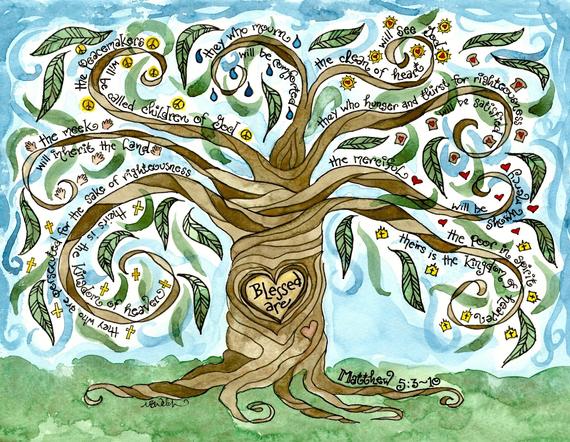
Christ’s Beatitudes (Matthew 5:1-12)

Sermon on the Mount by Gisele Bauche

When Jesus saw the crowds, he went up the mountain, and after he sat down, his disciples came to him. And he began to speak and taught them, saying:

“Blessed are the poor in spirit, for theirs is the kingdom of heaven.

“Blessed are those who mourn, for they will be comforted.

“Blessed are the meek, for they will inherit the earth.

“Blessed are those who hunger and thirst for righteousness, for they will be filled.

“Blessed are the merciful, for they will receive mercy.

“Blessed are the pure in heart, for they will see God.

“Blessed are the peacemakers, for they will be called children of God.

“Blessed are those who are persecuted for the sake of righteousness, for theirs is the kingdom of heaven.

“Blessed are you when people revile you and persecute you and utter all kinds of evil against you falsely on my account. Rejoice and be glad, for your reward is great in heaven, for in the same way they persecuted the prophets who were before you. (New Revised Standard Version)

God’s Law (The Ten Commandments) was given on a mountain. That Law was restated and reframed on a mountain by Jesus in his Sermon on the Mount.

I believe that arguably one of the most important and impactful portions of Holy Scripture are the Beatitudes of Jesus, which serve as the foundation to all of Christ’s teaching.

Christ’s Beatitudes are not simply a random collection of pithy phrases from Jesus on what constitutes approval and blessing from God. They intentionally build upon each other and describe the nature of true righteousness.

The Poor in Spirit

Spiritual poverty, not wealth, is the spiritual base to the Christian life. Most of the original crowd listening to Jesus thought they were on the outside of the kingdom, on the margins of true religion. But Jesus told them they have a place in God’s reign as poor and pitiable people.

To be “poor in spirit” is to be a spiritual beggar who recognizes they have nothing to offer God. It is seeing oneself, one’s sin, and one’s life as spiritually bankrupt apart from God.

Beggars have neither the leverage nor the ability to strike deals with anybody; and so, they do one thing: beg continually.

The proud person would never be caught begging for anything. Yet, the humble spiritual beggar constantly prays because they need God. They discern that without God there is no hope. The kingdom of heaven belongs to the penitent and not to the proud.

The Mourners 

Mourning is the emotional response of acknowledging one’s spiritual poverty. 

Grief and lament have a central place in Christian theology and life. To avoid it, work around it, or short-circuit its process is to refuse Christ; there is no righteousness apart from mourning over sin. Crying, weeping, and even intense tears are important and necessary.

To experience personal grief over one’s sins and the sins of the church and the world is a Beatitude of Jesus. You neither need position, power, privilege, nor pedigree to be a mourner. All can mourn. This is the door by which we enter the kingdom of God.

The Meek

A meek and gentle spirit is the result of realizing poverty of spirit and practicing lament.

At the heart of what it means to be meek is a spirit of non-retaliation. Whenever we are flat on our backs before God, there is no place to look but up. Thus, there is no ability to look down on others.

To be meek is to be broken and moldable before God. A meek person takes personal responsibility for their attitudes and actions. The meek have no need to retaliate, even when egregiously wronged, because they fully entrust themselves to God alone who judges the living and the dead.

Ironically, brokenness is the path to righteous wholeness.

The Hungry and Thirsty

Only those who know their poverty of spirit, personally grieve over sin, and are gentle, end up longing for righteousness.

The desire for righteousness is a recognition that without God I will not make it. I cannot be righteous without Jesus. Simply put, righteousness is a right relationship with God and others.

Those who hunger and thirst for God’s righteousness know they cannot make things right by themselves; they need God’s help.

If we think we can live most days of our lives without God, we do not yet know true righteousness. People who understand their great need for Jesus are easy to spot. They crave and devour God’s Word as their daily food; and they cannot stop blabbering on about Jesus.

There are three practices of living that arise from being filled with God’s righteousness: mercy, purity, and peacemaking. These Beatitudes cannot be conjured up by our own will; instead, they organically grow within us and are freely expressed because of what God is doing in our lives.

You cannot force them any more than you can force a stalk of corn to grow on your terms. Rather, you work with the unforced rhythms of God’s grace and allow righteousness to take root in you.

Down below in the soil, spiritual poverty, mourning, and humility germinate. Then, when the plant breaks the soil and flowers, it produces mercy, purity, and peace-making.

The Merciful 

Mercy begins with a heart that seeks to be generous; it is a loving response to someone or a group of people in misery. We accept them and help them because we ourselves have been there.

The merciful person looks for ways to come alongside others and help, rather than pile expectations and burdens on others without mentoring them in the ways of God.

The Pure In Heart

Purity also results from true righteousness. A stalk of corn might look good, but if you shuck it and it’s filled with worms, it’s not worth much. Legalistic righteousness is concerned to look good; it’s obsessed with performance, perfection, and possessions.

Conversely, the righteousness of God fills our hungry hearts and makes us pure and holy, set apart for good use.

The Peacemakers 

Those who make peace intentionally put themselves in the middle of trouble because they want to live righteously with the mercy and purity that God has provided for them.

Peace is realized through peacemakers. It seems we all desire peace, and yet, peacemakers are hard to come by. It’s a tough gig. To achieve peace, one must first be at peace with God and self – which is why we need the cross of Jesus Christ.

The Persecuted 

Living righteously, as presented by Jesus, tends to bring persecution; and the persecuted consider it a small price to pay for realizing God’s justice in the world.

Folks who are offended by even slight criticisms are usually the ones who are privileged and in power. They have not yet learned the ways of Jesus. Pettiness is nothing more than a sign of unrighteousness.

Yoking up with Jesus, following him, and living into his words and ways has always been risky and dangerous. The Beatitudes of Jesus are not characteristics that lead to power, prestige, or possessions, but likely just the opposite.

“The Beatitudes, spoken with the community of Jesus’ disciples in view, are paradoxes – the standards of the world are turned upside down as soon as things are seen in their right perspective, which is to say, in terms of God’s values, so different from those of the world. It is precisely those who are poor in worldly terms, those thought of as lost souls, who are truly fortunate ones, the blessed, who have every reason to rejoice and exult in their suffering. The Beatitudes are promises resplendent with the new image of the world and humanity inaugurated by Jesus.”

Pope Benedict XVI

Truly righteous persons become living Beatitudes; they are walking, talking blessings to the world. They abide with Christ and are witnesses to a subversive, yet wonderful, way of life, where the last are first and the greatest are the least.

O Lamb of God, that takes away the sins of the world, have mercy upon me.

O Lamb of God, that takes away the sins of the world, have mercy upon me.

O Lamb of God, that takes away the sins of the world, grant me your peace.

Take the Long View (Genesis 49:1-2, 8-13, 21-26)

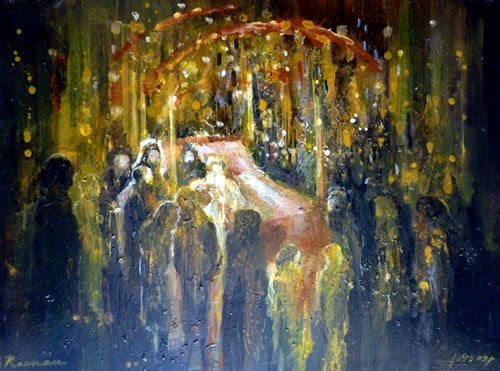
Jacob blesses his sons on his deathbed by Yoram Raanan

Jacob called his sons together and said:

My sons, I am Jacob,
    your father Israel.
Come, gather around,
    as I tell your future….

Judah, you will be praised
    by your brothers;
they will bow down to you,
    as you defeat your enemies.
My son, you are a lion
    ready to eat your victim!
You are terribly fierce;
    no one will bother you.
You will have power and rule
until nations obey you
    and come bringing gifts.
You will tie your donkey
    to a choice grapevine
and wash your clothes
    in wine from those grapes.
Your eyes are darker than wine,
    your teeth whiter than milk.

Zebulun, you will settle
    along the seashore
and provide safe harbors
    as far north as Sidon….

Naphtali, you are a wild deer
    with lovely fawns.

Joseph, you are a fruitful vine
growing near a stream
    and climbing a wall.
Enemies attacked with arrows,
    refusing to show mercy.
But you stood your ground,
    swiftly shooting back
with the help of Jacob’s God,
    the All-Powerful One—
his name is the Shepherd,
    Israel’s mighty rock.
25 Your help came from the God
your father worshiped,
    from God All-Powerful.
God will bless you with rain
    and streams from the earth;
he will bless you
    with many descendants.
My son, the blessings I give
are better than the promise
    of ancient mountains
    or eternal hills.
Joseph, I pray these blessings
    will come to you,
because you are the leader
    of your brothers. (Contemporary English Version)

Where does confidence come from?

The theme of confidence works its way through the patriarch Jacob’s deathbed prophecies and blessings – a resolute conviction in the promises of God – that the Lord will accomplish exactly what was promised.

Jacob expressed the hope and sure belief that God would bring the Israelites out of Egypt and into the land of Canaan as their inheritance – and, ultimately to the City of God, the eternal inheritance.

The Christian will find much in the blessing of Judah concerning the promises surrounding the coming of Christ. Mentioning the implements of “staff” and “scepter” are symbols of authority. And the reference to a donkey communicated a ruler was coming, as donkeys were the preferred mounts of royalty in ancient times.

What’s more, the washing of garments in wine, and eyes darker than wine, are allusions to the future blessing and abundance that will occur through the tribe of Judah. In fact, the first miracle of Jesus was turning water into wine – a deliberate attempt by the Apostle John to connect Jesus with Old Testament messianic prophecies of abundance and blessing. (John 2:1-12)

It’s important to adopt a long view of life. We must keep in mind that it took eighteen centuries for Jacob’s prophecy of Judah to occur. This long view is what gives us our confidence in life and provides the patience and perseverance we need for the here and now.

Seeing the big picture of God’s work in this world is necessary, because if we do not, we will likely become discouraged with the circumstances we face right now.

The reason Jacob makes it into the great Hall of Faith in the New Testament book of Hebrews is not because he was squeaky clean and perfect in how he lived his life; it was because he took the long view, the big picture, and saw that God was going to fulfill divine promises to Israel:

By an act of faith, Jacob on his deathbed blessed each of Joseph’s sons in turn, blessing them with God’s blessing, not his own—as he bowed worshipfully upon his staff. (Hebrews 11:21, MSG)

Furthermore, when we string the following three verses together across both Old and New Testaments of the Bible, we see the long view of God’s purposes:

It is true that you planned to do something bad to me. But really, God was planning good things. God’s plan was to use me to save the lives of many people. And that is what happened. (Genesis 50:20, ERV)

For I know the plans I have for you,” declares the Lord, “plans to prosper you and not to harm you, plans to give you hope and a future. (Jeremiah 29:11, NIV)       

And we know that all things work together for good to those who love God, to those who are the called according to his purpose. (Romans 8:28, NKJV)

In the Christian faith tradition, all of God’s promises come together and are fulfilled in the person and work of Jesus.

Christ is our salvation, our inheritance, and our hope. To give our lives to following Jesus in complete trust of faith is both our challenge and our privilege.

May we live by faith, and not by fear. And may we have patience and persevere through the most challenging of situations because we have adopted the long view of understanding the God is bringing all divine promises to fruition, all in good time.

Our confidence comes from the Lord.

Be present, O merciful God, and protect us through anxious times, so that we who are wearied by the changes of this life may rest in your eternal steadiness. Keep watch, dear God, with those who work, or watch, or weep this night, and give your angels charge over those who sleep. Tend the sick, Lord Christ; give rest to the weary, bless the dying, soothe the suffering, pity the afflicted, shield the joyous; and all for your love’s sake. Amen.