The Gentle King (Matthew 21:1-11)

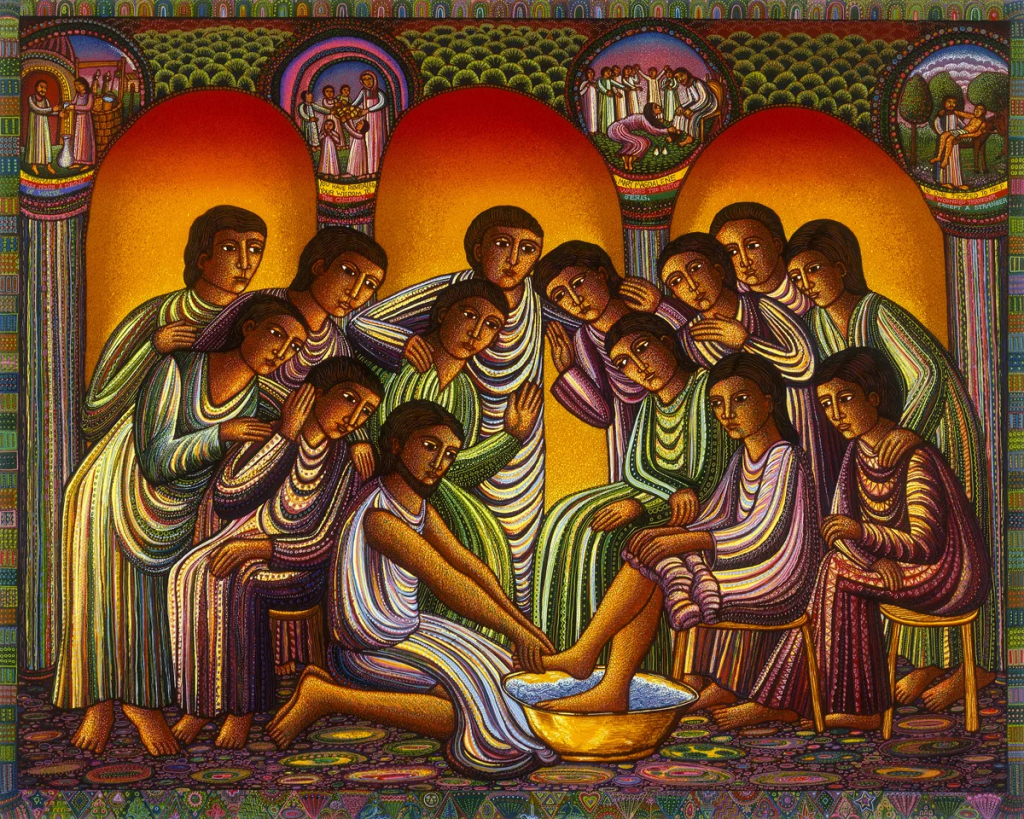
The Triumphal Entry, by He Qi

As they approached Jerusalem and came to Bethphage on the Mount of Olives, Jesus sent two disciples, saying to them, “Go to the village ahead of you, and at once you will find a donkey tied there, with her colt by her. Untie them and bring them to me. If anyone says anything to you, say that the Lord needs them, and he will send them right away.”

This took place to fulfill what was spoken through the prophet:

“Say to Daughter Zion,
    ‘See, your king comes to you,
gentle and riding on a donkey,
    and on a colt, the foal of a donkey.’”

The disciples went and did as Jesus had instructed them. They brought the donkey and the colt and placed their cloaks on them for Jesus to sit on. A very large crowd spread their cloaks on the road, while others cut branches from the trees and spread them on the road. The crowds that went ahead of him and those that followed shouted,

“Hosanna to the Son of David!”

“Blessed is he who comes in the name of the Lord!”

“Hosanna in the highest heaven!”

When Jesus entered Jerusalem, the whole city was stirred and asked, “Who is this?”

The crowds answered, “This is Jesus, the prophet from Nazareth in Galilee.” (New International Version)

A Humble Leader

Gentle humility and strong leadership are not mutually exclusive concepts. They can and should co-exist together.

Los Angeles County traffic cops receive plenty of complaints about their work. After all, most motorists don’t think they deserve a ticket. Each complaint gets documented and placed in the officer’s personnel file. One officer, however, Deputy Sheriff Elton Simmons, made 25,000 traffic stops over a span of 20 years, without a single complaint on his record.

When his supervisor started looking through Simmons’ file, he was stunned to find plenty of commendations, but not a single complaint. It was so unusual, that a CBS News crew was assigned to follow Simmons in an attempt to learn his secret. They described Deputy Simmons as having a “pitch-perfect mix of authority and diplomacy” without a trace of arrogance or self-righteousness.

Although handing out plenty of tickets, they never came with a guilt trip.  Deputy Simmons described his mentality: “I’m here with you. I won’t look down at you.” 

One driver who got a ticket from Simmons said, “It’s his smile. How could you be mad at that guy?”  “Apparently, you can’t,” concluded the CBS News team. “Time after time, ticket after ticket, we saw Officer Simmons melt away a polar ice cap of preconceptions.”

A Meek Celebrity

As Jesus entered Jerusalem for the last week of his life, he was at the height of his fame. Christ’s teaching and healing ministry touched thousands of people. Jesus was the most famous celebrity to come into town since David captured the city a thousand years before. 

But Jesus did not ride into Jerusalem as a great and mighty warrior who conquered Jerusalem in a military battle. There is coming a time, at the end of the age, when Jesus will take on this role, but that was not his purpose on this occasion. 

Hosanna in the Highest, by Malaysian artist Hanna-Cheriyan Varghese

One of the challenges for people in every era is to properly balance scriptural truth. Many Jews emphasized King David’s victories in battle, and his great political dynasty, and so, tended to overlook that David was also a humble servant. 

King David showed steadfast love and kindness to his subjects and submitted himself to God in such a way that, even with opportunities to seize the kingship from Saul who was trying to take his life, he left vengeance to God alone.

Christ’s triumphal entry portrays Jesus as King, the Son of David, but as a gentle king. He embodied both powerful authority and gentle humility. Jesus wanted the crowd to understand that he was not like most kings – he was a lowly king. 

Jesus as a meek celebrity seemed so odd that many people saw that combination of gentle authority as being wishy-washy. Jesus didn’t fit any of the typical labels that people expected. They wondered, “Is he a Pharisee? Or a Zealot? What’s his position on the Romans?  How is he going to lead us out from under Gentile rule?” There was lots of anxiety and concern over Jesus; the people could not nail down exactly what kind of guy he was.

A Servant Pastor

Over the years, as a Pastor, many people have wanted to label me as something, but have had a hard time doing it. Am I liberal or conservative? liturgical or non-liturgical? open or closed to particular people or groups? e.g. LGBTQ folks, Black Lives Matter, etc.

The problem with all this is that it assumes you cannot be both, as if life is all either/or, instead of both/and. It makes ministry about choosing sides, instead of breaking down barriers.

Meekness and strength, gentleness and authority, humility and leadership, grace and truth, love and anger, are all meant to be together – not compartmentalized in sequestered ghettos of the mind.

Jesus sought to hold kingly authority and divine righteousness together, at the same time, all the time. Christ came into Jerusalem to face the cross and take upon himself the sin of the whole world. He came as a gentle king.

Yet, many people do not want this kind of leader because they think leadership is all about power – taking charge with strong authority, telling people what to do, and controlling every aspect of the realm.  

Jesus, at times, acts like a decisive and absolute authority. He knocks over the tables of the money changers in the temple, curses fig trees, and refuses to answer direct questions. But then he turns around and goes against the people’s expectations of him as a leader by riding on a lowly donkey, inviting tax collectors and prostitutes to join him, going after the lost, and embracing the least persons in society.

A Donkey Lord

Jesus displayed a combination that seemed confusing and wishy-washy to many. Christ is both sovereign lord, and humble servant. Jesus riding on a donkey seemed a strange fusion of authority and humility. 

On the one hand, a donkey was the beast of burden for most working class poor people. Donkeys are ordinary, and not like war horses. Kings didn’t ride into conquered cities on donkeys. But, on the other hand, the donkey is also linked to Messiah’s power and authority.

Rejoice, rejoice, people of Zion!
    Shout for joy, you people of Jerusalem!
    Look, your king is coming to you!
He comes triumphant and victorious,
    but humble and riding on a donkey—
    on a colt, the foal of a donkey.

The Lord says,

“I will remove the war chariots from Israel
    and take the horses from Jerusalem;
    the bows used in battle will be destroyed.
Your king will make peace among the nations;
    he will rule from sea to sea,
    from the Euphrates River to the ends of the earth.” (Zechariah 9:9-10, GNT)

Jesus is the ultimate leader who uses his authority for the benefit of others, to bring peace. Jesus did not use his authority to consolidate power and squish enemies, but instead, gave his life so that others might live. 

Gentle and meek does not mean being a washrag or a limp noodle. Rather, it means to have power under control, e.g. a broke horse; it is power for useful purposes to serve people, not like other kings who were concerned with getting, consolidating, and keeping power, at all costs.

Jesus is the crucified Messiah; the modest leader; the lowly Lord; the God Man. We must hold it all, not emphasizing one aspect above another, so that we have the complete picture of Christ.

A Gracious Royal

Believers and followers of Jesus are royal children of the King. That means we live in the way of Jesus by bestowing grace to others. What does this “look like?”

  • In our families, Christian parents do not merely bark orders at kids, but love and support them by humbly and gently coming alongside and helping. 
  • In our neighborhoods, Christian citizens pray for the welfare of their neighbors, even and especially the ones who we may not like very well.   
  • In our work, Christian workers use their skills and abilities to serve others, transforming what we do from a secular job to a sacred vocation. 
  • In our daily life, Christians scan the horizon to seek people whom we might show God’s kindness, instead of just waiting for something to fall into our laps, if it ever does.

A Talking Donkey

From the Old Testament, we know that donkeys can talk (Numbers 22:21-38). If Christ’s donkey could speak, I imagine him saying: 

“King Jesus, why did you choose a lowly donkey like me to carry you to ride in your parade? Didn’t you have a friend who owned a horse – a spirited royal mount, fit for a king to ride? Why choose me, a small unassuming beast of burden, trained to plow and not to carry kings?”

It is a privilege to be a Christian. Perhaps you will say: 

“King Jesus, why did you choose me, a lowly unimportant person to bear you in my world today? I am poor and unimportant, trained to work, and not to carry kings – let alone the King of kings; and yet, you’ve chosen me to carry you in triumph in this world’s parade. King Jesus, keep me humble, so everyone may say, ‘Blessed is he who comes in the name of the Lord,’ and not ‘what a great Christian he is.’”

God of all, you gave your only begotten Son to take the form of a servant, and to be obedient, even to death on a cross: give us the same mind that was in Christ Jesus that, sharing in his humility, we may come to be with him in his glory, who lives and reigns with you and the Holy Spirit, one God, now and forever. Amen.

What Does God Want? (John 11:1-45)

The Raising of Lazarus, by Rembrandt, c.1632

Now a man named Lazarus was sick. He was from Bethany, the village of Mary and her sister Martha. (This Mary, whose brother Lazarus now lay sick, was the same one who poured perfume on the Lord and wiped his feet with her hair.) So the sisters sent word to Jesus, “Lord, the one you love is sick.”

When he heard this, Jesus said, “This sickness will not end in death. No, it is for God’s glory so that God’s Son may be glorified through it.” Now Jesus loved Martha and her sister and Lazarus. So when he heard that Lazarus was sick, he stayed where he was two more days, and then he said to his disciples, “Let us go back to Judea.”

“But Rabbi,” they said, “a short while ago the Jews there tried to stone you, and yet you are going back?”

Jesus answered, “Are there not twelve hours of daylight? Anyone who walks in the daytime will not stumble, for they see by this world’s light. It is when a person walks at night that they stumble, for they have no light.”

After he had said this, he went on to tell them, “Our friend Lazarus has fallen asleep; but I am going there to wake him up.”

His disciples replied, “Lord, if he sleeps, he will get better.” Jesus had been speaking of his death, but his disciples thought he meant natural sleep.

So then he told them plainly, “Lazarus is dead, and for your sake I am glad I was not there, so that you may believe. But let us go to him.”

Then Thomas (also known as Didymus) said to the rest of the disciples, “Let us also go, that we may die with him.”

On his arrival, Jesus found that Lazarus had already been in the tomb for four days. Now Bethany was less than two miles from Jerusalem, and many Jews had come to Martha and Mary to comfort them in the loss of their brother. When Martha heard that Jesus was coming, she went out to meet him, but Mary stayed at home.

“Lord,” Martha said to Jesus, “if you had been here, my brother would not have died. But I know that even now God will give you whatever you ask.”

Jesus said to her, “Your brother will rise again.”

Martha answered, “I know he will rise again in the resurrection at the last day.”

Jesus said to her, “I am the resurrection and the life. The one who believes in me will live, even though they die; and whoever lives by believing in me will never die. Do you believe this?”

“Yes, Lord,” she replied, “I believe that you are the Messiah, the Son of God, who is to come into the world.”

After she had said this, she went back and called her sister Mary aside. “The Teacher is here,” she said, “and is asking for you.” When Mary heard this, she got up quickly and went to him. Now Jesus had not yet entered the village, but was still at the place where Martha had met him. When the Jews who had been with Mary in the house, comforting her, noticed how quickly she got up and went out, they followed her, supposing she was going to the tomb to mourn there.

When Mary reached the place where Jesus was and saw him, she fell at his feet and said, “Lord, if you had been here, my brother would not have died.”

When Jesus saw her weeping, and the Jews who had come along with her also weeping, he was deeply moved in spirit and troubled. “Where have you laid him?” he asked.

“Come and see, Lord,” they replied.

Jesus wept.

Then the Jews said, “See how he loved him!”

But some of them said, “Could not he who opened the eyes of the blind man have kept this man from dying?”

Jesus, once more deeply moved, came to the tomb. It was a cave with a stone laid across the entrance. “Take away the stone,” he said.

“But, Lord,” said Martha, the sister of the dead man, “by this time there is a bad odor, for he has been there four days.”

Then Jesus said, “Did I not tell you that if you believe, you will see the glory of God?”

So they took away the stone. Then Jesus looked up and said, “Father, I thank you that you have heard me. I knew that you always hear me, but I said this for the benefit of the people standing here, that they may believe that you sent me.”

When he had said this, Jesus called in a loud voice, “Lazarus, come out!” The dead man came out, his hands and feet wrapped with strips of linen, and a cloth around his face.

Jesus said to them, “Take off the grave clothes and let him go.”

Therefore many of the Jews who had come to visit Mary, and had seen what Jesus did, believed in him. (New International Version)

The Raising of Lazarus, by Vincent Van Gogh, 1890

Here’s a Captain Obvious observation:

what God wants, and what we want, is not always the same thing. 

Today’s Gospel story centers around a man named Lazarus, the brother of Mary and Martha. The disciples were familiar with them since they were committed followers of Jesus. 

Their friend Lazarus became deathly ill. Christ and the disciples caught wind of it. Everyone believed Jesus could do something about this. But Jesus stayed put. He didn’t make a move to go to his sick friend. 

After a few days, Lazarus died. It was only then, that Jesus made his move.

The religious authorities in Jerusalem had it out for Jesus. But Jesus decided to go to Bethany and Jerusalem anyway. This made no sense to the disciples. Lazarus was lying dead in Bethany. Going there would put everyone at risk – which is why Thomas uttered the defeatist and dramatic statement, “Let us also go, that we may die with him.”

Yet, they all went. And once they arrived, Christ and his disciples found the grieving sisters. Mary and Martha believed that Jesus was the promised Messiah who would come and save the people. They didn’t understand why Jesus stayed away and didn’t come sooner. 

If Jesus had been there, he could have healed Lazarus. He healed other people, so why not a friend and a brother?

The death of Lazarus seemed to be the end. No one was happy with how things shook-out. Lazarus died. The disciples’ plans were dead. Mary and Martha’s expectations died…

but death is exactly what it takes in to have resurrection.

There’s no such thing as a painless miracle. Death isn’t a pleasant affair. I have been with countless people at the end of life, and I will tell you that, although it’s possible for a death to be peaceful, it’s still ugly business. 

It’s also painful to watch carefully laid and prayed over plans die. It hurts to see a long sought after dream just go up in smoke and die. To see anything or anyone we deeply care about die is gut-wrenching. Yet, in order for a resurrection to occur, there must first be a death.

There cannot be a new life unless there’s an old one. 

Jesus did the impossible by raising Lazarus from death and giving him new life. And the resurrection of Lazarus pointed to an even greater truth: Christ’s own death and resurrection was coming, and it will change everything.

Whenever what we want dies, then we are in a position to ask: So, what does God want? 

God wanted something better than what everybody else wanted. By allowing ourselves to be consumed with what God wants, it turns out to be the very best thing for us, even if it does not quite jive with what I want.

Everyone’s expectations needed to die, along with Lazarus, for the resurrection to become reality. Only then did Jesus act by rising Lazarus from death.

Jesus pointed to himself as the one able to bring life to all that is dead among us. Sometimes:

  • dreams must die so that Jesus can resurrect them to new life, with outcomes far more glorious than you and I could ever imagine
  • plans have to be dead and buried before Jesus will breathe new life into them, making those plans so much more than they could ever have been in our hands.
  • ministries, even churches, need to be dead as a doorknob so that Jesus can resurrect them and give them new life, invigorated with spiritual resurrection power.

If we desire to see the miracle of resurrection, we must die to ourselves – take up our crosses and follow Jesus into the grave so that he can transform our lowly expectations into a glorious new existence. Death does not have the last word because Christ’s resurrection makes it possible for us to have new life. Again, I ask:

What does God want? God wants to raise the dead to life.

Do you believe this? Yes, I believe. Help me in my unbelief.

Follow the path of what God wants and watch what the Lord will do for you.

It’s All About Jesus (Luke 24:44-53)

“Road to Emmaus” by He Qi

Jesus said to them, “These are my words that I spoke to you while I was still with you—that everything written about me in the Law from Moses, the Prophets, and the Psalms must be fulfilled.” Then he opened their minds to understand the scriptures. He said to them: 

“This is what is written: the Christ will suffer and rise from the dead on the third day, and a change of heart and life for the forgiveness of sins must be preached in his name to all nations, beginning from Jerusalem. You are witnesses of these things. Look, I’m sending to you what my Father promised, but you are to stay in the city until you have been furnished with heavenly power.”

He led them out as far as Bethany, where he lifted his hands and blessed them. As he blessed them, he left them and was taken up to heaven. They worshipped him and returned to Jerusalem overwhelmed with joy. And they were continuously in the temple praising God. (Common English Bible)

Perhaps you are feeling lost, maybe overwhelmed. Likely, you have experienced the feeling, even many times in your life, of being ungrounded, lacking a solid foundation under your feet – not quite knowing what’s up or down.

You sense there needs to be a great unifying force in your life – something to orient yourself around and make sense of the world, others, and especially yourself.

From the standpoint of Christianity, all of Holy Scripture – both Old and New Testaments – are focused upon and have their centrality in the person and work of Jesus the Christ. And it is this same Christ who opens us to understanding the scriptures.

My earliest memories of the Bible are in the church in which I grew up. I remember Bible stories from Sunday School and the pastor talking about particular verses from the Bible while I sat in our regular family pew. 

It wasn’t until my late teen years that I took up the task of reading the Scriptures for myself. And, I have to tell you, it absolutely changed my life. I found that many of the stories I heard as a kid were a lot juicier than I realized. I also discovered that there were simply a lot of things in the Bible I didn’t know even existed. 

However, the most profound breakthrough for me was plowing through all four Gospels and seeing the life and ministry of Jesus. My adoration and appreciation of Christ rose exponentially after watching him in action throughout Matthew, Mark, Luke, and John.

Rowan LeCompte (1925–2014) and Irene Matz LeCompte (1926–1970), The Walk to Emmaus. Resurrection Chapel, National Cathedral, Washington, DC. Photo: Victoria Emily Jones

I was so impressed with reading the Gospels that I moved into the rest of the New Testament. Then, I went back to the Old Testament and read the entire thing. In a matter of months I had read the entire Bible. Yet, I had more questions than when I started. There was just far too much I didn’t understand about it. 

So, I read the whole thing again… then again… and again… somewhere along the line, I’ve lost count of how many times I have read the Bible – I estimate around four-hundred times for the New Testament and the Old Testament about two hundred. And I still have so much more to learn and discover!

I’m not telling you this to impress anyone. In fact, many feel as if all that reading of the Bible is over the top. I assure you that it isn’t. 

After all, how could the living Christ ever open my mind to understanding the scriptures if I never bothered to read them?

And, after having read it once, why in the world would I spend so much of my life in plain straightforward reading of the Bible? I offer several reasons for my practice:

I can only lay hold of God’s promises if I know what they are. 

Living from a place of faith and calm in the midst of uncertainty and unrest doesn’t just happen. It comes from knowing the words of Scripture and allowing Christ to permeate my soul. The promises of Scripture are like an asthmatic’s inhaler, enabling us to slow down and take a deep breath.

I can only be like Jesus if I am getting to intimately know him. 

Reading Scripture about Jesus is like eating food. I have to do it regularly. It nourishes me for the day. Bible reading is stored energy, stockpiled emotional and psychological capital.   can speak and act like Jesus throughout the day by making moment-by-moment withdrawals from that vast reservoir of stored Scripture knowledge.

I can only be wise if I am connected to wisdom literature. 

By nature, we are all ignorant, and have to learn what is wise, just, and good through humility and experience. Over time, we can shed folly and become wise. I need help with becoming wise. I need a word from God each and every day to face life’s challenges, its ups-and-downs, as well as its mediocrity and mundane nature. Every day the Bible tweaks my life and prompts fresh mid-course corrections.

I need to see Jesus for who he is, and not what I think he is. 

Everyone has an idea about Jesus. But I believe the Christian Scriptures tell me who Jesus really is in all of his attributes, character, and sovereignty – which then tells me who God actually is. God is pretty big – so big that I can read the Bible for a lifetime and never exhaust knowing the Lord. I read my Bible in order to sharpen my vision of God and to think more accurately about all that matters most in this life.

I need to see the Church for what it is, and not what I think it is. 

Everybody and their dog have an opinion about how church should be and operate. But I must take my cues from the Bible about what is most important about the church and what it should be doing. I read the Bible in order to better know and understand who God’s people really are, and what they ought to be doing in this world. That’s important because the church is Christ’s Body.

I need Jesus. 

Reading the Bible is a personal experience — an actual encounter with the author. Daily Bible reading requires routine and structure, but it’s not mechanical—just as a body requires a bony skeleton, but it’s not the skeleton that gives it life. We do with the Bible what the Psalms guide us in doing—adore God, thank God, complain to God, wrestle with God, express perplexity to God, etc. Without God I am lost. Which is why, apart from Scripture, I am lost.

Reading the Bible is an investment of time, energy, reflection, meditation, and prayer. Struggling through its contents can change your life. It did mine. 

One of the great tasks you could ever do is to read the entire Bible from Genesis to Revelation, because it is God’s Word that reveals to us Jesus, the center of it all, the way, the truth, and the life.  

Dealing with Spiritual Blindness (John 9:1-41)

Coptic Church depiction of Jesus healing the man born blind

As he went along, he saw a man blind from birth. His disciples asked him, “Rabbi, who sinned, this man or his parents, that he was born blind?”

“Neither this man nor his parents sinned,” said Jesus, “but this happened so that the works of God might be displayed in him. As long as it is day, we must do the works of him who sent me. Night is coming when no one can work. While I am in the world, I am the light of the world.”

After saying this, he spit on the ground, made some mud with the saliva, and put it on the man’s eyes. “Go,” he told him, “wash in the Pool of Siloam” (this word means “Sent”). So the man went and washed, and came home seeing.

His neighbors and those who had formerly seen him begging asked, “Isn’t this the same man who used to sit and beg?” Some claimed that he was.

Others said, “No, he only looks like him.”

But he himself insisted, “I am the man.”

“How then were your eyes opened?” they asked.

He replied, “The man they call Jesus made some mud and put it on my eyes. He told me to go to Siloam and wash. So I went and washed, and then I could see.”

“Where is this man?” they asked him.

“I don’t know,” he said.

They brought to the Pharisees the man who had been blind. Now the day on which Jesus had made the mud and opened the man’s eyes was a Sabbath. Therefore the Pharisees also asked him how he had received his sight. “He put mud on my eyes,” the man replied, “and I washed, and now I see.”

Some of the Pharisees said, “This man is not from God, for he does not keep the Sabbath.”

But others asked, “How can a sinner perform such signs?” So they were divided.

Then they turned again to the blind man, “What have you to say about him? It was your eyes he opened.”

The man replied, “He is a prophet.”

They still did not believe that he had been blind and had received his sight until they sent for the man’s parents. “Is this your son?” they asked. “Is this the one you say was born blind? How is it that now he can see?”

“We know he is our son,” the parents answered, “and we know he was born blind. But how he can see now, or who opened his eyes, we don’t know. Ask him. He is of age; he will speak for himself.” His parents said this because they were afraid of the Jewish leaders, who already had decided that anyone who acknowledged that Jesus was the Messiah would be put out of the synagogue. That was why his parents said, “He is of age; ask him.”

A second time they summoned the man who had been blind. “Give glory to God by telling the truth,” they said. “We know this man is a sinner.”

He replied, “Whether he is a sinner or not, I don’t know. One thing I do know. I was blind but now I see!”

Then they asked him, “What did he do to you? How did he open your eyes?”

He answered, “I have told you already and you did not listen. Why do you want to hear it again? Do you want to become his disciples too?”

Then they hurled insults at him and said, “You are this fellow’s disciple! We are disciples of Moses! We know that God spoke to Moses, but as for this fellow, we don’t even know where he comes from.”

The man answered, “Now that is remarkable! You don’t know where he comes from, yet he opened my eyes. We know that God does not listen to sinners. He listens to the godly person who does his will. Nobody has ever heard of opening the eyes of a man born blind. If this man were not from God, he could do nothing.”

To this they replied, “You were steeped in sin at birth; how dare you lecture us!” And they threw him out.

Jesus heard that they had thrown him out, and when he found him, he said, “Do you believe in the Son of Man?”

“Who is he, sir?” the man asked. “Tell me so that I may believe in him.”

Jesus said, “You have now seen him; in fact, he is the one speaking with you.”

Then the man said, “Lord, I believe,” and he worshiped him.

Jesus said] “For judgment I have come into this world, so that the blind will see and those who see will become blind.”

Some Pharisees, who were with him, heard him say this and asked, “What? Are we blind too?”

Jesus said, “If you were blind, you would not be guilty of sin; but now that you claim you can see, your guilt remains. (New International Version)

Jesus healing blind Bartimaeus by Johann Heinrich Stöver, 1861. St John’s Church, Hesse, Germany

Assuming Blindness

Behind everything we believe and talk about, there are pre-suppositions or assumptions. The disciples had an assumption about blindness: its sin – not just a result of living in a fallen world, but personal sin. That is, an individual sinner whom we can point the finger to. The disciples demonstrated they were just as blind as the physically blind man.

Jesus had a clear and concise response to that assumption: nobody is at fault here, nobody. Which, to me, begs the question:

Have you considered that your thoughts are subjective, not objective?

Too many people treat their thoughts, ideas, and beliefs as if they were pure gospel truth (which is probably why they feel justified in assuming they are always right and are arbiters of truth!). Reality check: You, nor I, have the corner on truth. Jesus is the truth, not anybody else.

Healing Blindness

Since Jesus is the way, the truth, and the life, he has the power and authority to heal, making the blind to see. Sin wasn’t the issue; the true issue was an opportunity to showcase the gracious work of God. So, Jesus healed the man’s eyes so that he could see again. Healing is not a one-size-fits-all, which is why Jesus did something unique with the blind man, and then gave specific instructions on what to do.

Therefore, we must not assume that we know how a healing is supposed to happen. There’s no codifying a particular process or prayer in order to leverage God into performing one.

Investigating Blindness

The religious leaders always seem to have a problem about something. They, like the disciples, assumed sin was at the core of the man’s blindness. The leaders were befuddled that a sinner like Jesus (who doesn’t keep the Sabbath properly) could ever heal another sinner (a blind man). That’s a conundrum they couldn’t live with, and so, the questions kept getting heaped on the poor guy who was healed.

The religious leaders were trying to make sense out of what they thought was a nonsensical situation. It’s only nonsensical to them because they didn’t have any good sense to begin with. Their interaction with the healed man, and then with Jesus, only demonstrated their profound lack of awareness resulting in spiritual blindness.

Remaining in Blindness 

Many of the religious leaders, heretics in the early church, and spiritual phonies of today are not deliberately trying to deceive or lead others astray; they think they are doing the right thing when they are actually not. 

An eye-opening reality I discovered when I first studied church history is that the early heresies, condemned at church councils, were doctrines promoted by men who were not evil – they were just sincerely misguided. The heretics believed they were helping the church better understand the nature of God and Christ. However, they were unaware and blind to the actual nature of their teachings. 

Back when I wrote my master’s thesis in nineteenth century American Religious History, I read hundreds of sermons from southern preachers before the American Civil War. They had a “biblical” defense of Black chattel slavery. Many of them were influential pastors of large churches who led many people to Christ, that is, white people. Yet, at the same time, they were blind to how they slammed the door of God’s kingdom in the faces of Black folk, were complicit in slaveholder abuse, and fueled antagonisms between North and South.

Churches and Christians may be unaware and blind to how they keep people out of God’s kingdom by saying God’s grace is for all, and then avoid certain people; by having explicit written statements or rules that exclude people from service; or by binding people to human traditions and practices instead of Holy Scripture.

Our Eyes

“The eye is the lamp of the body. If your eyes are healthy, your whole body will be full of light. But if your eyes are unhealthy, your whole body will be full of darkness. If then the light within you is darkness, how great is that darkness! (Matthew 6:22-23, NIV)

In the ancient world, the eye represented what you fixed your gaze on, or what your focus was. In our culture, we could replace the word “eye” with the word “goal.” The word “body” represents the entirety of one’s life.  So, we might interpret Christ’s words in this way: 

A goal is the focus of a life. If your goals are good, your whole life will be full of proper focus. But if your goals are bad, your whole life will be full of blindness. If then, the focus within you is only really blindness, how great is that darkness!

If goals and dreams are toward earthly treasure, one will blindly move in that direction and have misplaced values. Today’s Gospel story portrays the need to be self-aware as individual Christians and as a church. We can choose to:

  1. Be open to new information
  2. Entertain the notion that you might be wrong
  3. Embrace a full range of knowing (head, heart, and gut)
  4. Allow the light of Christ to shine on every person and each situation
  5. Stick to your experience of others and events
  6. Consider how your words and actions affect others
  7. Keep accountable to others and ask for feedback

Monitoring ourselves and our own emotional landscape will help us to become aware of what’s happening inside us. And then, in turn, having our eyes opened enables us to truly see others and be aware of their needs.