To Believe, or Not (Mark 16:9-18)

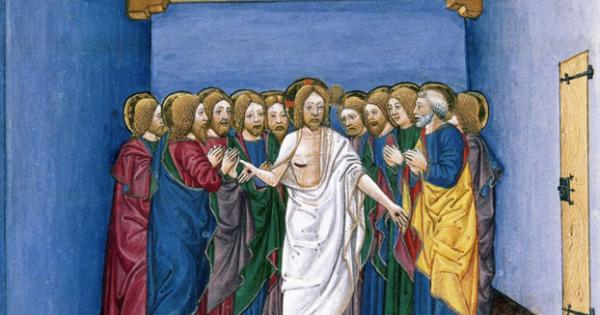
The risen Jesus appears to his disciples, by Unknown Italian artist, 1476

[Note: The earliest manuscripts and some other ancient witnesses do not have verses 9–20.]

When Jesus rose early on the first day of the week, he appeared first to Mary Magdalene, out of whom he had driven seven demons. She went and told those who had been with him and who were mourning and weeping. When they heard that Jesus was alive and that she had seen him, they did not believe it.

Afterward Jesus appeared in a different form to two of them while they were walking in the country. These returned and reported it to the rest; but they did not believe them either.

Later Jesus appeared to the Eleven as they were eating; he rebuked them for their lack of faith and their stubborn refusal to believe those who had seen him after he had risen.

He said to them, “Go into all the world and preach the gospel to all creation. Whoever believes and is baptized will be saved, but whoever does not believe will be condemned. And these signs will accompany those who believe: In my name they will drive out demons; they will speak in new tongues; they will pick up snakes with their hands; and when they drink deadly poison, it will not hurt them at all; they will place their hands on sick people, and they will get well.” (New International Version)
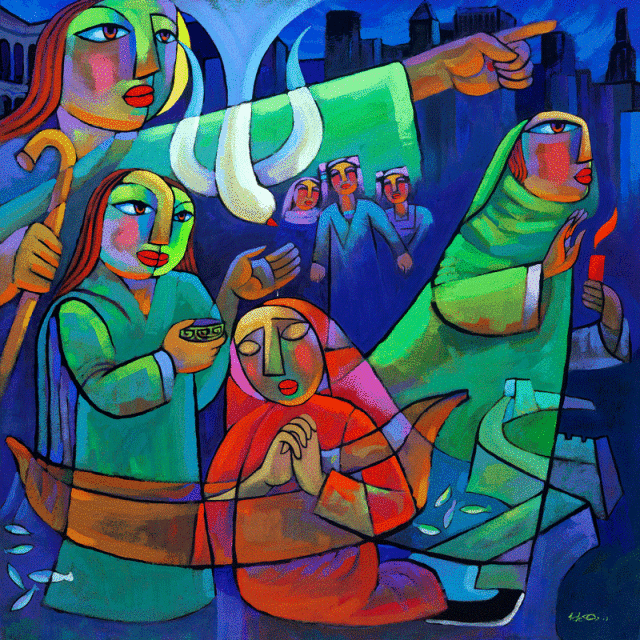
The Great Commission, by He Qi

So, how do you view the Bible? Some view it as a direct communication from God to human authors, as if the Lord actually wrote it all, akin to how Moses received the Ten Commandments. Others see the Bible as a thoroughly human invention of literature about God. And then there are those who are somewhere in-between the two views.

Textual criticism is a branch of study that examines a literary work, and aims to establish the original text. This is important and needed, especially since we have all sorts of ancient pieces of literature. We rely upon learned scholars who are fluent in the original languages, and in the examination of texts, so that we can have reliable translations of those texts.

Therefore, textual criticism of the Bible means thinking critically about manuscripts and variations in the biblical texts found in those manuscripts, in order to identify the original reading of the Bible. Keep in mind that, prior to the invention of the printing press, copies of everything had to be hand written. Scribes were trained scholars who meticulously copied manuscripts; and human error was always a part of the process.

The New Testament was copied by thousands of people in thousands of places in dozens of languages. Though that reality can make textual criticism rather complicated, this diversity is also a blessing; it speaks to the high probability that we have a very close and reliable authentic original Bible – namely because so many people were involved in copying scriptural texts.

Today’s lectionary reading is an entire chunk at the end of Mark’s Gospel that is very difficult to ascertain whether it was original to his writing, or not. If you are of the ilk that the Bible is a God-authored book, you will likely want to resolve this tension. And if you’re not, you just might be rolling your eyes at this point, as if this is all silly stuff that doesn’t matter.

I’m suggesting it is neither as silly nor as serious as some want to make it. It just is. And sometimes we must accept what is, without always having to explain it in objective Enlightenment terms; or relegate it to the realm of the ethereal and mystical.

Instead, we can deal with the text we have in front of us without any wringing of the hands, or ignoring it altogether. And what we have, it seems to me, is this: a text of Scripture that is consistent with the rest of Mark’s Gospel in showing us the nature of both belief and unbelief.

An ancient papyrus fragment of Mark’s Gospel

To believe, or not to believe? That is the question.

Throughout the Gospel of Mark, we are confronted with the choice of believing or disbelieving the acts of Jesus in his earthly ministry. And that issue of faith comes to a head with Christ’s resurrection.

The women exhibited belief. They made the pilgrimage to Christ’s tomb and discovered it empty. It is upon the testimony of women – even though a woman’s testimony was not considered reliable in that day – that believers know Christ is risen from death.

The men, however, are nowhere to be found. One reason for unbelief by people who ought to know better is that they go looking for all the wrong sort of evidence. While on this earth, Jesus refused to be like any sort of worldly ruler; he sought to use his authority by being a servant; and he tapped into the power of humility and love.

If we go limiting our epistemology (the study of how we receive knowledge) then we will likely not discover the truth about much of anything. The male disciples refused to believe the testimony of the female Mary Magdalene. The risen Christ finally showed himself and rebuked the stubborn men.

To see Jesus will take something else, something more, than our standard use of three dimensions and five senses and critical thinking skills. As important and needed as they are, it isn’t enough to truly see the risen Lord. We need to bring in some other epistemic impulses: the conscience and the gut; the spirit and the heart; intuition and experience; and the testimony of witnesses whom we would rather dismiss, than listen to.

Jesus ascends to heaven, but not everyone sees it – for obvious reasons. There are some who may search for evidence their entire lives, never to find it, because they want confirmation by means of their own mentally contrived and culturally conditioned constructs.

The Gospel is neither ant-intellectual nor only understood by the scholarly and learned; the good news of Jesus Christ is both simple and complex, easy to understand and hard to comprehend, compelling and revolting. And there is one thing for sure: the person and work of Jesus will always challenge us, change us, and move us.

The story is still being written, not just with pens and keyboards, with textual criticism and documentary evidence, but with mercy and love upon the tablet of the heart.

Lord, I want to believe. Help me in my unbelief! May I see and hear the risen Savior, through the enablement of the Spirit. Amen.

Jesus Is In the Room (Luke 24:36b-48)

Jesus appears to the apostles, by Duccio di Buoninsegna (1255-1319)

Jesus himself stood among them and said to them, “Peace be with you.” They were startled and terrified and thought that they were seeing a ghost. He said to them, “Why are you frightened, and why do doubts arise in your hearts? Look at my hands and my feet; see that it is I myself. Touch me and see, for a ghost does not have flesh and bones as you see that I have.” 

And when he had said this, he showed them his hands and his feet. Yet for all their joy they were still disbelieving and wondering, and he said to them, “Have you anything here to eat?” They gave him a piece of broiled fish, and he took it and ate in their presence.

Then he said to them, “These are my words that I spoke to you while I was still with you—that everything written about me in the law of Moses, the prophets, and the psalms must be fulfilled.” 

Then he opened their minds to understand the scriptures, and he said to them, “Thus it is written, that the Messiah is to suffer and to rise from the dead on the third day and that repentance and forgiveness of sins is to be proclaimed in his name to all nations, beginning from Jerusalem. You are witnesses of these things. (New Revised Standard Version)

Hanging Out and Scratching Their Heads

Christ’s disciples were abuzz. Two dudes showed up and told eleven of the original disciples that they had seen and talked to Jesus himself! This was a lot to wrap both their heads and their hearts around. Could they dare to hope it is true?

Peter and John encountered an empty tomb. And now these guys from Emmaus are giving this wild testimony of a risen Savior. Into the weird mix of doubt, curiosity, grief, hope, wondering, and outright confusion, Jesus materialized out of the blue saying, “Peace be with you.”

Already feeling unsettled and uncertain, the disciples had anything but a peaceful response to the presence of their Lord. Startled, troubled, and frightened they were, as if somebody had just dropped a skunk into the room.

Why the fear? Why not be overjoyed or overcome with sheer delight at seeing Jesus?

The disciples were caught off guard, as if they had zero expectation of seeing Jesus. Believing him to be dead, they immediately went to thinking this was some ghost. After all, the door was locked. Nobody could have gotten into the room without the disciples knowing it. (John 20:19)

A fresco of Christ appearing to the disciples, in the Visoki Dečani Monastery, Deçan, Kosovo

Face to Face with Faith

As it turns out, faith and belief are not uniform static terms. There are layers to faith. Yes, the disciples really did believe, and their faith developed over time with Jesus. However, their belief had not yet come to full bloom. So, in this sense, they still possessed a lack of faith and were rebuked by Jesus for it. (Mark 16:14)

A full-orbed belief in the Lord Jesus Christ is more than words, more than making professions, and more than signing-off on a doctrinal statement of faith. Faith is shown for what it is through our actions. (James 1:19- 2:26)

Faith comes to fruition when the head, the heart, and the hands all align together and conspire to proclaim the gospel in thought, word, and deed. If they are misaligned or incongruent with each other, then that faith is inadequate. There is yet another level to the belief which needs to emerge.

Perhaps this is instructive for people today. While maintaining beliefs about the person and work of Jesus, and acknowledging Christ’s death and resurrection, some Christians live as though Jesus had never risen from the grave. If Jesus were to suddenly show up and say, “Peace be with you,” like a startled puppy, they’d likely have an accident on the floor.

It’s a Real Resurrected Body

As Jesus had done so many times before in his earthly ministry, he invited the disciples to experience him in a real, tangible, visceral way. This is no ghost. This is a Christ who has physical flesh and bones. You can eat with this Jesus, real food and drink. Look at his hands and feet. Touch and feel them if you must. But, by all means, believe!

Christ is risen. So, now what? This is what the earliest of disciples struggled to understand – how to live in the reality of resurrection, and how Jesus is present with his followers. Christ is with us as a real human and as the real God.

Although Jesus appeared to be a ghost because he could seemingly pass through things, he is not. Christ has a very real body with flesh and bones, although it is a glorified resurrected body which isn’t quite the same as our current earthly bodies. He feels hunger and eats food.

Today’s story follows the Emmaus Road experience in which two people encounter the resurrected Christ. They didn’t even notice that it was Jesus and that they were looking at a glorified body. In that story, Jesus went with them and had a meal around the table.

The Disciples Are Now Witnesses

The eyes of the disciples were opened so that they could truly see Jesus for who he really is. And it happened in their communal eating together – just as it did in the previous story with the friends from the Emmaus Road. Specifically, their new spiritual sight enabled them to be witnesses to the reality of Christ’s resurrection.

The disciples seeing Jesus empowered them to proclaim the good news that repentance for the forgiveness of sins is real; deliverance from our guilt and shame can really happen, when we confess it and turn from it. No more being locked-up in a room in fear, or in a metaphorical personal prison of anxiety.

We Are Now Empowered

The post-resurrection encounter of the disciples and Jesus would not be confined to a one room lock-in experience. The Spirit of God will come upon all sorts of people, all over the world. The sadness of crucifixion and death transforms into the joy and confidence of gospel proclamation. A true release from the shackles of fear and guilt result in a giddy blabbering about Jesus everywhere one goes.

It turns out that seeing and touching Christ’s wounds on his hands and feet doesn’t evoke bad nightmares, but elicits good dreams for the future of faith – that resurrection is a reality, is reachable, and is a path to experience the blessing of God.

Jesus is in the room, my friend. Let your fear be changed into joy.

Holy and righteous God, you raised Christ from the dead and glorified him at your right hand. Let the words of Holy Scripture, fulfilled in Jesus your Son, burn within our hearts and open our minds to recognize him in the breaking of bread. Amen.

Spiritual Sight and Power (Acts 3:1-10)

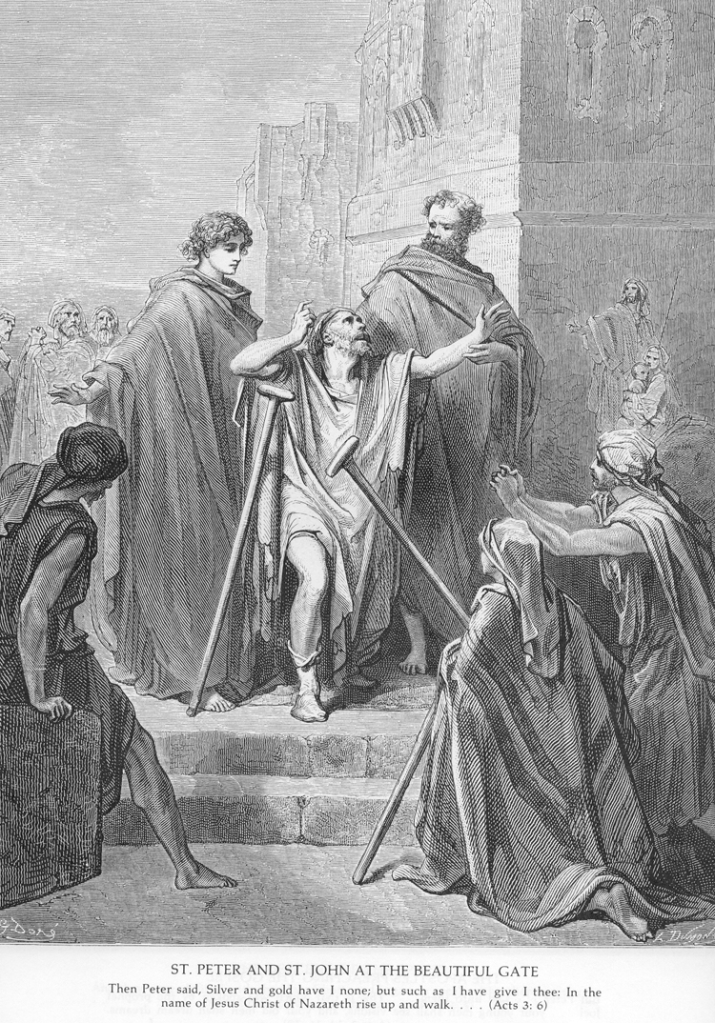
Peter and John heal the crippled man, by Gustave Doré (1832-1883)

Peter and John were going to the temple courtyard for the three o’clock prayer. At the same time, a man who had been lame from birth was being carried by some men. Every day these men would put the lame man at a gate in the temple courtyard. The gate was called Beautiful Gate. There he would beg for handouts from people going into the courtyard. When the man saw that Peter and John were about to go into the courtyard, he asked them for a handout.

Peter and John stared at him. “Look at us!” Peter said. So the man watched them closely. He expected to receive something from them. However, Peter said to him, “I don’t have any money, but I’ll give you what I do have. Through the power of Jesus Christ from Nazareth, walk!” Peter took hold of the man’s right hand and began to help him up. Immediately, the man’s feet and ankles became strong. Springing to his feet, he stood up and started to walk. He went with Peter and John into the temple courtyard. The man was walking, jumping, and praising God.

All the people saw him walking and praising God. They knew that he was the man who used to sit and beg at the temple’s Beautiful Gate. The people were amazed and stunned to see what had happened to him. (God’s Word Translation)

Peter and John at the gate of the temple, by Rembrandt

Money isn’t everything; and neither is having a lot of talent or giftedness. Yet, we often live our lives as if we cannot do much because of our lack of personal abilities and financial resources. But we can. All we need to do is give something that we all have to give.

Peter and John were disciples of Jesus. Though Jesus has ascended to heaven and the gift of the Spirit has come, they still maintained a daily rhythm of prayer three times a day at the temple.

As the two of them were about to attend afternoon prayer, they encountered a man at the gate. We are told that this particular guy was crippled. He came every day to the temple in order to beg. What is interesting to me is that this surely was not the first time Peter and John encountered the guy who begged at the gate.

Did they just ignore him? Was he one of many? Whatever the reason, they never put their eyes to him before. But on this occasion they did. In fact, they fixed their gaze on him and really took the time to stop and look at him.

I remember when my late brother-in-law had a complete turn around of his life to Jesus. At the time, he walked to work every day in the city. And every day there was a beggar on the corner. Most every day he had ignored him. One day he even spit on him.

The day after his great awakening to the Lord, he was walking to work and saw the beggar. But this time he really saw him. And when he looked into the man’s eyes, he had pity upon him. My brother-in-law – who took his lunch with him each day – surrendered it to the beggar. Eventually, he began a practice of bringing enough food for two, sitting down with the man, and talking with him as they ate together.

Perhaps for the first time, these disciples of Jesus, Peter and John, see the man who was there every day at the temple. They have not a thing with them. No money. No lunch. But they had something better: the power of grace and love.

In our contemporary Western society, we prefer things to be efficient and simple. Giving money, preferably online and dispassionately, is ideal for us. This way, we can give without any strings attached while feeling good about ourselves.

Yet, my brother-in-law and Peter and John decided to give the gift of connection. And that meeting of the eyes was the conduit for spiritual power to flow from one person to another. Doing what they saw Jesus do, the disciples gave the man who could not walk his legs back.

As a result, the guy was no longer lame nor a beggar. He became a fellow witness of God’s mercy and power. He went right up into the temple with Peter and John – walking and jumping and praising God.

It is not really money that gets things done. And it’s not our ingenuity or intelligence that really makes things happens. Throughout the book of Acts, demonstrations of God’s mighty power in the name of Jesus Christ is paramount. And those with alternative sources of power are shown to be powerless when it comes to life transformation.

In all of human history, including today, people like power; and power attracts wealth, as well as wealth attracting power. But the power of Christ’s resurrection is completely disconnected from worldly wealth. And it is never used for personal gain or popularity. And what’s more, this sort of power is available to every Christian – and not just a special class of super-Christians or clergy persons.

If we trace apostolic work in the New Testament, we shall find that the people with such spiritual power received it not because of extraordinary faith or exceptional virtue; instead, the Spirit grants us the ability to make a difference in this world by granting us the gift of sight – to truly see another as the precious image bearer of God that they are.

There are people right in front of us every day that we might not see. If we are wondering how to tap into the spiritual power of resurrection, we have no further to look than observing and gazing upon the folks within our eyesight, so that we can see them in new and redemptive ways.

Holy Lord, you gave us something more powerful and more valuable than riches; you have given us healing and hope. Please bring that healing and hope into our world and show us evidence of your presence in our lives. Amen.

If You Ask a Question, Be Ready for the Answer (Mark 12:18-27)

The Pharisees and Sadducees Come to Tempt Jesus, by James Tissot (1836-1902)

Some Sadducees, who say there is no resurrection, came to him and asked him a question, saying, “Teacher, Moses wrote for us that if a man’s brother dies, leaving a wife but no child, the man shall marry the widow and raise up children for his brother. There were seven brothers; the first married and, when he died, left no children,and the second married the widow and died, leaving no children, and the third likewise; none of the seven left children. Last of all the woman herself died. In the resurrection, when they rise, whose wife will she be? For all seven had married her.”

Jesus said to them, “Is not this the reason you are wrong, that you know neither the scriptures nor the power of God? For when people rise from the dead, they neither marry nor are given in marriage but are like angels in heaven. And as for the dead being raised, have you not read in the book of Moses, in the story about the bush, how God said to him, ‘I am the God of Abraham, the God of Isaac, and the God of Jacob’? He is God not of the dead but of the living; you are quite wrong.” (New Revised Standard Version)

Two-thousand years ago, in the first century C.E. (Common Era) the Jewish Sadducees learned the hard way that trying to discredit Jesus in public with silly questions is a bad idea.

Somehow, probably in a back room and perhaps drinking too much wine, they came up with a story designed to show, once and for all, that Jesus was nothing but a hayseed yokel from the bumpkin village of Nazareth who believes in a crazy notion like resurrection.

The Sadducees wanted a very public and definitive display that Jesus was a backward hick, not worth the time of day. So, they concocted a bizarre hypothetical story meant to discredit the supernatural. 

The Sadducees went to the Old Testament, and pointed out in the law that if a man dies without having children, the brother must marry the widow, thus keeping the legacy and land of the dead man in his family. By conjecturing that if this were to happen seven times over, they posed a hypothetical question: Whose wife would she be among all the brothers at this supposed resurrection?

As they were snickering to themselves believing that they had demonstrated the absurdity of resurrection, Jesus turned the tables on the Sadducees. Here are some observational lessons from this Gospel reading for today:

  1. Think again before you try and trip-up Jesus with philosophically ethereal questions.
  2. Consider that you will receive a rebuke from Jesus for being ignorant, mistaken, and wrong, if you try to posture yourself and control how a conversation with him ought to go.
  3. Be aware that Abraham, Isaac, Jacob, and Jesus are all alive. The Sadducees, however, no longer exist.
  4. Realize that Jesus will take the time and attention to listen and give feedback – maybe the kind you weren’t looking for.
  5. Understand that many things we get hung up on, Jesus doesn’t – and what Jesus sticks on, we may act like Teflon and let it slide.

And the lessons could keep coming, because there is always something to learn and discover when being with Jesus.

To deny resurrection is to deny Jesus. Christ died. He’s now alive. Hence, there is a resurrection. More than that, because Christ lives, others live. This is the Christian’s hope. 

I fully understand plenty of people don’t believe in resurrection. That’s their prerogative. I will simply point such a person no further than their own mind and heart. “Search your feelings,” as the Jedi would say, “What do they tell you?” The evidence you need, you already have.

And this was the penultimate lesson of Jesus to the inquisitive Sadducees. They already had the answer to their question for Jesus. It was right under their noses the entire time – right their in the law that they valued so highly. They just plain didn’t see it.

You already have everything you need for life and godliness in this present evil age. There’s no need to play philosophical games with Jesus.

One of the great sages of the last century, Dorothy from The Wizard of Oz, wisely said:

“If I ever go looking for my heart’s desire again, I won’t look any further than my own backyard. Because if it isn’t there, I never really lost it to begin with.”

Resurrection has always been there because God has always been around – even when we don’t see, perceive, or acknowledge the divine. Just because one may not believe in life arising from death, doesn’t mean it isn’t there or doesn’t exist.

It probably would not be a good idea to procrastinate the inevitable end-of-life scenario that awaits us all. Anytime is the right time to do a bit of personal funeral planning. Yet, if we mire it all with the esoteric hypothetical questions about what would happen in the most far-fetched of scenarios, methinks God is big enough and smart enough to see through our puny charade.

Better to ponder what is truly within your own soul, and how Jesus might already be present within and around all things, without us even knowing it. 

A good place to start in peering within is to give a straightforward honest reading of the New Testament Gospels and discover what resonates deeply with you about the person and work of Jesus.

Feel free to question Jesus about anything you want; just brace yourself for what kind of answer you might receive.