Titus 2:7-8, 11-15 – “Yes” to Grace

Grow in the grace and knowledge of our Lord and Savior Jesus Christ. (2 Peter 3:18)

In everything set them an example by doing what is good. In your teaching show integrity, seriousness and soundness of speech that cannot be condemned, so that those who oppose you may be ashamed because they have nothing bad to say about us.

For the grace of God has appeared that offers salvation to all people. It teaches us to say “No” to ungodliness and worldly passions, and to live self-controlled, upright and godly lives in this present age, while we wait for the blessed hope—the appearing of the glory of our great God and Savior, Jesus Christ, who gave himself for us to redeem us from all wickedness and to purify for himself a people that are his very own, eager to do what is good.

These, then, are the things you should teach. Encourage and rebuke with all authority. Do not let anyone despise you. (NIV)

It is grace which teaches us, enabling and ennobling us to forsake ungodliness and embrace hope. Grace is the scandalous and radical blessing of mercy, forgiveness, and love to those undeserving of it. Judgment is no teacher; it only condemns with criticism leading to self-contempt. Grace inoculates us from the self-despising words of the inner critic, whereas the judgmental voice heaps derision upon the soul and agrees with anyone who comes along and ridicules, despises, or scorns us.

God’s grace in Christ is redemptive. It challenges the notion we are not enough in comparison to others. Grace makes us better instead of telling us we should be better. The redeemed person, made over with abundant grace, accepts herself as a precious child of God, and so, becomes impervious to the critical rejection of others. After all, she has been received and adopted by the Lord of all. Grace enables us to advocate for ourselves and others, since we have an Advocate alongside us continually.

The shame of our past, the struggles of the present, and the stress of a perceived future all begin to melt next to the warm and purifying fire of grace. Jesus has snatched us back. We belong to God. Eager to be upright and holy in all things, and patiently waiting for the return of Christ, every good thing Christians are and do is because of grace.

The grace of God empowers us to choose the good and eschew the bad. It lifts us with encouraging love and support while simultaneously strengthening our faith to chuck the ungodliness. It is imperative we get interested in the truth of grace as it pertains to self. In fact, the Apostle Paul began his letter to Titus with an emphasis on what is true:

Paul, a servant of God and an apostle of Jesus Christ to further the faith of God’s elect and their knowledge of the truth that leads to godliness— in the hope of eternal life, which God, who does not lie, promised before the beginning of time. (Titus 1:1-2, NIV)

God is gracious. God is true. Therefore, grace is truth. The believer leans into and relies upon the unmerited and undeserved mercy and kindness of God, who does not merely speak truth but is truth itself. “I am the truth,” Jesus said to his disciples, as the very embodiment of honesty and veracity. (John 14:6)

There is a significant difference between doing good because of arm-twisting and living a godly life because of grace. Being cajoled into living the straight-and-narrow is accomplished typically through shaming another to the point of conformity. This is not the way of Christ. Grace bestows renegade love to extravagant sinners. Such a gift is so incredibly overwhelming that gratitude with delightful duty is the typical response.

Furthermore, grace is to be the example given to others. The Christian’s life is to be a model of saying “no” to unconscionable behavior and “yes” to a mindful righteousness which has awareness of the ways of grace. Like changing a filthy set of clothes, we are to put off self-condemning lies and put on the grace of the Lord Jesus. We are to put off the old ratty garments of judgmentalism and put on the new clean raiment given by Christ which is worthy of a royal child of God. Well, of course, we do not deserve this – which is why it is grace.

God is shaping and forming a people of grace in faith communities, distinct from and in stark contrast to judgmental persons in unjust structures of the world – a holy people, a special and treasured possession of the Lord, committed to observing divine ways of grace. (Deuteronomy 26:16-19)

Grace is one-way love. Watch other people you respect as examples and consider their happiness. You will see it over and over: one-way love lifts-up. One-way love cures. One-way love transforms. It is the change agent of life.

Almighty God and ever-present Lord of grace, you have brought me in safety to this new day. Preserve me with your mighty power, that I may not fall into sin, nor be overcome by adversity. And in all I do today, direct me to the fulfilling of your gracious purposes through Jesus Christ my Lord. Amen.


Matthew 17:22-27 – Because We Can

When they came together in Galilee, Jesus said to them, “The Son of Man is going to be delivered into the hands of men. They will kill him, and on the third day he will be raised to life.” And the disciples were filled with grief.

After Jesus and his disciples arrived in Capernaum, the collectors of the two-drachma temple tax came to Peter and asked, “Doesn’t your teacher pay the temple tax?”

“Yes, he does,” he replied.

When Peter came into the house, Jesus was the first to speak. “What do you think, Simon?” he asked. “From whom do the kings of the earth collect duty and taxes—from their own children or from others?”

“From others,” Peter answered.

“Then the children are exempt,” Jesus said to him. “But so that we may not cause offense, go to the lake and throw out your line. Take the first fish you catch; open its mouth and you will find a four-drachma coin. Take it and give it to them for my tax and yours.” (NIV)

In ancient times, the Jerusalem Temple was designed to serve as the bridge between God and humanity. It was the place where God “came down” and accepted the offerings of the priests on behalf of the people. In Christian theology, Jesus came to this world to become the permanent bridge and the eternal temple.

Jesus saw himself as the ultimate connector who spans the great expanse between God and people. Christ ascended to heaven and gave the Spirit to his people, the Body of Christ. Basic Christian ecclesiology recognizes the Church (both individual Christians and the Church universal) as the Temple of the Holy Spirit. The Spirit is the continuing presence of Jesus on this earth. Jesus, Spirit, and Church are inextricably bonded with divine superglue to engage in the mission of being God’s Temple – the place of connection between the human and the divine.

Jesus used the situation of a question asked about taxes and the Temple to speak and illustrate the value and import of connecting with both God and others.

Why did Jesus pay the temple tax?

A “drachma” was about a day’s wage. In the time of Christ, there was a two-drachma tax which was levied by the Jewish authorities on every male Jew between the ages of 20-50. The tax was implemented to support the temple building and all the services that went into it.

The temple tax was not compulsory, so typically, the tax collectors did not impose it on the poor – which is why the collectors asked Peter whether Jesus pays the tax or not, because Jesus was poor. Jesus paid the temple tax out of humility, even though he was exempt, so to not offend and cause unnecessary scandal. Said another way, Jesus and his disciples did not have to pay the tax but instead chose to use their freedom for the benefit of others.

There is freedom in Christ. Yet, because of love, and a focus on need instead of rights, we can choose to use our freedom to serve larger purposes than just our own interests. The Apostle Paul later framed it this way:

It is necessary to submit to the authorities, not only because of possible punishment but also as a matter of conscience. This is also why you pay taxes, for the authorities are God’s servants, who give their full time to governing. Give to everyone what you owe them: If you owe taxes, pay taxes; if revenue, then revenue; if respect, then respect; if honor, then honor. (Romans 13:5-8, NIV)  

We exist to serve more than ourselves. God has purchased and adopted us through the death of Christ; we are now the Temple of the Spirit. We can emulate the Savior and choose humility to serve others. A logical question arises about all this: If I do this and focus on responsible service instead of rights, then how am I going to make ends meet?  Is any of this realistic or practical?

How did Jesus pay the temple tax?

Jesus cares about supplying needs. Jesus can and does take care of people who choose to give for the benefit of others. Jesus told Peter the fisherman to go out and fish. A crazy thing happened – Peter found not only a two-drachma coin to cover the annual tax but a four-drachma coin to cover both Jesus and Peter’s tax!  This was a powerful lesson about God’s abundant grace. 

As God’s people, we not only believe in the miraculous; we depend on miracles. We can bank on Jesus supplying our need. This is not a health and wealth gospel. Jesus was monetarily poor, so I am not sure how anyone can justify that God wants all believers to be financially rich.

There was once a man I knew who only had $100 to his name. He got to know another man who needed a suit for his job. The man with a $100 gave it all to the man who needed the suit. That man is alive and well today with all his needs met. He is not rich. However, he is quite happy. If we never need a miracle, we have never given of ourselves enough to need one.

Peter was a fisherman, so Jesus told him to fish and there was a miracle. Sometimes we might get the wrongheaded notion we must do something way outside of our given giftedness. God created each person with a unique intellect, abilities, and strengths and so, we are to use them to affect a miracle – just as Peter did.

We can have a big picture view of our shared humanity without narrow provincial views which are unable to see the vast scope of human need. And so, we can trust God to use us for divine purposes. We can exercise faith in the miraculous for both ourselves and others. We can embrace Christ’s mission in this world to such a degree that we would never consider living any other way. May we do it because we can.

God of all abundance and grace, help us to find firm ground in a shaky economy. Provide jobs for the unemployed; give us strength and peace when anxiety and worry come knocking; grant us patience when things look bleak; and, bring us the serenity of your presence so that we can do your will for the salvation of others through Jesus Christ our Lord in the power of your Holy Spirit. Amen.

John 6:25-35 – The Bread of Life

The Breaking of the Bread by Sr. Mary Stephen

When they found him on the other side of the lake, they asked him, “Rabbi, when did you get here?”

Jesus answered, “Very truly I tell you, you are looking for me, not because you saw the signs I performed but because you ate the loaves and had your fill. Do not work for food that spoils, but for food that endures to eternal life, which the Son of Man will give you. For on him God the Father has placed his seal of approval.”

Then they asked him, “What must we do to do the works God requires?”

Jesus answered, “The work of God is this: to believe in the one he has sent.”

So, they asked him, “What sign then will you give that we may see it and believe you? What will you do? Our ancestors ate the manna in the wilderness; as it is written: ‘He gave them bread from heaven to eat.’”

Jesus said to them, “Very truly I tell you, it is not Moses who has given you the bread from heaven, but it is my Father who gives you the true bread from heaven. For the bread of God is the bread that comes down from heaven and gives life to the world.”

“Sir,” they said, “always give us this bread.”

Then Jesus declared, “I am the bread of life. Whoever comes to me will never go hungry, and whoever believes in me will never be thirsty. (NIV)

Christians everywhere hold to Jesus as the Son of God, Lord of the universe, and Savior of all. However, for most people who were following Jesus around in the first century, this was not their understanding of Christ.  In his earthly ministry, Jesus spoke in ways that introduced people to who he really was and sought to bring them to a point of following him based on his identity. 

Jesus wanted the crowds to him for who he really is – themselves for what they really needed – and follow him based on the deepest needs of their lives. I believe Jesus is the hope of all nations and all people, and in him humanity’s most basic and profound needs are met for forgiveness, love, and purpose in life. To address this, I ask three basic philosophical and theological questions of life:

What should human beings seek the most and work the hardest for in life?

The responses in history are legion. The ancient Greek philosopher Aristotle thought a proper appreciation for an ethical and virtuous life found in practical wisdom was where people’s most concerted efforts should be.  Karl Marx, the father of communism and socialism believed the proletariat should use their heads and their hands to rise above their economic conditions and oppression. In the late 1960’s, Bobby Kennedy said we ought to be working the hardest to achieve justice and not advance ourselves on the misfortunes of others. In more recent times, the Harvard Business Review is continually on the lookout for the best ways of being efficient, productive, and making the most of time because work itself is paramount.

Jesus said people are not to work for food that spoils, but for food that endures to eternal life.

He said this coming off one of his most famous miracles of all, the feeding of the five thousand.  Afterward, Jesus withdrew overnight to a place of solitude and prayer. He did another miraculous event by walking on water out to his disciples in a boat. In the morning, he and they were on the other side of the lake. The crowd did not know where he was and went looking for him.

Jesus knew the crowd of people wanted more. What they got was perhaps unexpected. Jesus told them to put their efforts into getting the bread that keeps on feeding. Jesus wanted the people to pursue and follow him not only for the things he could do for them, but to seek him for who he is. 

Jesus had further aspirations for the people beyond providing a supper – he desired the people to feast on himself – to ingest him, to take him into their lives in a deep and profound way as the fulfillment of all the hope and promises of the Old Testament. 

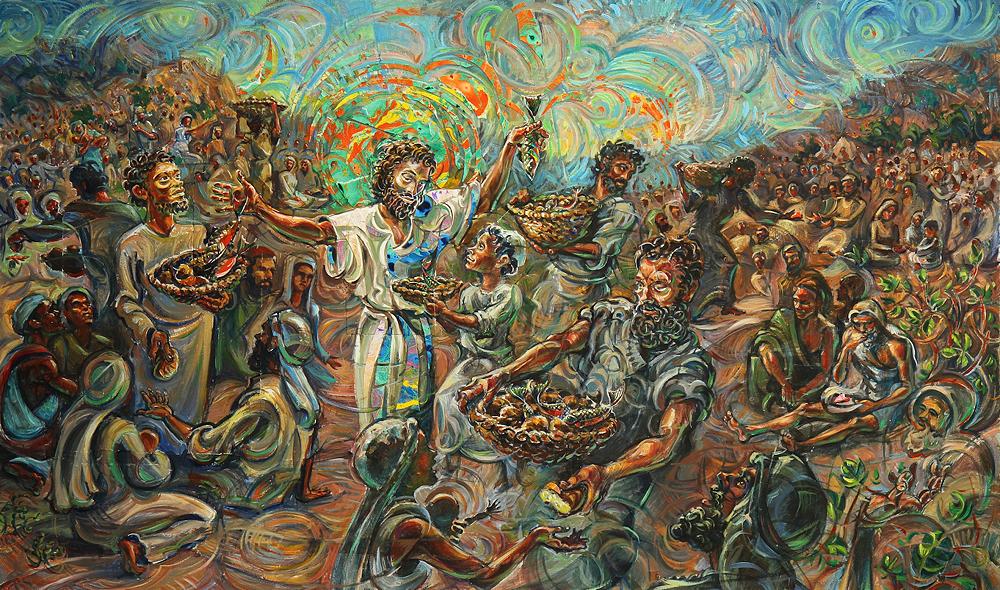
Jesus Feeds the Crowd by American artist Eric Feather

Jesus is the bread, the basic staple of life, that meets the cravings and needs of all people everywhere. Starving people, both in body and spirit, find in Jesus a meal which keeps on giving, a feast of grace that is both delectable and unending.

The answer to my own question is that, for me, one’s highest pursuit and greatest quest is Jesus. Apart from Christ, I will starve. Furthermore, Jesus is not some cheap fast food off a value menu; he is real soul food to be ingested and enjoyed with others.

I believe people need Jesus. A passionate seeking of Jesus, to follow him, live for him, center life around him, is my most ardent desire. I do not simply desire Jesus for what he can do for me; I vigorously chase after him because if I do not have Jesus, I will die, I will starve to death. 

For me, Jesus is so much more than a nice addition to my life, like a new puppy; Jesus is Lord and Savior. I must consume him, or I will be completely undone, and I will not survive! Jesus is my bread, my food, my life!  I cannot survive on a daily crumb, but I feast on every word that comes from the mouth of Jesus because in Christ there is the life that is truly life.

What should human beings be doing to do the works of God?

The short answer: believe. To have and keep faith in the One God has sent, Jesus, is the primary “work” that pleases God. Jesus communicated to the crowd that they can do so much more than follow him for another earthly meal – they can place their faith and hope in him for food that will last, food that will transcend the three-dimensional world.

Faith is more than an intellectual recognition to some facts about Christianity. And belief is not about always having clarity and certainty to every facet and loci of Christian doctrine. No, Christian faith is complete trust in Jesus as our hope and our life. Education, economic uplift, political stability, and institutional peace and justice are important activities for this world. For the Christian, the accomplishment of these and so much more comes from the grace of God in Christ. As people come to the end of themselves with their homebrewed and half-baked attempts at being satisfied, Jesus stands at the door and knocks, the Living Bread who offers himself for humanity’s deepest needs.

Giving kudos to Jesus might be nice, yet Christ himself cares about folks placing their trust in him for grace, forgiveness, and hope in their world. Jesus longs to reconnect people with God through giving himself as the means of making that happen. All the works we do in this life, every good deed we accomplish, and each positive action we do are all helpful and necessary… and they all pale in comparison to the greatest work of all, to believe in Jesus Christ as the hope of this world, the hope of your family, the hope of the church, and the hope of your life and mine. And it is all accessed by faith in the Son of God who loved me and gave himself for me.

Who really does the will of God?

Answer: Those who come to God through Christ. The person who comes to Jesus will never go hungry, and the one who believes in Christ will never be thirsty. Such persons do the will of God. They do not settle for signs of Jesus but desire him and find their ultimate satisfaction in him.

Yet far too many people settle for signs of Jesus rather than Jesus himself. It would be silly if I drove to a sign on Interstate 94 that said, “Milwaukee” and sat there under it, believing I was really in the city of Milwaukee. And it would be weird if I looked around for the art museum or other places underneath the sign.

Church buildings and furniture, stained-glass windows, pews, and even the Bible are not Jesus – they are simply and hopefully signs which point to him. They are all designed to lead us to Christ so that we may come to him. And coming to Christ is what the Lord’s Supper, Holy Communion, the Eucharist, and any other description you want to give about ingesting Jesus is about. The elements of bread and cup bring us to Christ so that we can experience Jesus and be joined to him by faith in a mystical union of human and divine in the unseen heaven.

Conclusion

Where will you find true satisfaction and hope? Probably not in the clearance aisle at Wal-Mart. Likely not in conforming to cultural Christianity or embracing generic forms of Jesus as merely good teacher and moral example. Furthermore, life’s ultimate satisfaction and hope are not to be found in a spotless house and perfect kids; in working more hours and making more money. Nor will we find contentment and peace in the radical independence of doing things my way.

Jesus is the Bread of Life. Through ingesting him, passionately pursuing him, believing in him, and coming to him in everything, we find the life that is truly life. Do not settle for any substitutes to Jesus. Come to the real person.

Lord God, you said that when we seek you with all our hearts, you will be found.  As the deer pants for streams of water, so we, your people, long for you in a dry and weary land.  We hunger and thirst for your righteousness.  We deeply desire your presence in all things. So, we die to ourselves and surrender to your will and way for us, by faith trusting you will come into our lives and completely take over. May your blessing rest upon us as we seek Jesus. Amen.

By Forever Be Sure

The Way of Peace

Peace is neither merely the absence of conflict nor simply tolerating each other. Peace in Holy Scripture is cooperative fellowship, a harmonious way of living with God and one another based in the person and work of Jesus Christ. Peace is simultaneously a virtue we already possess and an ideal we need to obtain and live into.

In writing to the Church at Philippi, the Apostle Paul strung together several verbs to make it clear how to achieve peace on the practical level. Six of the verbs are in the imperative form, that is, they are commands.  Paul gave these imperatives to the Church because they were in danger of a breakdown in their fellowship. Embedded within Paul’s message is a deep Christian spirituality based in knowing Christ, with an overall message and imperative to keep persevering and not give up on peace or on one another.

  • Stand firm in the Lord. (Philippians 4:1) 

Standing firm in faith is a function of knowing Jesus Christ – an experiential knowledge beyond mere mental acknowledgement (Philippians 3:7-10). Our feet are to be firmly planted and rooted in the soil of Jesus Christ as our highest value and our surpassing greatness over and above anyone or anything else. 

This first command is a bedrock imperative. We cannot really move to the other five imperatives until we ensure our foundation is solid. In other words, there will be no peace in our personal lives or in our corporate life together unless we embrace Jesus as our most precious relationship.

If our god is our stomach and we do not take charge and own our Christian walk through spiritual practices that connect us with Jesus, then peace will be elusive. We must patiently, deliberately, and slowly plod along with Jesus and follow him as our highest priority in every sphere of our lives.

  • Help resolve disagreements. (Philippians 4:2-3) 

Euodia and Syntyche were two prominent women leaders in the Philippian Church. Whatever their differences were, Paul made it clear to them that they must agree and be like-minded concerning the issue. 

This second imperative goes beyond telling two persons to work out their differences; the church was called upon to help do the work of peacemaking. Because peace characterizes the triune God, and Jesus Christ came to achieve peace on our behalf, God’s people are to be peacemakers.

Many differences are resolved with far fewer disagreements when we abide in Christ. If folks immerse themselves in Scripture and in knowing Christ, instead of taking the stance of being right despite any evidence to the contrary, then a lot less peacemaking would even need to take place.

New Testament scholar D.A. Carson has said, “Personal differences should never become an occasion for advancing your party, for stroking bruised egos, for resorting to cheap triumphalism, for trimming the gospel by appealing to pragmatics.  Focus on what unites you: the gospel. Be like-minded; think the same things; agree with one another. Work hard and humbly on these central issues, and in most instances the peripheral matters will take care of themselves. Resolve to pursue like-mindedness with other believers. This will ennoble and strengthen all sides, so that you will never abandon the Christian walk.”

  • Let your gentleness be evident to all. (Philippians 4:4-5) 

The Christian is to have a basic disposition of humility and meekness. There is to be gracious forbearance with others that is publicly observable. Rejoicing in the Lord need not be a command when we are truly pursuing the experiential knowledge of Christ (because joy then just spills out of us). Gentleness is the fruit of a meek and humble spirit, a direct result of knowing the gentle Savior.

A solid building block of conflict intervention and resolution is a humble and gentle spirit – which goes beyond personal holiness. It is being close enough to rub shoulders with others so that the gentleness can be experienced by another. This will sometimes require getting graciously involved in the interpersonal affairs of others. 

Getting involved does not mean dipping into other people’s business with unsolicited advice, angry diatribes, nor taking sides. It means, rather, extending basic human kindness in all affairs of group life, being part of the solution instead of adding to the problem.

  • Do not be anxious about anything. (Philippians 4:6a)

Where disharmony exists, anxiety is not far behind. Worry about the future only obfuscates a way forward. Sometimes anxiety is rooted in our theology. If we fundamentally view God as a stern Being whose chief activity is dispensing disapproval and wrath, then we will likely live with an underlying sense of anxiety and fear of upsetting such a God. Performance-based living comes from trying to pull ourselves up by our spiritual bootstraps to placate a hard-to-please God who is always looking over our shoulder to make sure we do not mess up.

On the other hand, if our theology has God as a loving Being who is pained by the damage sin does to the souls of people, then we become open to the gracious mending of broken spirits. In the Christian tradition, the death of Christ is the ultimate act of love in handling the sin issue once for all. God in Christ did for us what we could do for ourselves.

Chronic spiritual anxiety usually arises from the inability to perceive a generous and hospitable God having our backs and working on our behalf. Knowing God, who is gracious and compassionate, slow to anger and abounding in steadfast love, leads to peace and rest.  This logically leads to the fifth imperative….

  • Present your requests to God (Philippians 4:6b-7) 

Prayer naturally arises from a heart that knows God is listening. Prayers, petitions, and thanksgivings are all congruent actions stemming from an experiential knowledge of God’s grace.

Having the peace of God which transcends all understanding is a beautiful thing. If our theological view is of God playing games with us, holding out a carrot stick we can never quite reach, then peace will be elusive. Conversely, if we have confidence to present our requests to God and have the discipline to slow down long enough to do it, this inevitably leads to peace.

We are to pray about everything, in all circumstances with all kinds of prayers. Spontaneous prayers, written prayers, heartfelt prayers, silent prayers, and loud prayers are all encouraged. We are to pray without ceasing, praying for everyone – for rulers and all those in authority so that we may live peaceful and quiet lives in all godliness and holiness. Pray, then pray some more. If we struggle to pray, perhaps we struggle with our view of God.

  • Put it into practice (Philippians 4:8-9) 

Armed with a vigorous theology, the task of spiritual formation is unlearning harmful theological approaches and discovering new and helpful ways of the Divine. This requires some basic spiritual disciplines of Scripture reading and prayer (both individually and communally), and practices of silence and solitude which put us in a position to connect with God and self.

Conclusion

Healthy spiritual rhythms help us know God and God’s peace. To put the six imperatives into practice, a plan is needed which translates good intentions into good habits. We need a rule of life. God may be opposed to earning salvation but is not opposed to sanctified effort – and effort is necessary for effective spiritual practices.

Do you have a method for being a peacemaker? Are you developing ways for making gentleness evident? Is there a plan in place for avoiding anxiety? What is your agenda for structuring consistent prayer?

Experiencing peace does not spontaneously materialize. Peace occurs through tapping into the spiritual resources we have in Jesus Christ. Realizing practical peace is rolling up our spiritual sleeves and working on the biblical imperatives Paul provided for us. It is everyone’s job, and not only the job of a few. 

May you know the peace of Christ this day.

May you experience God as your refuge and strength.

May God hasten the day when wars shall cease, and poverty and pain shall end so that the earth may know and experience the peace of heaven through Jesus Christ our Lord.  Amen.