Luke 9:1-6 – On Power, Authority, and Mission

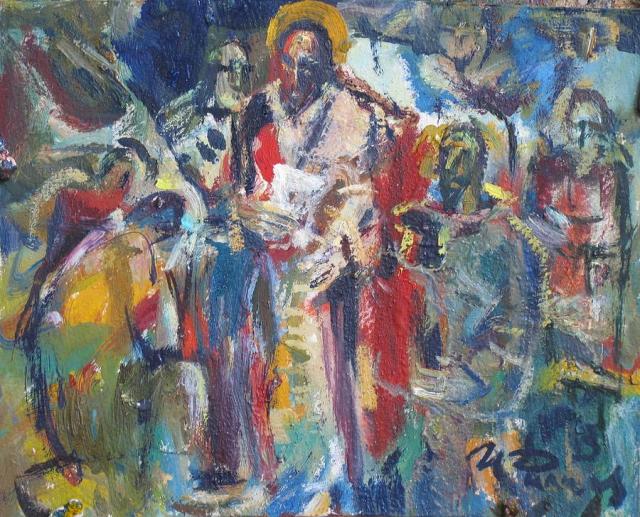
Jesus and the Disciples by Rudolph Bostic (1941-2021)

Jesus called the Twelve together and he gave them power and authority over all demons and to heal sicknesses. He sent them out to proclaim God’s kingdom and to heal the sick. He told them, “Take nothing for the journey—no walking stick, no bag, no bread, no money, not even an extra shirt. Whatever house you enter, remain there until you leave that place. Wherever they don’t welcome you, as you leave that city, shake the dust off your feet as a witness against them.” They departed and went through the villages proclaiming the good news and healing people everywhere. (Common English Bible)

You have likely heard the old nineteenth century adage from a member of the British Parliament, Lord Acton: “Power tends to corrupt, and absolute power corrupts absolutely.” The rest of the quote, which we seldom hear is this: “Great men are almost always bad men, even when they exercise influence and not authority.”

It’s almost as if Jesus knew this well before Lord Acton uttered it nearly two millennia later. Jesus Christ, in a truly wise and generous display of leadership, shared his power and authority with others. Rather than hoarding power and using authority to gain more authority, the Lord Jesus, rightful Ruler of the universe, delegated power and enabled those who ministered with him to share in carrying out his mission.

The only real Christian ministry is a bestowed ministry, granted to us by the delegation of Jesus. What this means for us, practically, is that believers minister as servants of God and stewards of the power and authority given to us. Grasping this basic accountability helps us to truly serve others with sensitivity and care – knowing we must give an account for the privilege of ministering in Christ’s name.

“There is no stronger test of a person’s character than power and authority, exciting as they do every passion, and discovering every latent vice.”

Plutarch (46-119, C.E.)

This has tremendous implications for us in all areas of life. Within the family, this means that parental authority can and ought to be delegated in wise increments, over time, as children grow and mature. The concept that a dad should be some sort of supreme leader who barks orders and demands fealty from mom and the kids is downright misguided, not to mention incredibly weird.

It also means that in the church and in faith communities, the wise use of power and authority will seek to identify and mentor younger disciples who will be given appropriate authority for expected ministry. Church leadership will listen to and equip those who have passions for particular service with the requisite authority to engage in effective ministry.

At the workplace, this involves forsaking a top-down approach of authority in favor of distributing power equitably amongst the workers with the greatest responsibilities.

In the political arena, this means Christians won’t tie their hopes in gaining power but rather in giving it away. They will seek equity and the common good of all citizens. And if that means deferring to a voice which isn’t being heard, then that is precisely what we do. Perhaps we see so little civility and concern for the other because Christians are much too enamored with dramatic miracles fueled by power.

Mosaic in the Papal Basilica, Rome, of Jesus and Disciples

Let’s not lose sight of the reality that healing sicknesses and suppressing the demonic is solely derived from Christ’s own authority, not ours. To press this reality home, Jesus instructed his disciples to take nothing with them. No staff, bread, bag, or money. Live among the locals, with them, on their turf and with their activities. Use the power and authority given to improve their lives and in so doing, lead them to greater spiritual truths.

If they don’t accept this gracious ministry, move on. No arm-twisting. No manipulation. No guilt-tripping. And definitely no using your given authority for grandstanding. A simple warning with shaking the dust off the feet is sufficient.

Every detail of the mission Christ gave to the disciples was a lesson in sheer and total dependence on God. Humble ministry and modest lifestyle will set the best table for a proper focus on benevolent and compassionate ministry. Just as increased knowledge ought to be used to love better and show us how much we actually don’t know, so increased authority ought to be used to serve others better and show us how much power we don’t have so that we might continually seek after the God who possesses all power and authority.

The good news is that God’s infinite and supreme power is given and focused in the person of Jesus Christ, who in turn, graciously bestows the authority to his followers so that they may proclaim forgiveness and new life. It’s a big message requiring large authority. And Jesus freely gives it:

And Jesus came and said to them, “All authority in heaven and on earth has been given to me. Go therefore and make disciples of all nations, baptizing them in the name of the Father and of the Son and of the Holy Spirit, and teaching them to obey everything that I have commanded you. And remember, I am with you always, to the end of the age.” (Matthew 28:18-20, NRSV)

It’s enough to make old Lord Acton smile in his grave.

Eternal God, you call us to live with faith in a world filled with so many challenges. Help us remember our mandate and our mission to use our given authority properly, lovingly, and confidently with obedience to our Lord.

Teach us by your Word, through our brothers and sisters in Christ, and in our prayers to learn and understand what you would have us to be and to do, so that we may fulfil our calling as Christ’s Body here on earth.

Draw your church together into one great company of disciples, together following our Lord Jesus Christ into every walk of life, together serving him in his mission to the world, and together witnessing to his love, in the strength of your Holy Spirit. Amen.

Philippians 1:18-26 – Do What’s Most Important

A mosaic of the Apostle Paul, Ravenna, Italy, 5th century C.E.

But what does it matter? The important thing is that in every way, whether from false motives or true, Christ is preached. And because of this I rejoice.

Yes, and I will continue to rejoice, for I know that through your prayers and God’s provision of the Spirit of Jesus Christ what has happened to me will turn out for my deliverance. I eagerly expect and hope that I will in no way be ashamed but will have sufficient courage so that now as always Christ will be exalted in my body, whether by life or by death. For to me, to live is Christ and to die is gain. If I am to go on living in the body, this will mean fruitful labor for me. Yet what shall I choose? I do not know! I am torn between the two: I desire to depart and be with Christ, which is better by far; but it is more necessary for you that I remain in the body. Convinced of this, I know that I will remain, and I will continue with all of you for your progress and joy in the faith, so that through my being with you again your boasting in Christ Jesus will abound on account of me. (New International Version)

So, what do you think leads to disunity in any group, whether in a church or elsewhere?….

Yes, unfortunately, there are many things which can divide a group of people. Chances are that discord comes from a lack of listening and love. And behind that lack is a spirit that desires attention and accolades. In other words, there cannot be unity whenever everyone wants to take credit for what’s good and blame others for what’s bad.

The Apostle Paul, writer of the letter to the Philippian Church, had a humble self-effacing approach to ministry. Paul knew exactly what was important to him and the advancement of the Church, namely, that Jesus Christ is proclaimed, that the good news of grace and forgiveness in Christ is given to people.

“The two most important days in your life are the day you are born and the day you find out why.”

Mark Twain

And so, for Paul, his purpose was crystal clear. Although he really didn’t like bad attitudes and impure motives, if the message of Christ was preached, that was of upmost significance. It didn’t matter to him if people took credit for his work, or not. Not a lot of people can say that.

The Apostle focused on himself. Ultimately, we cannot control anyone; we can only practice self-control. And that is exactly what Paul did. Notice that in today’s New Testament lesson, Paul expressed his own desire to live a life of hope, courage, and selfless ministry. He understood that all the troubles he had experienced up to this point, would likely keep happening in this earthly life.

Paul could have started a new apostles’ retirement community, stepped out of the fray, and simply studied Torah all day. It’s probably what he really wanted to do. But Paul knew better. He knew it was better for all the churches he planted that he keep laboring on their behalf.

Even though Paul was ready to die and be with his Savior forever, he wasn’t going to grab control that wasn’t his. Someday he would die, or Christ will return before that time. Until then, he was going to do his darndest to ensure the gospel of Jesus is spread far and wide.

A spiritually healthy believer in Jesus both longs for heaven and Christ, and also puts their head down and faithfully plugs away with listening to others and loving them to Jesus with gracious words of forgiveness and merciful acts of kindness.

I imagine when Paul wrote this letter, he was downright tired. I can relate. Laboring day after day as a hospital chaplain and a church pastor often leaves me with little rest and carrying the emotional burdens of both places. There are so many people who need basic human kindness, common decency, and focused encouragement. And they don’t get it because there are far too many people far too absorbed in maintaining mastery of their very small worlds.

“The unexamined life is not worth living.”

Socrates

There are days I’d like nothing more than retreat to the Northwoods of Wisconsin, read and write in a small cabin, and catch fresh walleye for my supper. Maybe that will happen someday, but not today. Today is all we have. Today is the day of salvation. There will not always be Today. Christ is coming. Then it will be tomorrow. And tomorrow is too late for too many people.

So, I continue, working with all the energy (or lack thereof) which the good Lord gives me. After all, we are not God. Everyone on this planet has only a finite amount of energy and life. The question then becomes, How will you spend your energy and your finite resources?

I suggest we take our cues from good old Apostle Paul and not bad old Jacob Marley, who didn’t get the picture until it was too late. I’d rather live right, die well, and enjoy eternity – instead of living like a peacock, dying kicking and screaming, and having a miserable eternity.

In this Advent season, we have the opportunity to focus on what’s most important, then live with those priorities in the next year.

May it be so, to the glory of God.

Luke 11:29-32 – Going Against the Crowd

As the crowds increased, Jesus said, “This is a wicked generation. It asks for a sign, but none will be given it except the sign of Jonah. For as Jonah was a sign to the Ninevites, so also will the Son of Man be to this generation. The Queen of the South will rise at the judgment with the people of this generation and condemn them, for she came from the ends of the earth to listen to Solomon’s wisdom; and now something greater than Solomon is here. The men of Nineveh will stand up at the judgment with this generation and condemn it, for they repented at the preaching of Jonah; and now something greater than Jonah is here. (New International Version)

Just when we think we might have a handle on Jesus as the meek and gentle Savior we get a picture of Jesus behaving badly. When the crowds begin increasing we might expect Jesus to be pleased. After all, we might reason, Jesus can reach more people, have a wider influence, and greater impact with a crowd. It’s good for kingdom business. 

But Jesus isn’t down for all the people following him around. He opens his mouth and tells them they are an evil generation. 

“The crowds” continually get a bad rap throughout the New Testament Gospels. That’s because Jesus isn’t much of a crowd kind of guy. Although he loved people deeply, the Lord Jesus typically had some hard words for the masses.

“It’s better to walk alone than with a crowd going in the wrong direction.” 

Mahatma Gandhi

Maybe it would help if we used the word “mob.” This is likely the more nuanced understanding of “crowds.” It’s the herd mentality which tends to rub Jesus the wrong way, that is, doing something without understanding why you’re doing it, just because other people are doing it. A mob of people acting in concert never ends well, which is why Christ confronts the crowd.

Jesus chided the people who were looking for a cool miracle, a clear sign of his power, and nice clean lines of spiritual authority. Christ didn’t give it to them. Instead, Jesus let the mob know they have ample opportunity to accept him – yet they aren’t doing a dang thing to move in that direction.

Sometimes, we might so desperately want to make Jesus as Joe Cool so that others will follow him. If only Jesus will heal this person in a big audacious miraculous way, we wrongheadedly think, lots of people will believe. 

Or, if only Jesus will compassionately and powerfully perform some grand universal sign that nobody can miss, we believe, the world will have to take notice and put their trust in God. 

However, that’s not how Jesus rolls. Christ simply pointed people back to characters in the Old Testament. Jesus insists that if people won’t take notice of what they already have, they are not going to be swayed with a shiny new miraculous sign from heaven.

Jesus defies any stereotype we might try and corral him with. And that’s as it ought to be – since Jesus is the rightful and sovereign King. 

So, this is why we need a steady daily stream of God’s Word to help ground us into the ways of Jesus. The more we allow the Scriptures to shape our spirituality, the more our lives will be formed into the likeness of Jesus. 

Spiritual growth and maturity is a process. It is often slow. There are not a lot of bells and whistles to it. On most days, there is not a lot of drama – just the pedantic plodding of a faithful believer trying to make sense of living the Christian life. 

And those are the people I think Jesus most likes to hang-out with.

“A man who wants to lead the orchestra must turn his back on the crowd.” 

Max Lucado

The popular thing isn’t always the right or best thing. Rather than being a lemming which ends up running off a cliff, we have other options, especially when it comes to thinking spiritually and theologically about things:

  1. Stop and think. It’s easy to go through a typical day on autopilot and do things out of habit. The best way to avoid this is to consciously stop and think about why you’re doing something or holding tightly to a particular belief. Does what I’m doing jive with the words and ways of Jesus? Why am I believing or living in this way? What is my purpose?
  2. Take the necessary time to make sound decisions. Avoid copying other people and taking shortcuts. Instead, pray, consult, collaborate, seek wisdom, and make a deliberate and well-thought decision based in the ethics of God’s kingdom. Am I doing my due diligence with properly searching the Scriptures and praying before I act? Have I interacted with some trusted and sage people?
  3. Be willing to stand out from the crowd. If what you believe and the way you need to live your life makes you stick out, well then, it makes you stick out. Giving up your power by letting others make decisions for you isn’t going to end well. To be a faithful followers of Jesus, we will likely have to go against some social norms and stand out as individual believers.

Astounding God, you sometimes shake us out our pre-conceived notions about you and invite us to see Jesus from a different viewpoint. Help me to see Jesus so that I might more fully embrace him and walk in his ways and in the strength of the Spirit. Amen.

The Christian Year

There are, in reality, two reasons to celebrate today. Not only is it right to say, “Happy Thanksgiving,” it’s also appropriate to say, “Happy New (Christian) Year!” That’s because, for the past two-thousand years, Christians have marked time differently than their secular culture.

The “Christian Year” (or “Church Calendar”) refers to a yearlong calendar that marks time according to God’s activities rather than ours. It is to live life in a rhythm with Christ at the center of worship.

Time is referenced in the Bible as both chronological (Chronos) and seasonal (Kairos). The Christian Year is a co-mingling of both these kinds of time. Liturgical Christians celebrate events in which God acted in history for the benefit of his people. In order to remember those moments, dates have been assigned on the Christian Calendar so that we will not forget these significant events and praise God for what he has done.

So, then, to observe The Christian Year helps Christians as God’s people to recall and retell the story of God, especially the redemptive events of Jesus. In doing so, it provides a guide for spiritual growth. The Christian Calendar is arranged in such a way as to proclaim the gospel of Jesus Christ over the course of a year. 

One of the ways this helps followers of Christ to remember distinct seasons is through the liturgical colors: 

  • Purple signifies a time for preparation and penitence.
  • White represents celebration, joy, and victory.
  • Green lets us know it is time to focus on spiritual growth and mission.
  • Red helps us recall the Passion of Christ and the fire of the Holy Spirit.

The Christian Year is organized and arranged with these seasons:

Advent The Christian Year begins not on January 1, but four Sundays before Christmas Day and up to Christmas Eve.  The purpose of Advent is to anticipate Christ’s incarnation and prepare Christians to celebrate the coming of Jesus.  We are also reminded that Jesus will return again at the end of the age.

Christmas Yes, Christmas is more than just a day on the Church Calendar and encompasses the twelve days from December 25 to January 5 (you may recognize the “12 Days of Christmas”).  Christmas is a celebration of the birth of Christ.

EpiphanyEpiphany follows Christmas from January 6 to the day before Ash Wednesday.  The term Epiphany means “manifestation.”  This is a celebration of God’s revelation, his manifestation to the entire world, not just to the Jews, but to the Gentiles, as well.  Epiphany emphasizes Jesus Christ’s earthly ministry of teaching, healing, and preaching.

Lent There are forty days in the season of Lent, from Ash Wednesday to Holy Saturday.  Lent is a time to recall Christ’s temptation, conflict, suffering, and death.  It is a season to contemplate Christian discipleship through the light of Christ’s Passion, engage in repentance, and put deliberate focus on spiritual disciplines that connect the penitent with Jesus.

EasterAs with Christmas, Easter is not just one Sunday; it is a season of fifty days up to the day of Pentecost.  Easter celebrates the resurrection of Jesus; helps believers recognize new life in Christ; and includes celebrating the Ascension of the Lord.

Pentecost This season runs from Eastertide to the Sunday before Advent.  Pentecost celebrates the gift of the Holy Spirit, the birth of the church, acknowledges personal and communal spiritual power, and calls Christians to rejoice in receiving God’s power.

Ordinary TimeThis is the same season as Pentecost.  Ordinary time (also known as Proper Time) refers to the ongoing work of the church to spread the gospel of Jesus Christ, which is the typical, expected, proper and ordinary work of ministry that Christ’s followers are to do.

God of all time, you make all things new, bring hope alive in our hearts, and cause us to be born again. Thank you for this new Christian Year of following Jesus and all the potential it holds. Come and kindle in us a mighty flame so that in our time, many will see the wonders of God and live forever to praise your glorious name. Amen.