
Ephesians 4:17-5:1 – Living into Truth

“I am the way, the truth, and the life.” –Jesus (John 14:6)

So, I tell you this, and insist on it in the Lord, that you must no longer live as the Gentiles do, in the futility of their thinking. They are darkened in their understanding and separated from the life of God because of the ignorance that is in them due to the hardening of their hearts. Having lost all sensitivity, they have given themselves over to sensuality so as to indulge in every kind of impurity, and they are full of greed.

That, however, is not the way of life you learned when you heard about Christ and were taught in him in accordance with the truth that is in Jesus. You were taught, with regard to your former way of life, to put off your old self, which is being corrupted by its deceitful desires; to be made new in the attitude of your minds; and to put on the new self, created to be like God in true righteousness and holiness.

Therefore, each of you must put off falsehood and speak truthfully to your neighbor, for we are all members of one body. “In your anger do not sin”: Do not let the sun go down while you are still angry, and do not give the devil a foothold. Anyone who has been stealing must steal no longer, but must work, doing something useful with their own hands, that they may have something to share with those in need.

Do not let any unwholesome talk come out of your mouths, but only what is helpful for building others up according to their needs, that it may benefit those who listen. And do not grieve the Holy Spirit of God, with whom you were sealed for the day of redemption. Get rid of all bitterness, rage and anger, brawling and slander, along with every form of malice. Be kind and compassionate to one another, forgiving each other, just as in Christ God forgave you. Follow God’s example, therefore, as dearly loved children. (New International Version)

Where is truth?

Truth is ultimately not found in a system. It is supremely discovered in a person. At the beginning of this Christian Epiphany season, we are reminded that Christ embodied truth. “I am the truth,” Jesus said. (John 14:6)

Jesus modeled a life of truth. He lived and spoke in love. He had a handle on the appropriate use of anger. He never evidenced a wagging gossipy slanderous tongue. There was no bitterness in his heart. He forgave others and was consistently compassionate.

Following Jesus in this way of life can often be difficult and challenging. Why, despite knowing better, do we have such a doggone hard time following Christ’s example of holy speech, pure words, and radical forgiveness?

If there was a simple answer/solution to the acerbic tongues of others, it would be easy to avoid using our words like a hot knife through butter, toasting others with subtle digs and cranky words. Simply telling ourselves (or others) to stop their bellyaching is only a manifestation of our own belligerent spirit running amok.

Gentle words are a tree of life;
    a deceitful tongue crushes the spirit.

Proverbs 15:4, NLT

Rather, we need a solid practical approach to those nagging white lies we keep putting out there and the bending of truth to suit our own selfish purposes. Neither sheer willpower nor hackneyed homebrewed prescriptions will get the job done.

When we go to the doctor, we want them to be honest with us about our true condition and health.  If we have a clean bill of health, we are glad for that truth.  If, however, we have something wrong, we want to know what it is and how to deal with it. Doctors who avoid the truth so to not make us feel bad or hurt our feelings are performing malpractice, not healing. We need a solid diagnosis and prognosis framed in a caring way. Trying to grow spiritually without hearing the truth about ourselves from a spiritual doctor is like trying to do heart surgery on yourself.

The truth will set us free. Yet, it will make us uncomfortable. We all have a real need to hear the truth spoken in love and to wrap our heads and hearts around it. This can only happen if we are open, honest, and real with each other. We are to stop being dishonest, and start being truthful.

What is truth? 

The Christian tradition teaches that Jesus is the way, the truth, and the life. Life together is shaped around the person and work of Christ. Since Christians share a common confession of Jesus, we are to share a common life together. That life revolves around the truth of Jesus.

As God’s chosen ones, holy and beloved, clothe yourselves with compassion, kindness, humility, meekness, and patience.

Colossians 3:12, NRSV

Therefore, we will put off non-Christian ways of relating to each other and put on a Christian way of relating to each other. We will speak truthfully because we belong to each other. Just as Jesus closely identified with us in his life, death, and resurrection, so we are to so closely identify with each other so that we take responsibility for each other. My problems are your problems – your issues are my issues. This is a stance of connection, not division.

We are to put off lying and put on truth. Too often, we are in the habit of pretending and being plastic. Acting as if we are okay when we are not, or even pretending life is hard, when it is not, is an untruthful presentation – it is a lie. Secrecy and deception are tools of Satan, not God. Therefore, we must put off the bad habit of pretention, and put on the good habit of speaking truthfully to each other. 

Why don’t we speak truth? 

Habits of lying come from the enemy of our souls who whispers in our ears that being truthful and transparent is too traumatic – we can’t do it. Buying into that snake oil thinking believes we cannot be open, honest, real, vulnerable, and genuine because it’s not worth the risk.

We might become convinced we’ll be rejected, lose face with others, or be a victim of gossip. Shame then takes the steering wheel instead of speaking truthfully to one another. So, we avoid the truth and, so, end up avoiding others.

Why are we to speak truth? 

Because we are responsible to one another. We are not meant to hide in the shadows but to step into the light and forsake all fakery and be truthful. When Ananias and Sapphira lied to the Apostle Peter, they were judged severely because they betrayed the community (Acts 5:1-11). Lying undermines and erodes true community.

How do we speak truth? 

We speak truthfully by making and keeping promises to each other. That is what God does with us. Communities which love truth will make a safe place for the awkwardness of confession, forgiveness, and healing. There is assurance that members will not abandon one another as they reveal their sins and weaknesses and fumble forward toward maturity and holiness.

Truthful communities are sacred spaces of encouragement and hospitality where we are safe to be real. No one should ever have to suffer in silence, cry alone, or wonder whether they will be forsaken. We must have a refreshing openness with each other since we belong to one another. 

“Yes, somewhere people still make and keep promises. They choose not to quit when the going gets rough because they promised once to see it through. They stick to lost causes. They hold on to a love grown cold. They stay with people who have become pains in the neck. They still dare to make promises and care enough to keep the promises they make. I want to say to you that if you have a ship you will not desert, if you have people you will not forsake, if you have causes you will not abandon, then you are like God. What a marvelous thing a promise is! When a person makes a promise, she reaches out into an unpredictable future and makes one thing predictable: she will be there even when being there costs her more than she wants to pay. When a person makes a promise, he stretches himself out into circumstances that no one can control and controls at least one thing: he will be there no matter what the circumstances turn out to be. With one simple word of promise, a person creates an island of certainty in a sea of uncertainty.”

Lewis Smedes, The Power of Promises

Where do we go from here with truth?

I harbor no delusions: Being transparent and real is scary. Yet, if we are to be the true humanity we are designed to be by our Creator, we will speak truthfully and not put up a false front.  We will neither hide nor hurl.  We will neither pretend everything is okay when it is not, nor project our problems onto others using untruthful accusations. We will do the hard work of learning to communicate by speaking the truth in love. 

There are two tendencies that may plague us going forward: complacency and mediocrity.

When it comes to relationships, we are too easily satisfied with a minimum amount of effort, words, and commitment. We need to make and keep promises to God and to each other; live into our baptisms; and renew our covenant of care and commitment to each other.  This means we will allow God to invade our hearts; we will let our mouths say what needs to be said; and be open enough to let others in. 

Though there are many of us, we are one body in Christ, and individually we belong to each other.

Romans 12:5, CEB

Some folks have putrid spiritual abscesses from either hiding the truth or hurling truth without love. Spiritual healing comes through spiritual surgery. God the Father sent God the Son to die on a cruel cross for all our unhealthy ways of relating to each other – and together sent God the Holy Spirit, the Spirit of Truth, to form a new community of believers around truth.

Putting off and putting on – that is the prescription for realizing truthful speech and life. It is not easy. It’s hard as hell. And it takes us all as a human community to do it. Sometimes things are messy before there can be order and peace. That is the price of authenticity and truth – and that’s okay.

Creator of all that is good and true, help me so to put aside falsehood and put on truthful living and speaking that love and compassion shine in and through me to the glory of Jesus Christ, your Son, my Savior, who with you and the Holy Spirit live and reign forever together in a Holy Trinity of Truth. Amen.

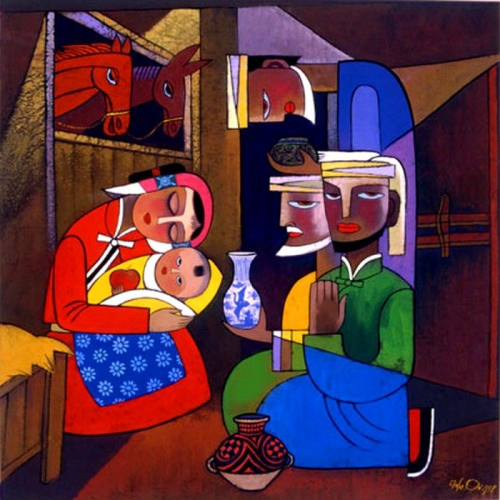
Matthew 2:1-12 – Epiphany of the Lord

The Three Wise Men by He Qi

In the time of King Herod, after Jesus was born in Bethlehem of Judea, wise men from the East came to Jerusalem, asking, “Where is the child who has been born king of the Jews? For we observed his star at its rising and have come to pay him homage.” When King Herod heard this, he was frightened, and all Jerusalem with him; and calling together all the chief priests and scribes of the people, he inquired of them where the Messiah was to be born. They told him, “In Bethlehem of Judea; for so it has been written by the prophet:

‘And you, Bethlehem, in the land of Judah,
    are by no means least among the rulers of Judah;
for from you shall come a ruler
    who is to shepherd my people Israel.’”

Then Herod secretly called for the wise men and learned from them the exact time when the star had appeared. Then he sent them to Bethlehem, saying, “Go and search diligently for the child; and when you have found him, bring me word so that I may also go and pay him homage.” When they had heard the king, they set out; and there, ahead of them, went the star that they had seen at its rising, until it stopped over the place where the child was. When they saw that the star had stopped, they were overwhelmed with joy. On entering the house, they saw the child with Mary his mother; and they knelt down and paid him homage. Then, opening their treasure chests, they offered him gifts of gold, frankincense, and myrrh. And having been warned in a dream not to return to Herod, they left for their own country by another road. (New Revised Standard Version)

“Truth, by which the world is held together, has sprung from the earth, in order to be carried in a woman’s arms.”

St. Augustine

Each year on January 6 in the Church Calendar, after the twelve days of Christmas, is the celebration of Epiphany. Christ’s coming to this earth as a child and becoming like us is much more than a baby in a manger.  Epiphany helps to bring a vision and understanding of God’s glory to all kinds of people of the world.

Epiphany means “manifestation” or “appearance.”

The event associated with this season is the visit of the Magi to Jesus. The season of Epiphany has a special emphasis on the teaching and healing ministry of Jesus. The great celebration and focus of these weeks is that salvation is not limited to Israel but extends to the Gentiles, as well.

Every season in the Christian Year has its unique angle of grace. With Epiphany, we see that one of the most scandalous truths of Christianity is that God graces common ordinary people who seem far from God with the gift of Jesus. 

God grants repentance that leads to life for all kinds of people no matter their race, ethnicity, gender, class, or background. It is a wondrous and astounding spiritual truth that God’s gracious concern is not limited to a certain type of person or a particular group of people.

Grace is and ought to be the guiding factor in how we interact with people. 

Losing sight of grace leads to being critical and defensive. Like King Herod of old, a graceless person becomes enamored with earthly power and control. But embracing grace leads to the humility of seeing the image of God in people quite different from ourselves. 

Like the Apostle Peter, who learned in a vision to bring the gospel to non-Jews, old legalisms begin to wear away so that people from all walks of life can have access to Jesus and his gracious saving and healing ministry. (Acts 10-11:18)

Grace brings down barriers and causes us to do away with unnecessary distinctions between others. Our appropriate response to such a grace is to glorify God for his marvelous and amazing work.

It is a merciful reality that the Magi, or Wise Men, pagan astrologers, were directed to the Messiah. A light was provided to lead them to Jesus. Apart from God’s care and intervention they would have remained in darkness. 

Adoration of the Magi by He Qi

It is still true for people today. This old broken world is wrapped in darkness. All kinds of people have no light at the end of the tunnel of their lives for hope and new life. The gospel of Jesus Christ brings that light to those unable to see. Jesus, in his teaching ministry, exhorted his followers not to hide their light but to let it shine for all to see. (Matthew 5:14-16)

Sometimes, maybe oftentimes, the best way to bring resolution to our own troubles and problems is through helping others make sense of their lives through the gracious light of Christ. Then, they can see an appearance, an epiphany, of what their lives could be in the gracious rule of the kingdom of God. 

As we celebrate Epiphany and journey with Jesus through his earthly upbringing and into his gracious ministry to people, let us keep vigilance to not let our light grow dim. Instead, let us hunger and thirst after Christ’s righteousness so that our joy is full, and our light is bright.

God of mercy, Lord of all, you have gifted the Church through the goodness of your grace to be your hands and do your work, to be your voice and share your words, to bring healing to broken lives. You have graciously gifted your people with the blessings of your Spirit, the power to transform lives and make all things new.

Now may our hearts receive, our mouths proclaim, our hands prepare for compassionate service so that the love we have may overflow into the hearts of others. May they receive your grace, your renewing Spirit, and your love, through Jesus Christ our Savior. Amen.

Psalm 72 – Justice and Righteousness

Give the king your justice, O God,
    and your righteousness to a king’s son.
May he judge your people with righteousness,
    and your poor with justice.
May the mountains yield prosperity for the people,
    and the hills, in righteousness.
May he defend the cause of the poor of the people,
    give deliverance to the needy,
    and crush the oppressor.

May he live while the sun endures,
    and as long as the moon, throughout all generations.
May he be like rain that falls on the mown grass,
    like showers that water the earth.
In his days may righteousness flourish
    and peace abound, until the moon is no more.

May he have dominion from sea to sea,
    and from the River to the ends of the earth.
May his foes bow down before him,
    and his enemies lick the dust.
May the kings of Tarshish and of the isles
    render him tribute,
may the kings of Sheba and Seba
    bring gifts.
May all kings fall down before him,
    all nations give him service.

For he delivers the needy when they call,
    the poor and those who have no helper.
He has pity on the weak and the needy,
    and saves the lives of the needy.
From oppression and violence he redeems their life;
    and precious is their blood in his sight.

Long may he live!
    May gold of Sheba be given to him.
May prayer be made for him continually,
    and blessings invoked for him all day long.
May there be abundance of grain in the land;
    may it wave on the tops of the mountains;
    may its fruit be like Lebanon;
and may people blossom in the cities
    like the grass of the field.
May his name endure forever,
    his fame continue as long as the sun.
May all nations be blessed in him;
    may they pronounce him happy.

Blessed be the Lord, the God of Israel,
    who alone does wondrous things.
Blessed be his glorious name forever;
    may his glory fill the whole earth.
Amen and Amen.

The prayers of David son of Jesse are ended. (New Revised Standard Version)

Today’s psalm is a prayer of King David – beseeching the Lord to help him rule with justice and righteousness – because G-d is just and right in all divine dealings with humanity.

“Justice” in the Old Testament is neither fairness nor the good being rewarded and the wicked punished. Rather, justice (Hebrew משפט, pronounced “mish-pot”) in its most basic sense is caring for the poor. A society is “just” to the degree in which every person has enough for the basic necessities of life and is lifted up as persons worthy of care and respect.

So, the way in which David measured his kingly rule was not by how big of an army he had, or how much gold there was in the royal treasury. Rather, a successful rule for David was measured by whether the interests of the poor were defended and provided for.  

A similar word to justice, “righteousness,” is neither some sort of smug godliness nor a sense of superior piety. Instead, righteousness (Hebrew צדקה pronounced “zed-a-ka”) is a relational term of being in sync with G-d and G-d’s ways. It works itself out in a philanthropic spirit of giving what is needed – both physically and spiritually – through acts of mercy such as forgiveness, debt relief, friendship, charity, etc.

Together, justice and righteousness are concerned for giving needed resources with a compassionate spirit of relationship. It seeks to meet the holistic needs of underprivileged people.

Psalm 72 is read in this Christian liturgical season of Christmas (December 25-January 5) because the celebration of the Christ child entering humanity gives great hope for the poor, the needy, the indigent, and all those who struggle to daily survive grinding situations of hardship and adversity.

This is why, when Jesus announced his earthly ministry, he made it clear the nature of that work would be upholding and extending justice and righteousness:

“The Spirit of the Lord is upon me,
    because he has anointed me
        to bring good news to the poor.
He has sent me to proclaim release to the captives
    and recovery of sight to the blind,
        to let the oppressed go free,
to proclaim the year of the Lord’s favor.” (Luke 4:18-19, NRSV)

The least, the lost, the lonely, and the lame have a champion – a Divine Advocate who will take up their cause and ensure they are treated as deserving human beings, with adequate care of both body and soul. Done properly, our living a just and right life requires we share compassion and empathy along with the monetary and physical resources.

“Whoever gives justice to the poor with a sour expression and in a surly manner, even if he gives a thousand gold pieces, loses his merit. One should instead give cheerfully and joyfully and empathize with him in his sorrow.”

Maimonides (1138-1204, C.E.)

Both the hand and the heart are always involved in biblical justice and righteousness. That way both the giver and the recipient benefit. Whereas the poor receive money or other material assistance, the donor receives the merit of sharing in G-d’s work.

So then, righteousness and justice involve giving assistance with the hand as well as encouragement with the mouth so that needs are met with no residual bitterness of heart.

Each of you should give what you have decided in your heart to give, not reluctantly or under compulsion, for God loves a cheerful giver. And God is able to bless you abundantly, so that in all things at all times, having all that you need, you will abound in every good work. As it is written:

“They have freely scattered their gifts to the poor;
    their righteousness endures forever.” (2 Corinthians 9:7-9, NIV)

May you know the joy and celebration of both giving and receiving with a grateful heart, attuned to the blessings of a generous G-d who stands behind it all.

Revelation 21:1-7 – Making Everything New

Making All Things New by James Janknegt

Then I saw a new heaven and a new earth; for the first heaven and the first earth had passed away, and the sea was no more. And I saw the holy city, the new Jerusalem, coming down out of heaven from God, prepared as a bride adorned for her husband. And I heard a loud voice from the throne saying,

“See, the home of God is among mortals.
He will dwell with them;
they will be his peoples,
and God himself will be with them;
he will wipe every tear from their eyes.
Death will be no more;
mourning and crying and pain will be no more,
for the first things have passed away.”

And the one who was seated on the throne said, “See, I am making all things new.” Also, he said, “Write this, for these words are trustworthy and true.” Then he said to me, “It is done! I am the Alpha and the Omega, the beginning and the end. To the thirsty I will give water as a gift from the spring of the water of life. Those who conquer will inherit these things, and I will be their God and they will be my children. (New Revised Standard Version)

The world as we now know it will someday pass away. 

We have a future hope – and it will literally be heaven on earth.

God will descend to dwell with us, and, so, will bring us to humanity’s original design God in the Garden – an unhindered relationship between God and people in which we are no longer dogged by a sinful nature, a sinful world system, and all the temptations a sinful devil uses to exploit for malevolent purposes. 

Tears, death, sorrow and pain will be a thing of the past. Our struggle with sin will be over.

The Apostle John’s revelation to the early church was a very encouraging message. The believers faced all kinds of trouble and persecution due to their commitment to Christ. To know that these problems are temporary, and that Christ’s changes are permanent, was a great comfort and boon to their faith.

One of the problems we experience in this present age is our chronic impatience. We want what we want, and we want it now! 

Throughout history God’s people have looked ahead in hope for the ultimate fulfillment of divine promises. John did not really give a brand new revelation to the church but upheld and anticipated, for Christians, what was true for Israel.   

“Look! I am creating new heavens and a new earth,
    and no one will even think about the old ones anymore.
Be glad; rejoice forever in my creation!
    And look! I will create Jerusalem as a place of happiness.
    Her people will be a source of joy.
I will rejoice over Jerusalem
    and delight in my people.
And the sound of weeping and crying
    will be heard in it no more.” (Isaiah 65:17-19, NLT)
     

In Christ’s first advent, God’s people believed all these promises would be fully and finally realized. But, like a young couple in their engagement period, the promises of God were initiated but not yet realized or consummated. 

People throughout the centuries have struggled with patience, wondering if all this talk of renewal, restoration, and revival would ever happen.

“Where is this ‘coming’ he promised? Ever since our ancestors died, everything goes on as it has since the beginning of creation….”  But do not forget this one thing, dear friends: With the Lord a day is like a thousand years, and a thousand years are like a day. The Lord is not slow in keeping his promise, as some understand slowness. Instead, he is patient with you, not wanting anyone to perish, but everyone to come to repentance. (2 Peter 3:4, 8-9, NIV)

God is even now in the process of moving history to its final stage. Can we be patient, letting God work until that final day comes? 

We live in an amazing time. Although the earth is a big place, we can traverse it by plane in less than two days. It used to be that a ship going across the Atlantic Ocean took three months from Europe to America. Now, we fly across the ocean in a matter of hours. Yet, we freak out whenever we have to be to the airport two hours before a flight and grump about standing in a twenty minute line to board a plane.

It used to be that communication moved at the same pace as a ship. Knowing about a significant event that happened in Europe took months to find out. Now we can know what kind of bread some Frenchman ate for breakfast almost instantly after he eats it because he posted it on social media. Yet, we complain about waiting a few extra seconds for something to load on our computers or smartphones, as if the world were about to end. 

Well, actually, the world is about to end.

Until that day comes, we are not to spend our remaining time trying to figure out exactly the day and hour of Christ’s second advent. We properly anticipate Jesus coming again when we let God change our hearts and lives, our neighborhoods and workplaces, our families and churches, to be like Christ.

God is presently preparing for Christ’s return by doing away with the old to make room for the new. With every changed life, there is the reminder that God is not slow in keeping promises but is active in transforming lives for good.

If anyone belongs to Christ, there is a new creation. The old things have gone; everything is made new!

2 Corinthians 5:17, NCV

The New Testament book of Revelation helps us break our fixation with the past and holding onto the ways we have always done things. We are reminded of God’s capacity and action for renewal. We can walk, right now, in newness of life. 

So, what do we do? Keep on sinning so God can keep on forgiving? I should hope not! If we’ve left the country where sin is sovereign, how can we still live in our old house there? Or didn’t you realize we packed up and left there for good? That is what happened in baptism. When we went under the water, we left the old country of sin behind; when we came up out of the water, we entered into the new country of grace—a new life in a new land!

That’s what baptism into the life of Jesus means. When we are lowered into the water, it is like the burial of Jesus; when we are raised up out of the water, it is like the resurrection of Jesus. Each of us is raised into a light-filled world by our Father so that we can see where we’re going in our new grace-sovereign country. (Romans 6:1-5, MSG)

To overcome impatience and embrace perseverance, we need a better perspective.

In the fall of 1991, a car driven by a drunk driver jumped its lane and smashed headfirst into a minivan driven by a man named Jerry Sittser. Sittser and three of his children survived, but Sittser’s wife, four-year-old child, and mother died in the crash.

In his book, A Grace Revealed, Sittser shares the following interaction some months after the accident with his son, David, who was one of the children who survived:

“Do you think Mom sees us right now?” he suddenly asked.

I paused to ponder. “I don’t know, David. I think maybe she does see us. Why do you ask?”

“I don’t see how she could, Dad. I thought Heaven was full of happiness. How could she bear to see us so sad?”

Could Lynda, my wife, witness our pain in Heaven? How could that be possible? How could she bear it?

“I think she does see us,” I finally said. “But she sees the whole story, including how it all turns out, which is beautiful to her. It’s going to be a good story, David.”

When all is stripped from our lives, and the world as we know it is done away with, what are we left with? 

We are left with God. And a participation with Christ in the renewal of all things. We do that through alleviating and doing away with the evils and troubles of this world. Whenever we seek to eradicate things like global poverty and sex-trafficking; help others come to grips with the evil of this world; change old devilish ways of living; or come alongside others in their trouble; then, God is using us to make everything new.

The end is coming.

But it’s not yet here. 

What’s here right now is God patiently bringing salvation to all kinds of people. 

So, let’s allow God to be God. And let’s allow the Lord to use us in proclaiming the good news that all things are being made new.

Amen.