A Crippling Grace

Jacob Wrestling the Angel by Karen Laub-Novak
Jacob Wrestling the Angel by Karen Laub-Novak (1937-2009)

Confrontation and struggle were a way of life for me in my first solo pastorate.  In the first six weeks of being in the church I faced every kind of sin imaginable, to the point that my mentor in the faith recommended I take some time off. I had not even been there for two months!  Although that was a difficult time, the greatest struggle was with God himself and feeling like my prayers were doing nothing but bouncing off the ceiling.  In fact, I spent several years of my life in an extended wrestling match with God.  He touched me and crippled me by his grace, reminding me how much he is in control.  Since that time, I walk with a limp that is not visible – an invisible limp which reminds me I am a different person – one who knows Jesus better and is much more at peace with life.

If we do not wrestle with God in the stressful times of our lives, we will have difficulty discovering what genuine humility is, how much we need the Holy Spirit, and the grace that can be ours to face the rest of our lives.  Five hundred years ago Thomas à Kempis wrote to new priests entering ministry with this advice:

“We should so firmly establish ourselves in God that we have no need to seek much human encouragement.  It is when a man of good will is distressed or tempted, or afflicted with evil thoughts, that he best understands the overwhelming need he has for God, without whom he can do nothing.  While enduring these afflictions he takes himself to prayer with sighs and groans; he grows tired of this life and wishes to die so that he could be undone to live with Christ.  It is in such times of trial that he realizes that perfect security and full peace are not to be found in this world.”

The Old Testament patriarch, Jacob, was worried and stressed.  He knew he had deceived his brother Esau many years earlier to gain their father’s blessing.  Now Jacob is about to meet Esau after all these years, and he is downright afraid for himself and his large family.  So, he divided them up into two groups, thinking that if Esau were to attack, the other group could escape. The night before the big stressful meeting, Jacob sent his wives and family across a tributary of the Jordan River, the Jabbok, and spent the night alone wrestling with God. (Genesis 32:22-31)

God will put us in life-compromising positions to create divine encounters so that we will walk away changed.  Those events usually come in the form of engaging God with all the questions and difficulties of an incredibly stressful situation.  The inner change that occurs comes in the form of a new identity, a new limp, and a renewed understanding of God’s grace. A new confidence arises, convinced that through disability and weakness we are strong and able.

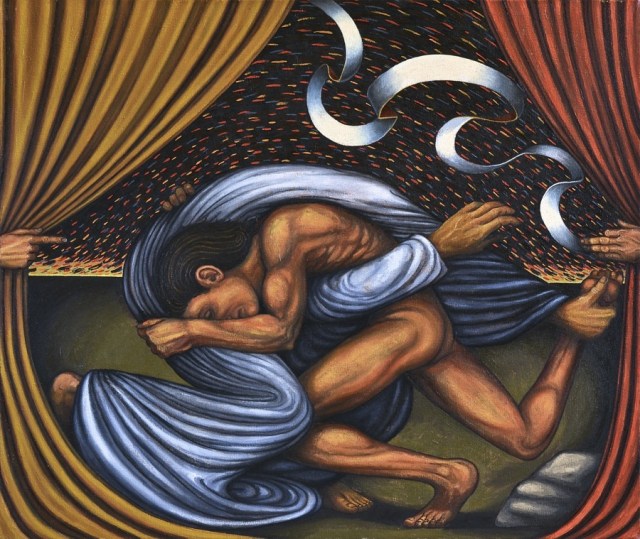
Jacob Wrestling with the Angel by Lippy Lipshitz
Jacob Wrestling with the Angel by Israel Isaac Lipshitz (1903-1980)

There is a good deal of symbolism happening in the story of Jacob wrestling with the angel of God.  First, take note that this Scripture story raises more questions than it answers, such as: Who was the man Jacob wrestled? Was he God, an angel, or someone else? Why have a wrestling match? What in the world is going on here?  The unanswered questions are symbolic of the reality that we do not and probably will not get the clarity we are looking for in our struggles with God.  Sometimes we might not even know it is God whom we are wrestling with.  It is quite possible where we see God estranged from us, he really has us in the grip of grace and will not let go.

Second, Jacob got up during the night, representing his dark night of the soul and struggle with the circumstance he must face.  Jacob was left alone with no one to deceive (his typical modus operandi) which is symbolic of his great need – he had no “tricks up his sleeve” and had nowhere to turn but to God.  Jacob was asked by his wrestling opponent what his name is. Jacob’s answer is a humble one, confessing who he really is (Jacob means “schemer” or “deceiver”).  Jacob asked for a blessing, which in itself is an act of humility because it is an honest profession that he lacks something necessary for life that he cannot provide on his own through any kind of ingenuity on his part.

Third, Jacob asked for God’s name – and got no answer to his question, no clarity, and no satisfaction.  This is deeply symbolic of the fact that God is mysterious, and we will not always get the answers to our questions we want.  God will not kowtow to our puny attempts at controlling him.  Jacob would not let the wrestling match end and held on, just like he grasped the heel of his brother Esau at their birth.  This is a symbolic reference to Jacob’s stubbornness which was redeemed and transformed into tenacity, rather than a manipulation of people to get what he wanted.

Fourth, God renamed Jacob, “Israel.”  Jacob is now distinguished from the old deceiver with a new identity.  Israel literally means “God fights” which is a reference of hope for Jacob’s descendants.  That Jacob struggled with God and was able to walk away from it is not really a statement of physical victory so much as a reference to Jacob’s having overcome his constant fear and need for control which prompted his continual trickery.
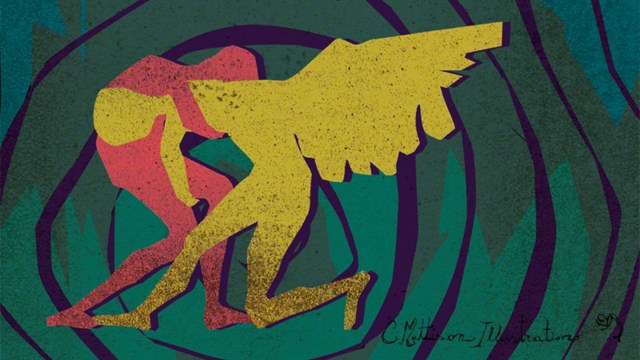
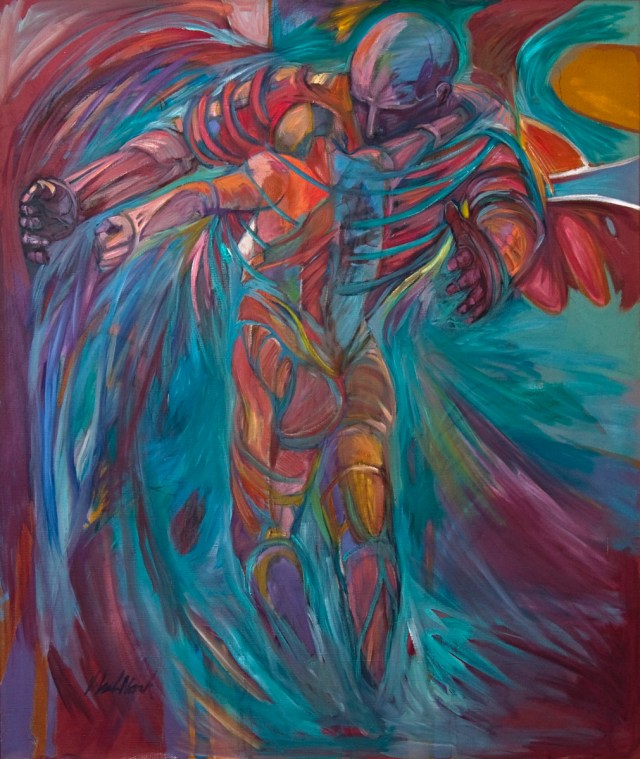
Jacob Wrestles the Angel by Christina Mattison Ebert

Fifth, Jacob’s limp is a permanent sign of God’s grace to Jacob. God is with him and his descendants.  Jacob is a different person having encountered God, and the limp is a continual reminder God changed his life forever – Jacob will never be the same after this.  Ironically, the limp made Jacob stronger, not weaker.  From this point forward in Jacob’s life, he is mindful of his limitations and that God is the One who will arise to fight, protect, and carry on the covenant promises.  There is no longer any need or even desire to scheme to accomplish anything.

It will be difficult to find grace apart from wrestling with God in the painful situations of life.  It is in such times we must be crippled by grace.  We need to be willing to fight with God. It is necessary to get in the match and struggle with God rather than worry within ourselves or just pretend everything is okay so that we will avoid the hard contest in front of us.

Has God left a permanent mark on you?  Do you carry a limp from him?  What is your name?  How does God identify you?  Our great need is not in being clever, smart, or working harder; it is God’s grace that we all need.  As a kid, when my parents left the house, my brother and I would rearrange the furniture so that we could have a good-solid-knock-down-drag-out wrestling match.  Since my brother was older, it usually ended badly for me with a pile-driver that left me incapacitated.  It is seriously a miracle that I am still alive after being dropped on my head so many times.

Whenever Christians approach the Lord’s Table, we are reminded of the Son who wrestled with the Father in prayer in the garden of Gethsemane and came away confident of facing a cruel cross so that we might have life.  The Lord Jesus carries with him even now the reminders of his suffering – the marks on his hands and his feet from a crucifixion that accomplished deliverance from sin on our behalf.  The elements of bread and cup are deeply symbolic reminders of what Jesus did as the cost for our salvation.  And they are further reminders that just as we eat this bread and drink this cup we will drink again with Jesus at the end of the age.  It is faith in Jesus alone that creates and secures for us a transformed life so that we can share in a crippling grace from him forever.

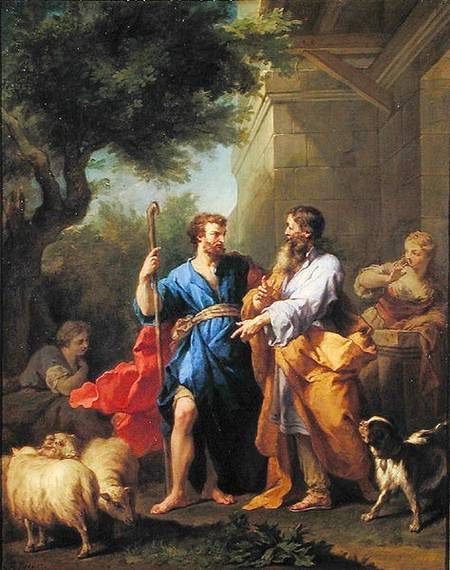
Genesis 31:1-21 – On the Move

Jacob and Laban by Jean Restout
Jacob and Laban by French artist Jean Restout (1692-1768)

Jacob heard that Laban’s sons were saying, “Jacob has taken everything our father owned and has gained all this wealth from what belonged to our father.” And Jacob noticed that Laban’s attitude toward him was not what it had been.

Then the Lord said to Jacob, “Go back to the land of your fathers and to your relatives, and I will be with you.”

So, Jacob sent word to Rachel and Leah to come out to the fields where his flocks were. He said to them, “I see that your father’s attitude toward me is not what it was before, but the God of my father has been with me. You know that I have worked for your father with all my strength, yet your father has cheated me by changing my wages ten times. However, God has not allowed him to harm me. If he said, ‘The speckled ones will be your wages,’ then all the flocks gave birth to speckled young; and if he said, ‘The streaked ones will be your wages,’ then all the flocks bore streaked young. So, God has taken away your father’s livestock and has given them to me.

“In breeding season, I once had a dream in which I looked up and saw that the male goats mating with the flock were streaked, speckled or spotted. The angel of God said to me in the dream, ‘Jacob.’ I answered, ‘Here I am.’ And he said, ‘Look up and see that all the male goats mating with the flock are streaked, speckled, or spotted, for I have seen all that Laban has been doing to you. I am the God of Bethel, where you anointed a pillar and where you made a vow to me. Now leave this land at once and go back to your native land.’”

Then Rachel and Leah replied, “Do we still have any share in the inheritance of our father’s estate? Does he not regard us as foreigners? Not only has he sold us, but he has used up what was paid for us. Surely all the wealth that God took away from our father belongs to us and our children. So do whatever God has told you.”

Then Jacob put his children and his wives on camels, and he drove all his livestock ahead of him, along with all the goods he had accumulated in Paddan Aram, to go to his father Isaac in the land of Canaan.

When Laban had gone to shear his sheep, Rachel stole her father’s household gods. Moreover, Jacob deceived Laban the Aramean by not telling him he was running away. So, he fled with all he had, crossed the Euphrates River, and headed for the hill country of Gilead. (NIV)

Moving and changing are inevitable. Change and movement are built into all creation, from the seasons of the year to our physical bodies. Some changes and moves we deem as good, and others, not so much. Yet, whether good or bad, any switch or shift in life can be difficult to cope with.

Whatever the circumstance, God stands behind everything, working out his purposes. There are times and seasons in our lives in which we can get lost in our own stories. Ultimately, however, our transitions from one place to another are much more about our individual stories fitting into the larger story of God. Whenever we are unable to see how our own story and the story of God fit together, it is an opportunity to exercise our faith and trust God. Listening to God and responding to his call to move and change will at times be difficult due to the uncertainty of our future.

In today’s Old Testament lesson, Jacob has served his father-in-law Laban for twenty years. Now, he hears the call of God to move. The principal actor and center of the story is not Jacob, but God.  The primary point of the narrative is a revelation of who God is, with Jacob as the supporting actor in the story. God was watching over and protecting Jacob. The Lord was following through on his promise given to Jacob’s grandfather, Abraham, to go to the land he would show him – to make Abraham into a great nation so that all people-groups on earth would be blessed through him.  So, this story of Jacob is one piece in the unfolding drama of God’s redemption which would ultimately find its fulfillment in the person and work of Jesus.

Jacob had in-law issues. His relationship with his father-in-law was morphing into trouble. Laban’s attitude had changed toward his son-in-law, probably due to Jacob’s increasing wealth, and Laban’s decreasing assets. So, God showed up and told Jacob to return to the land of his fathers. Along with the call to make a change came a promise of God’s continued presence with Jacob. The grace given to Abraham when calling him out of Ur was renewed with more grace when calling Jacob back to the land of his father and grandfather.  It is in God’s nature to be gracious and to heap grace upon grace.

Jacob Fleeing Laban by Filippo Lauri
Jacob Fleeing Laban by Italian painter Filippo Lauri (1623-1694)

Jacob heeded call of the Lord and began laying plans to move back to Canaan. But how to tell his family about this? What are his wives going to say? After all, he is talking about moving away with kids and teenagers still in the tent. So, with some anxiety, Jacob called his wives, Rachel and Leah, out to the fields to talk.  Jacob laid out the story of himself and Laban, which he framed more as a contrasting story between God and Laban:

Laban’s attitude changed – God’s attitude does not change. God is not fickle.

Laban was unreliable, reneging on promises – God is reliable and trustworthy, keeping his promises.

Laban kept changing his mind – God stays the same, yesterday, today, and forever.

Laban saw only self-interest – God sees everyone and shows solidarity with the oppressed.

This same God is concerned for us and will not renege on his promises. God is providentially working out his agenda and concern for this earth, and we can bank on it.

The response from Jacob and Rachel to Laban was some tricky thievery. Jacob stealthily took his family and ran away from the situation. Rachel straight up stole Laban’s household gods. (Note: Old Testament narratives do not usually tell us whether something is bad or good but instead lets the story unfold and speak for itself so that we can see the ethics working itself out).  Jacob and Rachel had a less than stellar response to God’s grace. We do not know exactly what the household gods are, or why Rachel stole them. What we do know is that there was a bit of pagan practice mixed in with worship of the one, true God.

God wants to be our everything – the faithful, gracious, and present God – because God is good all the time. Our circumstances will forever be changing, and God may ask us to move and go do something somewhere else. Yet, no matter the situation and how different our surroundings may become, God does not change, and he is here with us; and, at the same time, is continually moving to accomplish his purposes.

Loving God, you have made the whole of human life in your image; each one of us shaped in love. Your goodness is ever-present within us all. Yet, there is so much evil and pain in our world; it comes at us from every direction. Teach us how to rediscover your love within us and to use that love as a force for good. Help us to turn our hearts toward the world in hope, praying for each other and regarding each other as a treasure. Join us all together in prayer so that we might be the light which darkness can never overcome, through Jesus Christ our Lord. Amen.

Genesis 46:2-47:12 – How to Live in the World

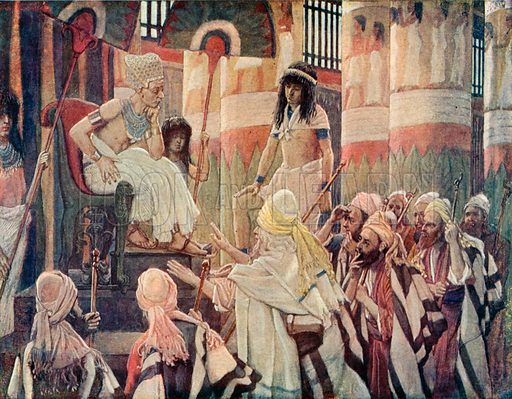
Joseph presents Jacob, his Father, to Pharaoh, Gen xlvii 7 and 8
Joseph presents Jacob and his brothers to Pharaoh by French artist James Jacques Joseph Tissot (1836-1902)

And God spoke to Israel in a vision at night and said, “Jacob! Jacob!”

“Here I am,” he replied.

“I am God, the God of your father,” he said. “Do not be afraid to go down to Egypt, for I will make you into a great nation there. I will go down to Egypt with you, and I will surely bring you back again. And Joseph’s own hand will close your eyes.”

Then Jacob left Beersheba, and Israel’s sons took their father Jacob and their children and their wives in the carts that Pharaoh had sent to transport him. So, Jacob and all his offspring went to Egypt, taking with them their livestock and the possessions they had acquired in Canaan. Jacob brought with him to Egypt his sons and grandsons and his daughters and granddaughters—all his offspring.

These are the names of the sons of Israel (Jacob and his descendants) who went to Egypt:

Reuben the firstborn of Jacob.  The sons of Reuben: Hanok, Pallu, Hezron and Karmi.

The sons of Simeon: Jemuel, Jamin, Ohad, Jakin, Zohar and Shaul the son of a Canaanite woman.

The sons of Levi: Gershon, Kohath and Merari.

The sons of Judah: Er, Onan, Shelah, Perez and Zerah (but Er and Onan had died in the land of Canaan).

The sons of Perez: Hezron and Hamul.

The sons of Issachar: Tola, Puah, Jashub and Shimron.

The sons of Zebulun: Sered, Elon and Jahleel.

These were the sons Leah bore to Jacob in Paddan Aram, besides his daughter Dinah. These sons and daughters of his were thirty-three in all.

The sons of Gad: Zephon, Haggi, Shuni, Ezbon, Eri, Arodi and Areli.

The sons of Asher: Imnah, Ishvah, Ishvi and Beriah.  Their sister was Serah.  The sons of Beriah: Heber and Malkiel.

These were the children born to Jacob by Zilpah, whom Laban had given to his daughter Leah—sixteen in all.

The sons of Jacob’s wife Rachel:

Joseph and Benjamin. In Egypt, Manasseh and Ephraim were born to Joseph by Asenath daughter of Potiphera, priest of On.

The sons of Benjamin: Bela, Beker, Ashbel, Gera, Naaman, Ehi, Rosh, Muppim, Huppim and Ard.

These were the sons of Rachel who were born to Jacob—fourteen in all.

The son of Dan: Hushim.

The sons of Naphtali: Jahziel, Guni, Jezer and Shillem.

These were the sons born to Jacob by Bilhah, whom Laban had given to his daughter Rachel—seven in all.

All those who went to Egypt with Jacob—those who were his direct descendants, not counting his sons’ wives—numbered sixty-six persons. With the two sons who had been born to Joseph in Egypt, the members of Jacob’s family, which went to Egypt, were seventy in all.

Now Jacob sent Judah ahead of him to Joseph to get directions to Goshen. When they arrived in the region of Goshen, Joseph had his chariot made ready and went to Goshen to meet his father Israel. As soon as Joseph appeared before him, he threw his arms around his father and wept for a long time.

Israel said to Joseph, “Now I am ready to die, since I have seen for myself that you are still alive.”

Then Joseph said to his brothers and to his father’s household, “I will go up and speak to Pharaoh and will say to him, ‘My brothers and my father’s household, who were living in the land of Canaan, have come to me. The men are shepherds; they tend livestock, and they have brought along their flocks and herds and everything they own.’ When Pharaoh calls you in and asks, ‘What is your occupation?’ you should answer, ‘Your servants have tended livestock from our boyhood on, just as our fathers did.’ Then you will be allowed to settle in the region of Goshen, for all shepherds are detestable to the Egyptians.”

Joseph went and told Pharaoh, “My father and brothers, with their flocks and herds and everything they own, have come from the land of Canaan and are now in Goshen.” He chose five of his brothers and presented them before Pharaoh.

Pharaoh asked the brothers, “What is your occupation?”

“Your servants are shepherds,” they replied to Pharaoh, “just as our fathers were.” They also said to him, “We have come to live here for a while, because the famine is severe in Canaan and your servants’ flocks have no pasture. So now, please let your servants settle in Goshen.”

Pharaoh said to Joseph, “Your father and your brothers have come to you, and the land of Egypt is before you; settle your father and your brothers in the best part of the land. Let them live in Goshen. And if you know of any among them with special ability, put them in charge of my own livestock.”

Then Joseph brought his father Jacob in and presented him before Pharaoh. After Jacob blessed Pharaoh, Pharaoh asked him, “How old are you?”

And Jacob said to Pharaoh, “The years of my pilgrimage are a hundred and thirty. My years have been few and difficult, and they do not equal the years of the pilgrimage of my fathers.” Then Jacob blessed Pharaoh and went out from his presence.

So, Joseph settled his father and his brothers in Egypt and gave them property in the best part of the land, the district of Rameses, as Pharaoh directed. Joseph also provided his father and his brothers and all his father’s household with food, according to the number of their children. (NIV)

Jacob Blesses Pharaoh
Jacob Blesses Pharaoh by Welsh artist Owen Jones, 1869

God likes fulfilling his promises to us – even and especially when we are in Egypt – in the world. Sometimes we work too hard at avoiding the world and creating heaven on earth right now.  God knew what the Israelites would face: four-hundred years of slavery in Egypt. Yet, God sent them anyway. Often, the people of God grow more in times of trial and hardship, than in times of plenty and peace.

The trip to Egypt included everyone in Israel. There is a genealogical list of those who made the journey because God fulfills his promises through people.  These are the folks who would carry on accomplishing the will of God.  Joseph and Jacob, the son, and the father, are reunited. Joseph diplomatically planned where the gang would live and work because Egyptians looked down on shepherds. Much like the ancient Israelites, we must navigate a world that is okay with us being in it yet not okay with us in the middle of things.

In the Old Testament, Egypt represents the world.  It is interesting God sent his people to live there. God seeks to create a people for his Name who are distinct from Egypt, yet, live among the people of the world.  There is a continual tension for God’s people to be holy and unique, not assimilating into the world’s mold; and, yet, at the same time, God wants them to have a constant engagement and interaction with the world. Therefore, two extremes are to be avoided: to focus solely on being a holy people through complete severance from the world as much as possible; and, to seek relevance in the culture through wholesale jettison of distinctiveness so that the sacred and the secular are connected.

God safeguards a distinct people so that they will be a preservative in the world. Godly people are neither to live in a vacuum, cut off from the world altogether, nor to be wed to the world so that the two are indistinguishable.  We live in a fundamentally broken world in need of the peace and grace of spiritual people within it. The Church has had to struggle with how to live in the world for two-thousand years.  We have the advantage of drawing from a rich Christian history. For there is nothing we face now which has not been faced by the church before.

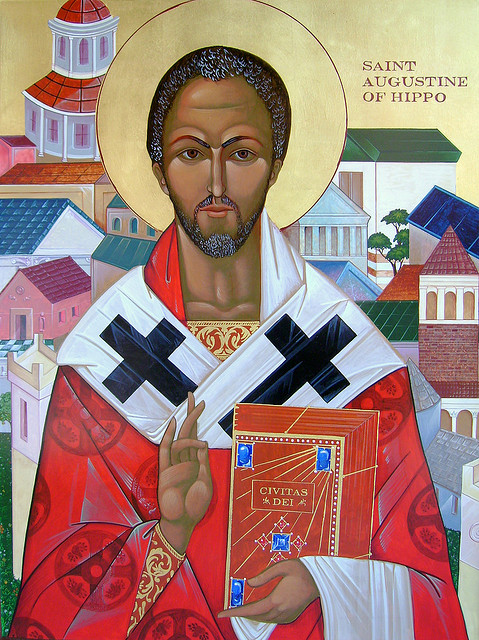
St Augustine

Saint Augustine wrote his seminal work, City of God, in about 413 C.E. The Roman empire had fallen, and pagans were blaming the Church because Christianity had become wed to the state. The people of God were unsure how to proceed.  So, Augustine sought to help Christians think about how to live in a post-Christian society.

Augustine’s work is lengthy and quite in-depth, so, the following is a brief distilling of his main arguments.  For Augustine, there are four essential institutions: two visible institutions; and, two invisible institutions:

  1. The Church – is a divinely established institution, designed to lead people to God.
  2. The State – is a political institution, adhering to political virtues to establish the peace.
  3. The City of Heaven – is made up of those predestined for salvation.
  4. The City of the World – is made up of those destined for eternal damnation.

We must pursue the City of Heaven, which for Augustine, is the pursuit of justice and righteousness. Augustine gave a clarion call for people to choose which city they will pursue, especially because many tended to blur the distinctions between the visible institutions of church and state.

Augustine’s conclusion is that the purpose of history is to show the unfolding of God’s plan. This involves fostering the City of Heaven and filling it with worthy citizens.  Therefore, the fall of Rome, a visible city so important to the people of Augustine’s day, was not near as important to the invisible God.

Maintaining an eternal perspective can help us today. The collapse of jobs, the scourge of a racialized society, the loss of life due to COVID-19, and injustice are significant events and circumstances – important enough to consider deeply how those issues will be handled. Augustine called out the people of his day for ignoring invisible spiritual solutions for the great problems among them.

Returning to the book of Genesis, a question arises: Will the Israelites become a nation through assimilation with Egypt and its institutions, or will they maintain their distinction as God’s people by relying on God’s covenant promises?  There are no easy answers to living in the world. However, it is important we struggle with how to get along in it.

God is the principal actor in the created world. God chooses to use his people as instruments of blessing to it.  Joseph’s wisdom and diplomacy, given by God, turned potentially catastrophic situations into times of prosperity. God, too, will use us as dispensers of wisdom – applying truth to concrete situations for the betterment of all involved.

Joseph handled the delicate situation of his brothers being shepherds while all shepherds were detestable to Egyptians.  Joseph brought the two worlds together through artful negotiation between the interests of both Pharaoh and the Israelites. He created a win/win scenario by setting up his brothers to help Pharaoh with his own needs in caring for livestock. In the end, all parties were satisfied because Joseph maintained a focus on needs instead of only advocating one side.

Rather than getting bogged down in promotion of methods and means, a sage approach is to maintain a focus on needs – which requires careful listening and a stance of empathy. Then, we can work toward prosperity for all instead of hardening into reified positions. A lot of problems in the church, work, society, and family can be turned to blessing if we seek the wisdom that comes from God.

May the Lord bless you and keep you; and, make his face shine on you and be gracious to you. May the Lord turn his face toward you and give you peace. Amen.

Genesis 33:1-17 – Brothers Reconciled

Jacob and Esau by Willow Winston
Jacob and Esau by British artist Willow Winston

Jacob looked up and saw Esau coming with his four hundred men. He divided the children between Leah and Rachel and the two maidservants. He put the maidservants out in front, Leah, and her children next, and Rachel and Joseph last. He led the way and, as he approached his brother, bowed seven times, honoring his brother. But Esau ran up and embraced him, held him tight and kissed him. And they both wept. 

Then Esau looked around and saw the women and children: “And who are these with you?” 

Jacob said, “The children that God saw fit to bless me with.” 

Then the maidservants came up with their children and bowed; then Leah and her children, also bowing; and finally, Joseph and Rachel came up and bowed to Esau. 

Esau then asked, “And what was the meaning of all those herds that I met?” 

“I was hoping that they would pave the way for my master to welcome me.” 

Esau said, “Oh, brother. I have plenty of everything—keep what is yours for yourself.” 

Jacob said, “Please. If you can find it in your heart to welcome me, accept these gifts. When I saw your face, it was as the face of God smiling on me. Accept the gifts I have brought for you. God has been good to me and I have more than enough.” Jacob urged the gifts on him, and Esau accepted. 

Then Esau said, “Let’s start out on our way; I’ll take the lead.” 

But Jacob said, “My master can see that the children are frail. And the flocks and herds are nursing, making for slow going. If I push them too hard, even for a day, I’d lose them all. So, master, you go on ahead of your servant, while I take it easy at the pace of my flocks and children. I’ll catch up with you in Seir.” 

Esau said, “Let me at least lend you some of my men.” 

“There’s no need,” said Jacob. “Your generous welcome is all I need or want.” 

So, Esau set out that day and made his way back to Seir. 

And Jacob left for Succoth. He built a shelter for himself and sheds for his livestock. That’s how the place came to be called Succoth (Sheds). (MSG) 

Repentance includes more than saying sorry. It also involves admitting wrong and making things right. This, then, lays the groundwork for an earnest attempt at reconciliation.  For example, the Christian does more than a simple acceptance and acquiescence of Jesus, if merely adding a bit of Christ to life will dash it up a bit and make it better. Rather, we are invited into the very life of Christ. This life turns us upside-down and inside-out in a new and radical allegiance.

Repentance and reconciliation are a way of life, as well as a necessary skill requiring development through continual practice and use. Broken relationships are the stuff of life, and we need gracious approaches to deal with them so that bitterness does not take root in our souls. Connection and peace between two people are a beautiful thing; it brings emotional health, spiritual wholeness, and life enrichment.

From the get-go, twin brothers Jacob and Esau in the Old Testament book of Genesis had a contentious relationship. At one point their relations were so bad that Esau was having some homicidal ideation toward his brother. Neither Esau nor Jacob handled things well between each other with Jacob leaving, finding a wife, and growing a family, and becoming wealthy. Twenty years passed before they came together again.

Jacob wrestling with God
Jacob Wrestling with the Angel of God by Jack Baumgartner, 2009

Jacob, knowing he was about to meet his brother, had an encounter with God that changed his identity from the old deceiver to the new Israel (Genesis 32:22-31).  In a demonstration of his new identity as Israel, Jacob worked at making amends for his old cheating ways by turning around the blessing he had stolen from his brother and then giving one back to him.

Jacob understandably had some dread in meeting Esau, considering what he had done to his brother in deceitfully taking both his birthright and blessing. Fresh from wrestling with God, Jacob demonstrated a newfound courage and humility through respect, gift-giving, and showing honor – reversing his past pattern of disrespect, stealing, and dishonor.

True turning away from what we have done wrong is by making things right. Merely having the feeling of being sorry is not repentance. Genuine repentance involves true sorrow; an earnestness to make restitution and reconciliation; an indignation over what happened; and, perhaps most importantly, a deep concern for the person(s) harmed by our wrongdoing (2 Corinthians 7:8-11).

The reconciliation between the brothers was a surprise because Jacob was not expecting Esau’s response. It seems Jacob was bracing for the worse, which would explain his high anxiety before the encounter. Esau’s gracious response was an answer to Jacob’s prayer.  For Jacob, seeing Esau’s face was like seeing the face of God – in fact, he saw both faces and lived!  Jacob likely would not have seen his brother’s face until he had first seen God’s. His divine experience prepared the way for the human encounter.

We all experience times when relationships unravel and need to be mended. Jacob procrastinated for twenty years before working at reconciliation with his brother. What made the difference for Jacob was trusting God, who always works out his promises, despite our human foibles.

May you know and experience the God who reconciles and restores, and in so doing extend that same earnestness to others.

Merciful God, I confess that I have sinned against you and against others through my own fault by thought, word and deed in things done and left undone. Especially I confess that I have _____.  therefore repent; for these and all my sins I am terribly sorry and pray for forgiveness. I firmly intend to make amends and seek for help. I ask for strength to serve you in newness of life through Jesus Christ, my Lord, in the power of your Holy Spirit. Amen.