Jacob’s Dream (Genesis 28:10-22)

Jacob’s Ladder by Darius Gilmont

Jacob left the town of Beersheba and started out for Haran. At sunset he stopped for the night and went to sleep, resting his head on a large rock. In a dream he saw a ladder that reached from earth to heaven, and God’s angels were going up and down on it.

The Lord was standing beside the ladder and said:

I am the Lord God who was worshiped by Abraham and Isaac. I will give to you and your family the land on which you are now sleeping. Your descendants will spread over the earth in all directions and will become as numerous as the specks of dust. Your family will be a blessing to all people. Wherever you go, I will watch over you, then later I will bring you back to this land. I won’t leave you—I will do all I have promised.

Jacob woke up suddenly and thought, “The Lord is in this place, and I didn’t even know it.” Then Jacob became frightened and said, “What a frightening place! It must be the house of God and the gateway to heaven.”

When Jacob got up early the next morning, he took the rock that he had used for a pillow and stood it up as a place of worship. Then he poured olive oil on the rock to dedicate it to God, and he named the place Bethel. Before that it had been named Luz.

Jacob solemnly promised God, “If you go with me and watch over me as I travel, and if you give me food and clothesand bring me safely home again, you will be my God. This rock will be your house, and I will give back to you a tenth of everything you give me.” (Contemporary English Version)

“Dreams are impartial, spontaneous products of the unconscious psyche, outside the control of the will. They are pure nature; they show us the unvarnished, natural truth, and are therefore fitted, as nothing else is, to give us back an attitude that accords with our basic human nature when our consciousness has strayed too far from its foundations and run into an impasse.

Carl Jung, Collected Works, Vol. 10

Not all unconscious dreams are the same, any more than all conscious experiences are alike.

Some dreams are not much more than a thing which occurs while we’re sleeping; they’re akin to the tedious or pedantic things we do while awake. Yet, other dreams are loaded with symbolic significance and have complex patterns of organization and relating.

However, all dreams which we carry with us into conscious waking – no matter whether mundane or extraordinary – are telling us a similar message: “Hey! Pay attention to this!”

In other words, our unconscious brains are usually aware of what we need more than our conscious minds; and dreams become the vehicle by which our unconscious alerts our conscious selves of something we need to focus upon.

Jacob’s Ladder by Ben Avram

Jacob needed to pay attention to something that he was not consciously aware of. Before his dream, Jacob had left home at the behest of his aging father. Mom and Dad wanted Jacob to have a good wife, so they sent him off to a specific place to find one.

Now, mind you, Jacob was a mama’s boy; he stuck close to home and was attached to his mother. Off on his first outing away from familiar confines, Jacob would have been understandably anxious and fearful. Although he had the blessing of his parents, Jacob’s unconscious self knew he also needed the blessing of almighty God.

So, the Lord showed up in a dream. To Jacob’s credit, he paid attention by acknowledging the importance of the dream. Jacob also made the Lord a promise that he would give back a tenth of anything and everything he acquired because of God’s blessing.

I wonder: How many times do you and I fail to acknowledge that the Lord’s presence is in the very place we are? Maybe our dreams are trying to tell us something – that the God of all things, including dreams, is with us in our own particular place and situation.

It can be frightening to be in a new place or new situation that you’ve never been in before. Yet, there is no place any of us can go where God is not already there.

You have looked deep
into my heart, Lord,
    and you know all about me.
You know when I am resting
    or when I am working,
and from heaven
    you discover my thoughts.

You notice everything I do
    and everywhere I go.
Before I even speak a word,
    you know what I will say,
and with your powerful arm
you protect me
    from every side.
I can’t understand all of this!
Such wonderful knowledge
    is far above me.

Where could I go to escape
from your Spirit
    or from your sight?
If I were to climb up
to the highest heavens,
    you would be there.
If I were to dig down
to the world of the dead
    you would also be there.

Suppose I had wings
like the dawning day
    and flew across the ocean.
Even then your powerful arm
    would guide and protect me.
Or suppose I said, “I’ll hide
in the dark until night comes
    to cover me over.”
But you see in the dark
because daylight and dark
    are all the same to you. (Psalm 139:1-12, CEV)

The Lord is with you. Your dreams have already confirmed it.

O God, give me strength for this day, and not to turn coward in the face of difficulty or duty. Let me not lose faith in other people. Keep my heart pure and caring, free from all ingratitude or meanness. Open wide the eyes of my soul so that I may see the good in all things. Grant me today a new vision of your truth; and for tonight, may the Lord Jesus be in my dreams so that I might awake again and serve him in joy and gladness, in the power of the Holy Spirit. Amen.

Genesis 49:1-33 – The Long View

Blessing of the Twelve Tribes

Then Jacob called for his sons and said: “Gather around so I can tell you what will happen to you in days to come.

“Assemble and listen, sons of Jacob;
listen to your father Israel.

“Reuben, you are my firstborn,
my might, the first sign of my strength,
excelling in honor, excelling in power.
Turbulent as the waters, you will no longer excel,
for you went up onto your father’s bed,
onto my couch and defiled it.

“Simeon and Levi are brothers—
their swords are weapons of violence.
Let me not enter their council,
let me not join their assembly,
for they have killed men in their anger
and hamstrung oxen as they pleased.
Cursed be their anger, so fierce,
and their fury, so cruel!
I will scatter them in Jacob
and disperse them in Israel.

“Judah, your brothers will praise you;
your hand will be on the neck of your enemies;
your father’s sons will bow down to you.
You are a lion’s cub, Judah;
you return from the prey, my son.
Like a lion he crouches and lies down,
like a lioness—who dares to rouse him?
The scepter will not depart from Judah,
nor the ruler’s staff from between his feet,
until he to whom it belongs shall come
and the obedience of the nations shall be his.
He will tether his donkey to a vine,
his colt to the choicest branch;
he will wash his garments in wine,
his robes in the blood of grapes.
His eyes will be darker than wine,
his teeth whiter than milk.

“Zebulun will live by the seashore
and become a haven for ships;
his border will extend toward Sidon.

“Issachar is a rawboned donkey
lying down among the sheep pens.
When he sees how good his resting place is
and how pleasant is his land,
he will bend his shoulder to the burden
and submit to forced labor.

“Dan will provide justice for his people
as one of the tribes of Israel.
Dan will be a snake by the roadside,
a viper along the path,
that bites the horse’s heels
so that its rider tumbles backward.

“I look for your deliverance, Lord.

“Gad will be attacked by a band of raiders,
but he will attack them at their heels.

“Asher’s food will be rich;
he will provide delicacies fit for a king.

“Naphtali is a doe set free
that bears beautiful fawns.

“Joseph is a fruitful vine,
a fruitful vine near a spring,
whose branches climb over a wall.
With bitterness archers attacked him;
they shot at him with hostility.
But his bow remained steady,
his strong arms stayed limber,
because of the hand of the Mighty One of Jacob,
because of the Shepherd, the Rock of Israel,
because of your father’s God, who helps you,
because of the Almighty, who blesses you
with blessings of the skies above,
blessings of the deep springs below,
blessings of the breast and womb.
Your father’s blessings are greater
than the blessings of the ancient mountains,
than the bounty of the age-old hills.
Let all these rest on the head of Joseph,
on the brow of the prince among his brothers.

“Benjamin is a ravenous wolf;
in the morning he devours the prey,
in the evening he divides the plunder.”

All these are the twelve tribes of Israel, and this is what their father said to them when he blessed them, giving each the blessing appropriate to him.

Then he gave them these instructions: “I am about to be gathered to my people. Bury me with my fathers in the cave in the field of Ephron the Hittite, the cave in the field of Machpelah, near Mamre in Canaan, which Abraham bought along with the field as a burial place from Ephron the Hittite. There Abraham and his wife Sarah were buried, there Isaac and his wife Rebekah were buried, and there I buried Leah. The field and the cave in it were bought from the Hittites.”

When Jacob had finished giving instructions to his sons, he drew his feet up into the bed, breathed his last and was gathered to his people. (NIV)

The theme of confidence works its way through the patriarch Jacob’s deathbed prophecies and blessings – a resolute conviction in the promises of God, that he will accomplish what he said he would do. Jacob expressed the hope and sure belief that God would bring the Israelites out of Egypt and into the land of Canaan as their inheritance – and, ultimately to the City of God, the eternal inheritance.

The Christian will find much in Judah’s blessing as the promise of the coming Christ, Jesus. Mentioning the implements of “staff” and “scepter” are symbols of authority. And, the reference to a donkey communicated a ruler was coming, as donkeys were the preferred mounts of royalty in ancient times. What is more, the washing of garments in wine, and eyes darker than wine, are allusions to the future blessing and abundance there will be through the tribe of Judah. In fact, the first miracle of Jesus was turning water into wine – a deliberate attempt by the Apostle John to connect Jesus with Old Testament messianic prophecies of abundance and blessing. (John 2:1-12)

long hallway

It is important for us to take the long view of life, keeping in mind that it took eighteen centuries for Jacob’s prophecy of Judah to occur. This long view is what gives us our confidence in life and provides the patience and perseverance we need right now.  Keeping in mind the big picture of God’s work in this world is necessary because if we do not, we will likely become discouraged with the circumstances we face right now.

The reason Jacob makes it into the great Hall of Faith is not because he was squeaky clean and perfect in how he lived his life, but because he took the long view, the big picture, and saw that God was going to fulfill his promises to Israel:

By an act of faith, Jacob on his deathbed blessed each of Joseph’s sons in turn, blessing them with God’s blessing, not his own—as he bowed in worship upon his staff. (Hebrews 11:21, MSG)

Furthermore, when we string the following three verses together across both Testaments, we see the long view of God’s purposes:

It is true that you planned to do something bad to me. But really, God was planning good things. God’s plan was to use me to save the lives of many people. And that is what happened. (Genesis 50:20, ERV)

For I know the plans I have for you,” declares the Lord, “plans to prosper you and not to harm you, plans to give you hope and a future. (Jeremiah 29:11, NIV)  

And we know that all things work together for good to those who love God, to those who are the called according to his purpose. (Romans 8:28, NKJV)

In the Christian faith tradition, all God’s promises come together and are fulfilled in the person and work of Jesus. He is our salvation, our inheritance, and our hope.  To give our lives to him in complete trust of faith is both our challenge and our privilege.

May we live by faith, and not by fear.

Be present, O merciful God, and protect us through anxious times, so that we who are wearied by the changes of this life may rest in your eternal steadiness. Keep watch, dear God, with those who work, or watch, or weep this night, and give your angels charge over those who sleep. Tend the sick, Lord Christ; give rest to the weary, bless the dying, soothe the suffering, pity the afflicted, shield the joyous; and all for your love’s sake. Amen.

Genesis 31:22-42 – On the Run

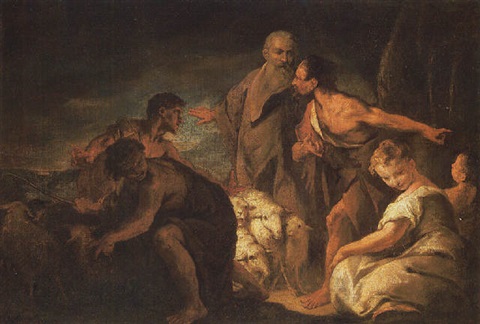
Jacob and Laban by Nicola Grassi
Jacob and Laban by Italian painter Nicola Grassi (1682-1748)

On the third day Laban was told that Jacob had fled. Taking his relatives with him, he pursued Jacob for seven days and caught up with him in the hill country of Gilead. Then God came to Laban the Aramean in a dream at night and said to him, “Be careful not to say anything to Jacob, either good or bad.”

Jacob had pitched his tent in the hill country of Gilead when Laban overtook him, and Laban and his relatives camped there too. Then Laban said to Jacob, “What have you done? You’ve deceived me, and you’ve carried off my daughters like captives in war. Why did you run off secretly and deceive me? Why didn’t you tell me, so I could send you away with joy and singing to the music of timbrel and harp? You didn’t even let me kiss my grandchildren and daughters goodbye. You have done a foolish thing. I have the power to harm you; but last night the God of your father said to me, ‘Be careful not to say anything to Jacob, either good or bad.’ Now you have gone off because you longed to return to your father’s household. But why did you steal my gods?”

Jacob answered Laban, “I was afraid, because I thought you would take your daughters away from me by force. But if you find anyone who has your gods, that person shall not live. In the presence of our relatives, see for yourself whether there is anything of yours here with me; and if so, take it.” Now Jacob did not know that Rachel had stolen the gods.

So, Laban went into Jacob’s tent and into Leah’s tent and into the tent of the two female servants, but he found nothing. After he came out of Leah’s tent, he entered Rachel’s tent. Now Rachel had taken the household gods and put them inside her camel’s saddle and was sitting on them. Laban searched through everything in the tent but found nothing.

Rachel said to her father, “Don’t be angry, my lord, that I cannot stand up in your presence; I’m having my period.” So, he searched but could not find the household gods.

Jacob was angry and took Laban to task. “What is my crime?” he asked Laban. “How have I wronged you that you hunt me down? Now that you have searched through all my goods, what have you found that belongs to your household? Put it here in front of your relatives and mine and let them judge between the two of us.

“I have been with you for twenty years now. Your sheep and goats have not miscarried, nor have I eaten rams from your flocks. I did not bring you animals torn by wild beasts; I bore the loss myself. And you demanded payment from me for whatever was stolen by day or night. This was my situation: The heat consumed me in the daytime and the cold at night, and sleep fled from my eyes. It was like this for the twenty years I was in your household. I worked for you fourteen years for your two daughters and six years for your flocks, and you changed my wages ten times. If the God of my father, the God of Abraham, and the Fear of Isaac, had not been with me, you would surely have sent me away empty-handed. But God has seen my hardship and the toil of my hands, and last night he rebuked you.” (NIV)

Jacob’s in-law issues did not magically disappear when he sneaked out of town with his entire family. I am glad God is faithful and acts on our behalf even when we are fearful with little faith. Far too often we do the right thing in the wrong way. It is far too easy to run away from people we don’t like. Yet, it is rarely so simple. Sometimes we plain need divine intervention to deal with people in our lives.

To Jacob’s credit, he obeyed God and headed back to the land of Canaan. However, he did it in a deceitful way which avoided confrontation. Out of fear of facing his father-in-law Laban and the worry of what might happen, Jacob got out of Dodge. It seems Jacob’s wife Rachel also acted out of fear by taking her father’s idols. Fear can cause us to have some skewed ideas and do some stupid things which get us in trouble.

“According to most studies, people’s number one fear is public speaking. Number two is death. Death is number two. Does that sound right? This means to the average person, if you go to a funeral, you’re better off in the casket than doing the eulogy.” –Jerry Seinfeld

Laban found out what was going on with Jacob and was anything but a happy camper. He went after the upstart Jacob with gusto and finally caught up to him. Despite having the power and ability to deal severely with Jacob, Laban backs off because Jacob finally found his voice and took his father-in-law to task. Embedded in Jacob’s rehearsal of their relationship is the God who intervened and took care of Jacob when Laban didn’t.

Jacob Confront Laban by Jan Steen, 1669
Jacob Confronts Laban by Dutch painter Jan Steen, 1669

The lengthy dialogue between Jacob and Laban was a power struggle: Laban wanted to keep the status quo authority as family head over Jacob’s family; but Jacob asserted himself as having his own distinct household.  In the end, they ended-up on equal footing because of God’s intervention.  Whereas Laban had his own intentions for Jacob and his family, God had other plans.  It was God who enriched Jacob with a wealth of flocks and herds, even as he was being oppressed and intimidated by Laban.

The same God, who was with Jacob, is with you and me:

  • God is with us through difficulty, oppression, and injustice.

Now, it is commendable if, because of one’s understanding of God, someone should endure pain through suffering unjustly. But what praise comes from enduring patiently when you have sinned and are beaten for it? But if you endure steadfastly when you’ve done good and suffer for it, this is commendable before God. (1 Peter 2:19-20, CEB)

  • God does not give up on his people. We Christians are often living contradictions, like Jacob, who acknowledge God and give him glory but at the same time act out of fear and insecurity. Out of the compost of human sin, the sovereign God accomplishes his will.

Christ died for us when we were unable to help ourselves. We were living against God, but at just the right time Christ died for us… while we were still sinners, and by this God showed how much he loves us. (Romans 5:6, 8, ERV)

  • God cares both about what we do, and about why and how we do it. Ethics is the difference between morality and legality; and, between what I ought to do, and what is required of me. Jacob did what was demanded of him by God; yet, he did it out of fear along with unwise methods.

Anything that is not done in faith is sin. (Romans 14:23b, GW)

  • God’s intervention is needed. Without divine help, we are hopelessly lost. Furthermore, we continue to need God so we can deal with the unpredictable attempts of others to control us and push us into a mold outside of trusting in God.

Give all your worries to God because he cares about you. (1 Peter 5:7, NCV)

  • God instills confidence in us. After twenty hard years of service, Jacob returned to the land of Canaan prosperous and more confident in God than ever. Jacob’s trials with Laban gave him a growing sense of dependence on God. Jacob struggled, suffered, and endured – and came out the stronger for it.

You know that when your faith is tested, your endurance has a chance to grow. So, let it grow, for when your endurance is fully developed, you will be perfect and complete, needing nothing. (James 1:3-4, NRSV)

God loves us enough to not always give us an easy out because he is concerned for our walk of faith and our education in grace. So, may you discover the intervening God and exercise trust through those times when others give you a hard time.

God, grant me the serenity to accept the things I cannot change, the courage to change the things I can, and the wisdom to know the difference. Living one day at a time, enjoying one moment at a time; accepting hardship as a pathway to peace; taking, as Jesus did, this sinful world as it is, not as I would have it; trusting that You will make all things right if I surrender to Your will; so that I may be reasonably happy in this life and supremely happy with You forever in the next. Amen.  –The Serenity Prayer by Reinhold Niebuhr, 1951

Genesis 32:22-31 – A Crippling Grace

Welcome, friends! Simply click on the video below and let us gather around God’s Word.

You can also view this video at TimEhrhardtYouTube

For today’s Old Testament story set to song, click Wrestle with God from the Church in Ireland; and, Jacob’s Song sung by Gabrielle Ariana.

May the Lord bless you
    and protect you.
May the Lord smile on you
    and be gracious to you.
May the Lord show you his favor
    and give you his peace.  Amen.