

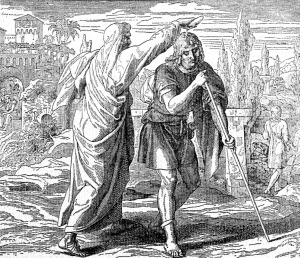
Then Samuel took a flask of olive oil and poured it on Saul’s head and kissed him, saying, “Has not the Lord anointed you ruler over his inheritance? When you leave me today, you will meet two men near Rachel’s tomb, at Zelzah on the border of Benjamin. They will say to you, ‘The donkeys you set out to look for have been found. And now your father has stopped thinking about them and is worried about you. He is asking, “What shall I do about my son?”’
“Then you will go on from there until you reach the great tree of Tabor. Three men going up to worship God at Bethel will meet you there. One will be carrying three young goats, another three loaves of bread, and another a skin of wine. They will greet you and offer you two loaves of bread, which you will accept from them.
“After that you will go to Gibeah of God, where there is a Philistine outpost. As you approach the town, you will meet a procession of prophets coming down from the high place with lyres, timbrels, pipes and harps being played before them, and they will be prophesying. The Spirit of the Lord will come powerfully upon you, and you will prophesy with them; and you will be changed into a different person. Once these signs are fulfilled, do whatever your hand finds to do, for God is with you.
“Go down ahead of me to Gilgal. I will surely come down to you to sacrifice burnt offerings and fellowship offerings, but you must wait seven days until I come to you and tell you what you are to do.” (New International Version)
Events were in motion. The priest and prophet Samuel was quite aware of the happenings. But the would-be king Saul was not at all savvy to what was transpiring.
While out and about engaging in his regular circuit ministry as judge in Israel, Samuel presided over the sanctuary feast. Saul was the unbeknown guest of honor. He had been picked out and placed at the head of the table. Only Samuel knew what was going on.
Without calling any attention to it, God was at work behind the scenes. The Israelites had petitioned for a king. They were of an attitude that we might imagine them being a bunch of malcontent children who complained to God saying, “All the other nations have a king. Why don’t we? We need a king, too! Give us a king! We want a king!” Who knows but that there maybe was a bit of stomping the foot along with the demand.
Sometimes what we think we want is not what we need.
Despite the people’s frame of mind and heart, and refusal of Samuel’s warning to them, the Lord decided to grant them a king. And Saul was the one chosen by God.
The actual anointing of the king, and setting him apart for that service, happened in private between Samuel and Saul. The priest poured oil on the head of Saul – which was a symbolic way of installation, as well as a sign of God’s blessing on him for a special position of leadership. This is why kings were often referred to as “the Lord’s anointed.”

As contemporary readers of the Bible, and separated by thousands of years of ancient Israelite culture, we may fail to grasp how radical this event is in Jewish history. Israel went centuries without any king at all; and now, at this point with Samuel and Saul, they have their first one.
This was a moment that changed everything for Israel. Even though Saul becoming king in Israel, this would likely not be identified by anybody as a seminal event in the Bible. Yet, just because it originally came without any glitz or ornate ceremony, the establishment of a kingship was a watershed moment, nonetheless.
But that’s typically how many things in life shake-out. People pray in the privacy of a secret prayer closet, or decide to step out with obedient faith for a seemingly insignificant place in time. There are no paparazzi or reporters, no large crowds or anyone really paying attention.
We choose to do something in the obscurity of our mundane daily lives. But the Lord is directing us, moving us toward something we could never imagine was going to happen. Big consequences can come about through the smallest acts of humility and quiet obedience.
Hopefully, we are more like this, than like the people who whined and clamored for a king.
Saul was anointed king. The people needed to know it. And Saul needed to be prepared for being a new sort of leader. Israel had to realize that God was setting up the kingship; it wasn’t just a thing Samuel came up with.
Therefore, three signs were given for Saul to expect. Each sign became progressively bigger so that the public could see and know that Saul is the person for whom God anointed.
Up to this point, Saul was really nothing more than another person in Israel. He never went to King’s College and learned how to be royal, simply because there was no such thing. But that was no problem for God. The Lord has the power and authority to turn anyone into a different person – including a king who can lead the people.
The only thing Saul had to do is listen to Samuel and obey the Lord. That’s it. Nothing more. Samuel would keep doing what he’s always been doing; and God will do what God has always done. Saul only needed to hear and do.
However, we can anticipate what happens whenever we humans are left to do nothing but listen and obey; we far too often hear and get anxious. And in our anxiety, we think we heard something different than what we really heard.
Things get complicated pretty fast when anxiety gets in the mix. Yet, to listen and obey is really quite simple, at its core.
Whenever things get crazy and complicated for you, I wonder if its really more complicated in your head or your heart than it really is. Perhaps it might be a lot simpler and calmer if you and I just did what we need to do, when we need to do it, without overthinking things.
Part of the reason the new kingship changed everything so much, is that after Saul became king, things got complicated pretty fast. And I think you know why…
O God, the source of all health, well-being, and peace: So fill my heart with faith in your love and trust in your divine will, that with calm expectancy I may make room for your power to possess me, and gracefully accept your leading in my life. Amen.


 Rev. Tim Ehrhardt