Who Is On the Lord’s Side? (Exodus 32:15-35)

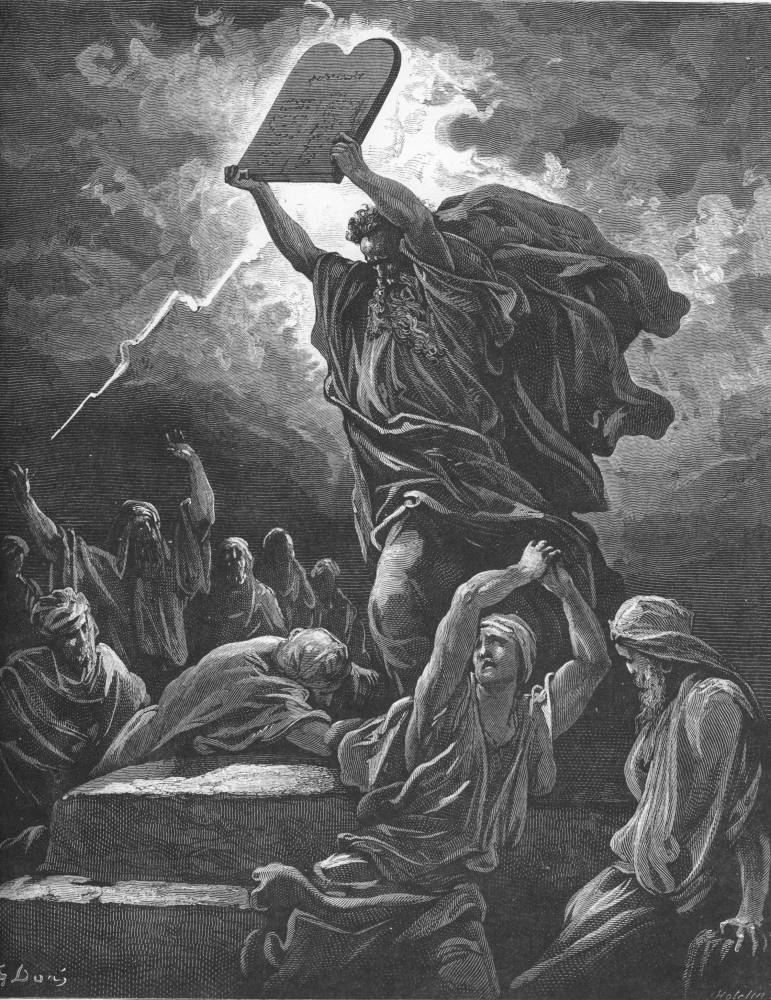
Moses breaks the tablets of the Law, by Gustave Doré (1832-1883)

Then Moses turned and went down from the mountain, carrying the two tablets of the covenant in his hands, tablets that were written on both sides, written on the front and on the back. The tablets were the work of God, and the writing was the writing of God, engraved upon the tablets. When Joshua heard the noise of the people as they shouted, he said to Moses, “There is a noise of war in the camp.” But he said,

“It is not the sound made by victors
or the sound made by losers;
it is the sound of singing that I hear.”

As soon as he came near the camp and saw the calf and the dancing, Moses’s anger burned hot, and he threw the tablets from his hands and broke them at the foot of the mountain.He took the calf that they had made, burned it with fire, ground it to powder, scattered it on the water, and made the Israelites drink it.

Moses said to Aaron, “What did this people do to you that you have brought so great a sin upon them?” And Aaron said, “Do not let the anger of my lord burn hot; you know the people, that they are wicked. They said to me, ‘Make gods for us, who shall go before us; as for this Moses, the man who brought us up out of the land of Egypt, we do not know what has become of him.’ So I said to them, ‘Whoever has gold, take it off’; so they gave it to me, and I threw it into the fire, and out came this calf!”

When Moses saw that the people were out of control (for Aaron had lost control of them, prompting derision among their enemies), then Moses stood in the gate of the camp and said, “Who is on the Lord’s side? Come to me!” And all the sons of Levi gathered around him.He said to them, “Thus says the Lord, the God of Israel: Put your sword on your side, each of you! Go back and forth from gate to gate throughout the camp, and each of you kill your brother, your friend, and your neighbor.” 

The sons of Levi did as Moses commanded, and about three thousand of the people fell on that day. Moses said, “Today you have been ordained for the service of the Lord, each one at the cost of a son or a brother, and so have brought a blessing on yourselves this day.”

On the next day Moses said to the people, “You have sinned a great sin. But now I will go up to the Lord; perhaps I can make atonement for your sin.” So Moses returned to the Lord and said, “Alas, this people has sinned a great sin; they have made for themselves gods of gold. But now, if you will only forgive their sin—but if not, please blot me out of the book that you have written.” 

But the Lord said to Moses, “Whoever has sinned against me I will blot out of my book. But now go, lead the people to the place about which I have spoken to you; see, my angel shall go in front of you. Nevertheless, when the day for punishment comes, I will punish them for their sin.”

Then the Lord sent a plague on the people because they made the calf—the one that Aaron had made. (New Revised Standard Version)

Honestly, this is just a sad story. The ancient Israelites were certainly not at their best. With Moses up on the mountain for about six weeks, there was a large leadership vacuum. Aaron, along with Hur, were to fill that space, keeping things on the straight and narrow while Moses was occupied receiving the commandments of God. That clearly didn’t happen.

Part of the reason for the people getting so out of hand with their sin was the absence of good solid leadership. There is a big contrast between Moses as leader and his brother Aaron as the interim leader.

Moses exhibited himself as a self-differentiated leader. That means, in short, that a leader cannot be overly identified with the group they lead; or else they will not have the needed perspective to make hard decisions. In other words, leaders need to have clearly defined boundaries.

Good leaders need to be in touch with the ideas and emotions of others but not dominated by them. The opposite of being a self-differentiated leader is one who tries to make everyone happy and has a hard time making unpopular decisions. Hence, the difference between the leadership of Moses and that of Aaron.

Who is on the Lord’s side? Which leader is following God’s words and ways? Notice the following distinctions between Moses the self-differentiated leader, and Aaron the leader without boundaries between himself and the people, as evidenced in today’s Old Testament lesson:

  • Moses maintained relational connections with the Levites and others who sought to uphold God’s covenant, when making decisions of conviction.
  • Aaron threw personal convictions aside in order to avoid conflict and keep everyone happy (which, by the way, isn’t even possible).
  • Moses avoided blame-shifting when dealing with the problem, but took ownership of what was going on when speaking with God.
  • Aaron just gave some lame excuses for why things went sideways.
  • Moses faced trouble and walked into the difficulty to make a difference and make things right.
  • Aaron put on a gas mask in the toxic culture and avoided dealing with the people’s sin.
  • Moses was a responsible leader who sought healthy honest relationships with God and others.
  • Aaron was an irresponsible leader who tried to create an unhealthy triangle in order to take the focus off of his poor decisions and actions.
  • Moses directly confronted the sinful situation when confronted with it.
  • Aaron procrastinated dealing with the people’s sin by simply giving them what they wanted.
  • Moses immediately acted when he saw there was a group of saboteurs in the camp.
  • Aaron hesitated in dealing with the unruly persons among the Israelites, with disastrous consequences.

By removing all the rabble rousers in the camp, Moses saved the people. Yet, even then, there was a devastating consequence from God; a divine plague was sent because of the golden calf which Aaron had made.

“Apis” was the most important and highly regarded bull deity of ancient Egypt. The Lord had judged the bull god – along with the other Egyptians gods – within the series of ten plagues which led to Israel’s deliverance. By making a detestable image that looked a lot like Apis, the Israelites, too, experienced a plague of divine judgment. The God who shows no favoritism deals with sin no matter who it is.

Maybe this awful scene could have been avoided – if there was some competent self-differentiated leadership in the absence of Moses. But we will, sadly, never know.

Holy God, forgive us for our idolatry, and help us to stop divinizing and revering creatures and created things in place of you, instead of your actual self and presence which is among us, through Jesus Christ our Lord in the power of the Holy Spirit. Amen.

The Golden Calf (Exodus 32:1-14)

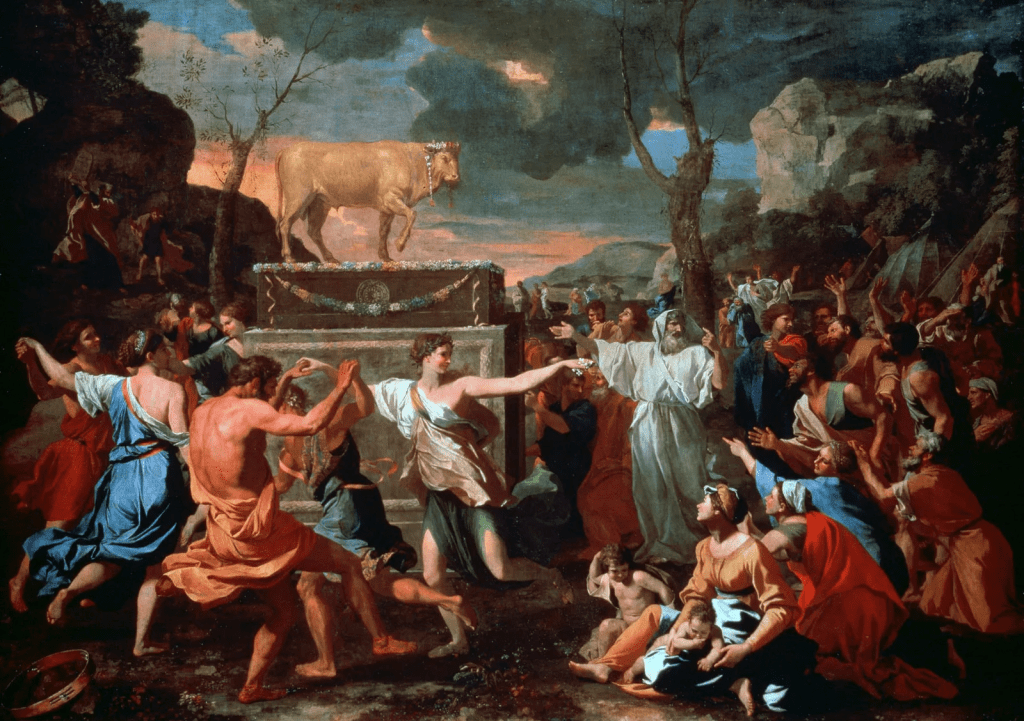
Adoration of the Golden Calf, by Nicolas Poussin (1594-1665)

When the people saw that Moses was so long in coming down from the mountain, they gathered around Aaron and said, “Come, make us gods who will go before us. As for this fellow Moses who brought us up out of Egypt, we don’t know what has happened to him.”

Aaron answered them, “Take off the gold earrings that your wives, your sons and your daughters are wearing, and bring them to me.” So all the people took off their earrings and brought them to Aaron. He took what they handed him and made it into an idol cast in the shape of a calf, fashioning it with a tool. Then they said, “These are your gods, Israel, who brought you up out of Egypt.”

When Aaron saw this, he built an altar in front of the calf and announced, “Tomorrow there will be a festival to the Lord.” So the next day the people rose early and sacrificed burnt offerings and presented fellowship offerings. Afterward they sat down to eat and drink and got up to indulge in revelry.

Then the Lord said to Moses, “Go down, because your people, whom you brought up out of Egypt, have become corrupt. They have been quick to turn away from what I commanded them and have made themselves an idol cast in the shape of a calf. They have bowed down to it and sacrificed to it and have said, ‘These are your gods, Israel, who brought you up out of Egypt.’

“I have seen these people,” the Lord said to Moses, “and they are a stiff-necked people. Now leave me alone so that my anger may burn against them and that I may destroy them. Then I will make you into a great nation.”

But Moses sought the favor of the Lord his God. “Lord,” he said, “why should your anger burn against your people, whom you brought out of Egypt with great power and a mighty hand? Why should the Egyptians say, ‘It was with evil intent that he brought them out, to kill them in the mountains and to wipe them off the face of the earth’? Turn from your fierce anger; relent and do not bring disaster on your people. Remember your servants Abraham, Isaac and Israel, to whom you swore by your own self: ‘I will make your descendants as numerous as the stars in the sky and I will give your descendants all this land I promised them, and it will be their inheritance forever.’” Then the Lord relented and did not bring on his people the disaster he had threatened. (New International Version)

The Golden Calf, by Sefira Lightstone

The ancient Israelites were dramatically delivered from slavery through a series of plagues on Egypt. Then, their lives were saved when God parted the Red Sea and the people fled from the advancing Egyptian army; collapsing the water on the soldiers when they tried to pursue the people.

The Israelites were led to Mount Sinai where God graciously entered into covenant with them; and gave them the law and the commandments. Yet, between receiving the covenant, and waiting for Moses to return from the mountain, the Israelites fell into chaos and a failure of faith. So, how did the relationship between God and Israel go so awfully sideways?

Moses spent a great amount of time with God on Mount Sinai. Apparently, the people believed that the forty days and forty nights on the mountain was too long and assumed that Moses would not return. So, what followed was idolatry, near annihilation, and intercession.

A failure of leadership

Aaron was left to lead the people during Moses’ absence. It didn’t take long for the people to get unruly and start working on Aaron. They asked him to make gods who will go before them, just as Yahweh and Moses had done in the pillar of cloud by day and fire by night.

For whatever reason, Aaron complied with their request. Maybe the people pestered him to death with constant bickering and asking, and he eventually gave-in to their coercion. Perhaps Aaron thought they had a point, and went with it as a willing participant. We aren’t told why. We are told that Aaron ordered the people to remove all the gold earrings they were wearing and bring them to him.

Aaron took all the gold he received and fashioned it into the form of a calf. Again, we aren’t told why Aaron chose to make a golden calf, in particular. Maybe he was forging a false god altogether in the shape of one of the Egyptian gods. After all, there had been a significant “back to Egypt” movement earlier, when circumstances got tough without food or water in the desert. Or perhaps Aaron was making a false image of the one true God. Either way you look at it, it’s not good.

The golden calf was handed to the people and proclaimed as the gods who brought them out of Egypt. If that weren’t bad enough, Aaron made the situation even worse by building an altar for the calf and declaring a feast for the next day. So, it’s no surprise to us as readers when we see poor leadership decision-making that leads to the people getting way out-of-hand in their festivities through drunkenness and sexual immorality.

The consequences of poor leadership

All of the revelry got God’s attention. The Lord saw the people’s depravity and commanded Moses to get back down the mountain, at once. God’s tone of voice and choice of pronouns took a turn. The Lord said to Moses, “Your people have acted perversely,” effectively distancing the divine from the mass of humanity at the foot of the mountain.

God was so upset that he started planning to destroy the whole lot of them and completely start over through the descendants of Moses. Yet, even though the Lord was very angry, and rightly so, Moses stepped in and interceded on the people’s behalf. Moses appealed to God’s reputation rather than God’s compassion. In an interesting twist, Moses turned the responsibility for the Israelites back onto God by saying they are your people, the ones whom you brought out of the land of Egypt.

What’s more, Moses pointed out to God that the Egyptians would question God’s motives for bringing the Israelites into the desert. And then Moses appealed to God’s covenant with Abraham, Isaac, and Jacob (Israel) to make a great nation of their descendants to dwell forever in the land God promised them. Moses actually persuaded the God of the universe to set aside divine anger and let the people live.

The people forgot who rescued them from slavery in Egypt. Regardless whether or not they had good intentions, the people failed in keeping their covenant obligations to God and sought to substitute God’s physical absence with a false image of God.

The implications of leadership for us

Today’s Old Testament story raises many questions for us. Here are just a few to ponder:

  • Which golden calves in our culture today draw our loyalty and love away from God when we get impatient with waiting for God’s timetable? Maybe our grumbling and complaining is a telltale sign that we are not content with God and what God is doing among us – and that we are fashioning (or have already fashioned) a god of our own making in the form of financial budgets, church buildings, or dogmatic theologies.
  • How have we made the God whom we worship into an idol that we try to control and manipulate for our own purposes? Perhaps we have substituted the one true God who is free, untamed, mysterious, and surprising, for a puny humanly constructed image, ideology, institution, or idol.
  • How do we maintain the balance between divine judgment with its consequences for disobedience, alongside God’s mercy, forgiveness, and faithfulness to the people? It could be, we are being led to grace, no matter how we go about answering the question.

Faithful God, you preside over an unfaithful people. Just as the people of Israel doubted your power and turned to other gods to fulfill their needs, we too, turn to other gods, seeking acceptance, power, and independence. Show us how to live humbly and walk in your ways, through the One who offered true power to all humanity, Jesus Christ our Savior and Lord. Amen.

Embrace the Change, Slowly (Exodus 24:12-18)

Moses receives the law from God on Mount Sinai, by Unknown artist, 1877

The Lord said to Moses, “Come up to me on the mountain and wait there; I will give you the tablets of stone, with the law and the commandment, which I have written for their instruction.” So Moses set out with his assistant Joshua, and Moses went up onto the mountain of God. To the elders he had said, “Wait here for us, until we come back to you. Look, Aaron and Hur are with you; whoever has a dispute may go to them.”

Then Moses went up on the mountain, and the cloud covered the mountain. The glory of the Lord settled on Mount Sinai, and the cloud covered it for six days; on the seventh day he called to Moses out of the cloud. Now the appearance of the glory of the Lord was like a devouring fire on the top of the mountain in the sight of the Israelites. Moses entered the cloud and went up on the mountain. Moses was on the mountain for forty days and forty nights. (New Revised Standard Version)

The Lord graciously entered into a covenant with the ancient Israelites. Following this, Moses was summoned to come up the mountain into God’s presence. There he would receive the tablets of stone with the law and the commandment on it. Yahweh was providing the people with instruction on how to live in the covenant relationship.

The scene was set for the Lord to give an extended revelation to Moses. Moses ascended the mountain, into the cloud, so that the people did not see him. For the next forty days and nights, God’s law and commandments were relayed and taught to Moses.

What did not happen is God tossing some stone tablets containing the law to Moses and then going on God’s merry way. The whole encounter unfolds over an extended period of time. That’s because we are people; we need time to wrap our heads and hearts around new realities. Humans require the gift of slowness to learn and absorb.

Western society, however, does not operate that way. More, faster, and better seems to be our cultural creed. And it’s found everywhere around us. Speed reading. More money. Bigger stuff.

Hogs and chickens are raised on factory farms in large confinement buildings. They never see the light of day. Instead, they are given steroids and growth hormones to grow faster and bigger, so that they can get to the market more quickly and get a better price.

Churches and faith communities in financial trouble look for quick solutions and fast turnarounds by expecting pastors to work more, faster, and better. Sports teams hire and fire coaches with dizzying frequency, believing that if the athletes aren’t faster and better with more wins, then there’s something wrong with them, the coach, or both.

But we have no further than the end of our nose to look for change.

People are in control of very little in this world, and so, a great deal of life is the ability to respond in changing circumstances – both wanted and unwanted. Resilience and flexibility are needed.

Moses receives the Ten Commandments, by Julius Schnorr von Carolsfeld, 1860

The Lord brought about the end of Egyptian slavery for the Israelites through a series of plagues against Egypt. God miraculously delivered the people from the Egyptian army by parting the Red Sea. And Yahweh graciously entered into covenant with them at the mountain. All of this was a major change of life.

It was the people’s responsibility to respond in faith and obedience to the actions and words of God. The Lord was allowing them the space and the time to come to grips with their new reality – which is one reason why Moses met with God for forty days and nights on the mountain.

The Israelites needed to spend their time adjusting to their new life, and contemplating the giving of the law, which was about to happen. Since we are privy to the end of the story, we know that the people did not do this. They became impatient, and experienced a failure of faith and obedience.

Aaron and Hur were the leaders who needed to step up and guide the people in the special opportunity of preparation for receiving the law. Whatever it is they did, it wasn’t that.

Murmuring, complaining, and arguing are the initial signs of impatience and wanting things to happen faster, even immediately. But faith is not forged this way. Faith is developed through dealing with adversity by looking to God, listening, and obeying. Faith knows that all things can be faced with joy.

My brothers and sisters, whenever you face various trials, consider it all joy, because you know that the testing of your faith produces endurance. And let endurance complete its work, so that you may be complete and whole, lacking in nothing. (James 1:2-4, NRSV)

Waiting, patience, and the stretching of faith is not typically what people sign up for. Whenever there are circumstances which warrant endurance and perseverance, it’s far too easy to become antsy and begin grumbling about the situation.

That’s what happened to the ancient Israelites. They had a stiff price to pay for their impatience and impertinence. Don’t be like them. Instead, decide now for encouragement, in and through, all circumstances.

Watch out, brothers and sisters, so that none of you have an evil, unfaithful heart that abandons the living God. Instead, encourage each other every day, as long as it’s called “today,” so that none of you become insensitive to God because of sin’s deception. We are partners with Christ, but only if we hold on to the confidence we had in the beginning until the end. (Hebrews 3:12-13, CEB)

May almighty God give you grace to persevere with joy, so that the Spirit may complete the work begun in you, through Jesus Christ our Lord. Amen.

The Pathology of Complaining (Numbers 20:1-13)

In the first month the whole Israelite community arrived at the Desert of Zin, and they stayed at Kadesh. There Miriam died and was buried.

Now there was no water for the community, and the people gathered in opposition to Moses and Aaron. They quarreled with Moses and said, “If only we had died when our brothers fell dead before the Lord! Why did you bring the Lord’s community into this wilderness, that we and our livestock should die here? Why did you bring us up out of Egypt to this terrible place? It has no grain or figs, grapevines or pomegranates. And there is no water to drink!”

Moses and Aaron went from the assembly to the entrance to the tent of meeting and fell facedown, and the glory of the Lord appeared to them. The Lord said to Moses, “Take the staff, and you and your brother Aaron gather the assembly together. Speak to that rock before their eyes and it will pour out its water. You will bring water out of the rock for the community so they and their livestock can drink.”

So Moses took the staff from the Lord’s presence, just as he commanded him. He and Aaron gathered the assembly together in front of the rock and Moses said to them, “Listen, you rebels, must we bring you water out of this rock?” Then Moses raised his arm and struck the rock twice with his staff. Water gushed out, and the community and their livestock drank.

But the Lord said to Moses and Aaron, “Because you did not trust in me enough to honor me as holy in the sight of the Israelites, you will not bring this community into the land I give them.”

These were the waters of Meribah, where the Israelites quarreled with the Lord and where he was proved holy among them. (New International Version)

Moses Strikes the Rock, by Rivka Korf

Every heinous sin you can think of – the worst of the worst – initially began as complaining and quarreling. Wherever you find murmuring and disrespect, you are looking at a spiritual illness which, if untreated, will poison the soul and result in apostasy, that is, a complete failure and repudiation of faith.

Today’s Old Testament lesson is a reminder and a warning that people’s faith can weaken to the point of becoming almost non-existent. There is a pathological process which brings people to a point of turning away from their faith:

  1. Complaining. It all starts with muttering some discontentment under the breath; murmuring dissatisfaction; and grumbling some ingratitude for what one already has. The Israelites complained about the lack of water. They quarreled with Moses about it and directed their anger at him.
  2. Psychotic depression. Most depression is normal, understandable, and even needed. However, psychotic depression is expressing a wish to be dead because of spiritual instability and an inability to see God at work. In other words, it’s manipulative. It’s a passive-aggressive type of anger directed at those who represent God. This is not a depression you can diagnose or put on someone; it’s a grief reaction gone sideways in wishing harm at self or others.
  3. Daydreaming. This is a preoccupation with “the good old days.” Back there in Egypt, the Israelites had figs, and grapevines, and water. But out here, they’ve got nothing. The people were experiencing extreme tunnel vision, only remembering the food they used to eat, instead of the bland manna they had to gather every day. They had completely blocked out the reason they were in the desert – because God brought a miraculous deliverance from slavery. Egypt was, in fact, anything but the good old days.
  4. Blaming. The people blamed Moses for bringing them into the wilderness. They criticized him for their lack of food and water. In reality, Moses was just doing what God wanted – and actually what the people wanted. The Israelites wanted out of Egypt; and then, when they left and things got hard, the people shifted the blame of hard circumstances onto Moses (and God).
  5. Disobeying. Why obey Moses or even Yahweh if you believe they’re out to get you, or don’t care? Maybe we just look out for ourselves and do what we think is best. (Exodus 16:1-28)
  6. Idolatry. Eventually, the people formed a “Back to Egypt” campaign. They turned their backs on Moses and on God. They lost faith, made a golden calf, and called it their god. (Exodus 32:1-8)

Despite all the whining and twisted thinking, God was gracious. The Lord told Moses to take up his staff, gather the people, and speak to a rock. God would provide by causing water to gush out of it.

At this point, Moses was upset. It seems to me he had enough of the people’s insolence and complaining. So, he ends up speaking to the people instead of the rock; and striking the rock with his staff instead of letting God do the striking.

It looks like rebellion rubs off and infects everyone, because Moses is chided by God for his own rebelliousness. Specifically, he was rebuked for not trusting God. As a result, Moses would not join the rest of the community in entering the Promised Land.

This is really a sad ending to the story. Moses was just trying to obey the Lord and lead the people. I can totally understand how exasperated he must have been from the constant griping of the people. Yet, Moses was held to account for his own lack of faith. And the people would eventually experience a harsh judgment for their faithlessness.

Don’t be misled. Bad company corrupts good character. (1 Corinthians 15:33)

Being around a bunch of ingrates will cause the good person to quit giving thanks.

Surrounding oneself with faithless people will result in that person eventually losing faith.

And hearing other people continually complain about their circumstances will cause you to grumble, setting the whole group on the road to spiritual death.

I don’t want that. And I don’t want it for you, either. If you are in such a group, get out, go, and be around people with the sort of values you care about. Life is too short to mess around with a bunch of complainers.

Lord Jesus Christ, you prayed for your friends that they would be one as you and your Father are one. We confess our resistance to your prayer. We have failed to maintain the unity of the Spirit. We have broken the bond of peace.

For the times we have not listened to each other, when we have spoken in anger, haste or fear, we are sorry. For the times we have not loved each other, when we have competed, or insulted or judged each other, we are sorry. For the harm that our disunity has done to our witness to the Gospel, we are sorry.

Have mercy on us, we pray. Restore us to friendship with you and with one another, through the power of your Spirit. Amen.