Insiders and Outsiders (Romans 11:13-29)

But I don’t want to go on about them [the Jews]. It’s you, the outsiders, that I’m concerned with now. Because my personal assignment is focused on the so-called outsiders, I make as much of this as I can when I’m among my Israelite kin, the so-called insiders, hoping they’ll realize what they’re missing and want to get in on what God is doing. If their falling out initiated this worldwide coming together, their recovery is going to set off something even better: mass homecoming! If the first thing the Jews did, even though it was wrong for them, turned out for your good, just think what’s going to happen when they get it right!

Behind and underneath all this there is a holy, God-planted, God-tended root. If the primary root of the tree is holy, there’s bound to be some holy fruit. Some of the tree’s branches were pruned and you wild olive shoots were grafted in. Yet the fact that you are now fed by that rich and holy root gives you no cause to gloat over the pruned branches. Remember, you aren’t feeding the root; the root is feeding you.

It’s certainly possible to say, “Other branches were pruned so that I could be grafted in!” Well and good. But they were pruned because they were deadwood, no longer connected by belief and commitment to the root. The only reason you’re on the tree is because your graft “took” when you believed, and because you’re connected to that belief-nurturing root. So don’t get cocky and strut your branch. Be humbly mindful of the root that keeps you lithe and green.

If God didn’t think twice about taking pruning shears to the natural branches, why would he hesitate over you? He wouldn’t give it a second thought. Make sure you stay alert to these qualities of gentle kindness and ruthless severity that exist side by side in God—ruthless with the deadwood, gentle with the grafted shoot. But don’t presume on this gentleness. The moment you become deadwood, it’s game over.

And don’t get to feeling superior to those pruned branches down on the ground. If they don’t persist in remaining deadwood, they could very well get grafted back in. God can do that. He can perform miracle grafts. Why, if he could graft you—branches cut from a tree out in the wild—into an orchard tree, he certainly isn’t going to have any trouble grafting branches back into the tree they grew from in the first place. Just be glad you’re in the tree, and hope for the best for the others.

I want to lay all this out on the table as clearly as I can, friends. This is complicated. It would be easy to misinterpret what’s going on and arrogantly assume that you’re royalty and they’re just rabble, out on their ears for good. But that’s not it at all. This hardness on the part of insider Israel toward God is temporary. Its effect is to open things up to all the outsiders so that we end up with a full house. Before it’s all over, there will be a complete Israel. As it is written,

A champion will stride down from the mountain of Zion;
    he’ll clean house in Jacob.
And this is my commitment to my people:
    removal of their sins.

From your point of view as you hear and embrace the good news of the Message, it looks like the Jews are God’s enemies. But looked at from the long-range perspective of God’s overall purpose, they remain God’s oldest friends. God’s gifts and God’s call are under full warranty—never canceled, never rescinded. (The Message)

A big reason a lot of people don’t go to church anymore, is that they can’t stand the bickering, backbiting, and belligerence amongst the people. It’s sad that so many have had a bad experience of Christians squabbling with each other. It’s not supposed to be this way.

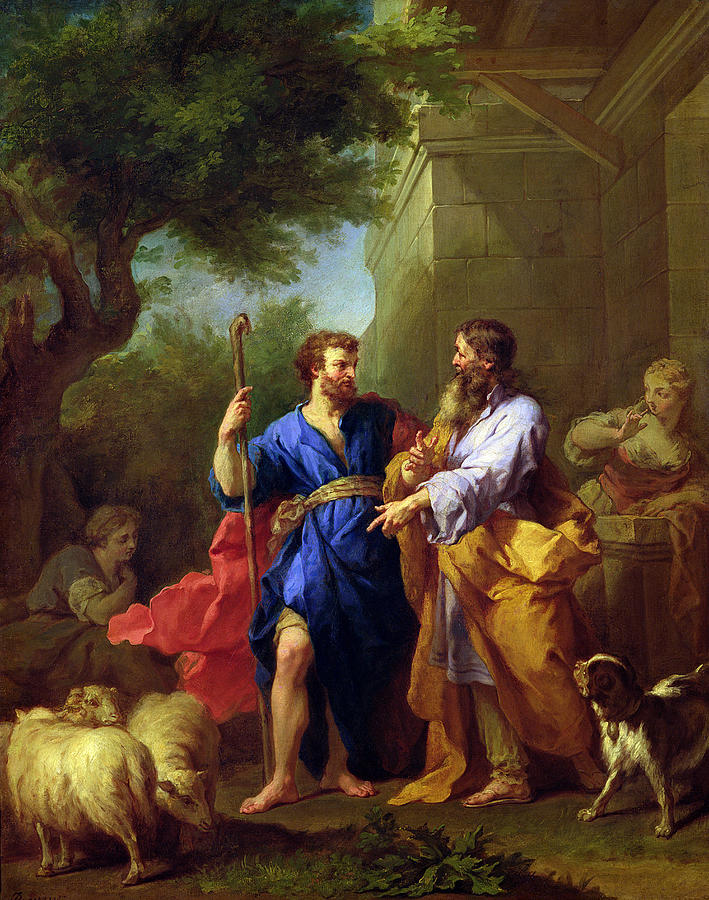
Paul disputing with both Gentiles and Jews, c.1175 C.E., (Victoria and Albert Museum, London)

The letter to the Romans reminds me of two siblings going at it, always at odds with each other. Gentile and Jew both together in one church, constantly arguing, and never stopping to listen to the other. The Apostle Paul, their spiritual parent, had enough of it. So, he wrote a lengthy tome, often alternating between speaking directly to Brother Gentile and then to Brother Jew.

Wisely, Paul never took sides and avoided favoritism even though he himself was Jewish. In today’s New Testament lesson, Paul speaks pointedly and forthrightly to the Gentiles in the church. He gets to the issue of Brother Gentile’s attitude and view toward Brother Jew. Father Paul’s instruction to Brother Gentile is also instructive for us, as we navigate a pluralistic world and a diverse church.

Brother Gentile tended to look down on Brother Jew as stuck in the past, too concerned for tradition, and unwilling to change. Brother Gentile thought it was high time Brother Jew understood that all that Jewish stuff is no longer needed; Gentiles were the future of the church.

For Brother Gentile, God has accepted him, and Brother Jew has been rejected as an unwanted anachronism. But Father Paul would have none of it; he was not going to allow Brother Gentile to eviscerate Brother Jew of his identity.

Notice Father Paul’s reasoning to his son, Brother Gentile, utilizing the lesser to the greater argument:

  • Brother Jew’s stumbling and bumbling has already caused Brother Gentile to come to faith in Christ.
  • Brother Gentile’s deliverance and acceptance will cause Brother Jew’s jealousy to kick in.
  • Brother Jew’s response will bring even greater spiritual blessing to the world.

Paul insisted that Brother Jew still has a prominent place in the family, and that a time is coming when the entire human family will have their socks blessed off because of him. Just as an olive tree is pruned and has branches grafted in, Brother Gentile needs to understand he’s a graft, and not part of the original tree.

Therefore, there is no place for arrogant pride. Grafted branches get broken off and pruned, too! And pruned branches can also be grafted back on the tree.

So, Father Paul wanted his sons to understand and appreciate one another as the one tree in God’s family. There is room for neither Brother Gentile’s complacency nor Brother Jew’s despair. Both brothers share together in one equitable tree of life, enjoying the blessings of renewal and restoration.

Let us take these lessons to heart in our interactions with folks who are different from ourselves! There is no room in God’s benevolent kingdom for simpletons who fail to see beyond the end of their noses. Instead, we are to appreciate our brother who looks, thinks, and lives differently than us.

God is only intolerant about intolerance. The Lord desires mercy and justice toward those distinctly offbeat from our own path. Just because Jesus is the way, the truth, and the life does not give any follower of Christ a license to misinterpret, misrepresent, and mistreat another group of people who subscribe to various jots and tittles other than me.

Neither you nor I are the Gardener. We do not get to do the pruning and grafting. That is God’s job, not ours. Love is our business, while the Lord will show both his kindness and sternness when and to whom he will.

Simply assuming we are always on the right side of things only produces a lack of listening, a lack of like-mindedness, and a lack of love. It creates a worldly system of demagoguery, inattention to suffering, and narrow policies, procedures, and laws which benefit only one brother, and not all the siblings.

Father Paul said earlier in his letter, “God doesn’t have any favorites!” (Romans 2:11, CEV)

Father James said in his letter, “Don’t treat some people better than others.” (James 2:1, ERV)

Father Peter said, “I really am learning that God doesn’t show partiality to one group of people over another. Rather, in every nation, whoever worships him and does what is right is acceptable to him.” (Acts 10:34-35, CEB)

And the witness of the Old Testament says, “Cut away the thick calluses from your heart and stop being so willfully hardheaded. God, your God, is the God of all gods, he is the Master of all masters, a God immense and powerful and awesome. He doesn’t play favorites, takes no bribes, makes sure orphans and widows are treated fairly, takes loving care of foreigners by seeing that they get food and clothing.” (Deuteronomy 10:17-18, MSG)

For our failure to realize that the whole world is a family, that Christ is all and in all: O Lord, forgive.

For our prejudice and self-consciousness of race, color, or language: O Lord, forgive.

For our indifference and lack of concern for our neighbors living in poverty and unemployment and for children who are ill-clothed, illiterate, and ill: O Lord, forgive.

For our unwillingness to understand the needs and problems of other people, the bitterness of those without power, and the groans of the oppressed: O Lord, forgive.

For our readiness to acquiesce in the ways of the majority, to seek the path of least resistance, and to prefer popularity to fairness: O Lord, forgive. Christ have mercy on us all. Amen.

Have a Piece of Humble Pie (Romans 9:14-29)

What can we say—that God is unfair? That’s unthinkable! For example, God said to Moses, “I will be kind to anyone I want to. I will be merciful to anyone I want to.” Therefore, God’s choice does not depend on a person’s desire or effort, but on God’s mercy.

For example, Scripture says to Pharaoh, “I put you here for this reason: to demonstrate my power through you and to spread my name throughout the earth.” Therefore, if God wants to be kind to anyone, he will be. If he wants to make someone stubborn, he will.

You may ask me, “Why does God still find fault with anyone? Who can resist whatever God wants to do?”

Who do you think you are to talk back to God like that? Can an object that was made say to its maker, “Why did you make me like this?” A potter has the right to do whatever he wants with his clay. He can make something for a special occasion or something for everyday use from the same lump of clay.

If God wants to demonstrate his anger and reveal his power, he can do it. But can’t he be extremely patient with people who are objects of his anger because they are headed for destruction? Can’t God also reveal the riches of his glory to people who are objects of his mercy and who he had already prepared for glory? This is what God did for us whom he called—whether we are Jews or not.

As God says in Hosea:

“Those who are not my people
I will call my people.
Those who are not loved
I will call my loved ones.
Wherever they were told,
‘You are not my people,’
they will be called children of the living God.”

Isaiah also says about Israel:

“Although the descendants of Israel are
as numerous as the grains of sand on the seashore,
only a few will be saved.
The Lord will carry out his sentence on the land,
completely and decisively.”

This is what Isaiah predicted:

“If the Lord of Armies hadn’t left us some descendants,
we would have been like Sodom and Gomorrah.” (God’s Word Translation)

In Christianity, humility is a virtue. Yet, sometimes Christians forget this, and they have to eat some humble pie.

In other words, there are times we need to be put in our place. It would go a lot better for us if we could just cultivate a humble spirit, rather than have humility forced upon us under embarrassing conditions.

The Apostle Paul realized he needed to make the Roman Church eat some humble pie. They were acting arrogant. The Jewish Christians and the Gentile Christians each thought they were better than the other. So, Paul reminded them both who was really in charge of things.

The proud person’s cry, when things don’t go their way, is “It’s not fair!” That’s because they believe they deserve to have something, to be on top, to call the shots on how things ought to go.

Paul was particularly hard on his fellow Jewish Christians, probably because he was quite familiar with their mindset about Gentiles (non-Jewish persons). The Jews tended to feel superior over Gentiles, and thus, to believe that they have the high ground and the right to trump Gentile thinking.

But Paul also took the Gentile Christians to task. They had a nasty habit of rolling their eyes whenever their Jewish sisters and brothers talked. The Gentiles mostly saw the Jews as hopelessly stuck in their old traditions and ways of doing things. And so, they believed new leadership was needed, wanting those crusty old guys out.

Therefore, each group – both the Jewish Christians and the Gentile Christians – had some major hang up’s about who should be in the Church and heading things up, and who should be out.

The Apostle (bless his exasperated heart) didn’t take sides. That’s because he knew that both groups were being knuckleheads. Each of them needed to get out of their pride. So, Paul cut them each some humble pie and dished it out.

Who is in and who is out is none of their concern. And what’s more, you’re never going to really know why some are in and some are out. The reason is that God is going to do what God is going to do. None of the petty posturing amongst each other means anything. In truth, everything is based on God’s call, and not on human decision, race, ethnicity, gender, politics, or anything else. It all comes down to God, not us.

God makes decisions and extends calls to people, all the time, that we don’t like. And Paul knew this. It is, in fact, what kept him humble. Paul understood he didn’t deserve a thing from God; everything good thing he had came from the Lord.

In his conversion from Jewish Saul to Christian Paul, the Apostle felt the sting of rejection from both groups. The Jews saw him as a traitor, a turncoat. The Gentiles didn’t trust him and wouldn’t accept him. But Paul, having had to eat humble pie himself – dished out by Jesus himself – learned to be patient and gentle. (Acts 9:1-5)

Yet, Paul had his boundaries and his limits. And the Roman Church crossed them. It was time for the entire church to hear a “suck it up, buttercup,” speech.

For the Jewish Christians, they were never “in” just because they were Abraham’s descendants. Abraham was called by God; therefore, everyone is called by God and not the other way around – and God calls whomever God chooses to call. There was nothing in Abraham to warrant a good choice. But God chose him anyway. And if God wants to take some of the Jews, the “chosen” people out, God will do it, because God isn’t accountable to us.

For the Gentile Christians, they weren’t brought “in” because of their own choice. Before they ever had a chance to choose God, God chose them. They were lost in darkness, far from God. But God, by sheer mercy and grace, called the Gentiles. And now that the Gentiles are “in” they can just as easily be “out” if God so chooses.

“The wonder is not that some are saved and others not, but that anybody is saved at all. If we receive what we deserve (judgment) or if we receive what we do not deserve (mercy), then in neither case is God unjust.”

John R.W. Stott

All of this is more than a bunch of power politics from the ancient world; these same dynamics impact us today in quite similar ways.

Any group of people who enjoy privilege over another group needs a slice of humble pie. Any group who continually disparages those in authority also needs a slice of humble pie.

In reality, there are times when every single one of us – including every community, institution, organization, corporation, and nation – needs a stiff reminder of who we really are, why we are really here, and what we are really supposed to be doing.

To eat humble pie means to acknowledge one’s mistake or wrongdoing and accept the humiliation that goes with that acknowledgement. We need to confess our sins and complicity in a host of the world’s ills. And we need to acknowledge that our awful predicaments aren’t just somebody else’s fault; we caused the crud.

We need the humility to ask for help; the humility to work with others very different from ourselves; and the humility to realize we could make the same mistakes again, if not for the grace of God.

Amongst us humans, we are all a community of equals. Yet, amongst God, none of humanity is equal to divinity. A clay pot has neither the right nor the ability to question the potter; they aren’t on the same level.

To enjoy divine privileges never gives us the right to show human prejudice. So let us be people who help one another live according to justice, mercy, and humility – for these are the very things which God calls us to embrace. (Micah 6:8)

Disturb us, Lord, when we are too well pleased with ourselves, and so, disparage others.
Disturb us, Lord, when with the abundance of things we possess, we lose our perspective and believe we are the masters of our own fate.

Disturb us, Lord, to dare more boldly by doing justice, loving mercy, and walking humbly with Jesus, in the enablement of the Holy Spirit. Amen.

Trust vs. Trickery (Genesis 30:25-36)

Jacob and Laban, by Pietro da Cortona (1596-1669)

After Joseph was born, Jacob said to Laban, “Release me from our agreement and let me return to my own country. You know how hard I’ve worked for you, so let me take my wives and children and leave.”

But Laban told him, “If you really are my friend, stay on, and I’ll pay whatever you ask. I’m sure the Lord has blessed me because of you.”

Jacob answered:

You’ve seen how hard I’ve worked for you, and you know how your flocks and herds have grown under my care. You didn’t have much before I came, but the Lord has blessed everything I have ever done for you. Now it’s time for me to start looking out for my own family.

“How much do you want me to pay you?” Laban asked.

Then Jacob told him:

I don’t want you to pay me anything. Just do one thing, and I’ll take care of your sheep and goats. Let me go through your flocks and herds and take the sheep and goats that are either spotted or speckled and the black lambs. That’s all you need to give me. In the future you can easily find out if I’ve been honest. Just look and see if my animals are either spotted or speckled, or if the lambs are black. If they aren’t, they’ve been stolen from you.

“I agree to that,” was Laban’s response. Before the end of the day, Laban had separated his spotted and speckled animals and the black lambs from the others and had put his sons in charge of them. Then Laban made Jacob keep the rest of the sheep and goats at a distance of three days’ journey. (Contemporary English Version)

Jacob left home by himself and went to his mother’s family. After twenty years away, he had two wives and twelve sons by four different women. He had worked for his father-in-law Laban for all that time – all to Laban’s advantage. During those twenty years, there was plenty of complicated and awkward family drama.

Now Jacob was ready to be done with all that. He wanted to move on and go back to the place of his family origin. But, of course, Laban had a good thing going and did not want Jacob to leave. So, he did his best to convince him to stay. Jacob was able to set his own terms. And there was some space put between his burgeoning family and his in-law’s.

But returning is a lot more difficult than leaving. When I left home as a young man I had all my worldly possessions in a ’74 Chevy Vega. And when I returned to the land of my origins, it was in a large rental truck with a wife a three kids. There was a lot of logistics involved, not to mention all the relationships we left.

For twenty years, Jacob and Laban did a weird relational dance. They were both tricky dudes, and were continually attempting to maneuver and outmaneuver the other. Yet, Jacob mostly got the brunt of unfairness.

In reality, Jacob owed Laban nothing. He had agreed to work for him fourteen years in total. But he could take nothing with him except his family – which would leave him with no means of support. And Laban was not about to give his son-in-law any support outside of his fatherly-in-law control.

Jacob came up with a strange set of terms concerning the flocks of sheep. Laban logically calculates that Jacob is unlikely to gain much profit from the plan, and can still keep the status quo going. So it becomes a done deal.

In a typical relational dynamic which they have become accustomed to, Laban himself sorts the flock, removes all the spotted and speckled sheep to a safe distance, and leaves Jacob with the rest.

So, if Jacob is to acquire any flock of his own, he needs to discover a way of breeding multicolored sheep from monochrome ones – a task which seems to be improbable if not impossible. But that’s exactly what Jacob does in the end, and that is yet the subject of another Old Testament lesson….

So, exactly what is today’s lesson? Life is anything but a nice, neat trajectory upwards toward achieving goals. Rather, life is a series of twists and turns, leading us to often take three steps forward and two steps backward in a herky-jerky sort of journey. Yet, behind it all, the Lord’s promises are still there, still in effect, still being worked out, in order to be fully realized. Nothing and no one is going to derail the plans and purposes of God.

Sometimes we need to be reminded that God is the giver of prosperity, and not anyone or anything else.

When you become successful, don’t say, “I’m rich, and I’ve earned it all myself.” Instead, remember that the Lord your God gives you the strength to make a living. That’s how he keeps the promise he made to your ancestors. (Deuteronomy 8:17-18, CEV)

To the person who pleases him, God gives wisdom, knowledge and happiness, but to the sinner he gives the task of gathering and storing up wealth to hand it over to the one who pleases God. (Ecclesiastes 2:26, NIV)

If any of you lacks wisdom, you should ask God, who gives generously to all without finding fault, and it will be given to you. (James 1:5, NIV)

We may, at times, feel the need to acquire what we want through trickery or manipulation. However, there is a God in heaven who sees and who cares. The Lord delights is being generous and giving to us, that is, if we are aware and attentive enough to ask. We might not get what we want immediately, and it likely won’t be easy, but we shall nonetheless receive it. We only need to trust.

Heavenly Father, source of all life, we thank you for the many ways in which you have blessed and enriched our lives: Keep us from possessiveness and greed, and lead us into the greater joy of sharing your gifts with others, through Jesus Christ, in whom is perfect peace. Amen.

Anxiety In the System (Acts 9:1-20)

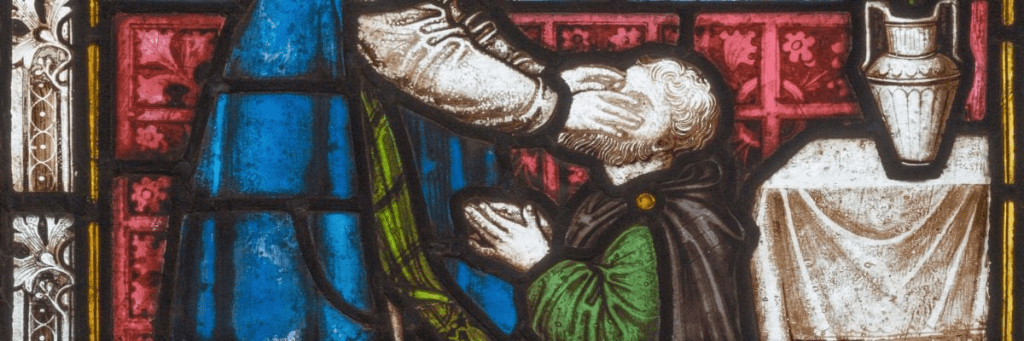
Ananias restoring sight to Saul, stained glass in St Mary Abbot`s Church, London, UK

Meanwhile, Saul was still spewing out murderous threats against the Lord’s disciples. He went to the high priest, seeking letters to the synagogues in Damascus. If he found persons who belonged to the Way, whether men or women, these letters would authorize him to take them as prisoners to Jerusalem. During the journey, as he approached Damascus, suddenly a light from heaven encircled him. He fell to the ground and heard a voice asking him, “Saul, Saul, why are you harassing me?”

Saul asked, “Who are you, Lord?”

“I am Jesus, whom you are harassing,” came the reply. “Now get up and enter the city. You will be told what you must do.”

Those traveling with him stood there speechless; they heard the voice but saw no one. After they picked Saul up from the ground, he opened his eyes but he couldn’t see. So they led him by the hand into Damascus. For three days he was blind and neither ate nor drank anything.

In Damascus there was a certain disciple named Ananias. The Lord spoke to him in a vision, “Ananias!”

He answered, “Yes, Lord.”

The Lord instructed him, “Go to Judas’ house on Straight Street and ask for a man from Tarsus named Saul. He is praying. In a vision he has seen a man named Ananias enter and put his hands on him to restore his sight.”

Ananias countered, “Lord, I have heard many reports about this man. People say he has done horrible things to your holy people in Jerusalem. He’s here with authority from the chief priests to arrest everyone who calls on your name.”

The Lord replied, “Go! This man is the agent I have chosen to carry my name before Gentiles, kings, and Israelites. I will show him how much he must suffer for the sake of my name.”

Ananias went to the house. He placed his hands on Saul and said, “Brother Saul, the Lord sent me—Jesus, who appeared to you on the way as you were coming here. He sent me so that you could see again and be filled with the Holy Spirit.” Instantly, flakes fell from Saul’s eyes and he could see again. He got up and was baptized. After eating, he regained his strength.

He stayed with the disciples in Damascus for several days. Right away, he began to preach about Jesus in the synagogues. “He is God’s Son,” he declared. (Common English Bible)

A telltale sign of spiritual blindness, a lack of awareness, and an unwillingness to change is to put all the focus on another person or group as the real problem of a society.

That’s exactly what Saul did. And that’s precisely why he needed a conversion.

Family Systems Theory

Murray Bowen was an influential psychiatrist of the twentieth century. His family systems theory, also known as Bowen theory, views a family (or any group of persons) as an emotional unit. Within this unit, a change in any of the individual persons results in the others compensating for the emotional functioning that’s been altered. 

Like touching one part of a spider web, the entire thing shakes. Bowen’s focus was that, rather than trying to change the other person, one can change themselves without becoming part of the problem. The theory states that if any family or group member can change their emotional functioning within the system, the whole family will improve its corporate functioning in response to that change. 

In short, we must learn to function in a healthy way within the group system. Personal transformation becomes the best approach to handling family crises and problems.

Saul the Pharisee to Paul the Apostle

Bowen’s statement of the human condition could be said of Saul and his conversion:

“The human is a narcissistic creature who lives in the present and who is more interested in his own square inch of real estate, and more devoted to fighting for his rights than in the multigenerational meaning of life itself. As the human throng becomes more violent and unruly, there will be those who survive it all….  I think the differentiation of self (remaining connected to others, yet separate from their problems) may well be one concept that lives into the future.”

Murray Bowen

Saul the Pharisee was an anxious soul. He was determined to keep the Christian sect from infecting his Jewish way of life. As the followers of Jesus grew, so did the anxiety of Saul and the Pharisees. Saul turned his attention to unhealthy ways of handling the situation – to the point that Christ himself showed up and let Saul know that his harassment needed to stop.

Our Need for Change

Whatever you think of Bowen’s theory, it’s easy to see that anxiety plays a major role in many individuals, families, and even churches. Whenever worry, fear, and anxiety take over a person or group of people, things become emotionally charged. 

The church is an emotional unit. Typically, the response to anything we don’t like is to try and change the other person who is rocking the boat or upsetting the status quo. The converted and changed Apostle Paul learned his lesson about the intricate web of anxious emotions: 

Don’t be anxious about anything; rather, bring up all of your requests to God in your prayers and petitions, along with giving thanks. Then the peace of God that exceeds all understanding will keep your hearts and minds safe in Christ Jesus. (Philippians 4:6-7, CEB)

Learning to manage our own anxiety, and cope with the incessant worry within ourselves, is imperative to dealing with relational problems in the group. The peace of God, not the peace of others, is what makes the difference. 

People are all for change, that is, we want others to change so that we don’t have to. The Christian, however, is to conform to Jesus, and not the other way around. Because the Lord is near to us, we have a consistent and continual presence to anchor ourselves, no matter whether the circumstances are to my liking, or not. 

Prayer becomes the means of casting anxiety away so that peace can take its place. Sounds easy – it’s anything but.

It’s only human to want everyone else to change when there are problems, adversity, or challenge. Yet the change most needed is quite personal, perhaps even an outright conversion.

Our focus must be on finding ways to remain connected to God and others without resorting to passive-aggressive tactics, cutting-off relationships altogether, or bullying others into changing with our violent or manipulative words.

Faced with unwanted change and/or difficult circumstances, rather than looking for others to alter their lives, try asking yourself one of these questions: 

  • What is one small step I can take to improve my situation?
  • If I were guaranteed not to make the situation worse, what would I do differently?
  • Is there a person in my life whose voice and input I haven’t heard in a long time?
  • What is one positive trait I possess that can serve me well in this situation?

Are there other questions you could ask that would be helpful? A journey that seems a thousand miles must begin with one step. What will that step be?