Family Dynamics (Matthew 12:46-50)

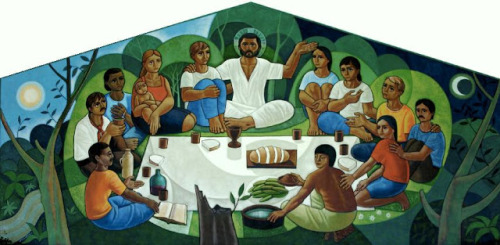
En la Cena ecológica del Reino (At the Ecological Kingdom Dinner) by Spanish artist Cerezo Barredo

While Jesus was speaking to the crowds, his mother and brothers stood outside trying to speak with him.Someone said to him, “Look, your mother and brothers are outside wanting to speak with you.”

Jesus replied, “Who is my mother? Who are my brothers?” He stretched out his hand toward his disciples and said, “Look, here are my mother and my brothers. Whoever does the will of my Father who is in heaven is my brother, sister, and mother.” (Common English Bible)

Jesus obviously did not get the cultural memo that blood is thicker than water.

When his own blood family were waiting outside for him, Jesus used the occasion to speak of what makes up a true follower of God. Christ boldly asserted that his true family is made up of people who do God’s will. By saying this, Jesus brought the point home that the kingdom of God turns on obedience.

Rather than merely confessing a belief, or appealing to a family heritage of faith, Jesus said that a genuine believer in God is one who listens to God’s words and then promptly obeys them. Therefore:

A Christian is defined by allegiance to Jesus, and not by having a certain bloodline. 

Identity determines activity. For example, if I identify myself primarily as…

  • a worker at my job, my activity will show it – I will spend long hours at my labor, and will do whatever it takes to please my boss and gain promotions.
  • an athlete, I will spend long hours honing my skills, and do whatever it takes to please the coach and to win.
  • a spouse and a parent, I will focus most of my attention on my family and seek to please them in all things. 

But if my identity is first and foremost as a Christian, I will seek to please Jesus. With my identity in Christ:

  • I will view my job as an opportunity to express the ethics of God’s kingdom, as a calling from God, and as a means for God to transform me for his glory.
  • I will view athletics as means to glorify God, and not as an end in and of itself but as a special gift for God to teach me about the importance of community and working together. 
  • I will view my kids as belonging to God and I will steward the trust of children given me by doing whatever it takes to teach and train them in the way of Jesus. I will thank God for my family and not confuse them with being God by idolizing them.

Jesus was inside a house, with his family on the outside. So, why were the family members of Jesus not inside the house sitting at his feet, taking the posture of a disciple?

The disciple Matthew wanted to communicate more than physical distance between Jesus and his physical family – being “outside” was meant to convey the posture of Christ’s family as spiritually distant, skeptical of him, and indecisive about who he was and what he was up to. The disciple Mark made this spiritual and emotional distance clear:

Jesus entered a house. A crowd gathered again so that it was impossible for him and his followers even to eat. When his family heard what was happening, they came to take control of him. They were saying, “He’s out of his mind!” (Mark 3:20-21, CEB)

Christ’s earthly family were not looking for Jesus to give them warm-fuzzies and have a big family hug. They were there to essentially say to him, “Cut it out, Jesus, because you’re acting like a nut-cake and embarrassing us all!”

Jesus was saying that identifying only with a biological family leads to only pleasing that family. However, identifying with Jesus leads to a radical form of following God that seeks to please him instead of submitting to family practices, mores, and beliefs which are inconsistent with the kingdom of God. 

Ethiopian Orthodox Church depiction of Christ and his disciples

For the Christian, the church is the family of God, and we are to act consistent with being in such a family.  We are to pursue God’s will, serve one another, and adopt outsiders into our family. The church is a family, not a restaurant. When we go to a restaurant, we either like the food and the service, or not. If the experience was unpleasant, we might complain to the waitress and may or may not come back. Try doing that with your mother and see where it gets you! 

As a biological family, we are committed to each other. There is no complaining about mom because of dad’s wrath. Instead, we are expected to clear our plates and put them in the dishwasher, to sweep the floor and clean the table, and to work together for the benefit of the entire family. In the same way, following Jesus means being committed to his family, the church.

Priority is to be given in doing God’s will, regardless of blood, because obedience to Christ identifies us as being in the family of God. Our actions and the way we live points to what we honestly believe and where our commitments truly lie. 

The first step of God’s desire for us is quality focused time in sitting at Christ’s feet and listening to him, because this is at the heart of all Christian discipleship. We can only do God’s will if we have clearly heard it; and we can only hear God’s will by taking the time to be at the feet of Jesus. 

Both listening and doing are necessary. Listening without engaging the world is a failure of mission; and doing without first listening leads to misguided acts and eventual burn-out. Allow Jesus to call the shots and let him instruct us so that we can live wisely and obediently. 

Jesus did not devalue blood relatives as irrelevant. Rather, the kingdom of God seeks to restore and redeem all things, including family. Both church and family are important. The relationships within each are to be nurtured.

The family of Jesus, the church, is important because Christ suffered and died for her. So, we are to be committed to the church, love the church, and serve the church because we are family. If we have a good grasp of this, we will make decisions based in what we believe God’s will is, instead of whether a relative will get upset, or not. 

We need to persistently pray for spiritually lost family members, and those whom we are estranged from. Most families have at least a few toxic persons in their orbit. Here is how we might pray for them:

  • That God will arrange divine appointments between them and others who love Jesus.
  • That God will draw them to the mercy of Christ.
  • That God will hinder the devil’s schemes against them.
  • That they will understand and respond to the good news of God’s grace.

O God, you made us in your own image and redeemed us through Jesus your Son: Look with compassion on the whole human family; take away the arrogance and hatred which infect our hearts; break down the walls that separate us; unite us in bonds of love; and work through our struggle and confusion to accomplish your purposes on earth; that, in your good time, all nations and races may serve you in harmony around your heavenly throne; through Jesus Christ our Lord. Amen.

The Trouble Is Turned (Esther 7:1-10)

The Coronation of Queen Esther, from the 1617 Scroll of Esther, Ferrara, Italy.

So the king and Haman came to have dinner with Queen Esther. On the second day, while they were drinking wine, the king asked Esther, “What is your request, Queen Esther? It will be granted to you. And what would you like? Even if it is up to half of the kingdom, it will be granted.”

Then Queen Esther answered, “If I have found favor with you, Your Majesty, and if it pleases you, Your Majesty, spare my life. That is my request. And spare the life of my people. That is what I ask for. You see, we—my people and I—have been sold so that we can be wiped out, killed, and destroyed. If our men and women had only been sold as slaves, I would have kept silent because the enemy is not worth troubling you about, Your Majesty.”

Then King Xerxes interrupted Queen Esther and said, “Who is this person? Where is the person who has dared to do this?”

Esther answered, “Our vicious enemy is this wicked man Haman!” Then Haman became panic-stricken in the presence of the king and queen.

The king was furious as he got up from dinner and went into the palace garden. But Haman stayed to beg Queen Esther for his life, because he saw that the king had a terrible end in mind for him. When the king returned from the palace garden to the palace dining room, Haman was falling on the couch where Esther was lying. The king thought, “Is he even going to rape the queen while I’m in the palace?” Then the king passed sentence on him, and servants covered Haman’s face.

Harbona, one of the eunuchs present with the king, said, “What a coincidence! The 75-foot pole Haman made for Mordecai, who spoke up for the well-being of the king, is still standing at Haman’s house.”

The king responded, “Hang him on it!” So servants hung Haman’s dead body on the very pole he had prepared for Mordecai. Then the king got over his raging anger. (God’s Word Translation)

“Let nothing disturb you, let nothing frighten you. All things are passing away: God never changes. Patience obtains all things. Whoever has God lacks nothing; God alone suffices.”

Saint Teresa of Ávila (1515-1582)

I sometimes half-jokingly say to people that it’s important for me to keep busy so that I stay out of trouble. The truth is, however, that I tend to find myself in trouble a lot – whether I’m busy, or not. The same could be said for the Jewish people.

If you are anything like me, you have experienced, on more than one occasion, of feeling like you are in a circumstance that’s like quicksand. It’s as if you are stuck with no way out. Queen Esther found herself in such a situation. Through no fault of her own, she was thrust upon the stage of being the intercessor between life and death, salvation and elimination. 

The wicked Haman, a high official to the king of Persia, had it out for the Jews. So, he orchestrated a devious plan to do away with them once and for all – even building a gallows on his own property in the anticipation of hanging one of them on it. That’s how much the guy hated Jews.

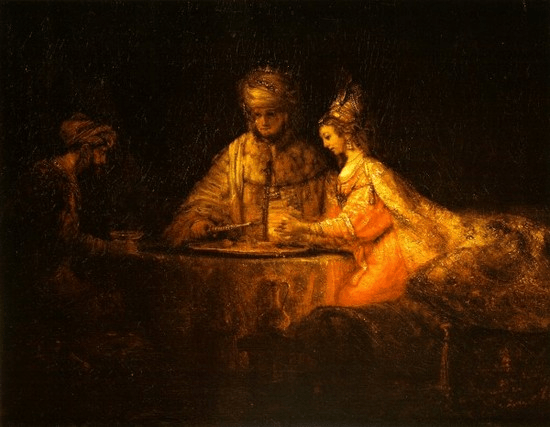
The King, Haman, and Esther, by Rembrandt van Rijn, 1660

But God, who is always awake and alert to whatever is happening in this world, had their backs. Even though the book of Esther does not once pronounce the name of God, the Lord’s influence and divine sovereignty are evident throughout the entirety of the story. 

God seems to specialize in hard cases, and in people who keep getting into trouble, despite their good intentions. And through providential means, the Lord inevitably gains the glory, and God’s people are wonderfully saved from circumstances well beyond their ability to save themselves.

Esther, a Jewish girl who became part of the king’s harem, and then the king’s wife and queen, humbly and prayerfully entered the king’s presence on behalf of her people, the Jews. Even though she was exalted to such a status, there was still the very real possibility that taking such an initiative would get Esther into deep trouble.

Yet, because of divine providence superintending the whole affair, the tables were turned, with the Jews being joyously delivered; and Haman literally finding himself at the end of his rope, on his own gallows. 

Prayer, sensitivity to God, and the humility to listen, undergirded Esther’s decision and courage to step out and act on behalf of her people. 

Especially when it comes to trouble, prayer is not optional equipment for the believer, but absolutely essential to facing each and every difficult situation. That’s because it is God, not us, nor any of our skill or ingenuity, that ultimately brings deliverance. 

Saving ourselves from impossible situations and dire circumstances is way above our pay grade; only God can bring true deliverance – the kind that genuinely changes people so that divine purposes are accomplished.

Our discouraging situations, hard cases, difficult people problems, and vexing trouble – whatever the situation – God has your back, and delights to answer our desperate pleas for help and deliverance. 

Like me, you may find yourself in trouble. But you can also find yourself with all the power of heaven behind you; and with an answer to your prayer that is beyond what you can even think or imagine.

Loving God, your Son Jesus Christ came that we might have life and have it abundantly. We humbly ask that you pour out your blessing upon our nation. Where there is illness, bring your healing touch; where there is fear, strengthen us with the knowledge of your presence; where there is uncertainty, build us up in faith; where there is dishonesty, lead us into truth; where there is discord, may we know the harmony of your love. This we are to bold to pray through Jesus Christ our Lord, who with you and the Holy Spirit are one God, now and forever. Amen.

Living with Purpose (Exodus 19:1-9a)

Moses, by Marc Chagall, 1956

On the first day of the third month after the Israelites left Egypt—on that very day—they came to the Desert of Sinai. After they set out from Rephidim, they entered the Desert of Sinai, and Israel camped there in the desert in front of the mountain.

Then Moses went up to God, and the Lord called to him from the mountain and said, “This is what you are to say to the descendants of Jacob and what you are to tell the people of Israel: ‘You yourselves have seen what I did to Egypt, and how I carried you on eagles’ wings and brought you to myself. Now if you obey me fully and keep my covenant, then out of all nations you will be my treasured possession. Although the whole earth is mine, you will be for me a kingdom of priests and a holy nation.’ These are the words you are to speak to the Israelites.”

So Moses went back and summoned the elders of the people and set before them all the words the Lord had commanded him to speak. The people all responded together, “We will do everything the Lord has said.” So Moses brought their answer back to the Lord.

The Lord said to Moses, “I am going to come to you in a dense cloud, so that the people will hear me speaking with you and will always put their trust in you.” (New International Version)

If I were to list every job I’ve ever had in my life, it would be a long list. I’m sure, at this point in my life, that I wouldn’t immediately recall some of them. Some workplaces were run well. Others, especially in the factories I worked, were characterized by inattention to working conditions and expected employees to be more like extensions of their machines than like people. And I typically never knew why we were doing what we were doing.

I’ve also been in many churches and pastored a wide array of congregations. Some of the churches were run well and were attentive to their mission and service to the world. Others left a lot to be desired. Without trying to be simplistic, today’s Old Testament lesson gives the clue to what makes the difference: a clear sense of purpose. 

God made it clear that Israel was given the mandate “to be a kingdom of priests and a holy nation.”

Although there was always a remnant of Israelites who held to this original purpose, we know the end of the story. Israel largely failed to fulfill their God-given reason for existence and did not follow through with their missionary goal. They ended up in exile, mostly because of straying from their intended purpose, which then also led to a lack of holiness.

When Christians, Churches, and faith communities of all kinds lose sight of why they exist, they degenerate into a bunch of finicky cats who want ever richer food and a lusher bed to sleep on. 

So, let’s be clear about the reason for our existence as an institutional Body of believers: We exist not to be catered to, but to be people who do the priestly work of interceding for others so that the nations might come to know the God of all the earth. 

“Intercessory prayer might be defined as loving our neighbor on our knees.”

Charles Bent

We exist for holiness, set apart to be the conduit between heaven and earth so that others might come to embrace the life that is truly life. 

Christianity recognizes that it was Christ who fulfilled the great promises of God as the ultimate Prophet, Priest, and King. Through his holy life, Christ became the priest who made the once for all sacrifice to end all sacrifices. He reigns over a moral kingdom which is a light to the nations. And the Church, as Christ’s Body, is to continue this purpose of kingdom ethics by letting the light of Jesus shine into the shadowy dark places of this world.

Wherever you find complaining, backbiting, gossip, and slander, there you will find a profound lack of purpose. Because without a “why,” people fill the vacuum with endless squabbling about petty affairs which amount to nothing, in the scope of eternity.

And wherever there is only talk of how others can meet personal needs and satisfy pet desires, in that place there is a lost mandate to be a priest bringing others to God. 

The gracious and priestly work of intercession is the purpose many are lacking. Believers everywhere must return to this holy and sacred vocation.

Jesus modeled for us the work of intercession when he prayed:

“Father, I want those you have given me to be with me where I am, and to see my glory, the glory you have given me because you loved me before the creation of the world. Righteous Father, though the world does not know you, I know you, and they know that you have sent me. I have made you known to them, and will continue to make you known in order that the love you have for me may be in them and that I myself may be in them.” (John 17:24-26, NIV)

The Lord has said what the divine purpose is. It is our task, therefore, to do everything God has spoken.

O sovereign and majestic God, you are holy. So, I choose to be holy in all I do. I intercede for those around me who either cannot or will not come to you on their own. Draw them to yourself so that they might experience the grace and mercy of Jesus Christ, through the power of the Holy Spirit. Amen.