There Is a Larger Perspective (Psalm 73:1-20)

Psalm 73, by Keli Hogsett. The artist states, “This piece is made entirely of wood ‘ends.’ The wood colored ends represent nearness to God, where the darker pieces represent the opposite. The darker ends can attract and manipulate the wooden ends, but the darker they get, they turn downward and are swallowed by the wooden ends.

God is indeed good to Israel,
    to those who have pure hearts.
But I had nearly lost confidence;
    my faith was almost gone
because I was jealous of the proud
    when I saw that things go well for the wicked.

They do not suffer pain;
    they are strong and healthy.
They do not suffer as other people do;
    they do not have the troubles that others have.
And so they wear pride like a necklace
    and violence like a robe;
their hearts pour out evil,
    and their minds are busy with wicked schemes.
They laugh at other people and speak of evil things;
    they are proud and make plans to oppress others.
They speak evil of God in heaven
    and give arrogant orders to everyone on earth,
so that even God’s people turn to them
    and eagerly believe whatever they say.
They say, “God will not know;
    the Most High will not find out.”
That is what the wicked are like.
    They have plenty and are always getting more.

Is it for nothing, then, that I have kept myself pure
    and have not committed sin?
O God, you have made me suffer all day long;
    every morning you have punished me.

If I had said such things,
    I would not be acting as one of your people.
I tried to think this problem through,
    but it was too difficult for me
    until I went into your Temple.
Then I understood what will happen to the wicked.

You will put them in slippery places
    and make them fall to destruction!
They are instantly destroyed;
    they go down to a horrible end.
They are like a dream that goes away in the morning;
    when you rouse yourself, O Lord, they disappear. (Good News Translation)

The psalmist Asaph communicated his own experience, which is really the experience of all Israel, and of all who genuinely seek to follow God.

Everyone who is truly pure in heart will struggle, at times, to make sense of all the impurity and injustice in the world. Even a cursory observation of this old world clearly sees that it is a broken messed up place.

Those observations challenge the faithful with questions such as, “Is God really good?” and “Is maintaining my purity and faithfulness worth it?”

Most often, the response to those questions is “Yes, but…”

Arrogant people prosper. They get away with being jerks. And it isn’t fair. Good people continually face adversity and hardship. Nothing comes easy. And it doesn’t make sense.

Contemplating this reality for too long can lead to a spiritual crisis of faith. It can produce doubt. It is likely to either morph into anger and bitterness, or a passive “meh” to most things in life.

However, observational appearances can be deceiving. There is much more to seeing than with our two physical eyes. There is the kind of sight which God has:

“I do not judge as people judge. They look at the outward appearance, but I look at the heart.”

1 Samuel 16:7

In truth, the real and actual power of arrogantly wicked people is their ability to create envy and jealousy in the righteous persons.

We need a different way of seeing, a reorientation of our limited understanding of life. Look at the world, containing both the wicked and the righteous, from an angle you haven’t seen before.

For Asaph, this breakthrough perspective happened in the sanctuary of his God. The psalmist began to see that the seeming wealth, health, and invincibility of the arrogant is merely a façade. Their true future is anything but prosperous.

Asaph also had a reorientation of himself. He began to understand and accept that his own heart had the shadows of bitterness and ignorance. He himself had too much vice hiding in his heart.

With the spiritual eyes of the heart, we can focus in on the presence of God. The Lord’s guidance is constant, even when it doesn’t seem like it. God’s handle on the future is secure.

The arrogant and the wicked will not last. There is a day coming when they will not rule over anything. Their end is a sure thing.

The wise heart discerns that not everything I see today will be the same tomorrow. Therefore, I can plan wisely for the future, and be patient that the goodness of God will ultimately prevail over it all. This orientation to life brings confidence and hope.

Wisdom also directs us to discern that our hope and confidence can wax and wane. Just because we may be full of faith, hope, and love today, does not mean that from here-on-out we will never have to struggle with these feelings of jealousy, envy, disappointment, and anger.

Far too often we think emotions can be easily replaced, the negative ones for the positive, envy for happiness, or jealousy for satisfaction.

However, we are more complex creatures than that, having the capacity to hold multiple emotions at the same time. Sometimes, the best thing is to recognize that I can be happy, even though I am sad, without ignoring or stuffing the sadness.

Consider this: At the same time, all the time, God is both terribly sad, as well as quite exuberant. The Lord both grieves and celebrates continually. That’s because God sees it all.

And if I were to see the entire scope of your life, I am sure there are aspects of that life which are joyous, and elements which are despondent, with great longing for change.

Asaph got a much fuller picture of how things actually are in this world. And with that more expansive perspective he discovered a sense of settled hope, despite the fact that nothing in his world had changed at all.

Indeed, I myself am to be the change that I long for in this world. And it starts with gaining a perspective of wisdom, and seeing the angle of immateriality.

Arrogant pride, hoarding of wealth, and injustice will not last forever. They are temporary. But there are permanent things in this universe, and none of them have to do with money or stuff.

When all is said and done, Love survives and thrives. God hasn’t gone anywhere. Jesus Christ is the same yesterday, today, and forever. The Spirit is still alongside us.

And the wicked are no more.

So, may righteousness, justice, and peace surround you today and everyday like a warm security blanket of hope. And may you know that you are seen and loved by a God who cares. Amen.

How To Live When Things Are Bad (Isaiah 33:10-16)

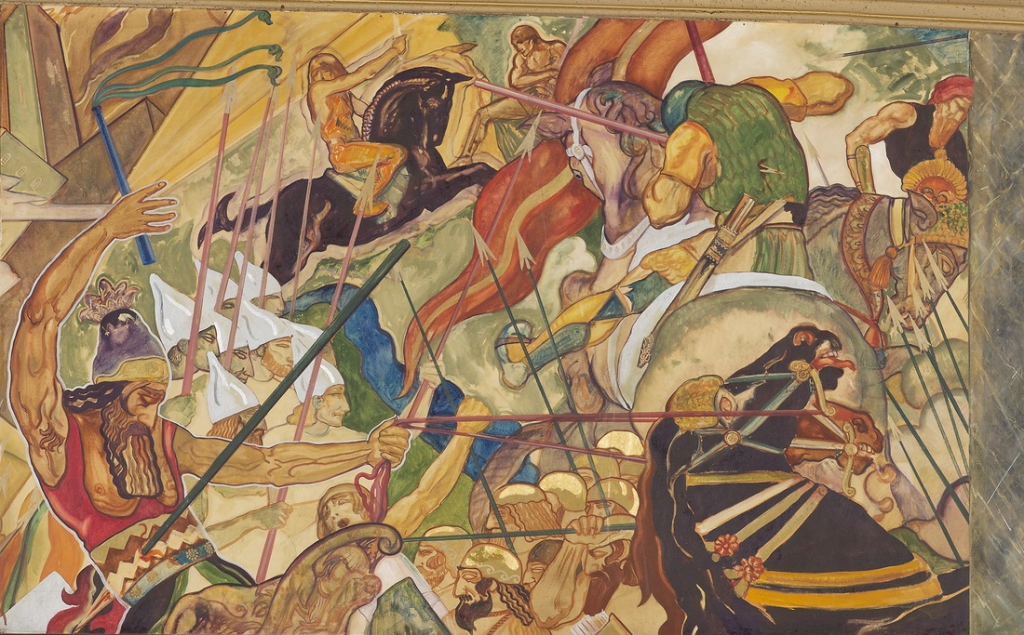
Mural depicting the wars of Israel and Judah with the surrounding nations, Wilshire Boulevard Temple, Los Angles

But the Lord says: “Now I will stand up.
    Now I will show my power and might.
You Assyrians produce nothing but dry grass and stubble.
    Your own breath will turn to fire and consume you.
Your people will be burned up completely,
    like thornbushes cut down and tossed in a fire.
Listen to what I have done, you nations far away!
    And you that are near, acknowledge my might!”

The sinners in Jerusalem shake with fear.
    Terror seizes the godless.
“Who can live with this devouring fire?” they cry.
    “Who can survive this all-consuming fire?”
Those who are honest and fair,
    who refuse to profit by fraud,
    who stay far away from bribes,
who refuse to listen to those who plot murder,
    who shut their eyes to all enticement to do wrong—
these are the ones who will dwell on high.
    The rocks of the mountains will be their fortress.
Food will be supplied to them,
    and they will have water in abundance. (New Living Translation)

The Assyrians were a nasty bunch. So were the people of Jerusalem, at the time of Isaiah’s prophecy. Maybe the folks in Judah played the comparison game and thought they were better than their foe. After all, the Assyrians were experts in war and torture.

Jerusalem was understandably terrified of the Assyrian army. And they trusted God, that is, to a degree. There’s a difference between looking to the Lord because you’re between a rock and a hard place, and placing faith in God because that is the default response of your life.

Easy for me to say. I’ve never stood on a city wall watching a powerful army surrounding me like a bunch of bullies on the playground.

Jerusalem was intimidated to the point of letting the Assyrian ruffians take their gold and silver. Well, actually, it wasn’t their gold; it was God’s. And when the army left, the city was still intact. But for how long?

It was humiliating. Being the victim of a bully always is. And because they’re bullies, it’s never enough. Like feeding the neighbor’s cat, the Assyrians end up going nowhere. They want more. In fact, they never really intended on leaving anyway. It was all a double-cross.

Judah, out of their fear and anxiety, made a bargain with the devil. A bully is a bully because they can be. Give in to them, and it only enables them to keep bullying. The Assyrians were ready for battle. It’s what they always did: fight and conquer.

It was at this point that Jerusalem finally got the clue that they’d been living with God in the background, not the foreground. They did their own thing, much like the hated and dreaded Assyrians.

So, the only recourse the people of Judah had was the mercy of their God. Yet, even though they ought to have petitioned the Lord from the get-go, at least they noticed the Lord is still there.

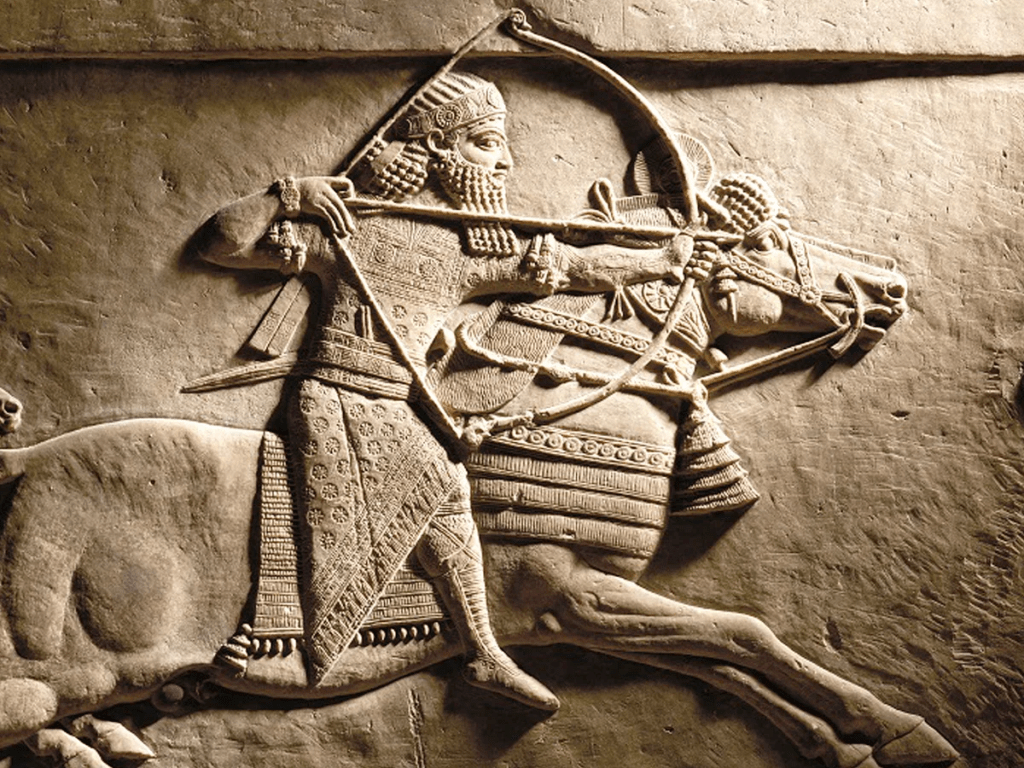
Assyrian king, British Museum

Unfortunately, most of our repentant overtures are way overdue. And yet, because of divine grace, the crazy mess we make of our lives is the very same place where a merciful God meets us.

Any sort of help is surely undeserved. It always is. The Lord, however, avoids making us grovel in our own vomit. God accepts us where we are, and not where we ought to be.

In truth, we all need to make a change, and not just the bullies. The sheer reality of God demands that we pay attention to what is right, just, and good. And the prophet Isaiah informed the people exactly how we must live in a world full of bullies and busted dreams.

We are to have an awareness of ethics and morality, a concern for humanity, and an orientation to help everyone thrive and flourish in this life.

The answer to life’s question of how to exist in this world and do more than just survive comes down to human morality:

  • Live right
  • Speak the truth
  • Despise exploitation
  • Refuse bribes
  • Reject violence
  • Avoid evil pleasures

The safe and stable way to live is to participate in the rhythms of mercy and justice that are woven into the fabric of the universe. The path to a contented and satisfying life is through goodness, not hatred.

Security and satisfaction don’t come through control of all circumstances; it comes by discerning that God has ultimate control, and that this God is good, not evil; just, not unjust; and righteous, not capricious.

According to the prophet, God will determine when the suitable time for assistance will come for us. And the Lord will deal with the ungodly according to the divine timetable, and not when we believe judgments should be rendered.

None of this is in our purview. Sometimes, talking about this sort of theology is a way of taking the focus off of our own need for an ethical and moral life. Sometimes, it is a helpful way of coming to grips with what is happening. Discernment is needed with oneself in these matters.

Trusting God means to exercise patience and perseverance, to focus on faith, to discipline ourselves in prayer, and to express confidence in hope.

We are not necessarily ruined whenever our circumstances are dire. The worse things become, the greater the display of divine power that can come.

By orienting ourselves around God and God’s strength and will, we grow in courage and develop in faith. We learn to trust in the worst of situations. We discover that the Lord knows the score of things, that God understands what’s going on.

And God laughs at the ungodly who believe they can bully the godly around. The most brilliant of military commanders is like a little toddler before the sovereign Lord of the universe. The fiery words they blow will blow back on them and consume their arrogance.

So, let us not harden our own hearts, but exercise a change of heart to let God be God, and to want for nothing but the courts of the Lord.

Let us not be like the bullies of Assyria who lived without a thought to the divine reality in front of them. Let us not become tormented, as if a fire were devouring us with inward anguish of soul, but instead:

  • Walk in right relations with others and with the Lord
  • Maintain truth and integrity in everything
  • Be free from corruption and offending others and God
  • Act with love toward your neighbor and your God
  • Refuse to accept a bribe
  • Restrain evil impulses
  • Open wide the spigot of goodness and justice

God is our refuge and strength, an ever-present help in trouble. Safety and abundance of good things is provided by the Lord. God protects. And God supplies. Rely upon God’s promises, and not the empty bellowing of others.

Be safe. Be strong. Be spiritual. We are all in this life together.

O God, my refuge and strength: In this place of unrelenting light and noise, enfold me in your holy darkness and silence, so that I may rest secure under the shadow of your wings. Amen.

Fight, Flight, Freeze, or Faith (Psalm 11)

I have taken refuge in the Lord.
    So how can you say to me,
    “Flee to the hills like a bird
        because the wicked
        have already bent their bows;
        they’ve already strung their arrows;
        they are ready to secretly shoot
        those whose heart is right”?
When the very bottom of things falls out,
    what can a righteous person possibly accomplish?

But the Lord is in his holy temple.
    The Lord! His throne is in heaven.
His eyes see—
    his vision examines all of humanity.
The Lord examines
    both the righteous and the wicked;
    his very being hates anyone who loves violence.
God will rain fiery coals and sulfur on the wicked;
    their cups will be filled
    with nothing but a scorching hot wind
    because the Lord is righteous!
    He loves righteous deeds.
    Those whose heart is right will see God’s face. (Common English Bible)

We all know what it feels like to take the brunt of someone’s poison verbal darts. It’s scary and stressful. What do you do? In a state of fear, shock, or panic, we will likely either fight, flight, freeze, or faith.

Fight

If you have ever received a nasty email based on half-truths and accusations; stood dumbfounded as someone hurled misinformation and criticism at you; and/or experienced the victimization that comes from slanderous and gossiping tongues, then the psalmist knows exactly how you feel. 

Cobbling together a hasty email response, full of anger and vitriol, only sucks us into the person’s evil ways. Metaphorically punching someone in the face for their slap to your face is how the demonic realm handles offenses. Fighting back with an equal or greater force is diametrically opposed to the way of Jesus in loving our enemies and praying for those who persecute us.

Flight

Then, there is the response of taking flight from the nastiness. Indeed, it sometimes seems as if good people are always getting swallowed whole by unjust words and behaviors directed squarely at them. 

And it doesn’t help when the downers among us stroll along and give us their unhelpful fatalism about how there is nothing we can do and how nothing will ever change.

Freeze

Some folks are just plain dumbfounded that another person can be so mean or controlling, so they freeze, unable to speak or do anything. They end up suffering in silence, without their victimization having a voice.

Faith

To be the target of evil speech or malevolent actions is, at the least, unsettling, and, at worst, can bring years of struggle, depression, and inability to serve. Yet, there is someone who sees it all, and that someone will address the wrong. 

We have an option beyond fighting back in anger, fleeing altogether in fear, or freezing in our tracks. We can trust God. We can have faith.

God Sees

The Lord sits aloft, overseeing all, and knows everything humanity does and says. God always does right and wants justice done. Everyone who shares a divine sense of what is right and just will see God’s face. God will act because the Lord abhors and despises those who are cruel and enjoy violence.

It’s not a good idea to get on God’s bad side. The way to flare God’s anger is by possessing an acerbic tongue; relishing in verbal violence; and, having no remorse about any of it. Because God loves people, God hates evil. 

The righteous can take solace in the truth that God really does see the harm done and is in a position to do something about it. Like the psalmist, we seek the Lord. The Lord fights our battles.

Not Okay

Whenever we are harassed and the ungodly give us a hard time, the psalmist isn’t offering some nice religious platitudes such as, “Just let go and let God,” “Everything works for the good of those who love God,” or “It’s okay, you’ll be in heaven someday.”

In another context, maybe those statements are helpful. But being in the teeth of the wicked, all is not okay. As much as some folks try to sanitize an evil situation with rainbows and butterflies, the evil is real, and it’s there.

The truth is that everything is not okay. And it’s okay to not feel okay. The earth is filled with violence, malevolence, oppression, injustice, and systemic evil. The psalmist knows this, all too well.

Humble yourselves under God’s power so that he may raise you up in the last day. Throw all your anxiety onto him because he cares about you.

1 Peter 5:6-7, CEB

God Acts

Today’s psalm is reminding and reassuring us that the Lord is aware of what’s going on and will most certainly do something about it. God will act to punish the wicked and deliver the Lord’s people.

There may not be peace this present moment, yet it will not always be this way. We shall behold the face of the Lord.

The Lord is a righteous judge. Justice is the foundation of God’s throne. God sees the entire spectrum of humanity and can make a right assessment of people’s thoughts, intents, words, and actions.

We, however, cannot. Therefore, it is most necessary for us to put our trust in a Divine Being who cares about right and wrong and has the power to act with justice.

Whenever we are hemmed-in through the schemes of diabolical persons and are powerless, there is always the choice to trust in the Lord. The outcome of every life on earth rests in the hands of God. And it will be a just and right rendering.

Trust in the Lord and do good. Seek peace and pursue it. We might struggle mightily on both the inside and outside – our hard circumstance might not change immediately – yet God is the One who will vindicate the just person when the time is right.

You are not alone. The Lord is with you always.

God of justice, look at the state of your servant and act on my behalf. Do not let evil prevail. Thwart the ungodly so that they can no longer do any harm. Amen.

How Much Is Too Much? (1 Kings 4:20-28)

King Solomon’s court, by Claude Vignon (1593-1670)

The people of Judah and Israel were as numerous as the sand on the seashore; they ate, they drank and they were happy. And Solomon ruled over all the kingdoms from the Euphrates River to the land of the Philistines, as far as the border of Egypt. These countries brought tribute and were Solomon’s subjects all his life.

Solomon’s daily provisions were thirty cors of the finest flour and sixty cors of meal, ten head of stall-fed cattle, twenty of pasture-fed cattle and a hundred sheep and goats, as well as deer, gazelles, roebucks and choice fowl. For he ruled over all the kingdoms west of the Euphrates River, from Tiphsah to Gaza, and had peace on all sides. During Solomon’s lifetime Judah and Israel, from Dan to Beersheba, lived in safety, everyone under their own vine and under their own fig tree.

Solomon had four thousand stalls for chariot horses, and twelve thousand horses.

The district governors, each in his month, supplied provisions for King Solomon and all who came to the king’s table. They saw to it that nothing was lacking. They also brought to the proper place their quotas of barley and straw for the chariot horses and the other horses. (New International Version)

Wealth, in and of itself, is neither good nor bad – it just is. The real issue is why any particular person wants to be wealthy, how we view wealth, and what we do with it when we have it.

In ancient Israel, under King Solomon, the Israelites enjoyed a time of prosperity, safety, and abundance. To flourish and thrive in life is good. The ability to meet basic needs, and to enjoy life is good.

King Solomon on his throne, by Frans Francken the Younger (1581-1642)

But what about beyond that? Is there such a thing as too much? And what about others who may not be able to make ends meet?

Solomon certainly had a lot. Yet, we do have warnings in Holy Scripture about exorbitant wealth. Here is what the Deuteronomic law says concerning any future king:

The king, moreover, must not acquire great numbers of horses for himself or make the people return to Egypt to get more of them, for the Lord has told you, “You are not to go back that way again.” He must not take many wives, or his heart will be led astray. He must not accumulate large amounts of silver and gold. (Deuteronomy 17:16-17, NIV)

Whatever standard one may use, I would say 12,000 horses falls into the great-numbers-of-horses category. And likewise, having 1,000 wives is most likely 999 too many for just about every man on the planet.

Indeed, Solomon’s heart was eventually led astray. It’s quite sad. Even the wisest and wealthiest person who ever lived was not able to sustain complete faithfulness to God. The remainder of Deuteronomy’s instruction about a future king is this:

When he takes the throne of his kingdom, he is to write for himself on a scroll a copy of this law, taken from that of the Levitical priests. It is to be with him, and he is to read it all the days of his life so that he may learn to revere the Lord his God and follow carefully all the words of this law and these decrees and not consider himself better than his fellow Israelites and turn from the law to the right or to the left. Then he and his descendants will reign a long time over his kingdom in Israel. (Deuteronomy 17:18-20, NIV)

In all fairness, King Solomon started out paying attention to God’s law. In his wisdom, he sought to learn and obey – but it ended up being only a partial obedience.

A dimension of any rule or government is to realize that – with any sort of success, security, and wealth – there is always a dark underbelly to it. That is, there are people within that government who are not enjoying its largess and wealth.

Under the new expanded governmental system, Solomon had his kingdom, and its subject peoples, divided into districts in order to give provisions, as well as laborers for his ambitious building projects. Not everyone was enjoying leisure time under a fig tree.

King Solomon set up an economic system that transferred wealth from nations subservient to Israel, and from subsistence farmers within Israel, to support the massive needs of Jerusalem.

The city, under Solomon, was living off the surplus grain to feed all of the horses, as well as the tribute exacted from surrounding nations. In other words, the wealth was being centralized by Solomon for his many projects and interests.

All of the opulence was meant to impress people with wealth, exhibiting Israel’s and Solomon’s great power and wisdom. Yet, if we are to follow the old adage, “follow the money,” we would discover a governmental system that extracted money from others; and produces a lot of oppression, grievances, and exploitation – hence, the dark underbelly of it all.

This sort of situation is precisely why we have prophetic literature in the Old Testament. The prophets are especially attuned to the cries of injustice amongst the people. Every society needs such persons who are within the system, yet are able to be a voice for those who are voiceless.

Had King Solomon moved beyond his partial obedience to complete and total obedience, I surmise that he likely would have considered the needs of everyone within his empire, before establishing a system of government that depended upon economic exploitation.

Specifically, perhaps Solomon ought to have engaged more vigorously and robustly with the covenant code between God and Israel that he was supposed to know so well.

And perhaps, Christianity and the Church have been too lax on the subject of handling Holy Scripture. Because, for all of our talk of being faithful to scripture, that talk has not translated into a solid social and economic understanding of human need and justice.

It simply will not do to label anything we don’t like as communist or socialist. And it will not do to say King Solomon was wealthy and successful, as if that, in and of itself, is the evidence of God’s favor. In reality, it means little, apart from a complete fidelity to God’s law.

In my judgment, Jesus did better than all of this. He pointed us to an alternative system which considers the common good of all persons, and not just some people. The ethics and morality of his Sermon on the Mount lays out the foundational means upon which any sort of governmental system ought to build upon. (Matthew 5-7)

But seek first his kingdom and his righteousness, and all these things will be given to you as well.

Jesus (Matthew 6:33, NIV)

If we are looking for the same sort of wealth and success as Solomon, that means we’ll need to ignore Jesus. Yet, if faithfulness, obedience, humility, righteousness, mercy, purity, and peacemaking matter more than our economic bottom line, then I believe we will discover that the pursuit of these virtues leads to having all of our needs met, as well.

Lord of our lives, teach us how to use our money and our possessions. Deliver us from stinginess and wasteful extravagance; inspire our giving with the spirit of true generosity. Help us always to remember your generous love for us, that we may be wise and faithful stewards of the good gifts you have given us. Amen.