Amos 8:4-12 – A Spiritual Famine

Listen to this, you who walk all over the weak,
    you who treat poor people as less than nothing,
Who say, “When’s my next paycheck coming
    so I can go out and live it up?
How long till the weekend
    when I can go out and have a good time?”
Who give little and take much,
    and never do an honest day’s work.
You exploit the poor, using them—
    and then, when they’re used up, you discard them.

God swears against the arrogance of Jacob:
    “I’m keeping track of their every last sin.”
God’s oath will shake earth’s foundations,
    dissolve the whole world into tears.
God’s oath will sweep in like a river that rises,
    flooding houses and lands,
And then recedes,
    leaving behind a sea of mud.

“On Judgment Day, watch out!”
    These are the words of God, my Master.
“I’ll turn off the sun at noon.
    In the middle of the day the earth will go black.
I’ll turn your parties into funerals
    and make every song you sing a dirge.
Everyone will walk around in rags,
    with sunken eyes and bald heads.
Think of the worst that could happen
    —your only son, say, murdered.
That’s a hint of Judgment Day
    —that and much more.

“Oh yes, Judgment Day is coming!”
    These are the words of my Master God.
“I’ll send a famine through the whole country.
    It won’t be food or water that’s lacking, but my Word.
People will drift from one end of the country to the other,
    roam to the north, wander to the east.
They’ll go anywhere, listen to anyone,
    hoping to hear God’s Word—but they won’t hear it. (The Message)

Four hundred years of silence….  That’s how long it was between the Old and New Testaments of the Bible. In that period, there was no word from God. No prophets sent by God. No divine message, at all, of either judgment or grace. There was complete silence from the Lord… until the fullness of time, when the incarnation of Jesus changed everything. Why so long to hear from God?

The prophet Amos delivered a scathing message to God’s people about their total disregard for the poor and needy in the land. Those in positions of authority and power in Israel merely looked on the less fortunate as commodities – as pawns to be taken advantage of for the rich merchants. 

Because the wealthy never took the time to listen to the poor, God would not listen to them. A famine was coming – neither about hungering for food in short supply, nor about thirsting for clean water. Instead, there will be a scarcity of hearing words from God. Folks can search far and wide just to get a wordy tidbit or even a crumb of a message from the Lord, but they won’t find it.

Whenever people refuse listening to the poor, the entire human community is at risk of experiencing a famine of God’s speech. That’s for all people, not just some. Justice is the responsibility of everyone, and not just a few.

“If you can’t feed a hundred people, then feed just one.”

Mother Teresa

Scripture says people don’t live on food alone but by every word that comes from the mouth of God (Deuteronomy 8:3; Matthew 4:4). God’s Word is necessary sustenance, just as much as the need for three square meals a day. Withholding both physical and spiritual resources from others, either through sheer inattention or blatant disregard, damns a society to experiencing famine in the total sense of the word – for all, not just some.

We live in a day when the poor are often disregarded. Either they are ignored altogether or are given hand-outs and services without ever having any significant human contact.  In other words, very few people take the time to listen and get to know the real face of poverty. After all, we are busy making money and checking our stocks, and…. 

Oh, my, perhaps we have the answer as to why there is such a lack of revival in the land. The Lord shows such solidarity with the poor that to ignore them is to ignore God. No matter our financial picture and outlook, every one of us can grace the poor with the gift of time and listening to them. For in doing so we might just be listening to the voice of God.

God identifies closely with the poor, distressed, and needy. The Lord listens to the lowly. So, we as God’s people, are to share this same concern.

God will rescue the needy person who cries for help
and the oppressed person who has no one’s help.
He will have pity on the poor and needy
and will save the lives of the needy. (Psalm 73:12-13, GW)

Those who mock the poor insult their Maker; those who rejoice at the misfortune of others will be punished. (Proverbs 17:5, NLT)

Those who are gracious to the poor lend to the Lord, and the Lord will fully repay them. (Proverbs 19:17, CEB)

If you close your ear to the cry of the poor, you will cry out and not be heard. (Proverbs 21:13, NRSV)

Those who give to the poor will lack nothing, but those who turn a blind eye will be greatly cursed. (Proverbs 28:27, CEB)

Give your food to the hungry
    and care for the homeless.
Then your light will shine
    in the dark;
your darkest hour will be
    like the noonday sun. (Isaiah 58:10, CEV)

The Spirit of the Sovereign Lord is on me,
    because the Lord has anointed me
    to proclaim good news to the poor. (Isaiah 61:1, NIV)

 Jesus said, “If you want to be complete, go, sell what you own, and give the money to the poor. Then you will have treasure in heaven.” (Matthew 19:21, CEB)

 If we are rich and see others in need, yet close our hearts against them, how can we claim that we love God? My children, our love should not be just words and talk; it must be true love, which shows itself in action. (1 John 3:17-18, GNT)

We already have words from God. What will we do with them?…

Gracious God, you are found everywhere – both the halls of power, and the back alleys of slums.  As I seek you more and more, may I see the face of Jesus in everyone I encounter, whether rich or poor so that I can share the gift of life with them all in this season of anticipation.  Amen.

Amos 6:1-8 – Against Complacency

Woe to you who think you live on easy street in Zion,
    who think Mount Samaria is the good life.
You assume you’re at the top of the heap,
    voted the number-one best place to live.
Well, wake up and look around. Get off your pedestal.
    Take a look at Calneh.
Go and visit Great Hamath.
    Look in on Gath of the Philistines.
Doesn’t that take you off your high horse?
    Compared to them, you’re not much, are you?

Woe to you who are rushing headlong to disaster!
    Catastrophe is just around the corner!
Woe to those who live in luxury
    and expect everyone else to serve them!
Woe to those who live only for today,
    indifferent to the fate of others!
Woe to the playboys, the playgirls,
    who think life is a party held just for them!
Woe to those addicted to feeling good—life without pain!
    those obsessed with looking good—life without wrinkles!
They could not care less
    about their country going to ruin.

But here’s what’s really coming:
    a forced march into exile.
They’ll leave the country whining,
    a rag-tag bunch of good-for-nothings.

God, the Master, has sworn, and solemnly stands by his Word.
    The God-of-the-Angel-Armies speaks:

“I hate the arrogance of Jacob.
    I have nothing but contempt for his forts.
I’m about to hand over the city
    and everyone in it.” (The Message)

A fool is one who either cannot or will not see that their personal actions have communal ramifications. Arrogant people are shortsighted, and when there is no immediate consequence to their selfish actions, they quickly assume everything is okay.

Perhaps we are fools – not so much because of any heinous sins – but because of our great indifference toward the mass of humanity across the world, as well as the neighbor across the street.

If there is any foolishness with the Christian, I submit to you that it could likely be because we believers have abjectly avoided the Old Testament minor prophets as some anachronistic judgment of the past which has little to do with living in today’s New Testament grace.

It is high time that Christians, especially Western Christians, take the entirety of their Bibles seriously through a hard examination of the prophet Amos.

“Morally, there is no limit to the concern one must feel for the suffering of human beings. Indifference to evil is worse than evil itself; in a free society, some are guilty, but all are responsible.”

Abraham Joshua Heschel

Those with power and privilege nearly always believe that what is good for themselves is good for everybody else. In their pride, they either cannot or will not look under the ghost of Christmas Present’s robe. The boy Ignorance, and the girl Want, are out-of-sight, out-of-mind, for the foolish person of indifference.

The issue is not one of actually possessing wealth and influence. After all, the Lord God is wealthy and influential beyond anything we can imagine. The real issue is how we have obtained such things and whether we seek to use them for the common good of all people, and not just for myself or people just like me.

It will not do to be a simpleton and toss out flippant phrases such as, “If they want money they can get a job,” “They’re just lazy and unmotivated,” “The government takes plenty from me for those people,” “They could be self-sufficient if they really wanted to,” “They should be happy that I give them a [minimum wage] job,” “The poor are uneducated…addicts…drug seekers…unreliable…” And on the blustering goes, ad infinitum, ad nauseum.

Those, and many more statements like them, are nothing more than mere projections of the privileged few upon the masses. Truth is that addiction, debt, ingratitude, and laziness are marks of the rich and powerful in the same way you can find them anywhere. What’s more, projecting and deflecting are endemic of the mind that either cannot or will not engage in critical thinking and avoid logical fallacies.

Such persons are unaware that their luxurious eating and drinking in the dining room of the Titanic will suddenly be their last meal. Their complacency is their ruin.

Many of us tend to see the sins of others rather than our own sins. So, reading Amos, we may reflexively think of “those people’s sins, back then,” or, the sins of “other people.” Yet, as Jesus suggests in the Sermon on the Mount, when we interpret the law, we should first examine the logs in our own eyes, rather than starting with the slivers in our neighbor’s eye. (Matthew 7:3-5)

The place to begin with giving Amos an honest hearing, is to look inwardly at our own shadow selves. The lack of self-awareness is the beginning of all callousness, complacency, and conceit.

“Unfortunately, there can be no doubt that man is, on the whole, less good than he imagines himself or wants to be. Everyone carries a shadow, and the less it is embodied in the individual’s conscious life, the blacker and denser it is. If an inferiority is conscious, one always has a chance to correct it.”

Carl Jung

There are two practices which can help illumine our inner person, thus opening the way to greater compassion for others:

  1. Listen to your self-talk. What’s going on in your mind? Is it a series of negative thoughts that make you feel like crud? Or do you also consider gratitude and positive thoughts? Take a couple of minutes each day to sit in silence and listen to the tone of your inner voice. It might even help to write down your thoughts so that you can get a better idea of what they are truly like. If we cannot listen to ourselves, we won’t be able to listen to the voice of others – which means we’ll never really understand other people.
  2. Pay attention to your feelings. Emotions are barometers of how we are truly doing, as well as flags which signal what we are supposed to be paying attention to.For example, a warm feeling in your face might mean you’re embarrassed; ‘butterflies’ in your stomach can mean you’re nervous; or clenching your teeth might mean you’re angry. Stuffing emotions or trying to avoid them will inevitably lead to hardness of heart.

I suggest focusing on these two practices while you are reading the prophet Amos. That’s because reading the prophets never leaves us the same. They evoke lots of self-talk and plenty of emotion. This is the path to better understanding the prophet’s message.

God of the prophets, and of all living things: We are all hungry in a world full of abundance. Give us the grace and awareness to see the abundance of our world and to acknowledge our sins of greed and fear. Give us openness of soul and courageous, willing hearts to be with our sisters and brothers who are in need. We ask for your intervention on behalf of every person hungry for earthly food and hungry for the taste of the Spirit of God.

We give thanks that we can be part of your compassion for all people. This world is blessed with enough food for every person to eat and be satisfied. And we can all feed on the bread of Christ, as God makes a home in our hearts. We are in awe and wonder your great love for us, that we are invited and urged to participate with you in the care of our brothers and sisters. In the name of the Father, Son, and Spirit, one God, now and forever. Amen.

Romans 12:17-21, 13:8-10 – Let Love Be Your Only Debt

Don’t mistreat someone who has mistreated you. But try to earn the respect of others and do your best to live at peace with everyone.

Dear friends, don’t try to get even. Let God take revenge. In the Scriptures the Lord says,

“I am the one to take revenge
    and pay them back.”

The Scriptures also say,

“If your enemies are hungry,
    give them something to eat.
And if they are thirsty,
give them something
    to drink.
This will be the same
as piling burning coals
    on their heads.”

Don’t let evil defeat you but defeat evil with good….

Let love be your only debt! If you love others, you have done all that the Law demands. In the Law there are many commands, such as, “Be faithful in marriage. Do not murder. Do not steal. Do not want what belongs to others.” But all of these are summed up in the command that says, “Love others as much as you love yourself.” No one who loves others will harm them. So, love is all that the Law demands. (Contemporary English Version)

Not everybody is likable. We all have others that drive us crazy on the inside with their annoying habits or ungodly ways of life. 

Sometimes we might experience much more than being irritated. Raging vitriol that results in verbal persecution; becoming the targets of evil intent; and, in some cases, finding ourselves victims of violence done to us or a loved one can stretch our Christian sensibilities to their maximum. It is understandable that in such cases we would be upset, angry, in grief, and desire justice.

As we reflect back on Reformation Day and the great truth that we are justified apart from any work of our own but by grace alone through faith, this helps to give understanding as to why we do not take vengeance into our own hands. 

We are clearly exhorted in today’s New Testament lesson to repay no one evil for evil because vengeance belongs to God alone, not us. 

If justification is a work of God to rescue and redeem sinners from their plight, then wrath is also a work of God. Just as justification is initiated and made possible through Christ by faith, so vengeance belongs to God, as well. Our part in the whole affair is to trust God to take care of judging the world. Judgment is way above our pay grade.

Our responsibility is showing love, even to those whom we consider enemies. If we are to love our neighbors as ourselves, then we will leave plenty of room for God to do what God does best: either show mercy to sinners or execute judgment upon them. It’s all God’s business what happens with humanity. Our business is coming under the lordship of Christ and allowing God’s new creation to work itself out through us. 

We are to work for the kind of justice that provides others with what they need, not what they deserve. The world cannot become a better place if we keep insisting on playing judge, jury, and executioner. Sometimes the best way to show love is to sincerely pray for the person for whom we have such difficulty loving. 

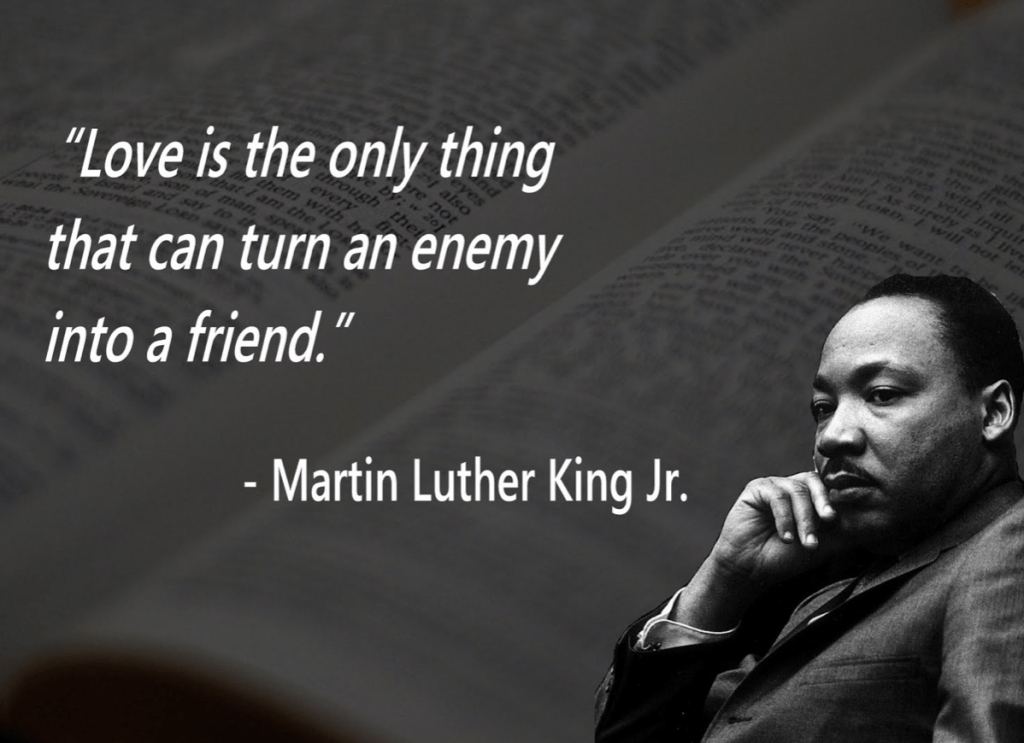
Who do you need to love today? Here is an excerpt from a sermon by Dr. Martin Luther King Jr., delivered at the Dexter Avenue Baptist Church, Montgomery, Alabama, on November 17, 1957:

“Love has within it a redemptive power. And there is a power there that eventually transforms individuals. That’s why Jesus says, ‘Love your enemies.’ Because if you hate your enemies, you have no way to redeem and to transform your enemies. But if you love your enemies, you will discover that at the very root of love is the power of redemption. You just keep loving people and keep loving them, even though they’re mistreating you.

Here’s the person who is a neighbor, and this person is doing something wrong to you and all of that. Just keep being friendly to that person. Keep loving them. Don’t do anything to embarrass them. Just keep loving them, and they can’t stand it too long. Oh, they react in many ways in the beginning. They react with bitterness because they’re mad because you love them like that. They react with guilt feelings, and sometimes they’ll hate you a little more at that transition period, but just keep loving them.

And by the power of your love, they will break down under the load. That’s love, you see. It is redemptive, and this is why Jesus says love. There’s something about love that builds up and is creative. There is something about hate that tears down and is destructive. So, love your enemies.”

Just and merciful God, you are the rightful Judge of all the earth. Help me to trust in you so that I can give room for you to do whatever you want to do in others’ lives. I pray you will grace many people with the repentance that leads to new life in Jesus. Amen.

Psalm 146 – Underdog

Praise the Lord!

Let all that I am praise the Lord.
    I will praise the Lord as long as I live.
    I will sing praises to my God with my dying breath.

Don’t put your confidence in powerful people;
    there is no help for you there.
When they breathe their last, they return to the earth,
    and all their plans die with them.
But joyful are those who have the God of Israelas their helper,
    whose hope is in the Lord their God.
He made heaven and earth,
    the sea, and everything in them.
    He keeps every promise forever.
He gives justice to the oppressed
    and food to the hungry.
The Lord frees the prisoners.
    The Lord opens the eyes of the blind.
The Lord lifts up those who are weighed down.
    The Lord loves the godly.
The Lord protects the foreigners among us.
    He cares for the orphans and widows,
    but he frustrates the plans of the wicked.

The Lord will reign forever.
    He will be your God, O Jerusalem, throughout the generations.

Praise the Lord! (New Living Translation)

I confess to being a classic cartoon connoisseur. Adults told me when I was a kid that I would outgrow watching them. Well, I’m still waiting for that day. 

One of the cartoons I enjoyed (and still do!) watching is “Underdog” (1964-1973). There is something deep within the human psyche that cheers for the underdog. Wally Cox was the perfect voice for the mild-mannered shoe-shine boy to take his underdog super energy pill and fly through the sky to rescue Sweet Polly Purebread.

That “something” inside us which identifies with the underdog is the justice of G-d. 

It’s important to understand that when the term “justice” is used, it isn’t meant primarily in punitive terms, as we might typically think of it. Rather, justice is providing people with what they need to survive, thrive, and flourish in life. Conversely, withholding needs from individuals or groups of people in this world is “injustice.” 

Today’s Psalm lets us know G-d cares about the underdog – the one who lacks basic material and spiritual provisions for living. 

G-d is deeply concerned for those who are powerless, defenseless, and on the margins of society. The psalmist identifies such persons: the hungry; prisoners; the blind; those bowed down; the orphan; and the widow. All these people represent individuals without ability to be movers and shakers in society. In short, they need G-d and deserve justice.

The Lord delights to use divine power in championing the underdog and lifting them up. What’s more, truth be told, it turns out that all of us are underdogs. Everyone needs G-d. 

We are meant to both receive and provide justice without prejudice or discrimination. Every action and decision we make is really G-d’s grace and enablement to do it. Thus, the logical and reasonable response to such a G-d is praise – to declare our hallelujahs to the One who reigns forever and will always see humanity’s great need. 

So, how will you acknowledge and praise G-d today for divine attributes and actions? Let such praise shape your soul and lift your spirit as you intentionally connect with the gracious G-d who gives us what we need so that we can say, “There’s no need to fear. Underdog is here!”

Almighty God, Father of all mercies, we your unworthy servants give you humble thanks for all your goodness and loving-kindness to us and to all whom you have made. We bless you for our creation, preservation, and all the blessings of this life; but above all for your immeasurable love in the redemption of the world by our Lord Jesus Christ; for the means of grace, and for the hope of glory. Amen.