God and the Human Condition (Romans 1:18-25)

For the wrath of God is revealed from heaven against all ungodliness and injustice of those who by their injustice suppress the truth. For what can be known about God is plain to them because God has made it plain to them. Ever since the creation of the world God’s eternal power and divine nature, invisible though they are, have been seen and understood through the things God has made.

So they are without excuse, for though they knew God, they did not honor him as God or give thanks to him, but they became futile in their thinking, and their senseless hearts were darkened. Claiming to be wise, they became fools, and they exchanged the glory of the immortal God for images resembling a mortal human or birds or four-footed animals or reptiles.

Therefore God gave them over in the desires of their hearts to impurity, to the dishonoring of their bodies among themselves. They exchanged the truth about God for a lie and worshiped and served the creature rather than the Creator, who is blessed forever! Amen. (New Revised Standard Version)

Exchanging Good for Bad

Nature abhors a vacuum. Everything is filled with something. If one thing is given up, another thing will take its place. Change is actually more like an exchange of one thing for another. Something is taken out, then replaced with something different.

We have exchanged:

  • Behavior that attends to the common good of all persons, for self-interested behavior to what is good for me and my family and/or group
  • Good deeds done from a pure heart, for good deeds done from an impure heart which give me an advantage or leverage over another
  • Steadfast committed love of others, for hustled love that gets discarded whenever things get hard
  • Submission to one another out of a sense of sacred reverence, for disobedience to anyone I don’t like
  • Dignity of being an image-bearer of God for the shame and ignominy of self-image
  • Majesty and worth of all persons in the world, for becoming masters of small worlds
Photo by Kindel Media on Pexels.com

And that’s not all, there’s more. We also have a nasty tendency to replace:

  • Freedom for shackles
  • Virtue for vice
  • Morality for immorality
  • Justice for injustice
  • Goodness for ungodliness
  • Truth for a lie
  • Wisdom for foolishness
  • Immortality for mortality
  • Honor for dishonor
  • Devotion for disregard
  • God for gods

These are all very poor replacements. In fact, the exchanges are so dark that they leave us in a state of guilt before God and all creation. Indeed, we all have sinned and fallen short of our intended purpose on this earth.

Guilt and Shame

Our response must not exchange guilt for shame because they are different words:

Guilt is assigned by God so that repentance and reconciliation might happen.

Shame, however, is introduced by us; we are the ones who label ourselves as a bucket of pig slop, not God.

Guilt is a function of the conscience, letting us know when we have said or done something wrong or hurtful; it is specific to a particular action or lack of action.

Shame, however, is a function of the “inner critic.” It interprets bad words or actions as we ourselves being bad, focusing not on actions but on our very personhood in the form of judgmentalism leveled at myself.

Guilt says, “I have done something bad.”

Shame, however, says, “I am bad.”

Guilt serves a redemptive purpose through alerting us that we need to deal with a wrong.

Shame, however, damages our spirits through telling us we are flawed and unworthy of love and connection with others.

Because guilt and shame are not the same, they need to be dealt with in different ways.

Guilt, if not faced and dealt with, becomes gangrene of the soul. Over time it festers and poisons our spirits, leading to significant emotional and sometimes physical problems. Forgiveness (both in apologies and in forgiving oneself) is the primary tool in dealing with guilt.

Shame, however, lives in the shadows and feeds on secrets. If shame persists, we withdraw from others and experience grinding loneliness. Therefore, the path out of shame is to openly name your shame and tell your story – thus taking away shame’s power and giving it back to yourself. Vulnerability is the tool which erases shame.

“Shame, blame, disrespect, betrayal, and the withholding of affection damage the roots from which love grows. Love can only survive these injuries if they are acknowledged and healed.”

Brené Brown

Emotional Creatures

In the absence of light, there is darkness. Purging oneself of belief in God merely means that another god will take her place. Scripture labels this “idolatry.”

What’s more, in the absence of feeling, in the quest to absolve oneself of unwanted emotions, there still remains emotion – because humans are emotional creatures.

People mostly rid themselves of any god concept because of how they feel about it. In fact, we do just about everything in life based on our emotions. This is a good thing, not a bad thing. We get into problems and fuss about emotions mucking up things, only because we never faced those feelings to begin with.

A person will never know God unless they understand this. The worship of God and the practice of Christianity is not only to engage the mind and the spirit, but also the body and the emotions.

Emotions and feelings are not like foreign microbes that enter the body as unwanted interlopers. They didn’t enter humanity as part of the world’s curse, after Adam and Eve’s fall into disobedience. No!

Rather, we are our emotions, just as much as we are our body, mind, and soul. Therefore, every emotion which exists, resides in us, all the time. We cannot purge ourselves of our emotions any more than we can remove the heart, the brain, or the bowels, and then expect to live.

Denying our emotions, suppressing feelings, and leaving them unacknowledged is terribly unhealthy and will slowly kill us – because our emotions are vital to our very existence.

Getting Rid of God

There are millions of spiritually dead zombies walking the earth who have jettisoned God altogether – either deliberately or unwittingly – because they discarded their emotions, long before they exchanged the sacred for the secular.

We all sometimes get physically ill; it’s part of the human condition, and we all understand that. So, we go to bed, or to the doctor, or to the hospital’s emergency department – depending upon the severity of our illness. We even go to a physician when we are healthy, just to get a check-up and make sure everything in the body is working as it should.

We also all get spiritually and emotionally ill; it’s part of the human condition. But we all don’t understand that. So, we soldier on, going about our regular business as if everything is hunky-dory. We don’t attend to our emotional selves. We don’t slow down and address what’s going on, or go to a church, or go to anyone. Instead, we suffer in silence.

Just as it ludicrous to get rid of the body altogether whenever we get a disease, so we must not rid ourselves of God whenever we get spiritually and emotionally sick. We face the illness and deal with it. It might require surgery. Recovery will hurt. That’s all part of facing it.

Ignoring God is about as smart as ignoring a heart attack. It might go away for a short time, but it’ll come back with a vengeance and do you in.

Emotions aren’t to blame when things are rough. Neither is God to blame when bad stuff happens. Both our emotions and God are realities we must deal with.

Just like the force of gravity is always there and needs to be respected (by not simply walking off the roof of your house, believing you don’t need gravity anymore) so the person and the power of God is always here and we absolutely need to come to terms with that reality, instead of walking away.

What will you do?…

A Parable about Faithfulness (Luke 19:11-27)

Parable of the Ten Minas, by Dutch painter Willem de Poorter (1608-1668)

The crowd was listening to everything Jesus said. And because he was nearing Jerusalem, he told them a story to correct the impression that the Kingdom of God would begin right away. 

He said, “A nobleman was called away to a distant empire to be crowned king and then return. Before he left, he called together ten of his servants and divided among them ten pounds of silver, saying, ‘Invest this for me while I am gone.’ But his people hated him and sent a delegation after him to say, ‘We do not want him to be our king.’

“After he was crowned king, he returned and called in the servants to whom he had given the money. He wanted to find out what their profits were. The first servant reported, ‘Master, I invested your money and made ten times the original amount!’

“‘Well done!’ the king exclaimed. ‘You are a good servant. You have been faithful with the little I entrusted to you, so you will be governor of ten cities as your reward.’

“The next servant reported, ‘Master, I invested your money and made five times the original amount.’

“‘Well done!’ the king said. ‘You will be governor over five cities.’

“But the third servant brought back only the original amount of money and said, ‘Master, I hid your money and kept it safe. I was afraid because you are a hard man to deal with, taking what isn’t yours and harvesting crops you didn’t plant.’

“‘You wicked servant!’ the king roared. ‘Your own words condemn you. If you knew that I’m a hard man who takes what isn’t mine and harvests crops I didn’t plant, why didn’t you deposit my money in the bank? At least I could have gotten some interest on it.’

“Then, turning to the others standing nearby, the king ordered, ‘Take the money from this servant, and give it to the one who has ten pounds.’

“‘But, master,’ they said, ‘he already has ten pounds!’

“‘Yes,’ the king replied, ‘and to those who use well what they are given, even more will be given. But from those who do nothing, even what little they have will be taken away. And as for these enemies of mine who didn’t want me to be their king—bring them in and execute them right here in front of me.’” (New Living Translation)

The great humanitarian issues of this world are not only individual concerns but are also systemic problems.

And the majority of those troubles are us climbing the wrong ladder. It’s a booger to get to the top and find out all that energy was expended for a worthless chamber pot full of $%&!.

So, whenever we examine Holy Scripture, especially the words of Jesus, it’s necessary to pay attention and hear both the responsibility of individuals and the accountability which human culture has to ensure a just society and equitable structural systems.

In other words, evil resides in both the individual human heart and in the world’s operating system. Corporations, communities, and churches not only have sinful persons within them; sin also resides in the very ways we about business, interactions, even worship.

Westerners tend to read a story, like today’s Gospel parable from Jesus, with individualist eyes. Yes, it is about individual servants; and it’s also about community and culture – and ultimately about the kingdom of God.

The cost of Christian discipleship is high, demanding both personal and communal faithfulness to Jesus Christ.

Christianity is concerned for all of life – not just the religious parts but all the parts – both body and soul, personal and communal, church and workplace, individual minds and institutional education, healthy emotional selves and healthy public discourse. It all matters to God.

Whoever’s in charge makes a big difference as to whether right and just systems are followed, or whether corrupt and oppressive operations are the chief mode of ruling.

To illustrate the contrast, Jesus told a parable about systemic evil and whether one will be faithful to that or some other way of operating.

In the parable, the nobleman becoming the king is a reference to an earthly ruler, not Jesus. Before this worldly prince takes off to obtain more authority, he summons ten of his servants and gives them each ten pounds, or coins.

As the sort of person who rules in standard worldly ways, the nobleman fully expects the servants to operate just as he himself would: collect unfair taxes, squeeze the poor of what little they have, and generally do whatever it takes to make a profit. This, of course, is why the story tells us that the general populace hate the guy in charge.

Parable of the Ten Minas, by Unknown 16th century artist

This is not a parable about rejecting the Messiah or God; it is about authority and government, economics and politics, systemic oppression and structural evil. It’s about where our faith and commitment is truly placed.

The ruler is quite pleased when the first and second servants faithfully invest in the politics and economics of his worldly kingdom. So, the servants are rewarded for abiding by the system.

However, if you buck the system, like the third servant did, you’ll get condemned. That servant knew the sort of ruler he was dealing with and the kind of cutthroat system which was in place. And he wanted nothing to do with it.

The third servant in the parable is unfaithful to the unjust ruler and oppressive system because he is faithful to another lord with a different kind of system. This servant was prepared to accept the consequences of his convictions and his inaction. In a way, he was practicing civil disobedience.

As servants under God’s rule and reign, we are not to play along with worldly systems of injustice and oppression. If we want to be faithful Christian disciples, then we must live into the words and ways of Jesus; we must be prepared to pay the price for our commitment to an alternative kingdom.

Everyone has faith. It’s just a matter of whom and what we place that faith in.

Perhaps Jesus had the words of his mother, Mary, in his mind when he told the story. She was willing to accept whatever happens in a complete commitment and faith in God:

“Here am I, the servant of the Lord; let it be with me according to your word.” (Luke 1:38, NRSV)

Jesus was unlike any earthly ruler. Christ operated very differently than any worldly government. He and his teaching were in stark contrast to others:

God will bless you people
who are poor.
    His kingdom belongs to you!

God will bless
    you hungry people.
You will have plenty
    to eat!
God will bless you people
who are now crying.
    You will laugh!

God will bless you when others hate you and won’t have anything to do with you. God will bless you when people insult you and say cruel things about you, all because you are a follower of the Son of Man…. So when this happens to you, be happy and jump for joy! You will have a great reward in heaven.

But you rich people
    are in for trouble.
You have already had
    an easy life!

You well-fed people
are in for trouble.
    You will go hungry!
You people
who are laughing now
    are in for trouble.
You are going to cry
    and weep!

You are in for trouble when everyone says good things about you. (Luke 6:20-26, CEV)

In order to embrace Christian ethics, worldly practices have got to be jettisoned. To make room for the good, the just, and the right, we must let go of any and all ways contrary to our Christian commitment of following Jesus.

Are you willing to be the third servant?

Gracious and sovereign Lord God of all, in your mercy, hear our prayers:

Help us to be understanding and forgiving of all those we encounter.

Show us how to serve one another, to offer love, care and support.

Guide all those who are called to lead and advocate in the world.

Inspire our leaders, teachers, doctors, social workers and counsellors to be bringers of hope in all situations.

Protect all those who carry peace to other nations. Bless the food, care and shelter they provide.

Comfort those who live with grief. Help them see the light of heaven.

Heal all the broken-hearted and those with broken bodies and spirits.

Embrace those in pain and physical suffering. May they feel your abiding and close presence.

Watch over all who feel isolated and alone. Calm their fears and lead them into peace and freedom.

Strengthen and encourage all those who seek to serve and protect the vulnerable.

Lead us to be generous with our time, possessions and money.

Lord, in your mercy, hear our prayers, and answer them according to your good grace and in your good time. Amen.

Speaking Truth to Power (Jeremiah 26:1-15)

The prophet Jeremiah, 6th century mosaic, Ravenna, Italy

Early in the rule of Judah’s King Jehoiakim, Josiah’s son, this word came from the Lord: The Lord proclaims: Stand in the temple courtyard and speak to all the people of the towns of Judah who have come to the temple to worship. Tell them everything I command you; leave nothing out. Perhaps they will listen, and each will turn from their evil ways. If they do, I will relent and not carry out the harm I have in mind for them because of the wrong they have done. 

So tell them, The Lord proclaims: If you don’t listen to me or follow the Instruction I have set before you—if you don’t listen to the words of the prophets that I have sent to you time and again, though you haven’t listened, then I will make this temple a ruin like Shiloh, and this city I will make a curse before all nations on earth.

The priests, the prophets, and all the people heard Jeremiah declare these words in the Lord’s temple. And when Jeremiah finished saying everything the Lord told him to say, the priests and the prophets and all the people seized him and said, “You must die! Why do you prophesy in the Lord’s name that ‘this temple will become a ruin like Shiloh, and this city will be destroyed and left without inhabitant’?” Then all the people joined ranks against Jeremiah in the Lord’s temple.

When the officials of Judah heard these things, they went up from the royal palace to the Lord’s temple and took their places at the entrance of the New Gate of the Lord’s temple. The priests and the prophets said to the officials and all the people: “This man deserves to die for prophesying against this city as you have all heard firsthand.”

Jeremiah said to all the officials and to all the people, “The Lord sent me to prophesy to this temple and this city everything you have heard. So now transform your ways and actions. Obey the Lord your God, and the Lord may relent and not carry out the harm that he’s pronounced against you. 

But me? I’m in your hands. Do whatever you would like to me. Only know for certain that if you sentence me to death, you and the people of this city will be guilty of killing an innocent man. The Lord has in fact sent me to speak everything I have said to you.” (Common English Bible)

When it comes to the spiritual and religious life, on the one hand, we hold the joy and contentment of divine connection and peace; and, on the other hand, we hold the sadness that many turn their backs on divine realities. In Christian terms, Jesus is both the cornerstone of faith and the stone which causes people to stumble and fall. (1 Peter 2:8)

Frankly, the Lord is not okay with cruel injustice, hollow worship, and inattention to both the divine and human. There is a way to make things right. But not everyone wants that. Systemic evil persists because there are always those who benefit from the current structures of power – and they care little about how it impacts those on the underbelly of their control.

Things may be going well for a large chunk of people. And, conversely, things may not be going well at all, for an even larger group of folks. Therefore, it is necessary to acknowledge that the world is not only good, but also quite broken. We must speak truth to power. I understand that this is no easy task, because rarely are things simply black and white, all good or all bad.

Jeremiah preaches in the temple gate, a woodcut by Unknown artist, 1886

In the prophet Jeremiah’s day, it was not that his opponents were pure evil with no acknowledgment of God. Rather, the problem was that the power brokers in Judah tried to keep a strict separation of religion from everything else; they were perfectly fine with God, that is, if the Lord would stay in the temple where he belonged.

But Jeremiah would have none of this sort of mentality and behavior. Keeping Yahweh out of matters of social justice, geopolitics, and institutional governance led to severe humanitarian problems. Jeremiah became God’s voice to a generation of people who ignored the divine in everything but religious ritual.

Bifurcating worship and work disconnects daily life from divine resources. Without God infused in all of life, a lack of grace fills the empty places. What’s more, the sovereign Lord can neither be silenced nor dismissed; God will find a way to accomplish peace and justice for the common good of everyone, and not just the few.

The heart of Jeremiah’s message was for king and people to be obedient in all of life, to recenter themselves around God’s law – not just the religious bits but the social ones, as well. Jeremiah did not proclaim something new. He was calling those in places of power and authority to a proper Torah observance.

The true needs and interests of our communities can never be addressed and lifted-up in the narrow self-serving interests of persons in power who turn a blind eye to anyone unlike them.

The needs and interests of our world lie in becoming who we were designed to be from the beginning: A people belonging to God, tapping into the deep reservoir of light and spirituality within us. It is to acknowledge the image of God inside us all.

We are to follow in the way of grace and truth. There is to be no division between the sacred and the secular because, for the Christian, Jesus is Lord of all.

We are to continually use our voice for both praise and prophecy, for shouting celebration to God and for speaking truth to power.

Holy God, the gracious Sovereign of all, we give you praise for your steadfast love toward us, your people. Keep us grounded in humility, sensitive to sin, attentive to that which is just and right, merciful in all things, pure in worship, and peace-loving through Christ our Lord in the strength of the Spirit. Amen.

Who Are We Listening To? (Jeremiah 23:9-22)

My head is reeling,
    my limbs are limp,
I’m staggering like a drunk,
    seeing double from too much wine—
And all because of God,
    because of his holy words.

Now for what God says regarding the lying prophets:

“Can you believe it? A country teeming with adulterers!
    faithless, promiscuous idolater-adulterers!
They’re a curse on the land.
    The land’s a wasteland.
Their unfaithfulness
    is turning the country into a cesspool,
Prophets and priests devoted to desecration.
    They have nothing to do with me as their God.
My very own Temple, mind you—
    mud-spattered with their crimes.” God’s Decree.
“But they won’t get by with it.
    They’ll find themselves on a slippery slope,
Careening into the darkness,
    somersaulting into the pitch-black dark.
I’ll make them pay for their crimes.
    It will be the Year of Doom.” God’s Decree.

“Over in Samaria I saw prophets
    acting like silly fools—shocking!
They preached using that no-god Baal for a text,
    messing with the minds of my people.
And the Jerusalem prophets are even worse—horrible!—
    sex-driven, living a lie,
Subsidizing a culture of wickedness,
    and never giving it a second thought.
They’re as bad as those wretches in old Sodom,
    the degenerates of old Gomorrah.”

So, here’s the Message to the prophets from God-of-the-Angel-Armies:

“I’ll cook them a supper of maggoty meat
    with after-dinner drinks of strychnine.
The Jerusalem prophets are behind all this.
    They’re the cause of the godlessness polluting this country.”

A Message from God-of-the-Angel-Armies:

“Don’t listen to the sermons of the prophets.
    It’s all hot air. Lies, lies, and more lies.
They make it all up.
    Not a word they speak comes from me.
They preach their ‘Everything Will Turn Out Fine’ sermon
    to congregations with no taste for God,
Their ‘Nothing Bad Will Ever Happen to You’ sermon
    to people who are set in their own ways.

“Have any of these prophets bothered to meet with me, the true God?
    bothered to take in what I have to say?
    listened to and then lived out my Word?
Look out! God’s hurricane will be let loose—
    my hurricane blast,
Spinning the heads of the wicked like tops!
    God’s raging anger won’t let up
Until I’ve made a clean sweep,
    completing the job I began.
When the job’s done,
    you’ll see that it’s been well done.

“I never sent these prophets,
    but they ran anyway.
I never spoke to them,
    but they preached away.
If they’d have bothered to sit down and meet with me,
    they’d have preached my Message to my people.
They’d have gotten them back on the right track,
    gotten them out of their evil ruts. (The Message)

Jeremiah had a hard gig as a prophet of the Lord. And what made it especially difficult was the continual stream of false prophets, preaching their “everything will turn out just fine” sermons in the face of economic injustice, social unrighteousness, emotional denial, and spiritual adultery.

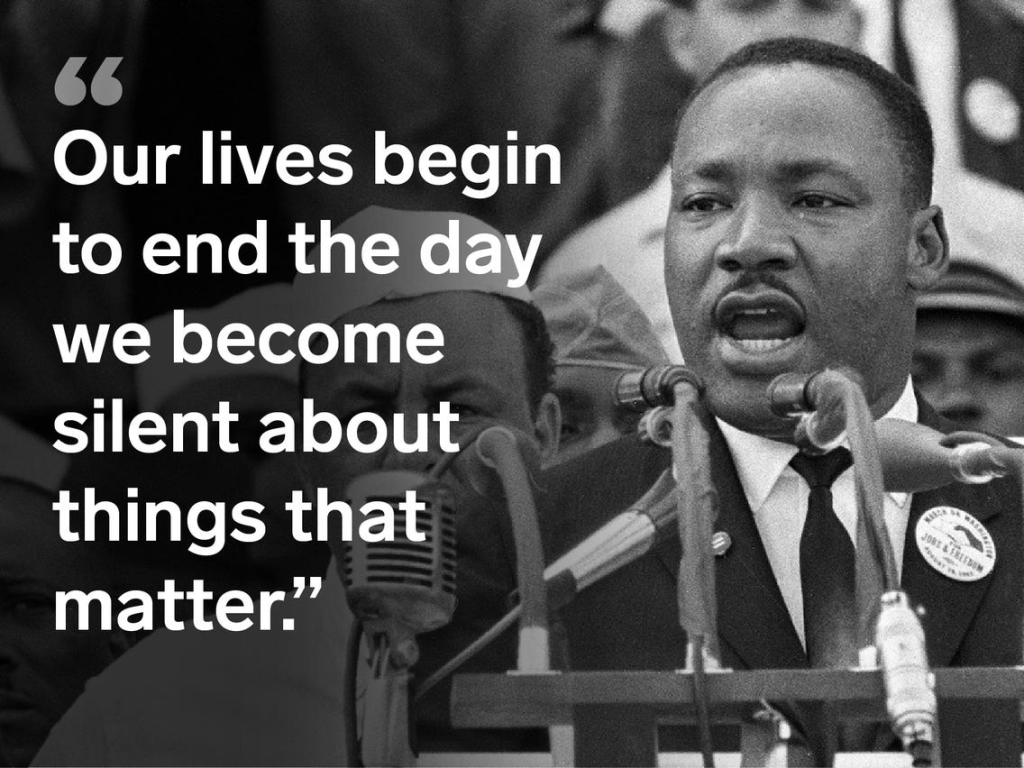
Methinks that Martin Luther King, Jr. must have felt a kinship with the prophet Jeremiah. After all, he was much like a modern-day prophet. In word and deed, he kept asking people to close the distance between the values they espoused and their actual behavior. 

The terrible treatment King and his allies received during the civil rights movement through non-violent marches and demonstrations, brought-out the awful gap between espoused American values of freedom, fairness, and tolerance, and the reality that Blacks really did not possess these in any manner close to the white population. 

Every prophetic ministry compels people to come face-to-face with the disparity between beliefs and behaviors.

Jeremiah knew all about the gulf between expressed values and actual conduct. And he faced a very large chasm between the two. 

Like Reverend King, Jeremiah was imprisoned, had rocks thrown at him, and was jeered for his message of calling people to live up to God’s agenda for humanity. 

White supremacy, or at least white privilege, was taken for granted in much of America before King. In the same way, Israelite privilege was taken for granted in Jerusalem, in Jeremiah’s day. Unfaithful prophets kept proclaiming Jewish supremacy and insisted that the Lord would be on their side of things. 

But the Lord insisted that these supposed prophets have neither attended a meeting of any divine council in heaven nor ever heard God speak to them.

I urge you, brothers and sisters, to keep an eye on those who create dissensions and hindrances, in opposition to the teaching that you have learned; avoid them. For such people do not serve our Lord Christ but their own appetites, and by smooth talk and flattery they deceive the hearts of the simple-minded. (Romans 16:17-18, NRSV)

The spirit of the age simply accepted power, privilege, and pedigree as the norm that ought to always endure. But God thinks differently about it. And so, the Lord sends prophets to call people back to justice, righteousness, and peace for the benefit of all persons.  

The zeitgeist of our own age is one of turmoil, uncertainty – and even chaos, violence, and death. We have our own contemporary self-appointed prophets who proclaim peace where there is no peace; safety, at the expense of others’ protection; militant forms of xenophobia; and an American exceptionalism which places a thin veneer of respectability over the graves of dead people’s bones.

The Lord will not contend with this forever.

An exercise in healthy introspection would be to consider these questions:

  • What are our most cherished values?
  • Where did we get them? Who are we listening to?
  • Are they God’s values? 
  • Who is really in control as the arbiter of values?
  • How might godly values of justice, righteousness, and peace be expressed in our everyday actions and behaviors?
  • Will we seek to engraft such values into our organizations, systems, faith communities, neighborhoods, and governments?
  • Can we work together in humility?
  • Do we have the courage to change, to share power, and to seek the common good of all persons?

Lord, have mercy, and grant us your peace.

All-Seeing God, you know the true state of every heart and every people group. Do your work of making me holy in all I do and say so that your values, and the words and ways of Jesus, might be expressed through me in the power of the Holy Spirit. Amen.