Learn to Live Well (Micah 7:18-20)

The Prophet Micah exhorting the Israelites to repent by Gustave Doré (1832-1883)

Who is a God like you, pardoning iniquity
    and passing over the transgression
    of the remnant of his possession?
He does not retain his anger forever
    because he delights in showing steadfast love.
He will again have compassion upon us;
    he will tread our iniquities under foot.
You will cast all our sins
    into the depths of the sea.
You will show faithfulness to Jacob
    and steadfast love to Abraham,
as you have sworn to our ancestors
    from the days of old. (New Revised Standard Version)

In a world obsessed with constant and rapid change, it is refreshing to know that there is a God whose essential character, attributes, and way of being in the world never changes.

The Lord is a God who is faithful, always keeping divine promises to people. God is pleased to show steadfast love and kindness through extending forgiveness. And because the Lord values pardoning human transgressions, God always looks sin square in the eye – not ever sugarcoating iniquities – and puts it down like a rabid animal.

In the prophet Micah’s day, the social and communal sins of the people were legion, leading to a great deal of injustice. Wealthy landowners creatively and unjustly seized property in order to feed their continual greed for more; false prophets went about preaching a positive future of peace, even though the poor became poorer through no fault of their own; and the nation’s leaders abused their power by fleecing the people of what little they had to begin with.

In short, dishonest business practices, dressed up by leadership as the path to prosperity, stirred up the just and right indignation of God. An assurance of pardon comes, yet only after there is confession of sin.

In this present contemporary era, we have our own legion of social sins which must be identified, confronted, confessed, expiated, and replaced with virtues that foster life and happiness.

Today’s way of doing business – whether in the corporate world and even in many faith communities – is to embrace an unholy ethic of more, faster, and better.

“Wait,” you may push back, “that doesn’t sound to me like anything bad.” And I would respond by saying that this is evidence of how far into our sin we have become, that we cannot distinguish our unjust practices from legitimate just practices.

Behind many contemporary business “ethics” are compulsions to beat the competition at all cost, obsessions with more money, and a lust for power and control. These are not practices helping people to live well.

More

In ancient Egypt, Pharaoh’s massive industrial complex was built on more – more pyramids and buildings, more wealth, more power and influence. Behind the “more” is usually old-fashioned greed. We want more market share, more numbers, more options and opportunities, more control.

Yet, what if the people doing the “more” are already tired, weary, and have given what they can? Like the Israelite slaves in Egypt, making more bricks translated to more wealth. And if it takes a literal whip to make them do more, then so be it.

Many modern workers put up with the “more” mantra only because they need their jobs and fear losing them if they don’t keep a ridiculously high level of production. And if anybody complains about it, they immediately get labeled (by the people in power) as not being grateful.

Faster

I once worked a job where a manager would occasionally and literally stand over my shoulder and time me with a stopwatch… sheesh… and I worked another job in which there was a quota for every day; we had to keep pace because production was king.

You don’t need to be in a factory for the clock to be the taskmaster. I don’t know of anyone who is hounded by a boss about time to experience contentment, peace, and rest. Speeding up to meet a quota or deadline only promises to create the necessity for more change, done faster.

None of this makes for a good life; and I would argue that it doesn’t make for good business either. It only produces empty and vacuous people who sacrifice themselves on the altar of work.

We are finite creatures with finite time and resources. We are not inanimate machines without a soul.

Better

One of the manifestations of valuing speed and productivity is also expecting fewer mistakes – because imperfection slows the wheels of progress. This is where people begin to be treated like machines instead of humans. And they become expendable; if they don’t do better, they get replaced with someone else.

Furthermore, this push to do better is often why workers are told to keep their problems at home and not bring them to the job. This has had a terrible impact on individuals, their families, and their relationships.

Forced compartmentalization has the effect of breaking down integrity and creating disparities. People’s very normal struggles cannot be shared with anyone but a professional counselor, therapist, or pastor. Their feelings and emotions become privatized.

Giving someone a list of resources might make management feel better, but it does little to actually help a grieving person who is right under their nose. Depression sets in because the person’s experience and emotions have been implicitly invalidated, leaving them with a sense that they’re meaningless and are a burden on others.

More, faster, and better – continually pumped into society’s bloodstream – is only making the world anxious, depressed, and with no energy to keep being yourself, that is, if you even know who you are anymore after such a pace of work.

What If?

Instead of more, faster, better, what if we…

  1. Embrace an unforced rhythm of life which recognizes the values of slowness, simplicity, and satisfaction?

2. Ask people to be themselves, to live life at a pace that’s doable and enjoyable?

3. Expect workers and people everywhere are to rest and adopt Christ’s easy yoke?

4. Take up the mantle as God’s people to be a counter-cultural movement of relationships which emphasize grace, love, mercy, patience, peace, joy, and spiritual support?

5. Put our energies into the careful construction of souls, instead of draining the spirits of people through unrealistic expectations?

6. Sought to live a simple life, without the need for more?

7. Learn to be satisfied with what we already have?

8. Rid ourselves of financial language to communicate with one another? (e.g. “invest in eternity,” “be an asset, not a liability,” “pay your debt to society,” etc.)

For the Christian, transformation isn’t dependent upon praying more, reading more, giving more, or serving more. Spiritual growth isn’t realized overnight; it takes time, in fact, a lifetime. And change isn’t about trying to be better, since our identity is already firmly in Christ.

My friends, you and I are enough. Transformation of life is the result of becoming open and receiving the grace of God in Christ. If we want forgiveness, we must face the sin of our world in all of its deceit, degradation, and damage.

Let’s not find ourselves on the other end of God’s ire because of unsound practices which dehumanize others. But let us accept and adopt rhythms of life that are consistent with being human and caring for others. That’s what the prophet Micah was looking for.

May it be so, to the glory of God.

Let Go and Give (Isaiah 58:1-12)

“Shout it aloud, do not hold back.
    Raise your voice like a trumpet.
Declare to my people their rebellion
    and to the descendants of Jacob their sins.
For day after day they seek me out;
    they seem eager to know my ways,
as if they were a nation that does what is right
    and has not forsaken the commands of its God.
They ask me for just decisions
    and seem eager for God to come near them.
‘Why have we fasted,’ they say,
    ‘and you have not seen it?
Why have we humbled ourselves,
    and you have not noticed?’

“Yet on the day of your fasting, you do as you please
    and exploit all your workers.
Your fasting ends in quarreling and strife,
    and in striking each other with wicked fists.
You cannot fast as you do today
    and expect your voice to be heard on high.
Is this the kind of fast I have chosen,
    only a day for people to humble themselves?
Is it only for bowing one’s head like a reed
    and for lying in sackcloth and ashes?
Is that what you call a fast,
    a day acceptable to the Lord?

“Is not this the kind of fasting I have chosen:
to loose the chains of injustice
    and untie the cords of the yoke,
to set the oppressed free
    and break every yoke?
Is it not to share your food with the hungry
    and to provide the poor wanderer with shelter—
when you see the naked, to clothe them,
    and not to turn away from your own flesh and blood?
Then your light will break forth like the dawn,
    and your healing will quickly appear;
then your righteousness will go before you,
    and the glory of the Lord will be your rear guard.
Then you will call, and the Lord will answer;
    you will cry for help, and he will say: Here am I.

“If you do away with the yoke of oppression,
    with the pointing finger and malicious talk,
and if you spend yourselves in behalf of the hungry
    and satisfy the needs of the oppressed,
then your light will rise in the darkness,
    and your night will become like the noonday.
The Lord will guide you always;
    he will satisfy your needs in a sun-scorched land
    and will strengthen your frame.
You will be like a well-watered garden,
    like a spring whose waters never fail.
Your people will rebuild the ancient ruins
    and will raise up the age-old foundations;
you will be called Repairer of Broken Walls,
    Restorer of Streets with Dwellings. (New International Version)

Let Go of the Hypocrisy and Get Real

Isaiah’s prophecy came to a community in conflict. The root of the issue was a hypocritical gap between the people’s conduct and their worship. They wondered why God had not noticed their pious fasting – why their actions before the Lord had gone unseen. Isaiah made it clear that their practice of fasting and their rituals of worship were ineffective because it was all self-serving instead of serving others.

Let Go of the Food and Get Generous

True fasting does not abstain from food just to get noticed (by God and/or others) but has the aim of a generous spirit and a giving heart. Both abstinence and generosity are necessary in the practice of fasting. 

Fasting is a much neglected spiritual practice today, so we need to make sense of the reason to do without food for a set amount of time. Fasting ought to put us in touch with our vulnerability; it should remind us of our mortality and our frailties. That’s why fasting is so often associated with the upcoming season of Lent.

Through fasting we remember that if we are not fed, we will die. Standing before God hungry, we realize that we are dependent creatures in desperate need of the Lord. By fasting, we discern that we are poor, and called to be rich in a way the world does not understand.

We are empty, called to be filled with the fullness of God. We are physically hungry, called to taste the goodness that can be ours in Christ, as we get in touch with a hunger for God.

Fasting, however, does not end with abstinence from food; and it is not merely a private individual thing. The spiritual discipline of fasting is meant to open our eyes and our hearts to the truly needy among us and in the world.  We are to be open to both the spiritual needs of people, and their very real material needs.

“When you see people freezing outside in the frigidity of unbelief, without the warmth of faith, impoverished and homeless, lead them home to the church and clothe them with the work of incorruption, so that, wrapped in the mantle of Christ, they will not remain in the grave.”

St. Jerome (347-430, C.E.)

Isaiah also addresses the very real daily tangible needs of people for the basic necessities of life. The message is this: Fasting is to personally abstain from food in order to provide food for another. 

Let Go of the Ego and Get to Praying & Repenting

Just as abstinence from and provision for food are two sides of the same coin, so fasting and prayer are, as well. We are to stop eating in order to take that time to pray and to give. Letting go of a meal puts the food that would have been eaten into the pantry for the needy. Fasting from lunch at our jobs can be done, not just to get more work accomplished, but so that we might share both our food and our friendship with those in need.

The prophecy of Isaiah has intimate connections between worship, fasting, justice, and reconciliation. They are meant to be a seamless whole, indivisible, enjoying a close bond that makes for powerful and effective ministry. All of this enables us to get back in touch with the real meaning of repentance:

  • To repair a broken relationship with God or with another person
  • To grieve over the reality of a certain situation
  • To devote oneself to service
  • To experience new life and spiritual growth

Isaiah wanted people to repent of both their individual sins and their social sins. Truth be told, we must all deal openly and honestly with our own complicity in the sins of our world, our nation, our church, and our families. The worship that God desires is inescapably corporate as well as compellingly personal. To ensure that all people around us flourish as human beings is both an obligation and a necessity to our collective fulfillment as God’s people.

The result of true fasting is a repentance that produces the fruit of renewal and restoration. Fasting connects us to God, and then leads us to repair and rebuild what has been broken and torn down. 

Let Go of Your “Precious” and Get Committed to God and Others

We fast to practice repentance, attach ourselves to God, and become more generous toward others. In the Lord of the Rings movies, Smeagol was much too attached to the power of the ring; it was his “precious,” and he was willing to do anything not to lose it or let it go.

Yet, we must all decide that we are going to let that precious thing go, at least for a time, whatever it may be. Each year at this time, before Ash Wednesday and the season of Lent, I decide in what ways I will practice fasting. In past years, I have abstained from buying certain things or watching TV. This year, however, I am going to do what fasting really is: abstaining from food for a set time. 

For most of the history of the church, Christians were expected to observe regular fasts on Wednesdays and Fridays, every week, year round.  When the season of Lent came, the church was united in their commitment to use the forty days as a time of introspection, confession, and fasting in order to prepare for the miracle of forgiveness on Good Friday and its life-giving power on Easter. It was understood to be a time of confronting sin, purging bad desires, yearning for forgiveness, and developing godly habits of living.   

For me, I think the least I can do is fast two meals a week – one on Wednesday and one on Friday (if not the whole days) to not only be in solidarity with the faithful that have gone before us, but in order to let the season of Lent do what it is intended to do.

I encourage you to consider implementing some sort of regular fast through Lent, if for no other reason, to fulfill the spirit and intent of Isaiah’s message to us so that we all connect deeply with Christ in purposeful Christian living.

Merciful God and Father, we have erred and strayed from your ways like lost sheep. We have followed too much the devices and desires of our own hearts. We have offended against Your holy laws. We have left undone those things which we ought to have done; and we have done those things which we ought not to have done – leaving us bereft of good. O Lord, have mercy upon us and restore us according to your grace, through Jesus Christ our Savior and Lord. Amen.

Leading Is Serving (Micah 3:1-4)

Then I said:

“Listen, leaders of Jacob, leaders of Israel:
    Don’t you know anything of justice?
Haters of good, lovers of evil:
    Isn’t justice in your job description?
But you skin my people alive.
    You rip the meat off their bones.
You break up the bones, chop the meat,
    and throw it in a pot for cannibal stew.”

The time’s coming, though, when these same leaders
    will cry out for help to God, but he won’t listen.
He’ll turn his face the other way
    because of their history of evil. (The Message)

The prophet Micah wasn’t speaking to the general population; he was specifically addressing leaders. Those in authority – whether religious, political, educational, or corporate – can be sometimes rather hard on the people they lead. Yet, most things rise or fall because of leadership, and not because of the people being led.

It’s one thing to be a Pastor and preach an angry sermon; a politician who spins the truth for their own advantage; a teacher who one day berates the students; or a boss who uncharitably chastises an employee; and it’s quite another thing for these behaviors to be habitual. A daily dose of leaders who view people as dumb sheep to fleece are eventually in for big trouble… from God!

Most leaders ascended to their position because they know what’s up and how to go about their business. They know the difference between right and wrong. But instead of viewing themselves as servants to the people, some leaders believe the people ought to be serving them. This sort of attitude comes out in snarky phrases, such as:

  • “If these idiots would only listen to me, and do what I tell them, we wouldn’t be in this mess!”
  • “How many times do I have to repeat myself!?”
  • “Excuses, excuses. That’s all I hear. They’re nothing but a bunch of lazy ungrateful people!”
  • “Leave your problems at home where they belong. We don’t talk about that stuff here!”
  • “What makes you think you can talk to me that way!?”
  • “It’s out of my hands. Not my responsibility.”
  • “It wasn’t like this in my generation. These young people just don’t want to do anything that’s hard. Back in my day I had to….”

The real problem, however, are the leaders themselves; they haven’t gotten out their own way to let the justice of God flow powerfully in them and through them to the benefit of everyone.

Having a leader who is attentive to basic human kindness, generous with words, and concerned for all under their authority is like a kiss on the lips. But a leader who only thinks of themselves is like a bad dream that won’t go away.

A society cannot survive without justice, that is, a concern for the common good of all persons – and coupled with systemic practices which reinforce that basic conviction. Some leaders have good hearts but bad organizational systems. Other leaders administrate well but have a hard time relating to people. We need both for justice to occur.

Once leaders get in a groove of justice, society flourishes. Yet, leaders need to be continually vigilant; their leadership can easily devolve into struggles to obtain and maintain power so that they can feel important and in control of things.

The Old Testament prophets, like Micah, used imaginative metaphors to make their case that injustice needed to be done away with. And they nearly always laid the burden of change on leaders. Leadership is meant to make things right, not wrong, and to help a group of people become better, not worse.

Justice is in every leader’s job description. It’s written on both the conscience and the heart in permanent marker.

When things go sideways, godly leaders first look at themselves, rather than reflexively blaming others. Typically, there is plenty of guilt to go around; yet the leader needs to bear the onus of the problem and begin addressing it by first looking within themselves.

It’s a leader’s responsibility to ensure that justice and freedom are established – and that there are no obstacles to all the people living successfully. Leaders are to be learners so that they may do good and create systems of good for everyone.

Stop doing wrong
    and learn to live right.
See that justice is done.
Defend widows and orphans
    and help the oppressed. (Isaiah 1:16-17, CEV)

Those who held authority in Micah’s day had gotten drunk on power and privilege; they openly used their authority to consume the poor and needy. Rather than empowering the underprivileged, the leaders snatched what little autonomy and resources the people possessed.

The good news is that there is a greater power operative in the universe than earthly leaders. A hard life caused by insensitive leadership will eventually give way to the Lord’s gracious and benevolent reign over all the earth.

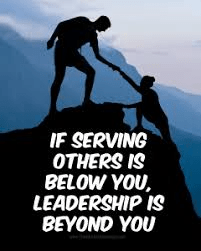
Until that time comes, we are to grow as leaders by seeking to be true and genuine servants.

Politicians are to pursue public service without prejudice and with a keen eye toward all classes of people;

Educators are to commit themselves to ensuring that learning happens with a variety of approaches, all pillowed with loving support;

Employers are to provide whatever is needed to make their employees successful at their jobs, including a safe and caring environment;

Religious leaders are to offer spiritual care and not spiritual judgment to all within their bounds of responsibility.

We all lead other people, whether or not we have the title or position as a leader. Therefore, we all must seek not to be served but to serve others. This is the way of justice and righteousness.

Gracious God and Leader of all: Help us to embrace the challenge and responsibility we have as leaders
to guide us to lead with integrity and common sense. Give us the wisdom to make intelligent decisions; the courage to make tough decisions; and the character to make right decisions. Embolden us to always be welcoming, inclusive, and open because of our Lord Jesus Christ, in whose name we pray. Amen.

Remember the Poor and Needy (Deuteronomy 24:17-25:4)

Harvest in Provence by Vincent Van Gogh, 1888

Do not deprive the foreigner or the fatherless of justice or take the cloak of the widow as a pledge. Remember that you were slaves in Egypt and the Lord your God redeemed you from there. That is why I command you to do this.

When you are harvesting in your field and you overlook a sheaf, do not go back to get it. Leave it for the foreigner, the fatherless and the widow, so that the Lord your God may bless you in all the work of your hands. When you beat the olives from your trees, do not go over the branches a second time. Leave what remains for the foreigner, the fatherless and the widow. When you harvest the grapes in your vineyard, do not go over the vines again. Leave what remains for the foreigner, the fatherless and the widow. Remember that you were slaves in Egypt. That is why I command you to do this.

When people have a dispute, they are to take it to court and the judges will decide the case, acquitting the innocent and condemning the guilty. If the guilty person deserves to be beaten, the judge shall make them lie down and have them flogged in his presence with the number of lashes the crime deserves, but the judge must not impose more than forty lashes. If the guilty party is flogged more than that, your fellow Israelite will be degraded in your eyes.

Do not muzzle an ox while it is treading out the grain. (New International Version)

In an ideal world, we would all use our common inner sense of justice, fairness, and kindness; we would pay attention to our conscience. Yet, as you and I know all too well, we are far from living in an idyllic setting.

Instead, we live in a fundamentally broken world – complete with injustice, disagreements, disputes, petty squabbles, and blatant insensitivity to others.

It seems we shouldn’t have to be told how to concern ourselves for the common good of all persons; yet that’s exactly what needs to happen. So, the Lord made it plain what the expectations are for meeting societal needs. And it’s already inside of us; we just need to recognize it’s there, tap into it, and obey our better angels.

The Lord expects:

  • No favoritism, cronyism, and isolationism. Immigrants, foreigners, and folks different from us are to be treated with equal justice and sensitivity. Cliques which are hawkish about keeping certain persons out of their group is mostly selfish and sometimes mean-spirited; and it’s always a sort of discrimination which God expects us to avoid.
  • Attention to the poor among us. In the ancient world, and still is some parts of our world today, when the crops are harvested, the needy would tag behind the harvesters in order to pick up what was left behind. Basic human kindness tells us that not only do we let them do this, but we also purposely leave a bit for them to get for themselves and their families. In our modern era, practices of exorbitant interest and unfair housing need to be replaced with concern for the less fortunate. Wealth is meant to be shared, not hoarded. To not do so is to steal from the poor.
  • Punishments which fit the crime. Inequitable societies are rife with kangaroo courts and unjust laws which favor a particular group of persons. It’s humiliating for a minority prisoner to serve a much longer sentence than a person who is in the majority of society… and we wonder why some folks are so angry sometimes. Good grief.
  • Inclusion. Concern for the common good of society doesn’t exclude folks we don’t like or don’t understand. The reason we are not to “muzzle an ox while its treading out the grain” is that they’re doing a job and they don’t need any hindrances to their work. Placing restrictions or extra rules on one group over another just because of race, ethnicity, religion, gender, or class is sinfully exclusionary.

The bottom line is that God cares about persons trapped in poverty. 

In the Old Testament, there are seven different words for the “poor.” The range of meanings includes those who are poor because of laziness, those born into poverty, those who are poor because of inhuman oppression or slavery, simple beggars, and the pious humble poor – who have no choice but to put their trust in God because of their grinding poverty.

The Law was quite clear about how to treat the poor:

Since there will never cease to be some in need on the earth, I therefore command you, “Open your hand to the poor and needy neighbor in your land.” (Deuteronomy 15:11, NRSV) 

The mistreatment, exploitation, and just plain inattention to the poor and needy were a chief reason God sent the prophets to Israel: 

Listen to me, you who walk on helpless people,
    you who are trying to destroy the poor people of this country, saying,
“When will the New Moon festival be over
    so we can sell grain?
When will the Sabbath be over
    so we can bring out wheat to sell?
We can charge them more
    and give them less,
    and we can change the scales to cheat the people.

We will buy poor people for silver,
    and needy people for the price of a pair of sandals.
    We will even sell the wheat that was swept up from the floor.”

The Lord has sworn by his name, the Pride of Jacob, “I will never forget everything that these people did. (Amos 8:4-7, NCV) 

The major theme of Deuteronomy is remembering. Don’t ever forget where you came from so that the memory of your past helps shape what kind of person you are in the present.

We must be reminded that it is the poor in spirit who enter the kingdom of heaven, not the proud spirit who forgets the poor. 

The humble person offers grace to people who cannot offer her something in return. It’s one thing to be merciful to people who will turn around later and scratch our backs. But it’s an altogether different thing to show mercy, regardless of whether they can pay you back. 

We are to speak and act with mercy to all persons, without prejudice. 

Eventually, an idyllic world will come. Until that time, we are to speed its coming by showing basic human kindness and compassion to the least among us.

Lord God, you give honor to the least, those who are forgotten, overlooked and misjudged. You came to give first place to the last, those left behind, misunderstood and undervalued. You came to give a warm welcome to the lost, those who are orphaned, abandoned and destitute. Help us to be your ears to listen to their cries; your voice speaking out love and acceptance; your feet walking beside those in need; and your hands to clothe, feed and shelter them. Lord, in your mercy, hear our prayer. Amen.