“But…!”

The righteous cry out, and the Lord hears them;
    he delivers them from all their troubles.
The Lord is close to the brokenhearted
    and saves those who are crushed in spirit. (Psalm 34:17-18, NIV)

“…you nullify the word of God for the sake of your tradition.” Jesus (Matthew 15:6)

In talking with other so-called “Christians” who don’t live in Minneapolis or Minnesota about events in my home of the Twin Cities, I have found a disturbing trend among many of them.

Those who support the Trump administration and I.C.E. agent activity – of whom I personally know several – typically begin their responses to me with saying things such as: “Well, I don’t condone all of the tactics of I.C.E., but…”

Then they drone on, giving an apologetic for the murders and violence in Minnesota by blaming the protesters and/or the local leadership, all the while referring to them as “rioters.”

In the last several years, I have personally attempted to remove the word “but” from my vocabulary as much as possible. The reason I do this is that:

The use of “but” in a sentence is a way of invalidating everything that was said in the first part of the statement.

I would conjecture that the reason for even making a prefacing comment before using the word “but” is to try and soften what the person really wants to say and emphasize. In other words, it’s a way of trying to appear somewhat empathetic or compassionate, so that the other person will listen. That’s why I try and no longer use the word “but.”

In the past couple of years, I’ve even began calling out people who use this type of tactic with the word “but.” Instead of getting into an argumentative discussion (which is nearly always what happens when the “but” language is employed), I simply respond to the person, “No ‘buts’ in the urinal,” and ask them to reframe their statement without using the word.

I grew up in the era before public smoking bans. When I was a little kid, I remember smokers being everywhere in public, including restaurants. Typically, there was cigarette smoke just about everywhere – which also created a problem with cigarette butts.

Men’s public bathrooms were notorious for having cigarette butts in the urinals. Public places that had chronic problems with this practice would often put signs above the urinals stating, “NO BUTTS IN THE URINAL.”

Those signs always made me laugh hilariously because, well, I was a little boy and I took the message quite literally. After all, I was in a bathroom! (Even to this day, I laugh out loud anytime I see a sign while driving past a business which says, “Parking In Rear”).

I hope you get my point, as uncouth as it may be. There is no place for using the word “but” in a discussion with anyone, if you intend on simply invalidating what another has said or believes.

So, I have a real problem with the disingenuousness and attempted manipulation of much of the use of the word “but” with “Christians” whose intent is to invalidate my thought and practice of speaking and writing against the presence of I.C.E. in Minnesota, protesting their violence and perpetual lies, and constantly agitating for people to speak and act humanely.

Out of all the Old Testament prophets, perhaps Jeremiah had the worst problem with the “but” people. After all, such persons have always existed throughout history.

The prophet Jeremiah spoke out and against the popular notion that one could worship God and offer the proper sacrifices, but at the same time, do whatever the heck you want to do – including worship of other gods, and giving the shaft to the needy through terrible injustices.

“‘Hear the word of the Lord, all you people of Judah who come through these gates to worship the Lord. This is what the Lord Almighty, the God of Israel, says: Reform your ways and your actions, and I will let you live in this place. Do not trust in deceptive words and say, “This is the temple of the Lord, the temple of the Lord, the temple of the Lord!” If you really change your ways and your actions and deal with each other justly, if you do not oppress the foreigner, the fatherless or the widow and do not shed innocent blood in this place, and if you do not follow other gods to your own harm, then I will let you live in this place, in the land I gave your ancestors for ever and ever. But look, you are trusting in deceptive words that are worthless.” (Jeremiah 7:2-8, NIV)

According to the present Trump administration, the prophet Jeremiah would be labeled as a “domestic terrorist” for speaking out against the powers that be, and for prophesying judgment upon them for lying words and sacrilegious ways. He would receive that moniker because, in their understanding, he would be getting in the way of the kingdom’s operations.

As for me, because I have supposedly impeded I.C.E. operations in my own community through both word and action (according to their definition), I and my compassionate peace-loving family fits their understanding of “domestic terrorists,” even though we have done everything according to our limited abilities to practice de-escalation tactics, provide spiritual care to protesters and immigrants, and uphold the words and ways of Jesus, of whom we seek to follow with all our heart, soul, mind, and strength.

It is high time to dispense with the word “but” in our speech, and embrace the word “and.” I have a few suggestive examples:

“Even though we do not agree, I am sorry this has happened, and I grieve with you over these recent tragic deaths.”

“Although we are at loggerheads with each other, I too, believe that human life is sacred, and I will work toward peace and harmony in my community.”

“Yes, we disagree about many things, and I am here to listen and to seek to understand what you believe and why it is important to you.”

And tell me more about that…”

And I care about what happens to all of us in this world.”

And I love you, despite the fact we aren’t on the same page about this.”

These are statements I long to hear people of faith say to each other… I’m still waiting… and so I’m still presently living with profound sadness in a world in which it is imperative that Christians put love where love is not.

Grant, O God, that your holy and life-giving Spirit may so move every human heart – especially those in Minneapolis who are both resident and non-resident – so that barriers which divide us may crumble, suspicions disappear, and hatreds cease; that our divisions being healed, we may live in justice and peace; through Jesus Christ our Lord. Amen.


Protest As Faith

But when they opposed Paul and became abusive, he shook out his clothes in protest and said to them, “Your blood be on your own heads!” (Acts 18:6)

“Your name will no longer be Jacob, but Israel, because you have struggled with God and with humans and have overcome.” (Genesis 32:28)

Deliver us from the evil one. (Matthew 6:13, NIV)

If it looks like terrorism, talks like terrorism, and acts like terrorism, it’s probably terrorism.

I have become exasperated in numerous ways in the past few days – not only from the federally-sponsored terrorism which is presently oppressing and abusing the Twin Cities of Minnesota, but also from some “Christians” who say ungracious and unfeeling statements concerning what is happening in where I presently live.

The greater Minneapolis/St. Paul area is now my home, so that my dear wife and I can be near our middle daughter and her family who reside in south Minneapolis.

At the least, it isn’t helpful to make comments, such as the following, which I have heard multiple times from some “Christians:” “Well, if the leaders and people of Minnesota would just give a little cooperation, then everything would be okay,” and “Don’t you think Minnesota leadership is creating this protest scene to hide fraud investigations?”

At worst, those comments are a projection that put the deportations and deaths of Americans squarely on the actual victims, instead of the real perpetrators. I, for one, will not stand for that sort of attitude and rhetoric, and as it turns out, neither will my fellow Minnesota residents.

Because even the “unbeliever” knows right from wrong and the face of evil when they see it up close and personal.

When I hear blatant lies from federal officials which contradict my own eyes, ears, and experience; and see it coming from persons with a cross dangling from their neck, I begin to better understand the biblical stories of defiant faith in the midst of this present darkness (e.g. Luke 18:1-8).

Maybe such “Christians” would like to explain to my grandchildren why they shouldn’t be afraid when I.C.E. helicopters hover over their home…

Perhaps such professing “believers” would like to try and reassure my 36-year-old Christian white daughter of three children that she is safe and has nothing to worry about…

Maybe such church folk would like to try and console the hundreds of grieving families who lament the injustice done to their loved ones…

Just once, I wish these “Christians” would take seriously the Gospel admonitions to love neighbor, welcome the stranger, and provide for the needy who are near them, no matter who they are and without prejudice. (Matthew 22:39; 25:31-46)

The experience of faux faith from others is what creates the conditions for protest. And I strongly argue that there is such a thing as biblical protest. It can take many forms.

I find myself giving protest to God. Yes, the Lord God Almighty, Creator of heaven and earth. And I do so because I believe this is what I am called to do for this time and for this place.

The biblical characters of Job, Abraham, Jacob, and Moses, along with the psalmists and the prophets, all protested God to make things right in the middle of unjust circumstances and victimization.

They all struggled and wrestled with God concerning their respective situations. Yet, they never let go of the Lord and their own faith, holding fast to God’s justice, God’s goodness, and God’s righteousness – trusting God when they don’t understand why and what the heck is going on.

The Lord responded to those struggling believers’ uppity protests in a favorable way (Genesis 18:26-32; Exodus 32:14; Job 42:7). Pleading to God when unjust evil is running amok is to rectify injustice. Keeping silent is to passively accept evil, making one complicit to the injustice.

Believe it or not, God is perfectly fine, and actually likes it, when humans remind God of who God is in God’s very character. Because God is just, right, good, holy, and loving all the time, God’s people fully expect these inherent character qualities of God to work themselves out in practical ways on this earth.

We express the depth of our faith by tenaciously clinging to what we know about God, instead of running from God, or simply relying upon ourselves, doing whatever the heck we want to do, and putting a spiritual veneer over the lies, as if we are really pleasing God.

Furthermore, Christian history is replete with godly protest. For example, Black spirituals, sung by enslaved African-Americans, such as “Wrestle On, Jacob” and “I Will Not Let You Go, My Lord” were forms of pious irreverence against the entire slave system through complaints to God.

For decades I have found the psalms to be my best expression of defiant faith. Along with the psalmist I pray with fervor and flavor:

Rouse yourself! Why do you sleep, O Lord?
    Awake, do not cast us off forever!
Why do you hide your face?
    Why do you forget our affliction and oppression?
For we sink down to the dust;
    our bodies cling to the ground.
Rise up, come to our help.
    Redeem us for the sake of your steadfast love. (Psalm 44:23-26, NRSV)

I looked for pity, but there was none;
    and for comforters, but I found none.
They gave me poison for food,
    and for my thirst they gave me vinegar to drink.

Let their table be a trap for them,
    a snare for their allies.
Let their eyes be darkened so that they cannot see,
    and make their loins tremble continually.
Pour out your indignation upon them,
    and let your burning anger overtake them.
May their camp be a desolation;
    let no one live in their tents.
For they persecute those whom you have struck down,
    and those whom you have wounded they attack still more.
Add guilt to their guilt;
    may they have no acquittal from you.
Let them be blotted out of the book of the living;
    let them not be enrolled among the righteous.
But I am lowly and in pain;
    let your salvation, O God, protect me.

I will praise the name of God with a song;
    I will magnify him with thanksgiving.
This will please the Lord more than an ox
    or a bull with horns and hoofs.
Let the oppressed see it and be glad;
    you who seek God, let your hearts revive.
For the Lord hears the needy
    and does not despise his own who are in bonds. (Psalm 69:20-33, NRSV)

May the Lord take notice of defiant faith, and bring justice to the nations. Amen.

Remembering Dr. King

So the angel swung his sickle into the earth, and cut the vineyard of the earth, and he put what he reaped into the great winepress of God’s passionate anger. (Revelation 14:19, Common English Bible)

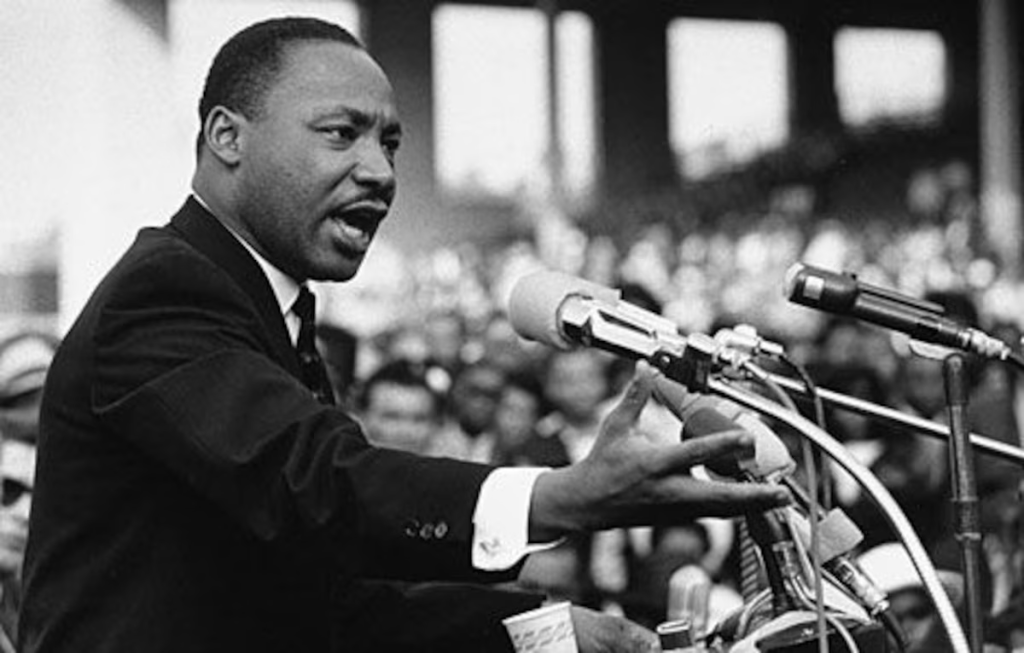
One of the things to keep in mind about Dr. Martin Luther, King Jr., especially on this day remembering his life and work, is that he was a committed Christian clergyman who had deep theological roots in everything he said and did.

King’s public speeches were filled with biblical allusions to the Old Testament prophets, and the New Testament writers. In his address to the Selma marchers, he said:

“How long will justice be crucified, and truth bear it?… It will not be long, because truth crushed to earth will rise again. How long? Not long, because you shall reap what you sow… How long? Not long, because the arc of the moral universe is long, but it bends toward justice.

How long? Not long, because: Mine eyes have seen the glory of the coming of the Lord; He is trampling out the vintage where the grapes of wrath are stored; He has loosed the fateful lightning of His terrible swift sword; His truth is marching on. He has sounded forth the trumpet that shall never call retreat; He is sifting out the hearts of men before His judgment seat. O, be swift, my soul, to answer Him! Be jubilant my feet! Our God is marching on.”

It seems to me that Dr. King would clearly understand our present moment in the United States of America. Two months before his assassination, King preached to his Atlanta congregation, stating:

“God didn’t call America to do what she’s doing in the world now.”

Dr. King could say that because he knew the keen distinction between patriotism and nationalism. Patriotism is a critical affirmation of one’s own country with the desire and attempt to help correct it, peacefully and non-violently, when she is in error. Nationalism, however, is an uncritical support of one’s own nation, regardless of any immoral speech or unethical actions in the world.

King was able to hold a fierce patriotic spirit, while at the same time understanding a nationalistic fervor which contradicted true and real patriotism. In his “I Have a Dream” speech of 1963, Dr. King reminded his listeners:

“My dream is deeply rooted in the American dream that one day this nation will rise up and live out the true mean of its creed: ‘We hold these truths to be self-evident, that all men are created equal.’”

Along with King’s hopeful patriotism, he expressed the sad reality of what he saw. Speaking a commencement address to Lincoln University students he said:

“Since the founding fathers of our nation dreamed this noble dream, America has been something of a schizophrenic personality, tragically divided against herself.”

Dr. King warned against a selfish and arrogant nationalism that champions one’s country at the expense of the world’s common welfare. He discerned that such narrow self-interest puts morality and ethical principles on the back burner of policy and practice. And once down that road, a nation will not stop “because of our pride and arrogance as a nation.”

A year before his death, King spoke at New York’s Riverside Church and called for “a worldwide fellowship that lifts neighborly concern beyond one’s tribe, race, class and nation,” insisting that this is “in reality a call for an all-embracing and unconditional love for all men.”

On this Martin Luther King, Jr. Day, I choose to remember that King’s words came from a place of scriptural wisdom which was hewn in the crucible of dedicated study, along with decided Christian conviction and practice that placed him in a long tradition of suffering saints who upheld what is most important in this life.

God’s justice for the weak and powerless, and God’s judgment against oppressive abuse, go hand-in-hand. It behooves us all to know which side of God we are really on.

Justice Remembered (Exodus 12:1-13, 21-28)

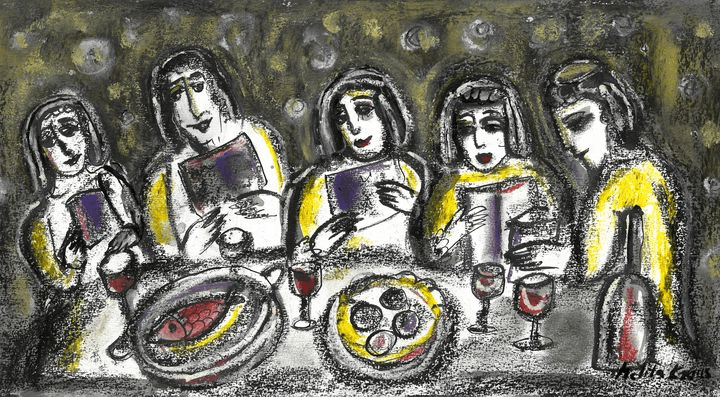
Passover Seder, by Melita Kraus

The Lord said to Moses and Aaron in the land of Egypt, “This month shall mark for you the beginning of months; it shall be the first month of the year for you. Tell the whole congregation of Israel that on the tenth of this month they are to take a lamb for each family, a lamb for each household. If a household is too small for a whole lamb, it shall join its closest neighbor in obtaining one; the lamb shall be divided in proportion to the number of people who eat of it. 

Your lamb shall be without blemish, a year-old male; you may take it from the sheep or from the goats. You shall keep it until the fourteenth day of this month; then the whole assembled congregation of Israel shall slaughter it at twilight. They shall take some of the blood and put it on the two doorposts and the lintel of the houses in which they eat it. 

They shall eat the lamb that same night; they shall eat it roasted over the fire with unleavened bread and bitter herbs. Do not eat any of it raw or boiled in water but roasted over the fire, with its head, legs, and inner organs. You shall let none of it remain until the morning; anything that remains until the morning you shall burn with fire. 

This is how you shall eat it: your loins girded, your sandals on your feet, and your staff in your hand, and you shall eat it hurriedly. It is the Passover of the Lord. I will pass through the land of Egypt that night, and I will strike down every firstborn in the land of Egypt, from human to animal, and on all the gods of Egypt I will execute judgments: I am the Lord. The blood shall be a sign for you on the houses where you live: when I see the blood, I will pass over you, and no plague shall destroy you when I strike the land of Egypt….

Then Moses called all the elders of Israel and said to them, “Go, select lambs for your families, and slaughter the Passover lamb. Take a bunch of hyssop, dip it in the blood that is in the basin, and touch the lintel and the two doorposts with the blood in the basin.

None of you shall go outside the door of your house until morning. For the Lord will pass through to strike down the Egyptians; when he sees the blood on the lintel and on the two doorposts, the Lord will pass over that door and will not allow the destroyer to enter your houses to strike you down. 

You shall observe this as a perpetual ordinance for you and your children. When you come to the land that the Lord will give you, as he has promised, you shall keep this observance. And when your children ask you, ‘What does this observance mean to you?’ you shall say, ‘It is the Passover sacrifice to the Lord, for he passed over the houses of the Israelites in Egypt when he struck down the Egyptians but spared our houses.’ ” And the people bowed down and worshiped.

The Israelites went and did just as the Lord had commanded Moses and Aaron; so they did. (New Revised Standard Version)

The Exodus, by Yoram Raanan

Today’s story of Passover is the highlight of Jewish history concerning both God’s judgment and God’s justice. It is a continual reminder that God is concerned with the divine Name; with his people; and with providing them what they need.

The Lord’s tenth and final plague against the Egyptians was the ultimate judgment of taking their firstborn children. At the same time, the Lord extended great justice to the Israelites by removing the oppressive obstacles which hindered them from having their basic human needs met.

Both God’s judgment and God’s justice were to be annually remembered through rituals established by God. These remembrance rituals of Passover are meant to be brought perpetually to Jewish minds, so that they will maintain a high view of Gods’ Name, and also never be a nation who acts like the Egyptians.

Passover and Exodus constituted a new beginning and new life for Israel. Slaughtering the Passover lamb was the start of liberation for the people; along with the eating of unleavened bread. Both the blood of the lamb, and the absence of leaven, together communicated freedom to the Israelites from God.

Even today, nearly four millennia later, Passover is still celebrated amongst the Jewish community as a great festival of freedom. The primary ritual in this celebration is the seder, an evening meal which involves eating several symbolic foods.

The purpose of coming together to eat special foods is to relive the experience of the Exodus from Egypt. It is a time of passing down the people’s communal memory, as well as reflecting upon God’s divine redemption for them.

The Passover rituals are the root of Christianity’s celebration of communion at the Table. For Christians, the final seder meal of Jesus and his disciples at the Last Supper in the Upper Room is remembered and relived, so that believers may contemplate the Cross of Christ as the ultimate divine redemption.

Table fellowship for both religions – Judaism and Christianity – has a central place in ritual remembrance. God is acknowledged and praised as the great Liberator from oppression. Justice is memorialized. Past events are remembered in order to live justly and rightly in the present.

Deliverance of people from both physical and spiritual slavery is a grand theme throughout all of Holy Scripture. People of freedom are never to let themselves again be placed in bondage. The New Testament puts the matter this way:

For freedom Christ has set us free. Stand firm, therefore, and do not submit again to a yoke of slavery. (Galatians 5:1, NRSV)

The yearning for freedom from oppression and injustice lies within the breast of every human on this earth. It’s why people will go out of their way to use whatever means they have of standing against abusive powers.

It is more than ironic that there are people today who espouse themselves as Christian, yet are hell-bent on using whatever means they have to oppress and abuse others into submission. Such persons are not demonstrating care for the Name of God, especially not the Name of Jesus Christ. Instead, they have another agenda – one that has nothing to do with liberation and freedom.

This is one big reason why we need rituals. Rituals keep us remembering the things we need to remember, and help us forget the things we need to forget.

Earthly power is not the summum bonum of life. Rather, real power is Love. Again, quoting the Apostle Paul from the Book of Galatians:

For you were called to freedom, brothers and sisters, only do not use your freedom as an opportunity for self-indulgence, but through love become enslaved to one another. For the whole law is summed up in a single commandment, “You shall love your neighbor as yourself.” If, however, you bite and devour one another, take care that you are not consumed by one another. (Galatians 5:13-15, NRSV)

Indeed, all that really counts for us in this life is “faith expressing itself through love.” (Galatians 5:6)

Remembering true freedom, and it’s real cost, through established rituals, is perhaps the best way of ensuring that the oppression and injustice of empires like Egypt and Rome do not happen in our present day.

Therefore, if we lose connection with important and seminal events of the past without ritual remembrance, we are setting ourselves up for terrible injustice to occur.

We are better than that. Redemption and remembrance can help show us the way.

Great God of all justice, righteousness, and redemption: Continue to break the yoke of Pharaoh in our time, and forever shatter the bonds of human oppression.. Hasten the Day when we shall all be free, at the coming of your Son, our Lord, Jesus Christ, who with you and the Holy Spirit are one God, now and forever. Amen.