Against Apathy (Obadiah 15-21)

The day of the Lord is near
        against all the nations.
    As you have done, so it will be done to you;
        your actions will make you suffer!
Just as you have drunk on my holy mountain,
        so will all the nations around you drink;
    they will drink and swallow quickly,
        and they will be like they’ve never been before.

But on Mount Zion there will be those who escape,
        and it will be holy;
        and the house of Jacob will drive out those who drove them out.
The house of Jacob will be a fire,
        the house of Joseph a flame,
        and the house of Esau straw;
    they will burn them up completely,
        and there will be no one left of the house of Esau,
for the Lord has spoken.
Those of the arid southern plain will possess Mount Esau,
        and those of the western foothills, the land of the Philistines;
    they will possess the land of Ephraim and the land of Samaria,
        and Benjamin will possess Gilead.
Those who remain of the Israelites
            will possess the land of the Canaanites as far as Zarephath;
    and those left from Jerusalem and who are now living in Sepharad
        will possess the cities of the arid southern plain.
The deliverers will go up to Mount Zion
        to rule Mount Esau,
        and the kingdom will be the Lord’s. (Common English Bible)

The prophet Obadiah is a small book in the sea of the Old Testament prophets (a single chapter of twenty-one verses). It’s a prophecy dedicated to the singular focus of delivering a message of divine judgment against the nation of Edom.

Why judgment? Because when people remove themselves from or place themselves in opposition to God (and God’s people) they can expect divine retribution, rather than restoration.

“The day of the Lord” is a phrase used throughout Holy Scripture as a reference to God’s upcoming judgment of the world. Along the way, until that final day, there are many nations which come and go.

Actions

Edom was in an ideal position to help Judah when King Nebuchadnezzar and the Babylonians captured Jerusalem in 586 B.C.E. But they didn’t. They could have given military assistance; but the ancient animosity between Jacob (Israel) and Esau (Edom) prevented this.

They still could have sheltered the Jews fleeing Jerusalem and Judah in order to escape the Babylonian onslaught. Edom’s rocky strongholds would have been extremely difficult for Babylon to maneuver in pursuit of Judah. Yet, the Edomites refused to trouble themselves in offering Judah even the slightest assistance in the day of its great need.

In fact, the situation was worse than refusing to assist. Edom committed violence against Judah at the time of Jerusalem’s fall. The Edomites progressed from being aloof and disinterested observers of Judah’s fate, to gloating over Judah’s trouble, to participating as invaders of Jerusalem. Finally, Edom played the antagonistic enemy who plucked off desperate Jewish fugitives as they tried to escape certain death.

The Edomites were like a bunch buzzards, hovering overhead, waiting for Babylon to smash Judah so that they could swoop down and devour the leftovers.

Accountable

Historically, we don’t really know much Edom was actually involved in Jerusalem’s destruction. Yet, it’s notable that some later Jewish traditions indicate that Edom helped the Babylonians burn the temple in Jerusalem to the ground. Whatever really happened, the Edomites took advantage of Judah and profited from their destruction. What’s more, God held them accountable for their actions and/or inaction.

And that is the very nature of sin. A sinner is one who either acts in breaking God’s penultimate command of love by harming another, or fails to act lovingly with apathetic inaction, when it is in their power to act. Therefore, living rightly and justly is not only refraining from acts of evil; it’s also doing good whenever we see that love and good works are needed.

It is a sin when someone knows the right thing to do and doesn’t do it.

James 4:17, CEB

Edom knew that Judah needed help, but refused to give it. So, the Edomites were guilty before God for failing to offer hospitality, relief, and basic human kindness. As for us, we have a great deal to answer for as idle spectators, whenever we are capable of being active helpers.

Apathy

Today, it appears that society has lost its self-awareness. As a result, there is widespread apathy toward others. We have made a devil’s bargain of trading an interior life of developing spiritual discipline and actionable love for an exterior life of position, power, and prestige.

In our contemporary culture, there is no longer any intentional and systematic spiritual formation happening. Instead, we are regularly fed the unholy porridge that we can do and think whatever we like, as long we aren’t hurting anybody.

Therefore, we don’t see the connection between our current political and religious acrimony and our spiritual apathy. We have relegated practices such as centering and contemplative prayer as mere optional extras for the eccentric few. “Why struggle with all this scriptural, religious, and spiritual stuff?” we say. “Meh, it’s not worth the effort.” From such a stance, we are only a stone’s throw away from not caring about our neighbor.

This all makes me wonder if the ancient Edomites, over time, created a culture of spiritual carelessness that neglected the disciplined life of the soul. I’m curious if they ever said things like, “I don’t have time for all that God stuff.”

It is this sort of apathy which underlies so much of Western society. Even the word “apathy” barely gets used anymore – along with a lot of other words like “avarice.” They have become relics of another era. But they’re still among us. And they come out in a phrase such as, “Yeah, whatever. It is what it is.”

We are largely an unhappy people these days. And we cannot seem to put our finger on why that is. Maybe we need to rediscover the prophets – and the ones who never seem to get a hearing – like the prophet Obadiah. Or are we too indifferent to give him an honest reading?

All too often, Lord, we turn away from the world’s many problems, which seem too big, too complex, or too far away. Forgive us our indifference.

It is easier, Lord, to see only what is around us: our lives, our homes, our challenges. Forgive us our isolation.

Help us to see with your eyes: eyes which notice one another and help us understand.

Help us to dream your dream: of communities that reach out and dialogue and where diverse people creatively cooperate.

Help us to be people of solidarity and action, so moved by prayer, encounter, and understanding that peace can become a reality. Amen.

Hospitality Is a Matter of Life and Death (Jeremiah 49:7-11)

Concerning Edom, the Lord of heavenly forces proclaims:
Is wisdom no longer in Teman?
    Has good sense vanished from the perceptive?
        Are they no longer wise?
Turn, flee, and run for cover,
    you inhabitants of Dedan.
I’m bringing disaster on Esau:
    its day of reckoning.
If workers would come to you to pick grapes,
    they would at least leave a few on the vine.
If thieves would come in the night,
    they would take only what they needed.
But me? I will strip Esau bare.
    I will expose his hiding places,
        and he will find no place to take cover.
His offspring, family, and acquaintances will perish,
    and there will be no one left to say,
“Leave me your orphans,
    and I’ll look after them;
        trust your widows into my care.” (Common English Bible)

You might be saying to yourself, “What in tarnation is this crazy fool doing, having a Bible lesson on this here piece of Scripture that means nothing to you nor me?” Oh, really? To which I say, “What darned fool never gets into the backwoods of the prophets?”

Esau was the twin brother of Jacob, a real mountain man sort of guy. Being outdoors and hunting game was his thing. His descendants were the Edomites. They inhabited the southwest portion of what is now the country of Jordan, and the southeastern portion of Israel and Palestine in the middle east. It’s a territory made up of a network of clefts and caves in the rocks.

Edom tended to think of themselves as being invulnerable, the man’s man. They always had the high ground and knew how to handle themselves in the wilderness. For anyone interested in taking the Edomites down, it would be very difficult to dislodge them from their rocky fortress home. Yet, there is no place that is not vulnerable to the eye and purpose of Yahweh.

Site of an ancient Edomite stronghold in present day Jordan

Just as there was bad blood between Jacob and Esau, so also the Israelites and Edomites did not like each other throughout their history. Edom had no intention of helping their ancestral brother, and even participated with the Babylonians in the conquest of Jerusalem. What’s more, they rejoiced over the fall of the city – all of which raised the eyebrow of God.

Lord, remember what the Edomites did
        on Jerusalem’s dark day:
    “Rip it down, rip it down!
    All the way to its foundations!” they yelled. (Psalm 137:7, CEB)

Turns out that the Lord listened to the psalmist and remembered. The destruction of Edom came about because of two overlapping sins: the profound lack of hospitality; and the overt participation of doing harm. To refuse hospitality is to put someone or a group of people in harm’s way. It also betrays an attitude that works out in eventually becoming an agent of harm to those they could have helped.

In this vein, Edom is much more akin to Sodom and Gomorrah than to its brother Israel.

“Now this was the sin of your sister Sodom: She and her daughters were arrogant, overfed and unconcerned; they did not help the poor and needy.” (Ezekiel 16:49, NIV)

When the ancient Israelites, after having been delivered by God from Egyptian bondage, and traveling in the wilderness, came upon Edom, they made a request of their brother:

“Please let us cross through your land. We won’t pass through any field or vineyard, or drink water from any well. We will walk on the King’s Highway and not turn to the right or to the left until we have crossed your border.”

Edom said to him, “You won’t cross through, or I will come out against you with a sword.” (Numbers 20:17-18, CEB)

It does no one any good to refuse offering hospitality to others. Both the one in need, and the one being inhospitable, find themselves in dire straits. The reason the Lord cares so much about this is that God, at the core, is hospitable – loving the stranger and granting aid to the alien.

Jesus, upholding this long tradition of divine caring and prophetic utterance, had this to say to those who were indifferent:

“Depart from me, you who are cursed, into the eternal fire prepared for the devil and his angels. For I was hungry and you gave me nothing to eat, I was thirsty and you gave me nothing to drink, I was a stranger and you did not invite me in, I needed clothes and you did not clothe me, I was sick and in prison and you did not look after me.”

They also will answer, “Lord, when did we see you hungry or thirsty or a stranger or needing clothes or sick or in prison, and did not help you?”

He will reply, “Truly I tell you, whatever you did not do for one of the least of these, you did not do for me.”

Then they will go away to eternal punishment, but the righteous to eternal life. (Matthew 25:41-46, NIV)

It is high time that we, as a contemporary people, take the Old Testament prophets seriously, and adopt the divine heart for the alien, the stranger, the fatherless, the widow, and all who find themselves unable to meet their own basic needs.

And when a refusal of hospitality happens on a national scale, the people of that nation will discover themselves a bygone country – much like Edom and the Edomites of old.

Whenever the national zeitgeist translates into draconian tactics for keeping “those other people” at a distance and say to them, “get out of our country,” without any hospitality, that nation has come under the eye of a holy God who has a zero tolerance policy toward base unkindness and purposeful callousness.

So, we ought to have the fear of God when we believe we have a moral right to exclude immigrants because they may potentially harm citizens by taking away jobs, reducing wages, and draining social services. This line of reasoning is not consistent with the way of Christ.

I, for one, believe we have failed to live up to the moral universalism we pretend lies at the heart of the United States’ theories and political philosophies; and we have not been willing to accept the radical changes needed to accommodate even a modest notion of hospitality for those who have been the targets for hate crimes based upon their race, ethnicity, ancestry, religion, and gender.

The age old sin of this world is that the wealthy and the privileged, although giving out of their largess, have no intention of sharing power and would never think of following the example of the poor widow who gave everything she had.

So, God said of the Edomites, “I will ‘Edom’ up!” And like the wild game their ancestor Esau killed and ate, they were gone. Turns out that hospitality is really a matter of life and death.

Lord Jesus, you welcomed all who came into your presence. May we reflect that same spirit through the value of hospitality. May your light shine in our hearts this day and dispel the darkness of hate and bigotry. Remove from us anything that stands in the way of radiating your presence. Amen.

One Grandfather’s Take on Marijuana

“Evil thrives on apathy and cannot exist without it.” Hannah Arendt

            Today is my birthday. I’m now 61 years old. I couldn’t have imagined, as a kid, that I’d be this old. But here I am – a husband for 38 years, a father of three precocious daughters, and, of all things, a grandfather of four boys. As a kid, I was largely clueless about a lot of things, which is the way it’s supposed to be. But, as an adult, if we aren’t aware of what’s happening – especially because of indifference – well then, we have the beginnings of real evil.

            The State of Wisconsin, the place I have lived for the past thirteen years, now stands out as what I describe as a marijuana desert. In every state of the union, either medical marijuana or recreational marijuana, or both, are now legal. But not Wisconsin. State Republican House Speaker, Robin Vos, has stated multiple times, “We are looking to say medical marijuana for people who have a truly awful long-term medical condition should be something we at least consider…. I don’t think recreational should ever happen.”

            My grandson is thirteen years old, and has had epilepsy his entire life. Every time my little buddy is hooked up to an EEG (used to measure the electrical activity of the brain, via electrodes applied to the scalp) the data shows that he, at times, experiences as many as three seizures per minute. 

Granted, they are rarely the grand mal, big-daddy-of-them-all, kind of seizures. Nevertheless, they are still seizures. The best pediatric doctors in the Midwest for this kind of thing tell us something that doctors aren’t prone to say, that they are stumped. Little buddy experiences up to seven different kinds of seizures, and he has defied any kind of solid diagnosis as to the nature of the epilepsy, let alone even thinking about a prognosis – other than that, if unchecked, he will not live to see adulthood. 

Yes, he is on medication – lots of it – with unimaginable side effects. Yet, without the meds, he would be having literally hundreds of seizures in any given day. Even on a good day, he has dozens. And even though most of his seizures last only a few seconds, each and every seizure damages the brain, if only a little bit. Add up the thousands of seizures over the span of a thirteen year old life, and factor the tens of thousands of them he will yet have in the next years and it, in my puny limited understanding, doesn’t look promising no matter how you examine it.

            When supposedly well-meaning politicians, pundits, religious folk, and faith communities rant about the ethics and morality of ungodly “potheads” having a legal avenue for their recreational smoking, what gets lost in the mix are children and families who could potentially be helped by legalizing marijuana – by a carefully genetically engineered strain administered medically and safely. 

In this grandfather’s mind (and heart) the greater risk is to keep doing what we’ve always done and hope that all will work out okay someday. When it pertains to a child’s life – that kind of thinking doesn’t cut it for me. It’s nothing more than the banality of evil, of keeping some political constituents happy, above thinking about the life of human beings in your own backyard.

            As a Christian Pastor, encountering this kind of ignorance amongst both politicians and parishioners is nothing new. Far too many of my denominational meetings have been given to angry persons upset about abortion and gays. Whereas there are those who believe this country is, in the words of one man, “trampling our Constitution and we are being judged as a nation for killing babies.” 

Without me even attempting to deal with any rightness or wrongness to that statement, the only kind of good that that kind of proclamation did was personal to the proclaimer – he just got something off his chest, and maybe he felt better for it. But I was left wondering: What about women who have had an abortion?  I cannot even begin to imagine that if there was a woman in the room who had an abortion in the past having to sit and listen to a guy put a label on her as a murderer. There is enough regret and grief in many a woman’s own heart without having someone twist the knife for her.

            There is a reason why many people often do not want others to know what they really think about certain issues, and why they want to keep all their skeletons in the closet. They do not want to be judged and condemned, and they have every reason to think that they will be – whenever they hear the raving of “Christians” who believe they are doing God a favor by effecting holiness through noise. 

It is imperative that we all, especially the Church, do the best we possibly can in order to create and sustain a culture of compassion and care through continual monitoring of what actually comes out of our mouths. When there are oft mentions of “the sin of homosexuality,” peppered with defamation upon LGBTQ+ folks; whenever there is a stream of hateful references to particular persons in poverty, or groups of black and brown people; and, when there is a blanket denunciation of marijuana as always being linked with persons getting high; then there is not an atmosphere of grace that leads to life, but a culture of fear that leads to death.

            Where some see the “issues” of gay marriage and transgendered inclusion, I see people created in the image of God who have the same needs of respect and equality that I do. Where some see political “issues,” I see persons in need of God’s justice and peace and basic human rights and decency.  Where some see the “issues” of poor lower class people versus upper class wealthy people; or Latin concerns versus Black concerns; or blue collar people’s agenda versus white collar people’s agenda; or plain (white) Americans versus all the other hyphenated Americans; instead, I see people – people in need of grace, mercy, and peace, just like me, who need a seat at the table and are heard in their own right with listening ears from me.

            My daughter needs support with her special needs son who happens to have epilepsy.  I am glad I can be there for her and for him. I am glad my church and many others care about them. This old sinful world has enough shame and pain in it without adding to the pile through ignorance and strife. Before we use our tongues, let’s have some working knowledge and some basic education about what we are talking about.  Most of all, let’s have some basic decorum and some working knowledge of God’s grace.

            So, this grandfather says to those in political power: “Do you consider this situation of a young boy with a terminal condition of epilepsy acceptable?” Evidently so since lawmakers have purposely dragged their feet for years about medical marijuana. There are times when individuals need to be called out, and a situation must be named for what it is. This grandfather, for one, is calling out the Wisconsin legislature, along with Speaker Vos, and naming this for what it is: indifference to human suffering.

            As of today, it is unfortunately too late for my grandson to have any significant assistance from medical marijuana in the form of cannabis oil for his condition. His epilepsy has come too far, and his brain has simply had far too many seizures. The hard reality is that, apart from a miraculous divine intervention, my grandson (who, I might add, is one of the nicest people of any age you’ll ever meet) will likely never see adulthood. But that wasn’t true 10 years ago, when I was writing letters and, evidently, speaking into the wilderness – getting form letter responses, if any response, at all.

            The time for consideration is past. Debate the “issue” of marijuana all you want. Meanwhile, there are people in Wisconsin who live with chronic pain and have to cross state lines just to get some help and a bit of relief from their chronic conditions. It is not supposed to be this way. And it does not have to be this way. Never mind that medical marijuana has been shown to significantly reduce and even eliminate some seizures in children. Ears have been stopped up and eyes wide shut for so long that hearts have become hard – and cannot even have compassion on children who are, frankly and literally, dying.

            There is a biblical proverb which states, “People who respect others will be blessed, but stubborn people will have plenty of troubles.” (Proverbs 28:14) We expect kids to be immature. And we expect the adults in the room to have the requisite growth over a period of time in order to make wise, responsible, and mature decisions. It looks like there are lot of politicians in need of remedial learning. Their stubbornness has already led to too much trouble for all of us.

*The Epilepsy Foundation exists to lead the fight to overcome the challenges of living with epilepsy and to accelerate therapies to stop seizures, find cures, and save lives. For more information, you may go to their website at epilepsy.com

**To learn more about epilepsy in Wisconsin, go to their website at epilepsywisconsin.org

***For information on medical marijuana and epilepsy: epilepsy.com/treatment/alternative-therapies/medical-marijuana

Repent! (Luke 3:1-18)

John the Baptist Preaching by Frank Brangwyn (1867-1956)

In the fifteenth year of the reign of Tiberius Caesar—when Pontius Pilate was governor of Judea, Herod tetrarch of Galilee, his brother Philip tetrarch of Iturea and Traconitis, and Lysanias tetrarch of Abilene—during the high-priesthood of Annas and Caiaphas, the word of God came to John son of Zechariah in the wilderness. He went into all the country around the Jordan, preaching a baptism of repentance for the forgiveness of sins. As it is written in the book of the words of Isaiah the prophet:

“A voice of one calling in the wilderness,
‘Prepare the way for the Lord,
    make straight paths for him.
Every valley shall be filled in,
    every mountain and hill made low.
The crooked roads shall become straight,
    the rough ways smooth.
And all people will see God’s salvation.’”

John said to the crowds coming out to be baptized by him, “You brood of vipers! Who warned you to flee from the coming wrath? Produce fruit in keeping with repentance. And do not begin to say to yourselves, ‘We have Abraham as our father.’ For I tell you that out of these stones God can raise up children for Abraham. The ax is already at the root of the trees, and every tree that does not produce good fruit will be cut down and thrown into the fire.”

“What should we do then?” the crowd asked.

John answered, “Anyone who has two shirts should share with the one who has none, and anyone who has food should do the same.”

Even tax collectors came to be baptized. “Teacher,” they asked, “what should we do?”

“Don’t collect any more than you are required to,” he told them.

Then some soldiers asked him, “And what should we do?”

He replied, “Don’t extort money and don’t accuse people falsely—be content with your pay.”

The people were waiting expectantly and were all wondering in their hearts if John might possibly be the Messiah. John answered them all, “I baptize you with water. But one who is more powerful than I will come, the straps of whose sandals I am not worthy to untie. He will baptize you with the Holy Spirit and fire. His winnowing fork is in his hand to clear his threshing floor and to gather the wheat into his barn, but he will burn up the chaff with unquenchable fire.” And with many other words John exhorted the people and proclaimed the good news to them. (New International Version)

John the Baptist was the sort of guy that people either loved or hated. When I think of John, I picture a hippy driving a Volkswagen bus with bumper stickers plastered everywhere with sayings like, “Get Right or Get Left,” “Turn or Burn,” “Repent or Regret,” “Jesus Is Coming to Take Over,” “Here Comes the Judge,” “Armageddon Outta Here!” and “Axe Me What’s Next.”

He tended toward seeing things as black and white. John wasn’t much of a gray area sort of dude.

Yet, no matter what one things of John the Baptist, he was affirmed by Jesus as doing exactly what he was supposed to do: Prepare for the coming of the Lord. (Matthew 3:13-17, 11:1-19)

And the best way to prepare, as John pointed out, is to repent.

Repentance is one of those big biblical words that sometimes gets lost as being archaic and out of touch – sort of like a hippy John the Baptist. Yet, without repentance, nobody becomes a Christian and no one lives a fruitful life following Jesus. 

To “repent” simply means to change our minds – to stop doing one thing, and to start doing another. 

Orthodox icon of John the Baptist

Throughout Holy Scripture, repentance means to stop sinning and start worshiping God. “Sin” and “worship” are also words that don’t get used a lot and tend to get relegated as antiquated language.

To “sin” is to say and do things which harm others, or to fail to say and do things which are helpful. (Deuteronomy 15:9; Proverbs 10:19; Romans 14:23; James 4:17; 1 John 3:4, 5:17)

To “worship” means to bend the knee, to submit and honor a deity. (Psalm 95:6; Matthew 4:8-10; Revelation 4:10, 5:14, 7:11, 11:16, 19:10,

The prophet Isaiah saw a vision of God in the temple, a self-revealing of the One true God that caused him to be completely unraveled with repentance.

The Apostle Peter saw the Lord Jesus in his immensity and power through a miraculous catch of fish. He then fell at the Lord’s feet and said, “Go away from me, Lord; I am a sinful man.” (Luke 5:8) 

John the Apostle had a vision of Jesus Christ in all his glory and heard his voice. John fell at the Lord’s feet as though dead. (Revelation 1:12-17) 

Ezekiel the prophet had a vision of God and saw the appearance of God’s glory. Then, he fell facedown. (Ezekiel 1:25-28) 

Even Daniel, perhaps the most righteous person of all time, saw a vision of God in all his glory and fell prostrate with his face to the ground, totally overwhelmed with God’s holiness and human sinfulness. (Daniel 8:15-18)

Methinks there is so much sin in the world and so much indifference in the church because people are not seeing a vision of a glorious and holy God. Because if they did, they would be completely beside themselves and see sin’s terrible foulness and degradation; they would repent from all the ways in which they have been apathetic and complacent in living their lives.

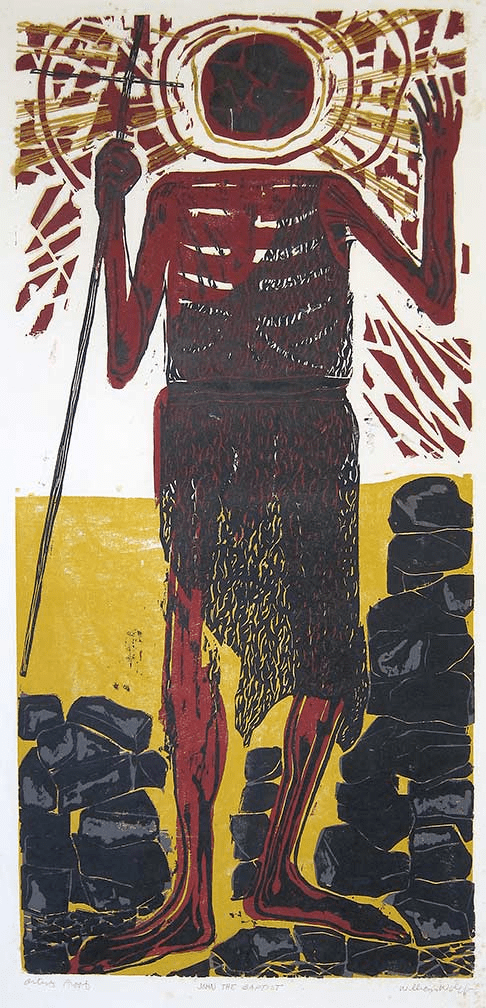
John the Baptist by William Wolff, 1968

We must, therefore, put ourselves in a position to see and hear God so that we can turn from all the obstacles that prevent us from experiencing Father, Son, and Spirit. 

And those hindrances to experiencing God are legion, including: 

  • Passiveness toward God’s Word and God’s creation, thus causing a lack of mindfulness and attention to the Holy Spirit.
  • Preoccupations and daydreams that prevents availability to the words and ways of Jesus.
  • Poverty of sleep, healthy habits, and an overall poor well-being that dulls the spiritual senses and prevents awareness of God.
  • Paucity of spiritual practices and disciplines that would put us in a position to experience a vision of God.

We must repent of all the ways we do not pay attention to God. The Lord is coming but we don’t perceive it.

  1. What, then, must we do to put ourselves in a position to see and hear God?
  2. In what ways might we corporately foster a sense of the holy God? 
  3. How will repentance fit into both our personal and corporate worship? 
  4. Have we identified and named the things that grieve the heart of God so that we can repent of them? 
  5. What is one action step you will take in response to this blog post?

None of us need to be like John the Baptist in order to be godly. We don’t have to eat locusts and be black-and-white thinkers. But we do all have to repent of the ways we make the road difficult by placing obstacles in the way of experiencing Jesus.

Most merciful God, we confess that we have sinned against you in thought, word, and deed, by what we have done, and by what we have left undone. We have not loved you with our whole heart; we have not loved our neighbors as ourselves. We are truly sorry and we humbly repent. For the sake of your Son Jesus Christ, have mercy on us and forgive us; that we may delight in your will, and walk in your ways, to the glory of your Name. Amen.