Healing the Outsiders (Matthew 8:1-13)

Jesus Healing, by Arthur Robins, 2020

When Jesus came down from the mountainside, large crowds followed him. A man with leprosy came and knelt before him and said, “Lord, if you are willing, you can make me clean.”

Jesus reached out his hand and touched the man. “I am willing,” he said. “Be clean!” Immediately he was cleansed of his leprosy. Then Jesus said to him, “See that you don’t tell anyone. But go, show yourself to the priest and offer the gift Moses commanded, as a testimony to them.”

When Jesus had entered Capernaum, a centurion came to him, asking for help. “Lord,” he said, “my servant lies at home paralyzed, suffering terribly.”

Jesus said to him, “Shall I come and heal him?”

The centurion replied, “Lord, I do not deserve to have you come under my roof. But just say the word, and my servant will be healed. For I myself am a man under authority, with soldiers under me. I tell this one, ‘Go,’ and he goes; and that one, ‘Come,’ and he comes. I say to my servant, ‘Do this,’ and he does it.”

When Jesus heard this, he was amazed and said to those following him, “Truly I tell you, I have not found anyone in Israel with such great faith. I say to you that many will come from the east and the west, and will take their places at the feast with Abraham, Isaac and Jacob in the kingdom of heaven. But the subjects of the kingdom will be thrown outside, into the darkness, where there will be weeping and gnashing of teeth.”

Then Jesus said to the centurion, “Go! Let it be done just as you believed it would.” And his servant was healed at that moment. (New International Version)

On a few occasions, my computer picked up a nasty virus that hijacked every file and function I have. The most frustrating thing about those events is that there was nothing I could do by myself to fix it or make it better.

I had to humble myself and ask a computer geek to get into my system and take care of the problem. It’s a weird feeling to look at my screen and have a stranger work inside my personal computer. But if I failed to get help, my computer was worthless – unless I let someone with authority fix the blasted thing.

Kingdom Values

Jesus is Lord of all. Since Christ has authority over everything, we are to live our lives in submission to his will and way. Only through humble resignation to Christ can we experience the healing and deliverance we seek.

Jesus preached his famous Sermon on the Mount (Matthew 5-7) and taught the people as one who had authority. In that Sermon, Jesus laid out the values of God’s kingdom: humility, sorrow over sin, meekness, purity, mercy, and peacemaking. In today’s Gospel lesson, we see the power of those values evidenced and expressed in two stories of healing and deliverance. 

The world needs saving, and that’s exactly what Jesus is up to. Christ’s authority is total – coming from his moral authority – as the very embodiment of the Beatitudes he taught. Grace always has the last word, as Jesus healed showing neither favoritism nor discrimination.  

Healing a Leper
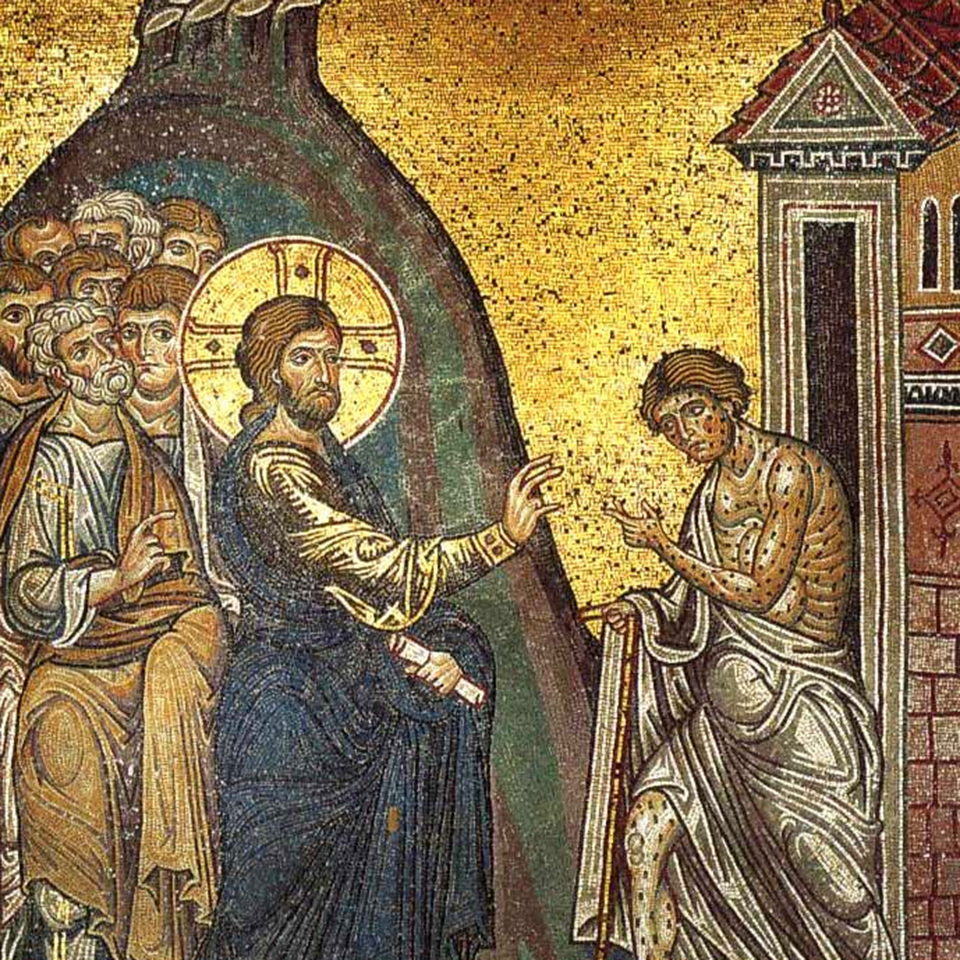
Jesus healing a leper, Cathedral of Santa Maria Nuova, Florence, Italy

In the first story, Jesus used his authority to heal and transform a leper. Leprosy was a feared disease in the ancient world. There was no known cure, and lepers were forced to live apart from everyone else. The Old Testament book of Leviticus says that a leper must wear torn clothes, let his hair be unkempt, cover the lower part of his face and cry out “unclean! unclean!” (Leviticus 13:45-46).  Lepers were the ultimate outsiders.

A leper came to Jesus with a humble profession of faith: “Lord, if you want to, you can make me clean.” It was a clear case of genuine need, and poverty of spirit. Jesus responded by doing the unthinkable: He touched him.  In a great and wonderful reversal, Jesus did not become unclean by touching the leper; but instead, the leper was made clean. 

Still today, the world needs to be touched. It’s an important way of following Jesus and changing the world. This requires us, God’s people, to get up-close and personal with outsiders and marginalized persons and groups. Christian service requires Christian touch.

Authentic Christian ministry communicates love through contact and identification with others. A thousand years after Christ’s earthly ministry, St. Francis of Assisi met a leper on the road:

“Though the leper caused him no small disgust and horror, he nonetheless, got off the horse and prepared to kiss the leper. But when the leper put out his hand as though to receive something, he received money along with a kiss”

Life of St. Francis, by Thomas of Celano

Francis did what seemed humanly impossible because he was filled with the love and compassion of Christ. The love of Jesus allows us to touch others with compassionate care, especially to those who have been rejected and mistreated.

Healing a Roman Officer’s Servant
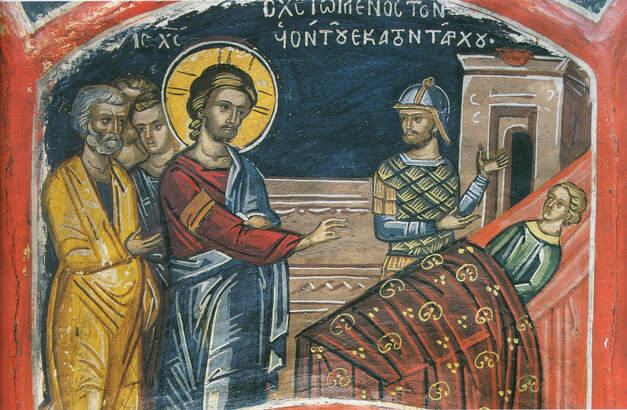
Fresco of Jesus healing the Centurion’s servant, Dionysiou Monastery, Mount Athos, Greece

The second story was equally eye-popping and unbelievable to the people in Christ’s day. Jesus used his authority to heal and transform a Gentile – and what’s more – a hated Roman army officer.

We see the values of the Beatitudes expressed in a Roman Centurion who felt unworthy to even have the Lord Jesus come into his house. The Centurion’s profession of faith amazed even Jesus: “Just say the word,” he said in recognition of Christ’s authority, which is big enough to heal without even being present. 

Although Centurions were the backbone of the Roman military machine and hated by the Jews, yet Jesus responded to the Centurion’s request, and he also affirmed his faith as greater than any Jew.

Grace answers to need, and not to smug self-confidence.

The Roman Centurion requested healing. Jesus listened and answered. The Centurion did not use his position to order Jesus or demand healing; he came in a spirit of humility and asked with confidence that Jesus could heal his servant if he wanted to. The Centurion threw himself on God’s mercy. So, Jesus upheld the Centurion as a model of faith for us all.

Healing Doesn’t Happen with the Independent

In affirming the Roman officer’s faith, Jesus also gave a solemn warning to the self-righteous: Their lack of humility and genuine faith would land them outside the kingdom. In another great reversal, the insiders will become the outsiders, and the outsiders become the insiders.

Independently proud folk do not experience healing and transformation because they don’t even know they are sin sick. They see no need for an intervention by Jesus because they already have their righteous deeds to boast about. Such persons are more concerned about looking good and saving face, than perceiving their own unworthiness. 

The self-righteous and self-sufficient approach to handling problems and difficult situations is to come up with good ideas and clever strategies, relying on sheer personal effort and willpower. Prayer may or may not happen; there is no honest beseeching of God. 

Delusional thoughts of personal autonomy only separate us from the grace of God that we so desperately need. 

There is a spiritual dimension to every situation and trouble we face – including sickness. If we only examine the medical and biological end of physical problems, we may be dealing with symptoms instead of the root issue that plagues us.

Are you hurting? Pray. Do you feel great? Sing. Are you sick? Call the church leaders together to pray and anoint you with oil in the name of the Master. Believing-prayer will heal you, and Jesus will put you on your feet. And if you have sinned, you will be forgiven—healed inside and out. Make this your common practice: Confess your sins to each other and pray for each other so that you can live together whole and healed. (James 5:13-16, MSG)

Conclusion

Jesus healed and transformed outsiders. Followers of Christ, dependent upon God, ask themselves:

  • Who are the outsiders among us?
  • Where are the strangers? 
  • How can we get close enough to touch aliens and immigrants? 
  • Will you help us intercede in prayer for foreigners? 
  • When can we search for and pursue those on the periphery of society? 

Believe that the risen and ascended Jesus can and will heal, deliver, and transform people of all kinds.

Jesus cannot be domesticated into some figurehead that suits our desires and conforms to our ideas about how things ought to be. Jesus is portrayed in these stories as eager to heal, wanting to show grace to the least and the lowly among society.

So, let us participate in the world’s healing, beginning with the Lord’s Prayer:

Our Father in heaven,
    may your name be kept holy.
May your Kingdom come soon.
May your will be done on earth,
    as it is in heaven.
Give us today the food we need,
and forgive us our sins,
    as we have forgiven those who sin against us.
And don’t let us yield to temptation,
    but rescue us from the evil one. Amen. (Matthew 6:9-13, NLT)

Psalm 1 – Choose Real Happiness

The truly happy person
    doesn’t follow wicked advice,
    doesn’t stand on the road of sinners,
    and doesn’t sit with the disrespectful.
Instead of doing those things,
    these persons love the Lord’s Instruction,
    and they recite God’s Instruction day and night!
They are like a tree replanted by streams of water,
    which bears fruit at just the right time
    and whose leaves don’t fade.
        Whatever they do succeeds
.

That’s not true for the wicked!
    They are like dust that the wind blows away.
And that’s why the wicked will have no standing in the court of justice—
    neither will sinners
    in the assembly of the righteous.
The Lord is intimately acquainted
    with the way of the righteous,
    but the way of the wicked is destroyed. (Common English Bible)

True happiness happens when we conform to disciplines of a good life and eschew practices that go against the grain of goodness. That statement might be a bit difficult to accept. Frankly, it is for me, and I wrote it.

You see, I’m not much of a conformity sort of guy. I like creatively doing my own thing, man. Bucking the system and questioning the rules is just something I do. Conformity tends to have a negative connotation with me – like a group of unthinking lemmings running off a cliff to their death.

Yet, the truth is that, although there is a wide range of creative choices we have for most everything, we as humans best function and discover happiness when we are in sync with our Creator. So, we can choose to ignore our foundational human hard-wiring, or we can live into it as the unique individuals we are.

Those two ways of shaping our lives are the path of the righteous and the path of the wicked. The way of the righteous leads to human flourishing, relational connection, and a vast spiritual life. Alternatively, the way of the wicked leads to human degeneration, disconnection from others, and spiritual death. It is to be out of sync with who we are as people.

Distinguishing between the righteous and the wicked is not always as easy as it looks. Only at the end of the age, when the Day of Judgment comes, will we know for certain the righteous and the wicked.

The magisterial Reformer of the sixteenth-century, Martin Luther, framed the two opposing ways as the theology of the cross and the theology of glory. The cross of Christ is G-d’s attack on human sin. Through being crucified with Christ, we find the way to human flourishing and life. It is the narrow road of grace.

A theology of glory is seeking to be radically independent – to rely primarily, perhaps even exclusively, on our own laurels and personal way of doing things. Although these might appear to be outwardly fine, they feed and water themselves from a wicked stream, devoid of grace.

Whenever we place our complete trust in self and forsake faith in something or someone outside of ourselves, it is a highway to the grave.

It is far too easy to place faith in our good works and to do good so that others will observe our goodness, rather than doing them out of the good soil of being planted in ancient and wise instruction.

Embracing tried and true practices of righteousness; delighting in G-d’s law; meditating on sound instruction; privately pouring over the large body of wisdom we have available to us; and diligently seeking to put it all into action is the way of good people who shall surely realize human happiness. They will yield gracious fruit. They will know blessing.

Joyful are people of integrity,
    who follow the instructions of the Lord.
Joyful are those who obey his laws
    and search for him with all their hearts.

Psalm 119:1-2, NLT

Serving only to be seen; seeking public accolades and personal recognition as a sole motivator; and disrespecting others to prop up individual respect is the way of the wicked. They don’t bother to consult the ancient ways of happiness. Instead, they pridefully believe they know what is best.

“You’re like manicured grave plots, grass clipped and the flowers bright, but six feet down it’s all rotting bones and worm-eaten flesh. People look at you and think you’re saints, but beneath the skin you’re total frauds.” (Matthew 23:27-28, MSG)

Abundance, generosity, gentleness, and grace marks the righteous because G-d is abundantly gracious and generous. Jesus is the gentle shepherd who mercifully and lovingly leads anxious sheep to the quiet pastures of settled happiness. Indeed, the Lord watches over the way of the righteous.

Only looking out for number one, stinginess, withholding good, hoarding, and angry criticism identifies the wicked. They have judgment in their future because they add no value to the great needs of humanity. Unhappiness is their lot.

We have choices. We can choose conformity to established patterns of godly instruction and happiness – or we can choose to rely solely on our own ingenuity and/or brawn to eke out a morsel of satisfaction.

Choose wisely, my friends.

O Holy Wisdom, direct us on your path. Make us worthy of your teachings and open our hearts to accept your embrace, that we may serve you in peace and grace. Amen.

James 4:11-16 – On Planning Well

Brothers and sisters do not slander one another. Anyone who speaks against a brother or sister or judges them speaks against the law and judges it. When you judge the law, you are not keeping it, but sitting in judgment on it. There is only one Lawgiver and Judge, the one who can save and destroy. But you—who are you to judge your neighbor?

Now listen, you who say, “Today or tomorrow we will go to this or that city, spend a year there, carry on business and make money.” Why, you do not even know what will happen tomorrow. What is your life? You are a mist that appears for a little while and then vanishes. Instead, you ought to say, “If it is the Lord’s will, we will live and do this or that.” As it is, you boast in your arrogant schemes. All such boasting is evil. (NIV)

Listening is both art and hard work. A few years back I spent a week at a prayer retreat. It was time intentionally set aside to hear God. It was hard work. I stayed in a little one room hermitage in the woods surrounding by God’s creation. On the first morning, I was in bed and at dawn I heard this loud thud on one of the windows. I woke up and heard it again, and then again. Outside there was a big male robin going at the window like there was no tomorrow. He did it about a dozen times before finally flying away. I laid there a bit frustrated with this stupid bird waking me up, and yet also wondered about that robin. Since I was there to connect with God, I started asking the question: “God, what are you trying to teach me through that stupid robin?”

I did not get an answer to my question. Then, the next day it happened again. Mr. Robin came by and took about a dozen hard tries at my window before flying away. However, this time I finally realized what was going on. Mr. Robin was perching just outside the window and looking at his own reflection. All he could see was a big rival robin staring back at him, on his turf, and he was going to tear into that interloper. Little did the birdbrain know that he was fighting a losing battle, against himself. 

“God, what are you trying to teach me through this robin?” Now, I had my answer. I was a Pastor tackling the issues and problems of others in the church and the world. Yet, I came to understand that I was only tackling myself, seeing my own reflection and struggling in a losing battle. I investigated the face of the enemy, and the enemy was me.

We are our own worst enemies. Much of life is determined by whether we plan for and with God. The natural temptation of us all is to view the landscape of human problems, assign enemies, and then fail to see that our greatest enemy is staring at us in the window’s reflection. Another temptation is to believe that when things are going well, it is because of our own doing – as if somehow, we can live and move and have our being independent of God in the equation. So, I ask, is God in our plans?

That is a big question. Here is just a smattering of what Jesus said about living for him: 

“Any of you who does not give up everything he has cannot be my disciple.” (Luke 14:33)

“Anyone who does not carry his cross and follow me cannot be my disciple.” (Luke 14:27)

“If you hold to my teaching, you are really my disciples.” (John 8:31)

“No one who puts his hand to the plow and looks back is fit for service in the kingdom of God.” (Luke 10:62) 

We are not called by God to control other people or events; we are called to practice self-control and listen to God as we determine the course of our lives in both the big and small things of life.

The Apostle James had to deal with some birdbrain robins. They were only looking at themselves and not doing the good they knew they ought to do.

The Actual Situation

Some of the people James addressed were planning and mapping out their lives without consideration of what God wanted. They neither looked to God before beginning their planning process nor intended on including him in their dealings. These certain businesspersons were independent minded. They viewed their time and money as their own. In their minds, they give God an hour on Sunday, and the rest of the time is their own; they make their own money and no one can tell them what to do with it; they make their own plans, and maybe ask God afterward to bless it all.

The actual situation was that people were holding back on God, only giving him a certain portion of their effort.  And this can happen to any of us, with anything we have.  We may not all have money and power, yet we all have time, and how we use our time says a lot about our faith.

One of the many things God taught me at my prayer retreat was through all my business and busy-ness that I was holding back in some ways. Yes, I could compassionately connect with people but was guarded with it. Having my armor up was coming from a fear of not doing something perfect, or at least not doing it really well; and, if I would give myself completely to compassionately connecting with others, I might get hurt (because I’ve been hurt before). I wonder if you can resonate with this.

God just wants us to show up, be present, and not be perfect. We are to do the best with the gifts and abilities given us and leave it all on the playing field so that it cannot be said of us that we did not do the good we knew we should have done.  Furthermore, there is nothing wrong with being afraid.  In fact, true courage involves fear because real bravery is doing what is right when it is scary to do it, no matter what the consequences might be.

The Analysis of the Situation

Life is truly short – like a mist that appears for a little while in the morning, and then vanishes. Thus, the scheming we might do to make money and guard our investments; the posturing to make ourselves look good; the power-plays we engage to get our way; and, the anxiety which prevents us from the things we know we ought to do amounts to nothing at the end of our lives.

I have talked with far too many people over the years who crucify themselves between the two thieves of regret over yesterday’s missed opportunities, and fear of what will happen tomorrow. I have observed far too many people who made lots of money, patented inventions, and won awards, yet had no one at the end of their lives to be with them. They were not there for others, and so others were not there for them. 

Jesus said we cannot serve both God and money (Matthew 6:24). In God’s economy, money is simply a tool to be used to meet needs and bless others. Yet, we tend to make audacious plans with money through accumulating debt and presuming we can pay it off; encouraging our kids to get high paying jobs as their highest objective; and, putting faith in the market economy to provide for us in the end. 

James was not saying money is bad and making plans is wrong; he was saying that the almighty dollar is not to be the motivating factor in our lives, and that God needs to be squarely in the middle of all that we do.

The Alternative to the Situation

The alternative to making plans independent of God is to plan carefully for God to be in everything – to find and do his will without trying to impose our will upon the divine.

This requires listening well. It is easy to rush and keep busy and then are unable to hear what God might be saying. When things are rough, we may work so we do not have to stop long enough to feel what is really going on inside of us. James encourages us to say, “If it is the Lord’s will, we will live and do this or that.”  Listening well enables living well.

The Audacity of the Situation

Some people in James’ day were boasting over their accomplishments.  Like Kings Nebuchadnezzar and Herod of old, they made plans and did what they wanted with delusions of grandeur. They believed they were the ultimate sovereigns of what could and should go on in the world of which they controlled. They had to learn the hard way that they were only masters of small worlds.

Boasting merely sets us up for a higher fall. We need God, and we need each other, and whenever we lose sight of that truth, we are on a one-way road to implosion. Whereas some might call it independence, God calls it evil.

The Awfulness of the Situation

The tragedy of independent planning and acting is that God is left out due to purposeful ignorance. Like the deceitful husband and wife duo, Ananias and Sapphira, there were certain persons who withheld their money and their resources so that they could look good to the rest of the community and influence happenings within the church (Acts 5:1-11).  It did not end so well for them.

Conclusion

Doing more with greater efficiency may help, yet it misses the point. We are to take the time and effort to relate meaningfully with God so that we can plan with confidence and make faith-based decisions on what we believe the Lord wants us to do.

Let us not find ourselves repeatedly flying into a window. Instead, let the Lord shape life in such a way that conforms to his purposes, so that we will then know genuine lasting joy and peace.

One mark of the mature person is that he/she has the same benevolence and character whether they are rich or poor. Since we are all rich in faith, let us continually demonstrate it by living for Jesus Christ, loving one another, and planning to reach a lost and unjust world with the good news of God’s grace.