

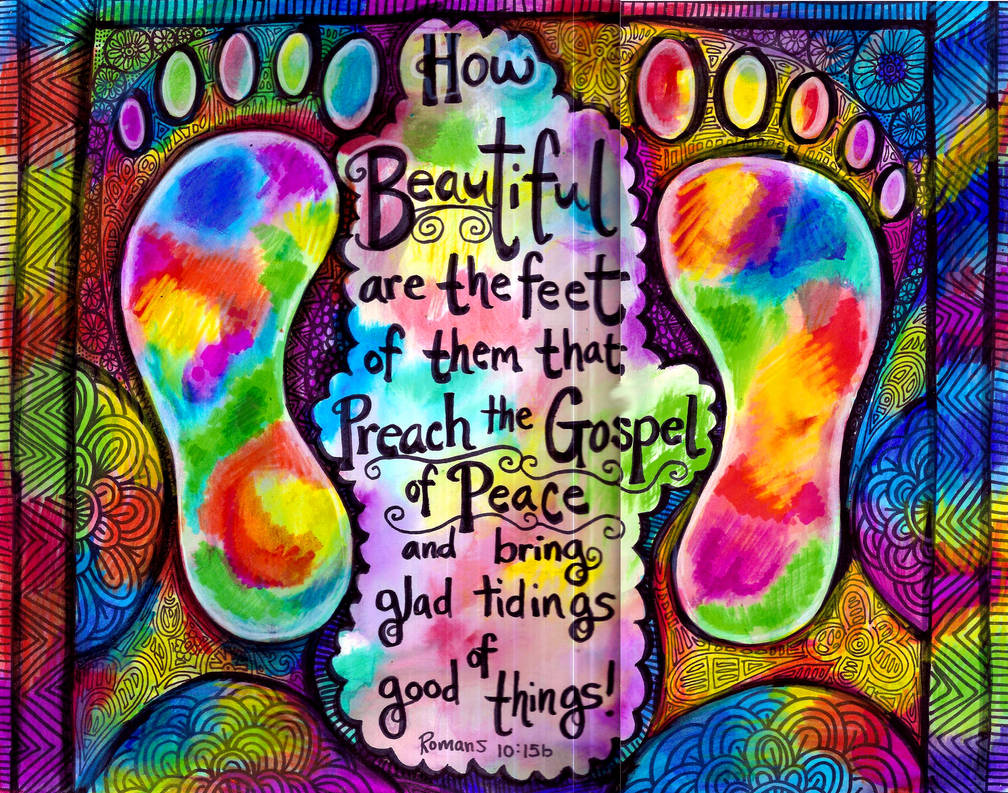
As it is written: “How beautiful are the feet of those who bring good news!”
But not all the Israelites accepted the good news. For Isaiah says, “Lord, who has believed our message?” Consequently, faith comes from hearing the message, and the message is heard through the word about Christ. But I ask: Did they not hear? Of course they did:
“Their voice has gone out into all the earth,
their words to the ends of the world.”
Again I ask: Did Israel not understand? First, Moses says,
“I will make you envious by those who are not a nation;
I will make you angry by a nation that has no understanding.”
And Isaiah boldly says,
“I was found by those who did not seek me;
I revealed myself to those who did not ask for me.”
But concerning Israel he says,
“All day long I have held out my hands
to a disobedient and obstinate people.” (New International Version)
“Beautiful” is not a typical description of anybody’s feet. That’s because feet are kind of gross. Feet stink. They get dirty and itchy; they’re often calloused and downright nasty looking. And no one comments that their feet feel good. People’s feet rarely feel that way.
It seems to me that feet are an apt metaphor for the bringing of salvation, of good news.
The Christian good news is this: There is salvation – forgiveness of sins – through Jesus Christ; and it is accessed by faith.
“Salvation” is a term which perhaps gets overused by Christians to the point that it becomes misunderstood and/or taken for granted. When that happens, it only becomes “meh” news and is no longer good news. For some, it’s a bit like feet – they’re there, but they hurt too much. We don’t think much about our feet until the corns, the bunions, or the toenails bother us. There’s a “meh” relationship to the foot.
In Christianity, the triune God has conspired within himself to bring us salvation. The good news is that God the Father has mercifully sent God the Son for the rescue of the entire world from sin, death, and hell; and Father and Son have further sent God the Holy Spirit to help us respond and live by faith.
Even back in the Old Testament, with the prophet Isaiah, such a merciful deliverance was predicted. Isaiah’s description of the life and rejection of the Suffering Servant wondered if faith would happen in response to salvation. Would they really see it as “good” news? Can feet really be beautiful?
Who has believed our message
and to whom has the arm of the Lord been revealed? (Isaiah 53:1, NIV)
The Apostle Paul, knowing a thing or two about suffering, walking a lot of missionary miles with his feet, was confident that, indeed, faith is awakened in the hearing of the message. The message is good news, and it will be received. Good news has to be proclaimed before it can take hold.
So faith comes from what is heard, and what is heard comes through the word of Christ. (Romans 10:17, NRSV)
Good news has to be announced up-close and personal. It takes getting on our two feet, walking across the street, across the room, or across the world to bring it. That’s because salvation is relational. The message of salvation is there amongst people; it has always been deep within them, as those created in the image and likeness of God.
The heavens are telling the glory of God,
and the firmament proclaims his handiwork.
Day to day pours forth speech,
and night to night declares knowledge.
There is no speech, nor are there words;
their voice is not heard;
yet their voice goes out through all the earth
and their words to the end of the world. (Psalm 19:1-4, NRSV)
In the book of Romans, we see Jewish Christians and Gentile Christians together in one church. Historically, the Jews were God’s people – the insiders – and the Gentiles were not a people, the outsiders. Now the Gentiles are included and are no longer outsiders. Not all the insiders were okay with this situation.
In the Old Testament, Moses predicted insider Israel’s overall response to this situation of feet walking amongst the Gentiles and announcing the good news of salvation.
They have roused my jealousy by worshiping things that are not God;
they have provoked my anger with their useless idols.
Now I will rouse their jealousy through people who are not even a people;
I will provoke their anger through the foolish Gentiles. (Deuteronomy 32:21, NLT)
The prophet Isaiah also spoke of Gentile inclusion into God’s saving activity; and the Jewish response to salvation for them:
I was ready to respond to those who didn’t ask.
I was ready to be found by those who didn’t look for me.
I said, “I’m here! I’m here!” to a nation
that didn’t call on my name.
I extended my hands all day
to a rebellious people
walking in a way that isn’t good,
following their own plans.” (Isaiah 65:1-2, CEB)
This in no way is meant to be hard on ancient Israelites and the Jewish people. It is really a commentary on including others who are different, what God thinks about it, and the challenge this poses to those holding onto the status quo.
Throughout all of biblical history, into the past two thousand years of church history, and even today, those who consider themselves as God’s people, the insiders, tend to be blinded by the privileges bestowed on them by a gracious God. And they usually think of only one thing: To preserve their status and their spiritual monopoly by excluding others who are different.
It is a hardening of the heart – or maybe the calloused feet – that does not want to recognize that certain persons and people groups can be saved and included as God’s people alongside the rest.
Fortunately, the Apostle Paul, a Jewish Christian, longed for all to be saved and to come to a knowledge of God. He himself wanted to know Christ and “be found in him, not having a righteousness of my own that comes from the law, but that which is through faith in Christ—the righteousness that comes from God on the basis of faith.” (Philippians 3:19)
Salvation is neither attained through strict observance of the rules, nor by being a good or nice person. It is graciously given by the God who came and whose feet walked amongst us. Deliverance comes through an acceptance by faith in the Son of God who loved us and gave himself for us – including people who others might consider as outsiders or unworthy of it.
From my vantage point, the feet that bring a gracious message of good news for all are truly beautiful.
Almighty God, Father of all mercies, we give you humble thanks for your goodness and steadfast love to all kinds of people. We thank you especially for your immeasurable love in the redemption of the world by our Lord Jesus Christ. And, we pray, give us such an awareness of your mercies, that with truly thankful hearts we may show forth your praise, not only with our lips, but in our lives, by giving ourselves to your service, and by walking before you in holiness and righteousness all our days. Amen.








 Rev. Tim Ehrhardt