Psalm 149 – Praise and Punishment

Church stained glass windows sword dividing

Praise the Lord!
Sing to the Lord a new song,
his praise in the assembly of the faithful.
Let Israel be glad in its Maker;
let the children of Zion rejoice in their King.
Let them praise his name with dancing,
making melody to him with tambourine and lyre.
For the Lord takes pleasure in his people;
he adorns the humble with victory.
Let the faithful exult in glory;
let them sing for joy on their couches.
Let the high praises of God be in their throats
and two-edged swords in their hands,
to execute vengeance on the nations
and punishment on the peoples,
to bind their kings with fetters
and their nobles with chains of iron,
to execute on them the judgment decreed.
This is glory for all his faithful ones.
Praise the Lord! (NRSV)

The initial question that arises with me is this: Is this a psalm of praise to the Lord, or an imprecatory psalm encouraging the punishment of the wicked? Well, perhaps the obvious answer is “yes.” I suppose what I am really struggling with is that out of all the one-hundred fifty psalms in the psalter, only this one has this unique combination of vocal praise and punishing action.

The psalm begins much like many psalms of praise but takes the unexpected turn of a call to a war-like operation to execute vengeance on enemies. I freely admit that I do not know quite what to make of this strange amalgam. I wonder along with the venerable Old Testament scholar Walter Brueggemann who said, “One cannot tell whether this is a responsibility to fend off oppressors or a temptation to gather imperial power.”

Perhaps my wrestling with this psalm is really the struggle with history itself. The Holy Scriptures do not shy away from the realism of its times and often offers historical events and human attitudes with unvarnished narratives. The Bible, and especially the psalmist, will not let us sanitize the past as some idyllic bygone era of divine drama to be envied. Instead, we receive the liberation of God’s people with all its harsh truth.

So, it could be that is why I also loathe seeing some mass market crosses which look ornately beautiful, as if Christ’s death was some pleasant affair. Deliverance from sin, death, and hell came at an awful price. Jesus absorbed all the foulness and degradation of a tortuous ignoble death. In other words, he was a bloody mess, publicly displayed for all to jeer at and be repulsed by.

What is more, for the Christian, perhaps the sagest approach to today’s psalm is unabashedly choosing to view it through Christocentric lenses. Christ is the strong man who has bound the ruler of this dark world with iron chains and secured our liberation from a hellish existence. And the Lord will return, the nations of the earth will be judged, and the faithful will reign with Christ forever.

Even if I read a bit too much into the psalm by interpreting it Christologically, it still leaves the intention of the imprecation open as to its true nature. In other words, the psalm simply does not tell us the trajectory of the curse which comes out of the praise. We are left to wonder in what kind of direction it goes. The Christian tradition of reading psalms and seeing Jesus in them might be our best guide.

Whichever way we choose to examine this unique psalm, the thing which we do know is that it unequivocally stands as a defiance of the nations and peoples of the earth who oppose the living God. Resistance to injustice, unrighteousness, and evil is encouraged by this psalm. The only ruler of this earth who has absolute power is God; and, anyone or any group which attempts to gain and grab such power for themselves is to be resisted. For the harsh reality of living on this created yet fallen earth is that violent and insolent people still desire total control and will do just about anything to get it and keep it.

Almighty and sovereign God, we, your people, ask in the Name of your most precious Son, Jesus Christ, our risen and ascended Lord, to look upon the good desires of your humble servants, and stretch forth the right hand of your power to be our defense against evil in all its insidious forms. And do not lead us into temptation, but deliver us from the evil one. For yours is the kingdom and the power and the glory forever. Amen.

Psalm 83:1-4, 13-18 – Against Evil

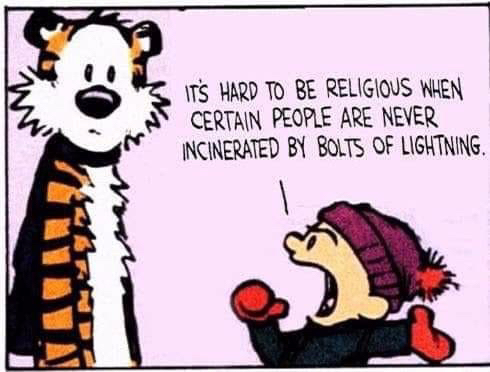
Calvin and Hobbes - imprecation

O God, do not be silent!
Do not be deaf.
Do not be quiet, O God.
Don’t you hear the uproar of your enemies?
Don’t you see that your arrogant enemies are rising up?
They devise crafty schemes against your people;
they conspire against your precious ones.
“Come,” they say, “let us wipe out Israel as a nation.
We will destroy the very memory of its existence….”

O my God, scatter them like tumbleweed,
like chaff before the wind!
As a fire burns a forest
and as a flame sets mountains ablaze,
chase them with your fierce storm;
terrify them with your tempest.
Utterly disgrace them
until they submit to your name, O Lord.
Let them be ashamed and terrified forever.
Let them die in disgrace.
Then they will learn that you alone are called the Lord,
that you alone are the Most High,
supreme over all the earth. (NLT)

The psalms are the church’s prayer book.  Many of the psalms are laments and many of them are worshipful songs of praise. Then there are the “imprecatory” (pronounced im-PRECK-a-tory) psalms.  To “imprecate” means to invoke evil upon someone; it is to pronounce a curse.  The reason for the imprecatory psalm is that it is not any person’s place to engage in revenge or retaliation.  Instead, for people who are genuinely caught in the cross-hairs of evil and have sinful persons dogging them, prayer is their most effective recourse.

Sometimes you must tell it like it is.  There is a time to do your best in putting up a good face and dealing with people who do not ever stop gossiping, slandering, and trying to get their way.

There is also a time to call such behavior “evil” and cry out to God for help.

There are many folks who consider imprecatory psalms a problem because of their detailed expressions of imprecation. Yet, such psalms refuse to put a positive spin on malevolent motives, wicked words, and destructive actions. Desperate people utter desperate prayers. Their unflinching sense of injustice will not allow them to sugarcoat the villainous plans of corrupt people. Evil is never toppled with tepid prayers from wimpy worshipers. Rather, nefarious agendas are thwarted in the teeth of specific, focused, and intense prayers directed with spiritual precision to the very core of diabolical forces.

We need not be shy about being real with God, even with praying imprecatory prayers.  There really are people in this world, maybe even in your own life, that have malicious intent against you or others.  Our job is not personal revenge, but to entrust ourselves to the God who fights for the poor, the oppressed, and the needy against the arrogant and the powerful.

Let your prayers reflect your life.

Along with psalms of praise lifted during times of celebration, so imprecatory psalms are not to be ignored but need to be uttered equally loud as prayers to almighty God in seasons of desperate evil. If you have a gut feeling deep down that wicked people are running amok, then use this psalm as a prayer against the darkness which seeks to envelop the earth.

Jesus Christ will build his church and the gates of hell shall not overcome it (Matthew 16:18). The picture Jesus portrayed is one of faithful believers equipped with righteousness and justice storming the gates of hell, not shying away from it. Baked within the Lord’s words were the promise that evil atrocities will not have the day – that God’s people will not be destroyed or overwhelmed because of demonic and satanic power.

There is a time to flee and then there is a time to engage. I am suggesting that the chief way of mitigating evil is to punch it in the mouth with imprecatory psalms prayed with righteous flavor and focused directly against the powers of this present darkness. Why prayer of all things in dealing with evil?…

For we do not wrestle against flesh and blood, but against principalities, against powers, against the rulers of the darkness of this age, against spiritual hosts of wickedness in the heavenly places. (Ephesians 6:12, NKJV)

Spiritual problems require spiritual implements to solve. And the tool of imprecatory psalms is a major way of not only pushing back the dark forces of this world but is the means of spiritual assertiveness against all forms of heinous acts and acerbic words from depraved people and evil systems.

God’s wrath is an expression of God’s love.

God is not okay with evil taking root in the lives and institutions of humanity. Prayer is our privilege of coming to the God who upholds justice and righteousness. For if God is for us, who can be against us?

God Almighty, may you hear me in the day of my trouble and send help from your holy sanctuary and strengthen my faith. Breathe your Holy Spirit into me and inspire me with a passion for goodness and truth, justice, and righteousness. Lord Jesus be present with me in your risen power and protect me from harm and from all that would hinder your healing presence in this world. You overcame the forces of Satan, redeemed the world, then ascended to the Father. May you be with me and within me; before me and behind me; on my right and on my left; above me and beneath me; and around me always. Amen.

Psalm 28 – To Be, or Not to Be

David pelted with stones
David being pelted with stones, by unknown Slovakian artist, 1937

I cry out to you, Lord.
You are my rock; don’t refuse to hear me.
If you won’t talk to me,
I’ll be just like those going down to the pit.
Listen to my request for mercy when I cry out to you,
when I lift up my hands to your holy inner sanctuary.
Don’t drag me off with the wicked and those who do evil;
the type who talk nice to their friends
while evil thoughts are in their hearts!
Pay them back for what they’ve done!
Pay them back for their evil deeds!
Pay them back for their handiwork!
Give back to them exactly what they deserve!
Because they have no regard for what the Lord has done,
no regard for his handiwork,
God will tear them down and never rebuild!

Bless the Lord
because he has listened to my request for mercy!
The Lord is my strength and my shield.
My heart trusts him.
I was helped, my heart rejoiced,
and I thank him with my song.
The Lord is his people’s strength;
he is a fortress of protection for his anointed one.
Save your people, God!
Bless your possession!
Shepherd them and carry them for all time! (CEB)

The biblical character David, in frustration and agony, cried out for help, for God to hear his prayers. And, when his prayer was heard, David gave exuberant praise to the Lord for listening to him. We are not told specifically of how that prayer was answered and what happened between the request and the response. It seems the juicy details are left out on purpose, so that maybe we would not get lost in the retribution but stick with the fact that there was a desperate need and the Lord stepped in and did something about it.

As I pondered this psalm and its lack of life-detail, I wondered about David’s situation: Could it be that David gave God praise just for being heard by him?  Was David cured in some way, or was he healed from the need to be healed?  Was there even any actual deliverance that occurred?  Did David come to praise God despite a lack of deliverance?  Was David’s joy in his relationship with God conditional, or unconditional?

Hamlet
Hamlet, played by actor Matt Amendt in the Pittsburgh Public Theater, 2018

William Shakespeare’s Hamlet (c.1601 C.E.) put the question this way: “To be, or not to be, that is the question.” Hamlet’s soliloquy went on to say:

“Whether ’tis nobler in the mind to suffer
The slings and arrows of outrageous fortune,
Or to take arms against a sea of troubles,
And by opposing end them? To die: to sleep;
No more; and by a sleep to say we end
The heartache and the thousand natural shocks
That flesh is heir to, ’tis a consummation
Devoutly to be wish’d. To die, to sleep;
To sleep: perchance, to dream: ay, there’s the rub;
For in that sleep of death what dreams may come
When we have shuffled off this mortal coil,
Must give us pause: there’s the respect
That makes calamity of so long life;
For who would bear the whips and scorns of time,
The oppressor’s wrong, the proud man’s contumely,
The pangs of despised love, the law’s delay,
The insolence of office and the spurns
That patient merit of the unworthy takes,
When he himself might his quietus make
With a bare bodkin (knitting needle)?”

Hamlet, much like David of old, was miserable and burdened with a profound lack of power to change his circumstances. So, he reflects on life and death in a morbid and melancholy way. It is not that Hamlet was contemplating suicide as much as he meditated on what life truly is and finding some meaning within it. Unlike David, Hamlet cannot find the courage to deal with his frustration and feels stymied with fear of the unknown.

If we are blatantly honest with ourselves, we must admit that far too often we have a particular outcome in mind for God to do.  Our hopes and expectations are tethered to God doing something extremely specific so that, if it does not come to pass (or does not come quickly!) we become discouraged and disillusioned. Like Hamlet, we become lost in the shadows of our thinking and ponder some sort of escape.

So, here is another set of questions I am asking myself: If my adverse circumstances do not change, can I praise God anyway?  Can I, like David, take joy in simply being heard?  Can I find gratitude in all situations?  Do I only express thanks and praise to God when things are going my way?  Am I open to whatever God wants to do in my life, even if it is not what I would choose?  Do I feel that I am above having to put up with the wickedness of this world?  Am I expecting heaven on earth, or am I willing to suffer as Jesus did?

I honestly believe the answers to those questions will determine the trajectory of our Christian experience. For the identity and meaning of all persons is found in the divine.

I praise you, O God, in the good and the bad, the easy and the difficult, the failures and the victories.  You are Lord over all things.  You are my strength and shield in every circumstance.  When I am weak, I am strong. I can do all things through Christ who strengthens me.  Amen.

Psalm 35:1-10

            Sometimes you just have to tell it like it is.  There is a time to do your best in putting up a good face and dealing with people who don’t ever stop gossiping, slandering, and trying to get their way.  But there is also a time to call such behavior “evil” and cry out to God for help.
            Psalm 35 is a classic prayer in the category called “imprecatory psalms.”  The term “imprecatory” means to call down a curse on a person or group of people.  Maybe this surprises you that there is such language in the Bible.  In fact, there are 18 such imprecatory psalms which make a clear petition to God for him to turn the evil back on themselves that they inflict (or try to inflict) on others.
            I’m a believer in making simple observations about the biblical text.  Let’s observe a few things about such psalms:
1.      David asks God to deal with the evil behavior of powerful people.
Unlike most of us, David went through a time in is life where there were powerful people who were literally trying to hunt him down and take his life.  As much as we might speculate whether David wanted to take matters into his own hands, the fact remains that he didn’t.  David relied on God to execute judgment.
2.     David did not hold his feelings back in describing exactly what he wanted God to do.
There is nothing sanitized here in the psalm.  David was understandably upset.  He did nothing wrong, yet he was being chased like an animal.  David said it plainly to God: “attack my attackers;” “aim your spear at everyone who hunts me down;” “send your angel after them;” “surprise them with disaster;” and, “let them fall and rot in the pits they have dug.”  Whatever you might think about how a proper Christian ought to say and pray, imprecatory curses might not be your first thought.  But here they are, out there for us to read in the Holy Bible.
3.     The psalms are the prayer book of the church.
That includes the imprecatory psalms.  Yes, they ought to be prayed by us right along with psalms of praise, thanksgiving, and song.  I want you to think what might be a radical thought for you: We ought to include imprecatory prayers in our regular rhythms, routines, and rituals of prayer.
 
            Evil will not have the last word.  God opposes the proud and the arrogant who step on others to get their way.  But he gives grace to the humble, that is, those who look to him for justice and righteousness; are open about their feelings of hurt and upsetedness; and, lift-up imprecatory prayers which are biblically consistent.


Saving God, you protect the helpless from those in power and save the poor and needy who cry out to you.  Mighty God, turn back on those with slanderous tongues, gossiping words, and sinful actions the evil they intend to inflict on others.  Let them fall into a deep black hole for which they cannot get out and harm anyone again; through King Jesus, our Savior, in the assistance of the Holy Spirit.  Amen.