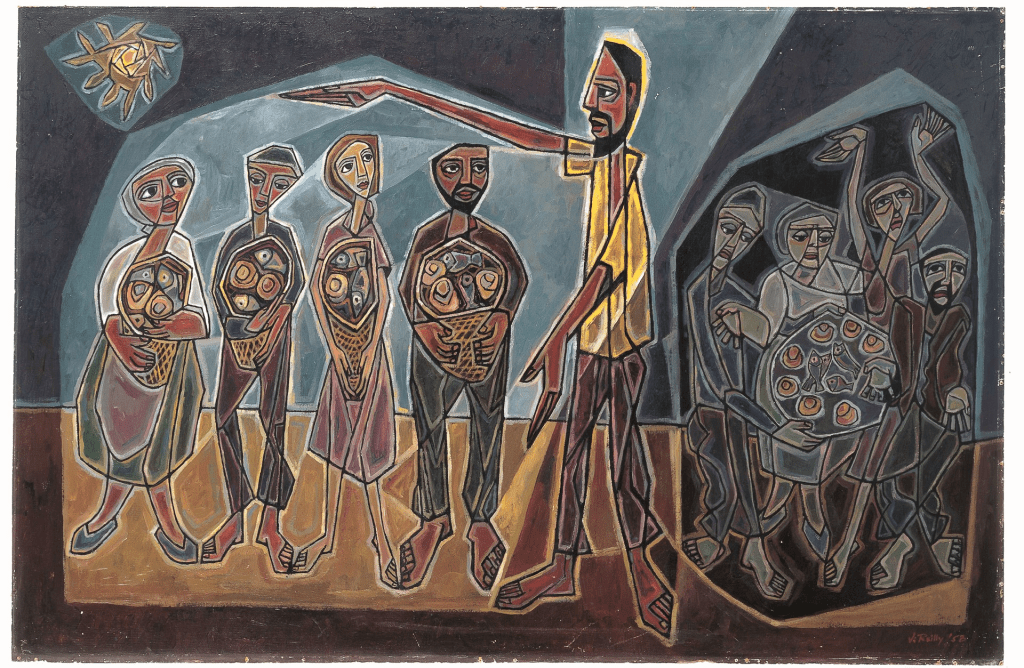
Jesus Feeds the Five Thousand (Matthew 14:13-21)

The Feeding of the Five Thousand, by John Reilly (1928-2010)

When Jesus heard what had happened, he withdrew by boat privately to a solitary place. Hearing of this, the crowds followed him on foot from the towns. When Jesus landed and saw a large crowd, he had compassion on them and healed their sick.

As evening approached, the disciples came to him and said, “This is a remote place, and it’s already getting late. Send the crowds away, so they can go to the villages and buy themselves some food.”

Jesus replied, “They do not need to go away. You give them something to eat.”

“We have here only five loaves of bread and two fish,” they answered.

“Bring them here to me,” he said. And he directed the people to sit down on the grass. Taking the five loaves and the two fish and looking up to heaven, he gave thanks and broke the loaves. Then he gave them to the disciples, and the disciples gave them to the people. They all ate and were satisfied, and the disciples picked up twelve basketfuls of broken pieces that were left over. The number of those who ate was about five thousand men, besides women and children. (New International Version)

Miracles still happen

I know of a woman who once brought a pan of lasagna to a community meal at her church, thinking that only 25-30 people would be fed. However, 70 people showed up. Her immediate thought was to go buy more, but she didn’t have the time.

So, here is what the dear woman did: She looked up to heaven, gave thanks, and started dishing out the lasagna – until every last person was fed. She confided in me that “every time I put my spatula down there was food to put on it!”

The story of Jesus feeding thousands of people is not just a nice account that happened a long time ago; Jesus is still in the miracle business. Christ can take our meager resources and turn them into something with a large impact on a lot of people. 

For this to happen, all we need to do is follow our Lord’s simple instructions: “You give them something to eat,” and, “Bring them here to me.” Jesus, using a simple act of obedience by the disciples, did one of the most famous miracles in history.

The message of the story is simple, but profound: Jesus can multiply whatever little we have, to accomplish his kingdom work, through us. Jesus could do miracles without us, but he wants us to participate in the work. We only need to bring our few loaves and fish to him.

The compassion of Jesus is the motivation for miracles

Jesus withdrew to a solitary place. But the crowd did not leave him alone. Rather than be annoyed by the situation, Jesus looked at the large group of people and his heart went out to them. So, he went about the work of healing the sick. Please know that God does not begrudgingly deal with you, as if you were an interruption to his day; he has compassion.

The desire of Jesus is for us to participate in the miracles

After a full day of healing, Christ’s disciples came to him as if he was unaware of the people’s need for food. They gave a very rational and realistic answer to the problem of hunger: Dismiss them so they can go out to eat. But Jesus said, “They don’t need to go away; you give them something to eat.” 

I detect maybe a hint of sarcasm in the tone of the disciples reply: “We have only five loaves of bread and two fish.” But their math was way off because they did not count Jesus.  “Bring them here to me,” Christ replied. If we have ears to hear, Jesus is still saying this today: bring them here to me. Through simple prayer and active obedience, we give Jesus what we have, no matter how little or insignificant it seems to us.

Much of what we do in the American church is a reasonable and rational ministry; it has little to do with the impossibility of faith and seeing God work in ways that are incomprehensible to our modern sensibilities.

A Chinese pastor once visited the United States. After seeing our vast resources of money, buildings, and ministries. He said, “This is amazing! It’s incredible what you American Christians can do without God!” 

In reality, we need God – who is in the business of taking our simple obedience and humble participation, and doing the miraculous. And it has always been this way. For example….

Elisha Multiplies the Widow’s Oil, from  L’histoire dv Vieux et dv Nouveau Testament, 1670

The wife of a man from the company of the prophets cried out to Elisha, “Your servant my husband is dead, and you know that he revered the Lord. But now his creditor is coming to take my two boys as his slaves.”

Elisha replied to her, “How can I help you? Tell me, what do you have in your house?”

“Your servant has nothing there at all,” she said, “except a small jar of olive oil.”

Elisha said, “Go around and ask all your neighbors for empty jars. Don’t ask for just a few. Then go inside and shut the door behind you and your sons. Pour oil into all the jars, and as each is filled, put it to one side.”

She left him and shut the door behind her and her sons. They brought the jars to her and she kept pouring. When all the jars were full, she said to her son, “Bring me another one.”

But he replied, “There is not a jar left.” Then the oil stopped flowing.

She went and told the man of God, and he said, “Go, sell the oil and pay your debts. You and your sons can live on what is left.” (2 Kings 4:1-7, NIV)

You want me to do what?

What if we were to operate as if God were truly in the business of doing miracles?  Would it impact the way we pray, and the way we act?  What if we understood just enough of Jesus and what he can and wants to do that we would be bold to say: “This might sound crazy, but what if we….”

  • found out everyone who needs food in this community, go love on them, and feed them…
  • used our property to create a community garden and seek to help people grow their own food…
  • came up with a God-sized plan to reach our community…
  • prayed to see a hundred people come to Christ through this church… 

Most of our plans don’t require us to do anything impossible, so we simply settle for the possible.

We too often do nothing out of a sense that God either cannot or does not want to use me or what I have. But it just won’t do to stand afar off and expect God to work without us giving what we have – whether that something is time, money, conversation, food, hospitality, or whatever. 

Our limitations mean nothing to Jesus, so he doesn’t hear us when we say:

  • my home is too small, and it’s not clean enough
  • I don’t have enough money,
  • I’m not smart enough
  • my schedule won’t allow it
  • I don’t have enough resources

You don’t need much – only the willingness to be part of the miracle Jesus is doing.

Conclusion

You want me to do what? Feed thousands? Lead someone to Jesus? Pray in front of others? Work for justice?

Sometimes, the greatest miracle is for people to be open, real, and transparent enough to believe that Christ can do a miracle through confessing my sin, participating in a ministry, or having a spiritual conversation with an unbeliever. 

The question is never, “Can God use me?” It is, “What miracle does God want to do through me and through this church?”

It is no accident that when Jesus distributed the bread that it sounds a lot like communion. The Lord’s Supper may seem irrelevant, as if it is merely remembering Jesus. However, God’s design is much bigger: The Lord wants to do a miracle. 

God wants the practice of our communion together to bring healing and wholeness that the world cannot give. It might be unrealistic to expect that Jesus can use a Table to feed and reach thousands, but we don’t serve a God who is limited to work through rational means.

Blessed are you, O Lord God, King of the Universe, for you give us food to sustain our lives and make our hearts glad. We thank you for your countless blessings, especially for the gift of your Son, for the Church, for our faith, and now for this meal we are about to participate in, through Christ our Lord. Amen.

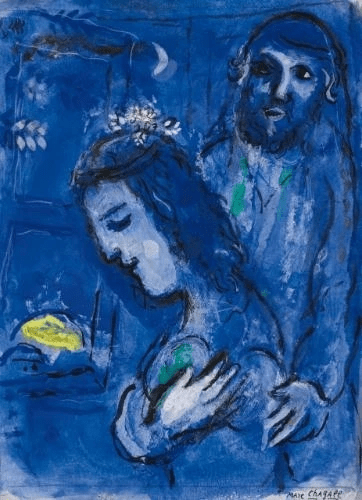
A Laughable Faith (Genesis 18:1-14)

Abraham and Sarah, by Marc Chagall, 1956

One hot summer afternoon while Abraham was sitting by the entrance to his tent near the sacred trees of Mamre, the Lord appeared to him. Abraham looked up and saw three men standing nearby. He quickly ran to meet them, bowed with his face to the ground, and said, “Please come to my home where I can serve you. I’ll have some water brought, so you can wash your feet, then you can rest under a tree. Let me get you some food to give you strength before you leave. I would be honored to serve you.”

“Thank you very much,” they answered. “We accept your offer.”

Abraham went quickly to his tent and said to Sarah, “Hurry! Get a large sack of flour and make some bread.” After saying this, he rushed off to his herd of cattle and picked out one of the best calves, which his servant quickly prepared. He then served his guests some yogurt and milk together with the meat.

While they were eating, he stood near them under the tree, and they asked, “Where’s your wife Sarah?”

“She is right there in the tent,” Abraham answered.

One of the guests was the Lord, and he said, “I’ll come back about this time next year, and when I do, Sarah will already have a son.”

Sarah was behind Abraham, listening at the entrance to the tent. Abraham and Sarah were very old, and Sarah was well past the age for having children. So she laughed and said to herself, “Now that I am worn out and my husband is old, will I really know such happiness?”

The Lord asked Abraham, “Why did Sarah laugh? Does she doubt that she can have a child in her old age? I am the Lord! There is nothing too difficult for me. I’ll come back next year at the time I promised, and Sarah will already have a son.” (Contemporary English Version)

You never know what a day will bring.

Abraham and Sarah woke up one morning and went about their daily routines. But when they went to bed that night, their lives were turned upside-down. After all, God has a way of shaking up our lives, in a good way.

There’s nothing quite like an unsolicited promise. It seems the old couple, Abraham and Sarah, had come to grips with their childlessness. But the Lord was about to upset the status quo, in a good way.

“To one who has faith, no explanation is necessary. To one without faith, no explanation is possible.”

St. Thomas Aquinas

A divine promise was made. The only thing Abraham and Sarah needed to do was believe – and, well, do what a couple needs to do to conceive a child. I don’t know many couples who are sexually active at 100 years old. It certainly would take an act of faith to believe that you could become impregnated and give birth to a baby at that age.

True belief results in decisive action. Abraham and Sarah believed and God’s promise was activated in their lives, not only changing the couples’ life, but also transforming history. The experience taught them to keep their heads up and continue looking ahead for the fulfillment of all God’s good promises.

By faith Abraham obeyed when he was called to go out to a place that he was going to receive as an inheritance. He went out without knowing where he was going.

By faith he lived in the land he had been promised as a stranger. He lived in tents along with Isaac and Jacob, who were coheirs of the same promise. He was looking forward to a city that has foundations, whose architect and builder is God.

By faith even Sarah received the ability to have a child, though she herself was barren and past the age for having children, because she believed that the one who promised was faithful. So descendants were born from one man (and he was as good as dead). They were as many as the number of the stars in the sky and as countless as the grains of sand on the seashore. (Hebrews 11:8-12, CEB)

Sometimes faith seems laughable. Belief in God, or at least in God’s promise, might appear by some to be about as possible or relevant as getting a hamburger named after you at Burger King. But faith, nonetheless, is very real and very needed.

Without faith, there’s no hope, and no basis for love. Belief is the foundation from which we construct a life. Faith imagines and actualizes a new reality, even when that reality seems improbable, impossible, and far-fetched.

In the New Testament Gospels, there were people who believed Jesus could heal their paralyzed friend. They envisioned a different reality than the one their friend was experiencing.

Some people brought to him a paralyzed man on a mat. Seeing their faith, Jesus said to the paralyzed man, “Be encouraged, my child! Your sins are forgiven”…. Then Jesus turned to the paralyzed man and said, “Stand up, pick up your mat, and go home!” And the man jumped up and went home! (Matthew 9:2, 6b-7, NRSV)

The size of the faith is not the issue – it is in whom that faith is placed. The littlest of faith in Jesus can have massive results, whereas the biggest of faith in someone who cannot get you to the other side gets no results.  Small information put into action through placing complete trust in Jesus makes all the difference.

“I [Jesus] assure you that if you have faith the size of a mustard seed, you could say to this mountain, ‘Go from here to there,’ and it will go. There will be nothing that you can’t do.” (Matthew 17:20, CEV)

God is ready to open a new future to us. And, indeed, it will be a good, just, and right future beyond what we ourselves can even ask or imagine. We just need a bit of faith to see the impossible become possible.

You never know what a day will bring. Maybe today you’ll experience a faith so laughable that it will change your life forever.

O heavenly Father, in whom we live and move and have our being: We humbly pray you to guide and govern us by the Holy Spirit, so that in all the cares and occupations of our life we may not forget you, but may remember that we are ever walking in your sight, and so, trust in your grace and goodness, through Jesus Christ our Lord. Amen.

Make the Impossible Possible (Judges 7:12-22)

The camp was huge. The Midianites, Amalekites, and other eastern nations covered the valley like a swarm of locusts. And it would be easier to count the grains of sand on a beach than to count their camels. Gideon overheard one enemy guard telling another, “I had a dream about a flat loaf of barley bread that came tumbling into our camp. It hit the headquarters tent, and the tent flipped over and fell to the ground.”

The other soldier answered, “Your dream must have been about Gideon, the Israelite commander. It means God will let him and his army defeat the Midianite army and everyone else in our camp.”

As soon as Gideon heard about the dream and what it meant, he bowed down to praise God. Then he went back to the Israelite camp and shouted, “Let’s go! The Lord is going to let us defeat the Midianite army.”

Gideon divided his little army into three groups of 100 men, and he gave each soldier a trumpet and a large clay jar with a burning torch inside. Gideon said, “When we get to the enemy camp, spread out and surround it. Then wait for me to blow a signal on my trumpet. As soon as you hear it, blow your trumpets and shout, ‘Fight for the Lord! Fight for Gideon!’ ”

Gideon and his group reached the edge of the enemy camp a few hours after dark, just after the new guards had come on duty. Gideon and his soldiers blew their trumpets and smashed the clay jars that were hiding the torches. The rest of Gideon’s soldiers blew the trumpets they were holding in their right hands. Then they smashed the jars and held the burning torches in their left hands. Everyone shouted, “Fight with your swords for the Lord and for Gideon!”

The enemy soldiers started yelling and tried to run away. Gideon’s troops stayed in their positions surrounding the camp and blew their trumpets again. As they did, the Lord made the enemy soldiers pull out their swords and start fighting each other.

The enemy army tried to escape from the camp. They ran to Acacia Tree Town, toward Zeredah, and as far as the edge of the land that belonged to the town of Abel-Meholah near Tabbath. (Contemporary English Version)

It took some doing, but Gideon finally got around to taking on the massive army of people.

For years, marauders from the East came and raided Israel. They ate crops and livestock, then destroyed anything that was left. The Israelites, of course, were miserable. Yet, what could they do? There were so many of them!

So, they begged God for help. (Judges 6:6-7)

And the Lord responded. God chose Gideon to be the agent of change.

But Gideon failed to see it. He just couldn’t wrap his pea brain and small heart around the fact that God was choosing him to lead the charge against this humungous mean-spirited ornery bandits.

It was as if Gideon was Barney Fife, being made Sheriff in the Old West town to try and stop the powerful thieves from making off with all their cattle and drinking all of the saloon’s whiskey.

So, it took a while for Gideon to envision what the Lord was doing. And, on top of it all, God went and whittled the Israelite army down to 300 men. That’s it. A few hundred townsfolk against an army that was too big to count.

Yet, Gideon, bless his doubtful and fearful heart, was handed one last piece of gracious information. He caught a conversation between two of the enemy about a dream; it emboldened him to listen and act. And the result was a miraculous victory in which the big bullies were driven from the valley – not because of Gideon’s superior faith or ability – but because the Lord made it possible through him.

And that is precisely how it still works today.

I’m a guy who likes his research; and I can study something to death before pulling the trigger. For me, knowledge is power; and I’ll gobble up every morsel of information I can get my hands on in order to feel a semblance of confidence and courage. But the real issue is trusting God and sensing the Lord’s presence. God is with me. And if God is with me, who can be against me? (Romans 8:31-39)

And I’m not the only one. We all have our ways of trying to feel better and make some sense of the nonsensical situations we get put into, such as:

  • Creating a detailed plan of everything that’s going to happen, accounting for every contingency possible. But God already has a plan. The real issue is: Will you accept it?
  • Making everyone around you happy. Giving, helping, serving. If you could just bake enough cookies for all those men, then everything will be okay, right!?… Wrong. God already loves you and has your back. If some people don’t like you, that’s not the end of the world.
  • Working harder than everyone else. Putting your nose to the grindstone and determining you’ll outwork the enemy. That might get some short term results, but it will only result in burnout. The victory isn’t up to you; it’s up to God.
  • Giving in and giving up. Meh. Why even try? They’re just going to beat up everyone and steal everything anyway. I’ll just tap into my spirit animal, Eeyore, and watch a bunch of British dark comedy on TV. Yet, that approach helped get you into the mess you’re in now. Pay attention to the Lord’s voice, not somebody else’s.
  • Retreating to the high ground. We just need to get away. Stay safe. Keep everyone protected by getting them out of harm’s way. However, anyone outside of God’s will is never safe. If the Lord says to take on something, that’s the safest place you can be.
  • Throwing a party. Hey, let’s try and make the best of it. Let’s eat and drink today, for tomorrow we die. It’s better to go out having fun than wasting away worrying about everything. Pass the chip dip, please. *Sigh* You’re the dip! Trying to put a positive spin on a terrible situation is a terrible solution that will have negative results.
  • Taking charge. If everyone will just listen to me and do what I tell them, we’ll get out of this mess. Reality check, my friend: Who put you in charge? The Lord is God; you are not him. Stop it! Start taking orders from God and follow the Lord.
  • Failing to take a side. Why all the conflict? Can’t we all just get along? Maybe if I take a nap it will all go away. I’m not even going to touch that one. Did you hear yourself?

Most of life is about calming ourselves long enough to hear the voice of the Lord speaking to us. And if we will just take a few deep breaths and follow through with what God tells us, it’s going to go a lot better than any of our contrived ways of coping.

God is with you. God loves you. God makes the impossible possible. Faith over fear. Calm over chaos. Armed with that understanding, you’ve already won.

Sensing the Divine (Exodus 3:1-5)

The Burning Bush by Yoram Raanan

Now Moses was tending the flock of Jethro his father-in-law, the priest of Midian, and he led the flock to the far side of the wilderness and came to Horeb, the mountain of God. There the angel of the Lord appeared to him in flames of fire from within a bush. Moses saw that though the bush was on fire it did not burn up. So Moses thought, “I will go over and see this strange sight—why the bush does not burn up.”

When the Lord saw that he had gone over to look, God called to him from within the bush, “Moses! Moses!”

And Moses said, “Here I am.”

“Do not come any closer,” God said. “Take off your sandals, for the place where you are standing is holy ground.” (New International Version)

The burning bush is one of those iconic objects and stories in Holy Scripture. Moses had an experience which changed his life, as well as the lives of all the Israelites then and now.

Having spent the first forty years of his life as a darling in the Egyptian court; and then the next forty years far from that life on the backside of the desert with a bunch of sheep; it’s an understatement to say that Moses did not expect or ever envision encountering God in a burning bush. The impossible has no possibility… Or does it?…

The experience of the burning bush fired the five senses of Moses:

  • See. There was the paradoxical sight of seeing fire in a bush that isn’t burning up.
  • Smell. All around there were the smells of sheep, the outdoors, and perhaps, even the lack of smelling burnt wood.
  • Hear. Listening to the voice and call of God from within the bush.
  • Taste. Spiritually and emotionally savoring God’s attentive justice toward the people.
  • Touch. Removing his sandals to feel the grounding of sacred space.

The story also comments on the senses of God, as well. Even though God is Spirit and is worshiped as such, God is alive with divine sensations:

  • See. Observing the approach of Moses, and the misery of the Israelites.
  • Smell. The stench of injustice wafting into God’s nostrils, bringing a strong divine reaction.
  • Hear. Listening to the cries of suffering and oppression amongst the people.
  • Taste. Anticipating the savor of showing mercy, justice, and righteousness.
  • Touch. A profound and holistic touching of Moses so that both he and the Israelites would never be the same again.

Through it all, the close identification between God and the people is expressed. The Lord feels the humiliation and pain of the Israelites – and vows to uproot them from the Egyptian factory farm of slavery and plant them firmly into rich Promised Land soil.

And what God promises to do, God has the authority and power to make good on.

Although experiencing all of this unbelievable sensory encounter, Moses knew it to be an impossible task in freeing so many Israelites from such a powerful Egyptian juggernaut.

After all, the people had their senses aflame, as well; and not in a good way:

  • See. The sight of family being worked to the bone; and cruelly treated.
  • Smell. The constant smell of bricks baking, mixed with the ever-present smell of death.
  • Hear. Listening day after day to the groans of people, just trying to survive under awful conditions.
  • Taste. Every day tasting the desert dust.
  • Touch. Overstimulated with handling tools to the point of hard callouses and dry, cracked, bloody hands.

Hundreds of years of backbreaking bondage to a national force so mighty that nothing can be done about it be broken…. Ah, but God specializes in systems of oppression and miserable people.

It is the Lord’s abilities which conquer the mightiest of foes and can extend mercy to the lowest and the least powerful. The entire Israelite situation was ripe for divine intervention and supernatural wonders to occur.

God will make a way where there seems to be no way. God works in ways which transcend our senses.

  • See. We are blind, but God gives us the gift of sight.
  • Smell. Our nostrils have become accustomed to the smell of death, but God’s aroma of life awakens us to new hope.
  • Hear. We are deaf, but God opens our ears with the sound of justice.
  • Taste. Our taste buds are shot with the gruel of poverty, but God causes our tongues to dance with the zest of mercy.
  • Touch. Our nerve endings are raw from cruel bondage, but God touches us with freedom.

You already intuitively know deep in your spirit that the impossible is possible with God. It’s never a question of God’s ability, but of God’s timing.

God is able and works the impossible in its proper time so that justice and mercy will have their full effect.

God of the impossible: I believe. Help me in my unbelief.

God of mercy: I receive. Help me in my denial.

God of justice: I accept. Help me in my rejection.

God of all time: I endure. Help me in my impatience.

God of All: I submit. Help me in my rebellion.

God of power and of might: I trust. Help me in my distrust.

God of our Lord Jesus Christ: I follow. Help me in my wandering.

God of the nations: Yes, you know that I love you. Yes, Lord, you know I love you. Lord, you know all things, and you know that I love you. So, yes, I will answer your call to go. Help me in my sending. Amen.