Don’t Fear, Believe! (Mark 5:21-43)

Jesus heals the daughter of Jairus, by Hyatt Moore

When Jesus had crossed again in the boat to the other side, a great crowd gathered around him, and he was by the sea. Then one of the leaders of the synagogue, named Jairus, came and, when he saw him, fell at his feet and pleaded with him repeatedly, “My little daughter is at the point of death. Come and lay your hands on her, so that she may be made well and live.” So he went with him.

And a large crowd followed him and pressed in on him. Now there was a woman who had been suffering from a flow of blood for twelve years. She had endured much under many physicians and had spent all that she had, and she was no better but rather grew worse. She had heard about Jesus and came up behind him in the crowd and touched his cloak, for she said, “If I but touch his cloak, I will be made well.” Immediately her flow of blood stopped, and she felt in her body that she was healed of her disease. 

Immediately aware that power had gone forth from him, Jesus turned about in the crowd and said, “Who touched my cloak?” And his disciples said to him, “You see the crowd pressing in on you; how can you say, ‘Who touched me?’ ” He looked all around to see who had done it. But the woman, knowing what had happened to her, came in fear and trembling, fell down before him, and told him the whole truth. He said to her, “Daughter, your faith has made you well; go in peace, and be healed of your disease.”

While he was still speaking, some people came from the synagogue leader’s house to say, “Your daughter is dead. Why trouble the teacher any further?” But overhearing what they said, Jesus said to the synagogue leader, “Do not be afraid; only believe.” He allowed no one to follow him except Peter, James, and John, the brother of James. When they came to the synagogue leader’s house, he saw a commotion, people weeping and wailing loudly. When he had entered, he said to them, “Why do you make a commotion and weep? The child is not dead but sleeping.” And they laughed at him.

Then he put them all outside and took the child’s father and mother and those who were with him and went in where the child was. Taking her by the hand, he said to her, “Talitha koum,” which means, “Little girl, get up!” And immediately the girl stood up and began to walk about (she was twelve years of age). At this they were overcome with amazement. He strictly ordered them that no one should know this and told them to give her something to eat. (New Revised Standard Version)

Christ Healing the Hemorrhaging Woman, by Ivan Rutkovych, 1698

Hopeless. That’s how two people felt in today’s story. One of them a woman, and the other the father of a little girl.

To have a sense of hopelessness is perhaps one of the worst feelings a person could ever have; it is to suffer with the despair that your suffering isn’t going to end.

It was still early in Christ’s earthly ministry. Jesus had already performed amazing exorcisms and healed people. His fame was spreading, and crowds began to form everywhere he went.

The Hemorrhaging Woman

The woman had suffered for 12 years with hemorrhaging. She went through a string of doctors with no answers to her malady. Her condition drained her not only bodily, but also emotionally and financially. Despite everything she tried, not only did things not get better, but they got worse.

She likely didn’t get out much because of her situation. But even if she did, the woman would have to literally remain on the margins of the community because of all the blood. In other words, she was unclean, and anyone who touched her would be, as well.

I see many folks in my line of work who have had an adverse health condition for years. Some of them have had a debilitating illness for so long that the sickness is what now defines them. Their daily schedule is ruled by doctor appointments and therapy sessions. Their health maladies have taken over their identity.

Despair and desperation are close cousins. The woman’s desire to gain back her life aroused the courage to seek out Jesus. And she believed that by resolutely getting through the crowd of people, that even if the edge of his cloak could be touched, restoration would happen.

True faith leads us to act in a way that seems irrational to others.

The woman pushed and wormed her way close enough to Jesus to touch just the edge of his cloak… and the effect was immediate. She felt it in her body. The woman was cured with but a simple touch.

Then the woman became afraid, realizing that Jesus was aware that someone touched him. And a woman, no less, who had a hemorrhaging issue. Christ looked around, trying to find out who did it.

The extreme awareness of Jesus contrasts with the blatant unawareness of his disciples. They dismissed their Teacher’s investigation because of all the people who clamored around him. But Jesus was determined to find the person who touched him.

The woman realized she could not hide what she did, and what happened. With her robust faith in Jesus, she was willing to face any consequence for touching the rabbi. She was so scared that she trembled as she talked to Jesus. The woman revealed her story to him of who she is and what brought her to this point.

Genuine faith and healing always brings light, because grace and redemption will have its way in this fallen dark world.

Whereas we might expect a religious leader to respond with disdain or shock, and likely a firm rebuke, Jesus honored the woman by calling her “daughter.” He truly saw her, and publicly bestowed blessing and peace upon her.

Jesus confirmed and affirmed the woman’s healing in front of everyone. She was hopeless no more.

The Sick Young Girl

Christ continued his journey to young girl’s house. Her faither, Jairus the synagogue ruler, appealed to Jesus to come and heal her. She was at the end of life. As the father of three daughters myself, I can easily imagine the despair and desperation of Jairus concerning his precious little girl’s condition.

Somehow he knew there was only one hope for his daughter; Jairus needed Jesus because there was nothing he could do, or anybody could do, to save her. And once he got to Jesus, his poverty of spirit was evident, his humility palpable.

Jairus fell to his knees and became a spiritual beggar. He pleaded with Jesus to come and lay healing hands on his dear girl.

But his hope morphed into hopelessness; while on the way, Jairus received the devastating news that his daughter had died. All is lost… or is it?

Jesus didn’t think so. He simply gave a hopeful reassurance, “Don’t fear. Believe!” To the unbeliever, those words must seem cruel – giving a father whose child has died false hope. But for God, nothing is impossible. In God’s kingdom, death never has the last say on a person’s life.

It’s hard to have faith and hope whenever everyone else is mourning and crying and grieving. Arriving at the house, Jesus said yet another possibly cruel thing: “The child’s not dead but sleeping.” Christ understood that she was not all dead, just mostly dead.

The nervous and stressed laughing of the people in the house did nothing to deter Jesus. He was supremely confident about what would happen – a future that no one else could yet see.

A simple command, just a few words, was all it took. Taking the girl’s mother and father into the room, I imagine Jesus saying with a combination of authority and compassion, “Little girl, get up!”

Since Christ’s authority knows no bounds, the girl immediately got up. She was alive – so alive that it’s as if nothing ever made her ill to begin with.

Only a Story?

You may think this is only a story. Perhaps you believe there’s nothing to this, other than an ancient follower of Jesus trying to make his Teacher look like a healer, a savior.

For me, the story confirms what I know and believe to be true from my own experience as a church pastor, hospital chaplain, and follower of God: The impossible happens with Jesus. Christ is more powerful than anything life throws at us. Jesus is enough.

Amen. Soli Deo Gloria.

Speak To the Dry Bones (Ezekiel 37:1-14)

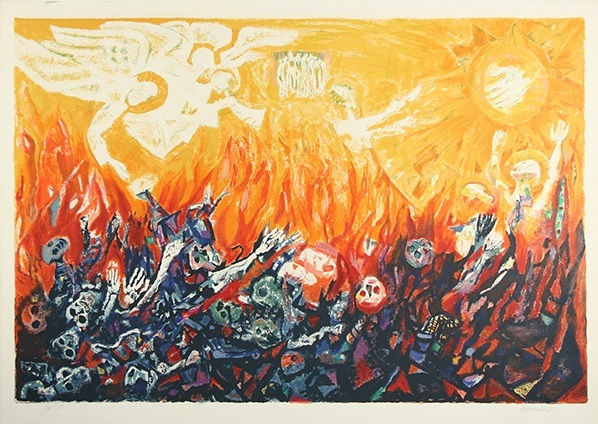
Valley of the Dried Bones, by Abraham Rattner (1895–1978)

The power of the Lord came over me. The Lord brought me out by his Spirit and put me down in the middle of a valley. The valley was filled with bones. He led me all around them. I saw that there were very many bones at the bottom of the valley, and they were very dry.

Then he asked me, “Son of man, can these bones live?”

I answered, “Only you know, Almighty Lord.”

Then he said to me, “Prophesy to these bones. Tell them, ‘Dry bones, listen to the Lord’s word. This is what the Almighty Lord says to these bones: I will cause breath to enter you, and you will live. I will put ligaments on you, place muscles on you, and cover you with skin. I will put breath in you, and you will live. Then you will know that I am the Lord.’ ”

So I prophesied as I was commanded. While I was prophesying, suddenly there was a rattling noise, and the bones came together, one bone attaching itself to another. As I looked, I saw that ligaments were on them, muscles were on them, and skin covered them. Yet, there was no breath in them.

Then the Lord said to me, “Prophesy to the breath! Prophesy, son of man. Tell the breath, ‘This is what the Almighty Lord says: Come from the four winds, Breath, and breathe on these people who were killed so that they will live.’ ”

So I prophesied as he commanded me, and the breath entered them. Then they came to life and stood on their feet. There were enough of them to form a very large army.

The Lord also said to me, “Son of man, all the people of Israel are like these bones. The people say, ‘Our bones are dry, and our hope has vanished. We are completely destroyed.’ So prophesy. Tell them, ‘This is what the Almighty Lord says: My people, I will open your graves and take you out of them. I will bring you to Israel. Then, my people, you will know that I am the Lord, because I will open your graves and bring you out of your graves. I will put my Spirit in you, and you will live. I will place you in your own land. Then you will know that I, the Lord, have spoken, and I have done it, declares the Lord.’ ” (God’s Word Translation)

Dry. It might be good for humor or a martini. Dry, however, doesn’t feel good when it’s a time of spiritual dryness.

Perhaps you are dry. It seems the entire world is dry. Wars, conflict, death, violence, uncertainty, unrest, and upset people everywhere is evidence that there is dryness across the earth. Many institutions, organizations, companies, and faith communities have become so withered and dry, that they have folded and died.

The hard circumstances of our world, stress in our families, and challenging personal lives may easily create anxiety, and, so, parch our souls and leave our spirits bone dry. There is, however, a God who can breathe new life into us and move us from old-worn ruts in our thinking, feeling, and behaving, to renewed ways of being in the world. 

The prophet Ezekiel’s vision is a promise and a hope of resurrection, revival, and new life. Regardless of who we are and the situations in front of us, we are all displaced people – cast out of Eden and in need of restoration. 

We, along with the ancient Israelites, are in exile and long to return to our true home with God. Along with St. Augustine we declare that our “hearts are forever restless until they find their rest in God.”

Maybe you are presently experiencing the dry bones of hopelessness and despondency. Perhaps you are in a dark night of the soul where all of life seems like one huge rut. It could be you are wondering if God is really listening, or is even there at all, because of the dry bones surrounding you.

In my work as a hospital chaplain I often encounter patients who are, ironically, bone dry from too much drinking. Their alcoholism is like a massive desert littered with thousands of dry bones. Attempting to reanimate themselves while dulling the pain of incredibly hard dry circumstances, they drink liter after liter of “spirits” to replace the dead spirit inside them. Some become so dry and dead inside their immaterial selves, that they seek to end their material lives through suicide.

But it need not be this way. We might believe we will be able to live life and pursue God better without danger or hardship – that somehow difficulty is not to be part of life. The dry bones exist, however, as an opportunity for God to give life. That’s why Alexander Solzhenitsyn’s reaction to his exile in a Soviet labor camp in Siberia was to bless it, because it was there he said:

“I discovered that the meaning of earthly existence lies not, as we have grown used to thinking, in prospering, but in the development of the soul.”

Alexander Solzhenitsyn

God not only gives life; God restores life. And this is an important truth to know and remember in the inevitable dry times of our lives. God is not only a helper; the Lord reanimates us from spiritual rigor mortis to lively resurrection through breathing on us. And this is done for a reason. Jesus came to his disciples after his resurrection and said:

God resuscitates us for a purpose, so that we might be a blessing to the world. Faith is not only a possession to keep, but a gift to give. We glorify God in loving one another and loving the world as Jesus did.  God could have resurrected the bones without Ezekiel. Instead, the Lord used Ezekiel and had him participate in the revival by speaking to the bones. 

Such a challenge to speak to the dry bones can seem overwhelming to us. What do you do when your life is upended, even shattered – when such a profound change comes to you that it is impossible for your life to be as it was? 

The questions and commands of God seemed totally absurd to Ezekiel, speaking to dead dry bones. Yet methinks we ought to operate more in the realm of the absurd than in the realm of the safe routine.

Perhaps we ought to expect our faith to be exercised and look for God to breathe new life into the dead and decaying. To believe that something, someone, or even myself can change is to have internalized this amazing story of dry bones living again. 

Our self-imposed graves cannot hold us because God is among us.

We need a genuine heaven-sent, Spirit-breathed, glorious reanimation in which God sends reviving grace and raises the dead. 

Lord of Resurrection, please be attentive to our prayers; and make what is impossible possible:

For those without hope – feeling dried up and cut off from you – open their graves and bring them back to the land of the living.

For those spiritually oppressed – held captive by sin – release them from their chains and let them go! For those who weep – lost and lifeless in a tomb of fear and shame – give them the peace of your presence, and show them what your love can do.

For those complacent – withering on the vine, and living a dull dry existence without any spiritual vigor – awaken them, O Lord! Breathe into them new life!

Pour out your Spirit, gracious God, and awaken all kinds of people to a revival of obedience, love, and courage.

May your people be so full of your Spirit that life comes rolling off our tongues and the strength of life empowers our hands for service. Amen.

What Can I Do in an Impossible Situation? (Daniel 2:1-23)

Daniel Interprets King Nebuchadnezzar’s Dream, by Mattia Preti (1613-1699)

In the second year of Nebuchadnezzar’s rule, he had many dreams. The dreams made him anxious, but he kept sleeping. The king summoned the dream interpreters, enchanters, diviners, and Chaldeans to explain his dreams to him. They came and stood before the king.

Then the king said to them: “I had a dream, and I’m anxious to know its meaning.”

The Chaldeans answered the king in Aramaic: “Long live the king! Tell your servants the dream, and we will explain its meaning.”

The king answered the Chaldeans: “My decision is final: If you can’t tell me the dream and its meaning, you will be torn limb from limb, and your houses will be turned into trash dumps. But if you do explain the dream and its meaning, you’ll receive generous gifts and glorious honor from me. So explain to me the dream as well as its meaning.”

They answered him again: “The king must tell his servants the dream. We will then explain the meaning.”

The king replied: “Now I definitely know you are stalling for time, because you see that my decision is final and that if you can’t tell me the dream, your fate is certain. You’ve conspired to make false and lying speeches before me until the situation changes. Tell me the dream now! Then I’ll know you can explain its meaning to me.”

The Chaldeans answered the king: “No one on earth can do what the king is asking! No king or ruler, no matter how great, has ever asked such a thing of any dream interpreter, enchanter, or Chaldean. What the king is asking is impossible! No one could declare the dream to the king but the gods, who don’t live among mere humans.”

At this, the king exploded in a furious rage and ordered that all Babylon’s sages be wiped out. So the command went out: The sages were to be killed. Daniel and his friends too were hunted down; they were to be killed as well.

Then Daniel, with wisdom and sound judgment, responded to Arioch the king’s chief executioner, who had gone out to kill Babylon’s sages. He said to Arioch the king’s royal officer, “Why is the king’s command so unreasonable?” After Arioch explained the situation to Daniel, Daniel went and asked the king to give him some time so he could explain the dream’s meaning to him. Then Daniel went to his house and explained the situation to his friends Hananiah, Mishael, and Azariah so that they would ask the God of heaven for help about this mystery, in hopes that Daniel and his friends wouldn’t die with the rest of Babylon’s sages. Then, in a vision by night, the mystery was revealed to Daniel! Daniel praised the God of heaven:

God’s name be praised
    from age to eternal age!
        Wisdom and might are his!
God is the one who changes times and eras,
    who dethrones one king, only to establish another,
        who grants wisdom to the wise and knowledge to those with insight.
God is the one who uncovers what lies deeply hidden;
    he knows what hides in darkness;
I acknowledge and praise you, my fathers’ God!
    You’ve given me wisdom and might,
        and now you’ve made known to me what we asked of you:
            you’ve made known to us the king’s demand. (Common English Bible)

Daniel Interprets Nebuchadnezzar’s Dream, 1917

The King’s Trouble

Nebuchadnezzar was quite the guy – a stereotypical ancient king, in many ways. In our story for today, he certainly comes across as a demanding sovereign, expecting his wishes and commands to be done, no matter how difficult or unreasonable they seem to others.

The king was bothered by a troubling dream. So, in expected kingly fashion, Nebuchadnezzar called for his court appointed sages to explain it to him. And in an over-the-top expectation, even for an arrogant king, Nebuchadnezzar had no intention of telling them what it is he had dreamt.

The sages, of course, had no idea what to do with this exaggerated command. The king’s wise men replied that no one – except the gods – can reveal such secrets as what was dreamt. But in King Nebuchadnezzar’s line of thinking, since the gods of the sages cannot reveal the dream – and thus an interpretation of the dream – then those gods must be weak, ineffective, and useless.

The King’s Anger

In reading and listening to the story, we can feel the response of Nebuchadnezzar coming, and know that it isn’t going to be good. Indeed, the king flew into a rage. The wise men’s failure to provide the contents of the dream, and so, a solid interpretation for the dream, led King Nebuchadnezzar to order them all killed. In issuing such a command, this meant that Daniel and his wise friends were to be killed, as well.

Daniel was a Jewish exile, brought to Babylon after Nebuchadnezzar’s conquest of Jerusalem. He was wise, godly, and even-keeled. Daniel calmly intervened and offered to do exactly what the king requested in the first place. All he asked was for some time. Then, Daniel immediately went to his godly and wise friends, and together they looked to the Lord in prayer.

Sure enough, just as God had come to Nebuchadnezzar in a dream, so God came to Daniel and revealed the mystery to him. Daniel’s prayer of thanksgiving makes it clear that the source of the wisdom is the God of heaven, and not Daniel himself. Thus, we are meant to make the connection that Daniel’s God is vastly superior than the gods of the court sages.

The King’s Limits

King Nebuchadnezzar’s sovereignty and control was not universal. It is God who grants wisdom. Yes, we do our part in gaining knowledge and understanding as best we can. We look into Holy Scripture for guidance and seek to obey biblical commands and live into divine promises. Yet, there is also an aspect of wisdom that is given by God.

Ultimate insight comes as a result of both human observation and learning, and divine revelation and response to prayer. Throughout the book of Daniel, a prominent theme is the importance of prayer as the prerequisite to receiving wisdom. Daniel and his three friends joined in prayer together, immediately after hearing of the king’s situation and command.

An even greater theme in the book of Daniel is that God can give wisdom because there is nothing hidden from the Lord; God understands everything. And it is this theological conviction which underlies prayer. Daniel and his companions were supported and emboldened by their knowledge of God.

Believers in every historical age have the privilege of beseeching God for wisdom when circumstances are rough and dire. As the Apostle James says in the New Testament:

My friends, be glad, even if you have a lot of trouble. You know you learn to endure by having your faith tested. But you must learn to endure everything, so you will be completely mature and not lacking in anything. If any of you need wisdom, you should ask God, and it will be given to you. God is generous and won’t correct you for asking. (James 1:2-5, CEV)

Whenever facing opposition and suffering, it is important to know that God is in control, and that divine enablement and insight is only a prayer away.

Blessed God, Light of the world, shine upon us and disperse the clouds of our selfishness and stubbornness, so that we may reflect the power of the resurrection in our life together. Amen.

Sensing the Impossible (Exodus 3:1-15)

The Burning Bush, by Yoram Raanan

Now Moses was tending the flock of Jethro his father-in-law, the priest of Midian, and he led the flock to the far side of the wilderness and came to Horeb, the mountain of God. There the angel of the Lord appeared to him in flames of fire from within a bush. Moses saw that though the bush was on fire it did not burn up. So Moses thought, “I will go over and see this strange sight—why the bush does not burn up.”

When the Lord saw that he had gone over to look, God called to him from within the bush, “Moses! Moses!”

And Moses said, “Here I am.”

“Do not come any closer,” God said. “Take off your sandals, for the place where you are standing is holy ground.” Then he said, “I am the God of your father, the God of Abraham, the God of Isaac and the God of Jacob.” At this, Moses hid his face, because he was afraid to look at God.

The Lord said, “I have indeed seen the misery of my people in Egypt. I have heard them crying out because of their slave drivers, and I am concerned about their suffering. So I have come down to rescue them from the hand of the Egyptians and to bring them up out of that land into a good and spacious land, a land flowing with milk and honey—the home of the Canaanites, Hittites, Amorites, Perizzites, Hivites and Jebusites. And now the cry of the Israelites has reached me, and I have seen the way the Egyptians are oppressing them. So now, go. I am sending you to Pharaoh to bring my people the Israelites out of Egypt.”

But Moses said to God, “Who am I that I should go to Pharaoh and bring the Israelites out of Egypt?”

And God said, “I will be with you. And this will be the sign to you that it is I who have sent you: When you have brought the people out of Egypt, you will worship God on this mountain.”

Moses said to God, “Suppose I go to the Israelites and say to them, ‘The God of your fathers has sent me to you,’ and they ask me, ‘What is his name?’ Then what shall I tell them?”

God said to Moses, “I am who I am. This is what you are to say to the Israelites: ‘I am has sent me to you.’”

God also said to Moses, “Say to the Israelites, ‘The Lord, the God of your fathers—the God of Abraham, the God of Isaac and the God of Jacob—has sent me to you.’

“This is my name forever,
    the name you shall call me
    from generation to generation. (New International Version)

Moses with the Burning Bush, by Marc Chagall, 1966

The burning bush is one of those iconic objects and familiar stories in Holy Scripture. The experience of Moses changed both his life and the lives of all the Israelites then and now.

Having spent the first forty years of his life as a darling in the Egyptian court, then the next forty years far from that life on the backside of the desert with a bunch of sheep, it is an understatement to say Moses did not expect or ever envisioned encountering God in a burning bush. The impossible has no possibility…. Or, does it?

That incredible encounter engaged the senses of Moses:

  • the paradoxical sight of seeing fire in a bush that isn’t burning up
  • the smells of sheep, the outdoors, and perhaps, even of fire
  • hearing the call of God from within the bush
  • spiritually and emotionally tasting the attentive justice of God
  • removing the sandals to touch and feel the grounding of sacred space

The story comments on the senses of God, as well. Even though God is Spirit and is worshiped as such, God is alive with his own sensations:

  • seeing the approach of Moses, and the misery of the Israelites
  • the smell of injustice wafting into God’s nostrils with a stench that brought a strong divine reaction
  • hearing the cries of suffering
  • anticipating the savory taste of showing mercy and justice together
  • touching Moses in such a profound way that he and the Israelites would never be the same

Through it all, the close identification between God and God’s people is expressed. The Lord feels the humiliation and pain of the Israelites and vows to uproot them from the Egyptian factory farm of slavery and plant them firmly into rich Promised Land soil. And what God promises to do, God has the authority and power to make good on.

An impossible situation, Moses thinks. How can hundreds of years of backbreaking bondage to a national force so mighty that nothing can be done about it, be broken? Who am I, Moses, to face such odds?

Ah, but God specializes in systems of oppression and miserable people. It is the Lord’s abilities which conquer the mightiest of foes and can extend mercy to the lowest and the least powerful. The entire situation is ripe for divine intervention and supernatural wonders to occur.

God will make a way where there seems to be no way. God works in ways which transcend our senses.

  • Where we are blind, God gives sight
  • Where we are deaf, God opens our ears with the sound of justice
  • When our taste buds are shot with the gruel of poverty, God causes our tongues to dance with the zest of mercy
  • When our nerve endings are raw from cruel bondage, God touches us with freedom
  • Where our nostrils have become accustomed to the smell of death, God’s aroma of life awakens us to new hope

My friends, I believe with all my heart that you already intuitively know deep in your spirit that the impossible is possible with God. It is never a question of God’s ability, but of God’s timing. God is able – and the Lord works the impossible in its proper time so that justice and mercy will have their full effect.

God of the impossible: I believe. Help me in my unbelief.

God of mercy: I receive. Help me in my denial.

God of justice: I accept. Help me in my rejection.

God of all time: I endure. Help me in my impatience.

God of All: I submit. Help me in my rebellion.

God of power and of might: I trust. Help me in my distrust.

God of our Lord Jesus Christ: I follow. Help me in my wandering.

God of the nations: Yes, you know that I love you. Yes, Lord, you know I love you. Lord, you know all things, and you know that I love you. So, yes, I will answer your call to go. Help me in my sending. Amen.