Be Patient – Third Sunday of Advent (James 5:7-10)

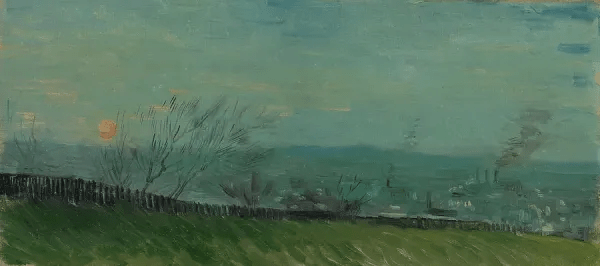
Sunset in Montmartre, by Vincent Van Gogh, 1887

Be patient, therefore, brothers and sisters, until the coming of the Lord.

The farmer waits for the precious crop from the earth, being patient with it until it receives the early and the late rains. You also must be patient.

Strengthen your hearts, for the coming of the Lord is near.

Brothers and sisters, do not grumble against one another, so that you may not be judged. See, the Judge is standing at the doors! 

As an example of suffering and patience, brothers and sisters, take the prophets who spoke in the name of the Lord. (New Revised Standard Version)

Patience is a wonderful virtue… unless you’re smack in the middle of circumstances you neither want nor asked for. Then, patience feels a whole lot more like a vice.

It’s easy to be impatient; it takes little to no effort at all. And praying for patience doesn’t help, because you’re prayer actually gets answered; God puts you in one of those unwanted situations.

The Jewish Christians for whom the Epistle of James was addressed were in that weird life-place of enduring hard circumstances. They were struggling with impatience, so much that the believers began cozying up to the rich and powerful to meet their ever-increasing needs. In their misery, they were looking to the very people who were using them and withholding wages from them. (James 2:1-7; 5:1-6)

It seemed as if God was shuffling his divine feet and not getting around to helping the Christians in their difficulty. They gave everything to Jesus and following him, to the point of being willing to suffer for the Name.

Their suffering led to outright persecution. The believers had to flee Judea for Gentile lands to the West (Acts 8:1-3). In their new homes they got double-trouble. Because they were Jews, they were looked at with suspicion. And because they were Christians, the Jewish community didn’t accept them. The believers were truly alone. All they had was Jesus.

It was enough, at least for a while. But it’s one thing to face difficulty, and quite another thing for the trouble to bleed into next week, next month, next year… When is this ever going to end?

Impatience doesn’t help. In fact, it only exacerbates an already agonizing situation. Grumbling and arguing and verbal fights begin to occur. The community starts to fracture. Blaming and shaming slowly replace the love and encouragement they once had together.

Every good thing in life takes time – lots of time! And the best things in life require a lifetime of endurance, perseverance, and patience. In order to keep going and hold onto our spiritual commitment, we need solid examples of patience, and reasonable ways to think about our situations.

I admit that it has been hard for me to be patient, as of late. I’m weary of American politics and the current administration. I’m tired of seeing my family members struggle with health issues day after day – many of them having to endure debilitating and heart-wrenching trials.

And there are some days when I’ve just had it with my own limitations. I can’t do many of the things I used to do, and it’s frustrating to tears to try and do some things that others do effortlessly.

Yet the Scripture reminds me of my days growing up on the farm. Planting and harvesting never happened in a week; it takes months to realize a return on all the hard work done through the Spring and Summer to get to Fall’s mature crop.
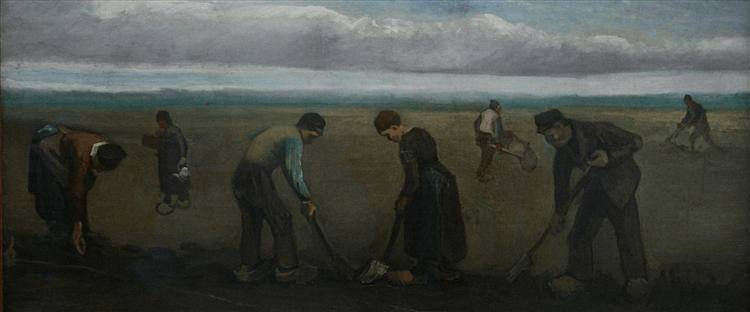
Peasants Planting Potatoes, by Vincent Van Gogh, 1884

I’m also reminded of the biblical prophets who suffered much for their message to the people. Lately, I’ve been reading the prophecy of Ezekiel in the Old Testament. If you have never read Ezekiel, or only read bits of it, you may not realize how incredibly difficult Ezekiel’s life was in serving Yahweh.

The prophet kept up a steady stream of very challenging situations to illustrate the message of judgment he was continually giving. Needless to say, Ezekiel was not always a popular guy. Proclaiming gloom, doom, and death all day every day tends to do that. In one encounter, for month after month, the prophet laid on his side and had to use excrement to light a fire and cook his food every day. God told him to, so that the people would see what was about to happen to them. (Ezekiel 4:1-17)

We have no record of Ezekiel grumbling or talking back to God. He faithfully did all that the Lord commanded him to say and do. He endured all the grumblers around him, and all the grieving people who had been displaced from their homes in Jerusalem.

In every generation, there are people in this world that undergo difficulties and troubles which others could never even imagine. And it’s been going on for millennia. Furthermore, terrible adversity will keep happening… until Christ returns.

Yes, there will be an end to all the suffering. But we may have to persevere to the end of our lives, remaining faithful to our spiritual commitment, and keeping up our love for one another. It won’t be easy to do.

I would be nothing but a hack preacher if I told you that everything will be bunnies and butterflies if you only look to Jesus and have faith. Although there can be joy, even in our mourning, there will always be the need for an agonizing form of patience that continually watches for help, healing, and hope in the return of Christ.

This is why it is so important not to let your own family, church, and faith community break down into fissures of impatience and grumbling.

We must keep our hearts strong. Ironically and paradoxically, that happens through our weakness.

In some ways, I’m weaker than I’ve ever been in my life. Yet, in other ways, I’ve never been stronger. The Trump administration can break me down and mess with my healthcare and my finances… my illness can keep me from ministry that I long to do… and the daily crud of life may redirect me in ways I don’t like… but I can truly say that God is good; God is the strength of my life.

I know that Christmas is coming. I’m looking for the birth of the Savior. I expect to see the angels rejoicing in the sky. I fully look forward to stepping in a few cow pies and horse apples in order to get a glimpse at the baby who changes the world.

Every good thing in life comes with a bit of manure on the shoes. And the best things in life are worth all the hardship one goes through in order to see the glory and majesty of the Divine.

I may not know you, my friend, but please know that I am praying for you. No matter what happens, I can always pray, always watch, always hope, always believe, and always love my neighbor, despite all the hate in this old fallen world.

Be safe. Be strong. Be spiritual. We are all in this life together.

God of joy and exultation, you strengthen what is weak; you enrich the poor and give hope to those who live in fear. Look upon our needs this day. Make us grateful for the good news of salvation and keep us faithful in your service until the coming of our Lord Jesus Christ, who lives forever and ever. Amen.

What Are You Searching For? (1 Samuel 9:15-27)

Now the day before Saul came, the Lord had revealed to Samuel: “Tomorrow about this time I will send to you a man from the land of Benjamin, and you shall anoint him to be ruler over my people Israel. He shall save my people from the hand of the Philistines, for I have seen the suffering of my people, because their outcry has come to me.” 

When Samuel saw Saul, the Lord told him, “Here is the man of whom I spoke to you. He it is who shall rule over my people.” Then Saul approached Samuel inside the gate and said, “Tell me, please, where is the house of the seer?” 

Samuel answered Saul, “I am the seer; go up before me to the shrine, for today you shall eat with me, and in the morning I will let you go and will tell you all that is on your mind. As for your donkeys that were lost three days ago, give no further thought to them, for they have been found. And on whom is all Israel’s desire fixed, if not on you and on all your ancestral house?” 

Saul answered, “I am only a Benjaminite, from the least of the tribes of Israel, and my family is the humblest of all the families of the tribe of Benjamin. Why then have you spoken to me in this way?”

Then Samuel took Saul and the young man and brought them into the hall and gave them a place at the head of those who had been invited, of whom there were about thirty. And Samuel said to the cook, “Bring the portion I gave you, the one I asked you to put aside.” The cook took up the upper thigh and set it before Saul. Samuel said, “See, what was reserved is set before you. Eat, for it was kept for you for this appointed time, so that you might eat with the guests.”

So Saul ate with Samuel that day. When they came down from the shrine into the town, a bed was spread for Saul on the roof, and he lay down to sleep. Then at the break of dawn Samuel called to Saul upon the roof, “Get up, so that I may send you on your way.” Saul got up, and both he and Samuel went out into the street.

As they were going down to the outskirts of the town, Samuel said to Saul, “Tell the young man to go on before us, and when he has passed on, stop here yourself for a while, that I may make known to you the word of God.” (New Revised Standard Version)

There are many times in our lives when we are on a quest for something that is lost. Saul was on a mission to find some lost donkeys. But, all along, there was a much larger quest taking place; God was on a quest to find a leader for Israel. Saul was wandering and looking for donkeys; he tried to find the “seer” (Samuel) in order to find the animals. He found, however, that he himself was the object of a bigger search.

I wonder how often we look and seek and turn over every rock in order to find something, only to discover that we had the thing all along. And if we were to look a bit deeper into ourselves, I believe we would find that we already have what we need.

We search for an answer, seek for a person who can lead us where we want to be, or go on a quest to find the something, or that someone, which will satisfy our longing for peace, normalcy, or at least, a smidge of relief. Yet, we just might be on the wrong search.

If spiritual guidance is what we want, then what, precisely, do we need? What exactly is it which requires help? We may end up looking like a jack ass, simply because we are searching for one.

In contrast to Saul’s blind searching, Samuel sits patiently and waits, knowing exactly who he’s watching for.

Even though Samuel, as the mouthpiece of God, had warned the people against asking for king, the people still demanded one. Yet, God was flexible and moved with the will of the people. And Samuel trusted the Lord and moved with God. None of this, however, negated the situation of the people’s misguided stubbornness.

The Lord takes our human decision-making, responsibility, and accountability seriously. So, we too, are to weigh our decisions carefully so that they are consistent with good purposes. And when things go sideways, we are to own up to our decisions and actions (or inactions).

Throughout the story, even though Saul looks impressive, he is continually clueless to everything going on. He isn’t aware that the donkeys have been found. He doesn’t know where to look for the seer, and that the seer is Samuel. He isn’t aware of why he is being invited to a feast. Saul was clueless that he was being chosen for a task.

To be unaware is to be driven by the forces within us which we do not recognize. Yet, conversely, to be aware is to have the conscious power of choices; we can choose one path over another because we have awareness of where those paths lead, as well as what is going on inside of us. In other words, we can make decisions wisely with awareness of self, others, and the world.

Saul had none of this awareness. And as his story unfolds throughout the rest of the book of 1 Samuel, we can observe how much he seems out of control and disconnected from himself, others, and the situations around him.

One of things which inevitably results from a lack of self-awareness, is impatience. The life of Saul, as we shall see, is marked by having ants-in-his-pants; he had a hard time waiting. The introduction we have of Saul in today’s story begins to clue us in on the fact that he actively searches for dumb animals, intimating that he himself may not be the brightest bulb in Israel.

Samuel, however, is self-aware, and thus, patient. He is able to wait, and does not give into any anxiety to do differently. Samuel’s quest for humility, wisdom, and knowledge of God helped him become aware and confident.

Which character do you most relate to, Samuel, or Saul? Why? In what ways might you gain a greater awareness of yourself, others in your life, and your circumstances? How might you develop a better awareness of the divine?

Most of all, what is it that you are truly searching for?

Blessed God, help me to see myself and my life through your unconditional love and acceptance of me so that your love and power can flow in and through me. Help me to remember that nothing can separate me from your love. Amen.

Impatient (Genesis 16:1-6)

Sarai and Hagar, by Cody F. Miller

Now Sarai, Abram’s wife, had borne him no children. But she had an Egyptian slave named Hagar; so she said to Abram, “The Lord has kept me from having children. Go, sleep with my slave; perhaps I can build a family through her.”

Abram agreed to what Sarai said. So after Abram had been living in Canaan ten years, Sarai his wife took her Egyptian slave Hagar and gave her to her husband to be his wife. He slept with Hagar, and she conceived.

When she knew she was pregnant, she began to despise her mistress. Then Sarai said to Abram, “You are responsible for the wrong I am suffering. I put my slave in your arms, and now that she knows she is pregnant, she despises me. May the Lord judge between you and me.”

“Your slave is in your hands,” Abram said. “Do with her whatever you think best.” Then Sarai mistreated Hagar; so she fled from her. (New International Version)

In a convoluted series of decisions, mostly outside of her control, Hagar became pregnant with Abraham’s son. Although it may seem strange to us today, the practice of building a family line through a surrogate – in this case the slave of the household’s mistress Sarai – was not an unusual way of handling infertility in the ancient world.

Yet, things went awry with that approach. God had promised that a son of Abram’s own flesh and blood would inherit the divine covenant. But it wasn’t happening quickly enough for his wife Sarai. And this impatience led to the worldly approach of trying to gain an heir.

Impatience

Throughout Holy Scripture, patience is a virtue, as well as a spiritual practice to be cultivated. Impatience is the ants-in-your-pants response of wanting something now, without all the fuss and effort of planting and cultivating. The inability to wait is the desire for an instant harvest of righteousness.

The spiritual life of patience, however, like every other virtue, requires progressive growth over a long period of time. That is the only way of attaining any sort of spiritual maturity in this life. To go with shortcuts, or ingenious plans for quickness and efficiency, will not end well.

And it only short circuits the spiritual growth and formation of the believer. Like a farm-factory-raised animal who has been given growth hormones to speed things along, the fallout is the mistreatment of creatures – both animal and human – in shortened lifespans and poor quality of life.

Perhaps the original ancestor of Sarai, Eve, also had a bit of impatience in wanting to gain wisdom, now, from the tree of the knowledge of good and evil. And maybe the original ancestor of Abram, Adam, was okay with letting Eve follow through with an impatient plan.

It could be that both Adam and Abram just wanted to keep their spouses happy; and so, they let them do whatever the heck they wanted in order to keep the peace. It certainly wouldn’t be the only time this ever happened in history.

A commitment to submitting to the process of developing patience is a must – otherwise, the believer will give up and retreat into half-baked ideas for getting what they want, without all the hard work. We also need to realize that patience itself is a great reward, and worth all the energy it takes to possess it.

Be patient, then, brothers and sisters, until the Lord’s coming. See how the farmer waits for the land to yield its valuable crop, patiently waiting for the autumn and spring rains. You too, be patient and stand firm, because the Lord’s coming is near.

James 5:7-8, NIV

What’s more, the effects of impatience are murmuring and complaining to God and others, leading to depression and anxiety. That’s what happened to the ancient Israelites in the desert when it was taking too long to get to the Promised Land:

They traveled from Mount Hor along the route to the Red Sea, to go around Edom. But the people grew impatient on the way; they spoke against God and against Moses, and said, “Why have you brought us up out of Egypt to die in the wilderness? There is no bread! There is no water! And we detest this miserable food!” (Numbers 21:4-5, NIV)

Worldliness

If we give the attainment of patience it’s due attention, then a lot of ungodly worldliness can be avoided. In Holy Scripture, “the world” is many times used not as a reference to the people of the earth, but as an inordinate interest in, concern with, or devotion to the systems, organizations, and institutions of this world that operate by unjust means.

Do not love the world or anything in the world. If anyone loves the world, love for the Father is not in them. For everything in the world—the lust of the flesh, the lust of the eyes, and the pride of life—comes not from the Father but from the world. The world and its desires pass away, but whoever does the will of God lives forever. (1 John 2:15-17, NIV)

Worldliness, then, is an obstacle to that which is good, right, and just; it is in opposition to and independence from God. In short, worldliness isn’t some sort of sophisticated intelligence, but is a way to get what we want apart from virtue and godliness. But God’s grace can be our teacher to a better way of life:

For the grace of God has appeared that offers salvation to all people. It teaches us to say “No” to ungodliness and worldly passions, and to live self-controlled, upright and godly lives in this present age, while we wait for the blessed hope—the appearing of the glory of our great God and Savior, Jesus Christ.

Titus 2:11-13, NIV

Conclusion

Patience is one of the hardest lessons in life to learn. Yet, a devotion to becoming skilled in the art of patience, and of forsaking the practice of impatience, can reap both existential and eternal rewards. And it will keep us from going down the path of worldly temptation; and delivered from the machinations of the evil one.

Perhaps with patience, Sarai could have avoided mistreating her servant; and maybe Abram could have stood up and held her accountable. Together, they would eventually embrace faith in it’s fullness and enjoy the blessing of a son from Sarai’s own womb. Yet, today’s Old Testament lesson would always serve as part of their history to learn from. And, thankfully, we can learn from it, as well.

Almighty God, support your people and grant us patience in all our circumstances and miseries.
Lord, when in the midst of trials and temptations, suffering and injustice, give us patience.
When wracked with pain, illness, and lack of sleep, give us patience.
When burdened with afflictions, wonderings, and loneliness, give us patience.
When overcome by fear, and all our spiritual energy is dried up, give us patience.
When distractions grab our attention, bring us back, and grant us patience, O Lord. Amen.

The Golden Calf (Exodus 32:1-14)

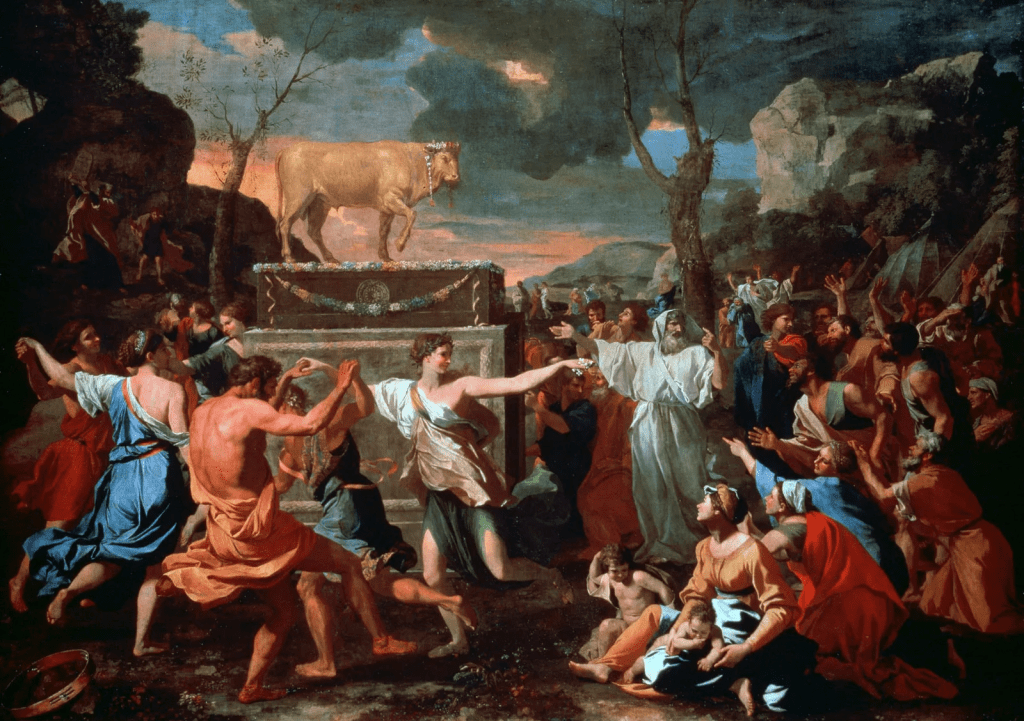
Adoration of the Golden Calf, by Nicolas Poussin (1594-1665)

When the people saw that Moses was so long in coming down from the mountain, they gathered around Aaron and said, “Come, make us gods who will go before us. As for this fellow Moses who brought us up out of Egypt, we don’t know what has happened to him.”

Aaron answered them, “Take off the gold earrings that your wives, your sons and your daughters are wearing, and bring them to me.” So all the people took off their earrings and brought them to Aaron. He took what they handed him and made it into an idol cast in the shape of a calf, fashioning it with a tool. Then they said, “These are your gods, Israel, who brought you up out of Egypt.”

When Aaron saw this, he built an altar in front of the calf and announced, “Tomorrow there will be a festival to the Lord.” So the next day the people rose early and sacrificed burnt offerings and presented fellowship offerings. Afterward they sat down to eat and drink and got up to indulge in revelry.

Then the Lord said to Moses, “Go down, because your people, whom you brought up out of Egypt, have become corrupt. They have been quick to turn away from what I commanded them and have made themselves an idol cast in the shape of a calf. They have bowed down to it and sacrificed to it and have said, ‘These are your gods, Israel, who brought you up out of Egypt.’

“I have seen these people,” the Lord said to Moses, “and they are a stiff-necked people. Now leave me alone so that my anger may burn against them and that I may destroy them. Then I will make you into a great nation.”

But Moses sought the favor of the Lord his God. “Lord,” he said, “why should your anger burn against your people, whom you brought out of Egypt with great power and a mighty hand? Why should the Egyptians say, ‘It was with evil intent that he brought them out, to kill them in the mountains and to wipe them off the face of the earth’? Turn from your fierce anger; relent and do not bring disaster on your people. Remember your servants Abraham, Isaac and Israel, to whom you swore by your own self: ‘I will make your descendants as numerous as the stars in the sky and I will give your descendants all this land I promised them, and it will be their inheritance forever.’” Then the Lord relented and did not bring on his people the disaster he had threatened. (New International Version)

The Golden Calf, by Sefira Lightstone

The ancient Israelites were dramatically delivered from slavery through a series of plagues on Egypt. Then, their lives were saved when God parted the Red Sea and the people fled from the advancing Egyptian army; collapsing the water on the soldiers when they tried to pursue the people.

The Israelites were led to Mount Sinai where God graciously entered into covenant with them; and gave them the law and the commandments. Yet, between receiving the covenant, and waiting for Moses to return from the mountain, the Israelites fell into chaos and a failure of faith. So, how did the relationship between God and Israel go so awfully sideways?

Moses spent a great amount of time with God on Mount Sinai. Apparently, the people believed that the forty days and forty nights on the mountain was too long and assumed that Moses would not return. So, what followed was idolatry, near annihilation, and intercession.

A failure of leadership

Aaron was left to lead the people during Moses’ absence. It didn’t take long for the people to get unruly and start working on Aaron. They asked him to make gods who will go before them, just as Yahweh and Moses had done in the pillar of cloud by day and fire by night.

For whatever reason, Aaron complied with their request. Maybe the people pestered him to death with constant bickering and asking, and he eventually gave-in to their coercion. Perhaps Aaron thought they had a point, and went with it as a willing participant. We aren’t told why. We are told that Aaron ordered the people to remove all the gold earrings they were wearing and bring them to him.

Aaron took all the gold he received and fashioned it into the form of a calf. Again, we aren’t told why Aaron chose to make a golden calf, in particular. Maybe he was forging a false god altogether in the shape of one of the Egyptian gods. After all, there had been a significant “back to Egypt” movement earlier, when circumstances got tough without food or water in the desert. Or perhaps Aaron was making a false image of the one true God. Either way you look at it, it’s not good.

The golden calf was handed to the people and proclaimed as the gods who brought them out of Egypt. If that weren’t bad enough, Aaron made the situation even worse by building an altar for the calf and declaring a feast for the next day. So, it’s no surprise to us as readers when we see poor leadership decision-making that leads to the people getting way out-of-hand in their festivities through drunkenness and sexual immorality.

The consequences of poor leadership

All of the revelry got God’s attention. The Lord saw the people’s depravity and commanded Moses to get back down the mountain, at once. God’s tone of voice and choice of pronouns took a turn. The Lord said to Moses, “Your people have acted perversely,” effectively distancing the divine from the mass of humanity at the foot of the mountain.

God was so upset that he started planning to destroy the whole lot of them and completely start over through the descendants of Moses. Yet, even though the Lord was very angry, and rightly so, Moses stepped in and interceded on the people’s behalf. Moses appealed to God’s reputation rather than God’s compassion. In an interesting twist, Moses turned the responsibility for the Israelites back onto God by saying they are your people, the ones whom you brought out of the land of Egypt.

What’s more, Moses pointed out to God that the Egyptians would question God’s motives for bringing the Israelites into the desert. And then Moses appealed to God’s covenant with Abraham, Isaac, and Jacob (Israel) to make a great nation of their descendants to dwell forever in the land God promised them. Moses actually persuaded the God of the universe to set aside divine anger and let the people live.

The people forgot who rescued them from slavery in Egypt. Regardless whether or not they had good intentions, the people failed in keeping their covenant obligations to God and sought to substitute God’s physical absence with a false image of God.

The implications of leadership for us

Today’s Old Testament story raises many questions for us. Here are just a few to ponder:

  • Which golden calves in our culture today draw our loyalty and love away from God when we get impatient with waiting for God’s timetable? Maybe our grumbling and complaining is a telltale sign that we are not content with God and what God is doing among us – and that we are fashioning (or have already fashioned) a god of our own making in the form of financial budgets, church buildings, or dogmatic theologies.
  • How have we made the God whom we worship into an idol that we try to control and manipulate for our own purposes? Perhaps we have substituted the one true God who is free, untamed, mysterious, and surprising, for a puny humanly constructed image, ideology, institution, or idol.
  • How do we maintain the balance between divine judgment with its consequences for disobedience, alongside God’s mercy, forgiveness, and faithfulness to the people? It could be, we are being led to grace, no matter how we go about answering the question.

Faithful God, you preside over an unfaithful people. Just as the people of Israel doubted your power and turned to other gods to fulfill their needs, we too, turn to other gods, seeking acceptance, power, and independence. Show us how to live humbly and walk in your ways, through the One who offered true power to all humanity, Jesus Christ our Savior and Lord. Amen.