The Need to Defend a Ministry (2 Corinthians 10:1-11)

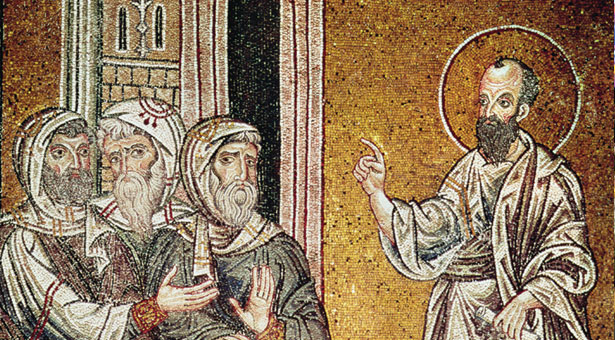
Mosaic of St. Paul Preaching, 12th century, Duomo, Monreale, Sicily, Italy

By the humility and gentleness of Christ, I appeal to you—I, Paul, who am “timid” when face to face with you, but “bold” toward you when away! I beg you that when I come I may not have to be as bold as I expect to be toward some people who think that we live by the standards of this world. 

For though we live in the world, we do not wage war as the world does. The weapons we fight with are not the weapons of the world. On the contrary, they have divine power to demolish strongholds. We demolish arguments and every pretension that sets itself up against the knowledge of God, and we take captive every thought to make it obedient to Christ. And we will be ready to punish every act of disobedience, once your obedience is complete.

You are judging by appearances. If anyone is confident that they belong to Christ, they should consider again that we belong to Christ just as much as they do. So even if I boast somewhat freely about the authority the Lord gave us for building you up rather than tearing you down, I will not be ashamed of it. I do not want to seem to be trying to frighten you with my letters. 

For some say, “His letters are weighty and forceful, but in person he is unimpressive and his speaking amounts to nothing.” Such people should realize that what we are in our letters when we are absent, we will be in our actions when we are present. (New International Version)

I don’t know about you, but I’m not a fan of feeling like I have to defend my ministry – my philosophy of how to go about things, my hermeneutics, my words, my actions, my clothes, my food – and pretty much everything about me. Believe it or not, I’ve been criticized for things like not having shiny enough shoes (and having too nice of shoes), the make and model of the car I drive (and don’t drive), being too serious (and not being serious enough).

So, for me, I detect in the Apostle Paul’s retort to the Corinthian Church, an exasperation. Reading between the lines, I can hear him saying something like, “I can’t believe I’m even talking about this stuff because you guys are about as spiritually aware as a bowling ball – and bowling balls haven’t even been invented yet. Heck, I don’t even know what a bowling ball is! That’s about how much you know what you’re talking about. Sheesh!”

Yet, despite Paul’s annoyance and displeasure with the Corinthians’ line of thinking, the Apostle still made up his mind to craft a response that was as humble and gentle as he could possible come up with.
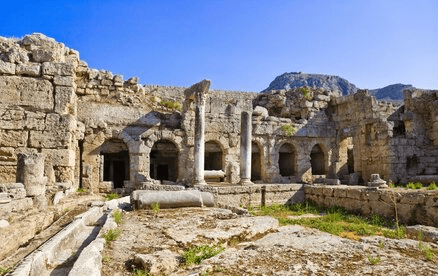
A modern archaeological site at Corinth, Greece

The Church’s first criticism toward Paul is that he is bold from a distance, but up close and personal, rather weak and unimpressive as an Apostle. I’m willing to be that every church pastor in the U.S. is more than able to know what this feels like in putting themselves in the Apostle’s shoes.

It’s an age old criticism that every preacher faces at various points, or at least with some sermons or writings. The people just don’t appreciate or like what they’re hearing or reading. It often comes out in the ubiquitous phrase, “I’m just not getting spiritually fed.” Wrapped up in that phrase is not only the criticism of oratorical skills, but also that they don’t like something about the preacher’s physical appearance, particular idiosyncrasies, or interaction with other people.

The second criticism of Paul by the Corinthians is that he acts too much according to human standards. In other words, the Apostle is just too worldly for them. If you happen to know anything about the ancient Corinthian Church, you’re either doing a major eye roll right now, or you’re just plain busting a gut in laughter.

There’s no more worldly church in the New Testament than the Corinthian Church. To have them bringing this point up to Paul is both laughable and downright sad. But again, every preacher nowadays knows the criticism all too well. For example, many pastors aren’t paid well with the convoluted reasoning that they shouldn’t be tempted toward worldliness – even though the parishioners themselves have no problem owning large homes, multiple cars, and high paying jobs.

The Corinthians were likely also concerned about Paul’s egoism – that he’s too much into worldly power and philosophies. Again, laughable stuff, considering the source. Yet again, these sorts of criticisms are rife within many churches. And the critics themselves tend to be ones who are enamored with wanting power and control for themselves, wanting to ensure that no one, including an upstart pastor, never treads upon their mastering of a very small world.
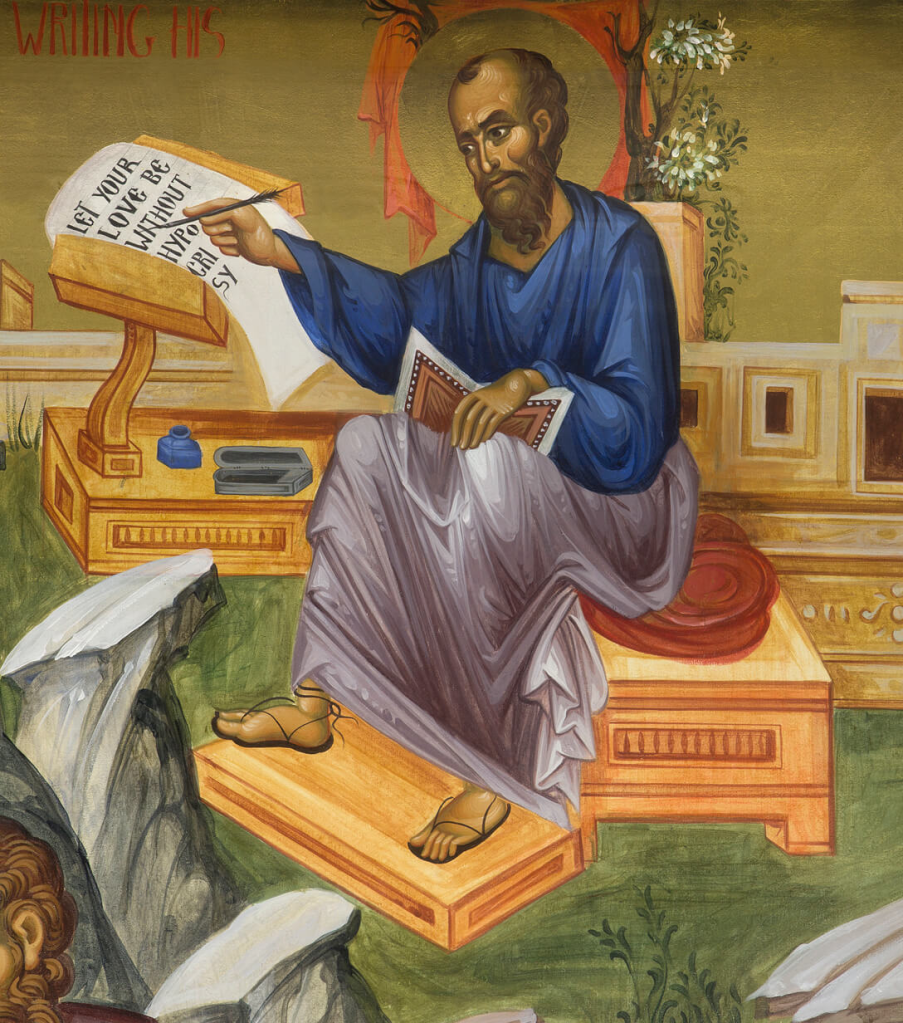
Orthodox icon of St. Paul writing to the churches

Paul responds to this by stating that he is, of course, a human being. However, he wields a different kind of power. Employing military metaphors, the Apostle describes the weapons that he uses as capable of destroying spiritual strongholds of arguments, and obstacles of pride against the knowledge of God – the very sorts of strongholds that were present among the Corinthians.

What’s more, Paul takes captive every thought and makes it obedient to Christ, and not to a self-serving agenda of worldly control and power. And he will use those weapons, if necessary, if the Corinthians keep up their petty criticisms and worldly behavior.

The bottom line of it all is that Christ made Paul an Apostle; and nobody in the Corinthian Church was made one. Paul’s authority was given, not taken, and he will use it to build up and not tear down. In other words, the Apostle Paul was committed to fulfilling his apostolic commission by establishing churches, building up those churches in the strength of faith, and protecting them from misguided and wrongheaded ways of operating.

All I have to say to this is that I am very glad that the Church belongs to Christ. Because that’s the only way we can still be talking about the Church still existing all these centuries later. God works, despite all the human foibles and nonsense.

Even though I talk like this (as does Paul!) there are still good Christian believers and good Christian churches in this world. Not every parishioner lacks self-awareness, is short-sighted, and has a plank in their eye. Nor are all pastors just in it for attention and some sort of worldly gain.

I’m still living and breathing, ministering and mentoring, after decades of Christian labor because of many good people who treated me well, spent good time with me, as well as those who received my teaching and my love, put it into practice, and have produced a harvest of righteousness beyond what I could imagine.

It would be good for all of us to experience supportive community, spiritual maturity, and wise ministry to others. If we can go through any process – no matter what it is – with the humility and meekness of Christ, then no matter what the end is, we have brought some peace and goodness into this old fallen world of ours.

And there is no shame in that!

Almighty and eternal God: Every good and perfect gift comes from you. Send down upon our pastors and parishioners alike a healthy spirit of grace and goodness, so that we all together may truly please you in all we say and do; and continually pour out your divine blessing upon us all. We ask this for the honor of your Son, our Advocate and Friend, Jesus Christ our Lord. Amen.


Galatians 3:15-22 – Law and Grace

Brothers and sisters, let me take an example from everyday life. Just as no one can set aside or add to a human covenant that has been duly established, so it is in this case. The promises were spoken to Abraham and to his seed. Scripture does not say “and to seeds,” meaning many people, but “and to your seed,” meaning one person, who is Christ. What I mean is this: The law, introduced 430 years later, does not set aside the covenant previously established by God and thus do away with the promise. For if the inheritance depends on the law, then it no longer depends on the promise; but God in his grace gave it to Abraham through a promise.

Why, then, was the law given at all? It was added because of transgressions until the Seed to whom the promise referred had come. The law was given through angels and entrusted to a mediator. A mediator, however, implies more than one party; but God is one.

Is the law, therefore, opposed to the promises of God? Absolutely not! For if a law had been given that could impart life, then righteousness would certainly have come by the law. But Scripture has locked up everything under the control of sin, so that what was promised, being given through faith in Jesus Christ, might be given to those who believe. (New International Version)

If the Apostle Paul were living in our day, I’m pretty sure he could have his own reality show, if he wanted. Paul is a terribly interesting man. Within church circles, his adventures are legendary. 

One of the most interesting things about Paul is his piercing intellect and flawless rhetoric. Today’s New Testament lesson has Paul taking on a Galatian heresy. Maybe we could call it “Law and Grace: SFU (Special Faith Unit).”  

The folks who were holding to the law were reminded by Paul that the promise to Abraham was a contract or covenant made by God that was binding, permanent, and divinely ratified. The law, on the other hand, was not – it was designed to be in effect for a specific amount of time, temporary, and only bound the people of God until the promise was fulfilled in Christ.

So, why in the world was there a law to begin with if it is no longer in effect? 

Paul said the law was added because of transgressions. It was as if God’s people were precocious and disobedient little children who needed some firm boundaries and rules in order to keep them safe and lead them to the time when they would grow to maturity. 

My friends, stop thinking like children. Think like mature people and be as innocent as tiny babies.

1 Corinthians 14:20, CEV

With the arrival of adulthood, there is no longer any need for the law.

The law was never designed to be permanent. So, when Christians cling to a rules-based faith, they are showing their immaturity. They need to grow up and embrace the permanent reality of living in the Spirit. 

Although you should have been teachers by now, you need someone to teach you an introduction to the basics about God’s message. You have come to the place where you need milk instead of solid food. Everyone who lives on milk is not used to the word of righteousness, because they are babies. But solid food is for the mature, whose senses are trained by practice to distinguish between good and evil. (Hebrews 5:12-14, CEB)

We must press on toward spiritual maturity, not being simpletons who embrace the law as if it were the actual faith itself. Instead, we need to pursue an adult faith – one which is thoroughly permeated and bathed in grace.

Grace is the permanent and pervasive reality that governs everything Christians are to do and say. Grace cannot be earned, only accepted, not achieved, but only given by God. 

Until we can grasp this fundamental truth of Christianity, the Christian life will never make sense. Only until we release our expectations of rules and let go of our orienting around law will we discover the liberation of a grace-filled existence.

Jesus said, “In a word, what I’m saying is, Grow up. You’re kingdom subjects. Now live like it. Live out your God-created identity. Live generously and graciously toward others, the way God lives toward you.” (Matthew 5:48, MSG)

We spread the message about Christ as we instruct and teach everyone with all the wisdom there is. We want to present everyone as mature Christian people.

Colossians 1:28, GW

The believer’s task is to grow in the grace and knowledge of our Lord Jesus. That happens not through the law but by grace – utilizing the God given gifts of faith, hope, and love.

Gracious God, you saved me through Christ alone by faith alone. Now help me to live by grace alone as the highest and greatest truth operative in the universe and in the kingdom of God. Amen.

Acts 2:14-24 – From Flaky to Faithful

Preaching of the Apostles (crayon on paper) by Peter Gorban, 1990

Peter stood up with the Eleven, raised his voice and addressed the crowd: “Fellow Jews and all of you who live in Jerusalem, let me explain this to you; listen carefully to what I say. These people are not drunk, as you suppose. It’s only nine in the morning! No, this is what was spoken by the prophet Joel:

“‘In the last days, God says,
    I will pour out my Spirit on all people.
Your sons and daughters will prophesy,
    your young men will see visions,
    your old men will dream dreams.
Even on my servants, both men and women,
    I will pour out my Spirit in those days,
    and they will prophesy.
I will show wonders in the heavens above
    and signs on the earth below,
    blood and fire and billows of smoke.
The sun will be turned to darkness
    and the moon to blood
    before the coming of the great and glorious day of the Lord.
And everyone who calls
    on the name of the Lord will be saved.’

“Fellow Israelites listen to this: Jesus of Nazareth was a man accredited by God to you by miracles, wonders and signs, which God did among you through him, as you yourselves know. This man was handed over to you by God’s deliberate plan and foreknowledge; and you, with the help of wicked men, put him to death by nailing him to the cross. But God raised him from the dead, freeing him from the agony of death, because it was impossible for death to keep its hold on him. (NIV)

In the New Testament Gospels of the Holy Bible, the Apostle Peter was a flake. He sometimes got it, and sometimes didn’t. Peter could discern Jesus was Messiah, but then would turn around and refuse that Christ had to die on a cross. He would get bold and walk on water, then, end up falling short and needing help from drowning. Peter stood tall for Jesus, and then denied him three times.

However, following the Gospels in the Acts of the Apostles, Peter is a completely changed man. He now gets it. He is brave. He confesses Christ with confidence and boldness. And, while the reader might be waiting for the other shoe to drop yet again, all the while Peter does not falter, flinch, or back down. Alright, Peter, way to go!

So, what is the difference between the Gospels and Acts with Peter? Why is there such a turnaround from flaky to faithful? The Scriptures make it plain: The Holy Spirit comes upon Peter. And he is never the same again. Everything falls into place for Peter. He proclaimed the life and death of Jesus in such a way that thousands changed their way of thinking, as well as their way of life, and placed their faith and hope in Christ as Savior and Lord. Not a bad day’s work for a former fisherman.

Peter’s message was pointed and straightforward: God raised Jesus up, forever changing the nature of death. Peter was dogmatic about stating that it wasn’t even possible for death to get a grip on Jesus. Oh, death thought it had him, the Grim Reaper believed he had Christ nailed to death for certain. Not so. The grave could not contain the immense and incredible power of divine love for humanity.

Inherit the Mirth

If it was impossible for death to keep its grip on Jesus, then there is absolutely nothing that can deter Jesus or hold him back from accomplishing what he wants to accomplish. Flaky believers are not going to frustrate Jesus or upset his plans; he’ll just send the Holy Spirit. 

We too often imprison ourselves in self-made spiritual jail cells, flaking-out in the Christian life, sometimes getting it right and once-in-a-while hitting upon some right combination we can’t explain, like a golfer who hits an amazing shot but can’t reproduce it no matter how hard he tries. The truth is: Jesus has conquered sin, death, and hell. By faith, we have forgiveness of sins in Christ and have the way opened to a new life in the Spirit. It isn’t a secret; it is a new reality.

The season of Lent is a time of remembering those things which hinder us in our walk with Jesus and repenting of our sins so that we can live anew. As we quickly approach Holy Week, the golf clubs of vulnerability, confession and prayer will keep us in God’s fairway and allow us to shoot par.

Gracious God, who raised Jesus from the dead, may the same power reside in me so that I can do your will in every situation through the power and presence of your Holy Spirit.  Amen.