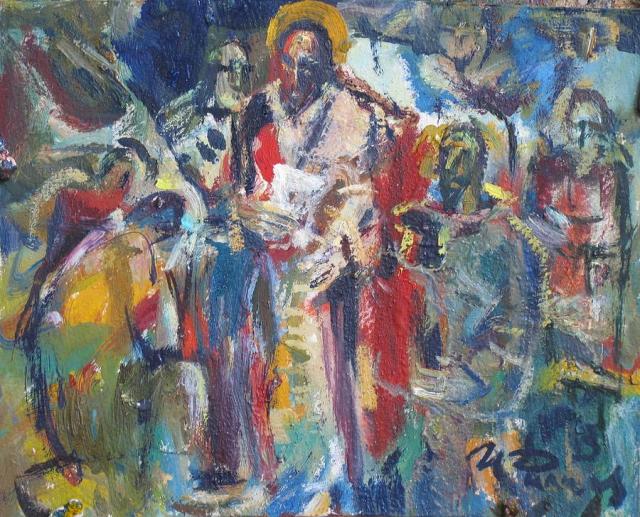
Grateful to God (1 Thessalonians 2:13-20)

Apostle Paul, by Ivan Filichev

And we also thank God continually because, when you received the word of God, which you heard from us, you accepted it not as a human word, but as it actually is, the word of God, which is indeed at work in you who believe. For you, brothers and sisters, became imitators of God’s churches in Judea, which are in Christ Jesus: You suffered from your own people the same things those churches suffered from the Jews who killed the Lord Jesus and the prophets and also drove us out. They displease God and are hostile to everyone in their effort to keep us from speaking to the Gentiles so that they may be saved. In this way they always heap up their sins to the limit. The wrath of God has come upon them at last.

But, brothers and sisters, when we were orphaned by being separated from you for a short time (in person, not in thought), out of our intense longing we made every effort to see you. For we wanted to come to you—certainly I, Paul, did, again and again—but Satan blocked our way.For what is our hope, our joy, or the crown in which we will glory in the presence of our Lord Jesus when he comes? Is it not you? Indeed, you are our glory and joy. (New International Version)

Reception and Acceptance of God’s Word

The Apostle Paul, in all of his letters to the churches, was attentive to affirming those things which are good amongst the believers; and not only the aspects of church life that needed change and/or repentance.

For the Thessalonians, Paul was profoundly grateful to God for the people’s receiving of the Word and their accepting it as from God. Perhaps there is no greater affirmation than this for the Christian.

In order to receive and accept God’s Word, people must know it. And people cannot know God’s Word unless they take the time and effort to read it and discover it for themselves.

Scripture reading is a foundational spiritual practice for Christians everywhere, and for all of Christ’s Church throughout the earth. Church worship liturgies, as well as individual Christians’ daily disciplines of faith, ought to be thoroughly saturated with Holy Scripture. Yet, many churches are believers, sadly, are not.

I am specifically calling out the conservative evangelical church on this. Although they claim to be Bible-centered, with an extended time for the sermon, there is a paucity of actual Scripture contained within those gathered times.

Too much of the preaching fails to truly explain Scripture, and there are virtually no Scripture readings or references outside the sermon and in the worship service. This is a travesty, and also a testament to the biblical ignorance of so many evangelicals.

What’s more, the evangelical impulse for a “personal quiet time with the Lord” is, in reality, practiced by precious few believers – and usually consists of little more than a daily crumb of the Bible.

I perhaps sound cranky and crotchety. Yet in a previous life, I was an evangelical Pastor for many years, and know the frustrations and challenges of attempting to bring biblical literacy to such churches and Christians. There’s a better way, but alas, that is a topic for another time and another post.

Imitators and Sufferers with God’s Churches

The true muster of a Christian and any Christian Church is the desire, speech, and action of actually following the words and ways of Jesus. It was the Lord Jesus himself who said:

“Remember what I told you: ‘A servant is not greater than his master.’ If they persecuted me, they will persecute you also.” (John 15:20, NIV)

“In this world you will have trouble. But take heart! I have overcome the world.”

Jesus (John 16:33, NIV)

Paul was thankful for the Thessalonians because of their solidarity with the other churches; and their willingness to suffer as Jesus did. What’s more, they did not try to reinvent the wheel, but affirmed the sound practices they saw in the original churches of Judea and imitated those good things.

This was not a matter of pragmatism, that is, just doing something that worked somewhere else and adopting it for yourself. Instead, Paul was talking about following the example of the first and earliest of churches. Those churches were made up of Jewish Christians who received a lot of persecution from their fellow Jews.

The Thessalonians, too, received grief and belligerence from the same sort of people, trying to bully them around and tell them what to do. But the believers held fast to the pattern of teaching and living they observed from both Paul and the churches who endured suffering in Judea.

It’s one thing to express belief. It’s quite another thing to suffer for those beliefs and experience persecution for them. God will handle the persecutors on Judgment Day, not us. It’s our job to remain faithful and persevere in the Christian life until that Day comes.

Glory and Joy in God’s Presence

For the Apostle Paul, glory and joy was not found in his great intellect and persuading many people, or his many accomplishments of planting churches and defending the faith. Paul’s highest joy was found in people coming to know Christ and living for Jesus.

His glory was in the hundreds of relationships established with people, and all the believers he mentored. In other words, Paul’s glory and joy was the real names and faces of people he encountered and gathered into the one Church, for whom Christ died and sacrificed himself.

It wasn’t even a thought in the Apostle’s big old head to gain glory for himself, or to pursue joy for it’s own sake. Rather, Paul discovered that real joy and glory comes in fulfilling the mission give to him by Christ:

To make disciples of all nations, baptizing them in the name of the Father, and of the Son, and of the Holy Spirit; teaching them to receive and accept God’s Word, to become imitators and sufferers with God, and to glory and joy in God’s presence.

Almighty God, Father of all mercies, we your unworthy servants give you humble thanks for all your goodness and loving-kindness to us and to all whom you have made.

We bless you for our creation, preservation, and all the blessings of this life; but above all for your immeasurable love in the redemption of the world by our Lord Jesus Christ; for the means of grace, and for the hope of glory.

And, we pray, give us such an awareness of your mercies, that with truly thankful hearts we may show forth your praise, not only with our lips, but in our lives, by giving up ourselves to your service, and by walking before you in holiness and righteousness all our days, through Jesus Christ our Lord, to whom, with you and the Holy Spirit, be honor and glory throughout all ages. Amen.


Thankful for Your Faith (1 Thessalonians 1:1-10)

Paul, Silas and Timothy,

To the church of the Thessalonians in God the Father and the Lord Jesus Christ:

Grace and peace to you.

We always thank God for all of you and continually mention you in our prayers. We remember before our God and Father your work produced by faith, your labor prompted by love, and your endurance inspired by hope in our Lord Jesus Christ.

For we know, brothers and sisters loved by God, that he has chosen you, because our gospel came to you not simply with words but also with power, with the Holy Spirit and deep conviction. You know how we lived among you for your sake. You became imitators of us and of the Lord, for you welcomed the message in the midst of severe suffering with the joy given by the Holy Spirit. And so you became a model to all the believers in Macedonia and Achaia. The Lord’s message rang out from you not only in Macedonia and Achaia—your faith in God has become known everywhere. 

Therefore we do not need to say anything about it, for they themselves report what kind of reception you gave us. They tell how you turned to God from idols to serve the living and true God, and to wait for his Son from heaven, whom he raised from the dead—Jesus, who rescues us from the coming wrath. (New International Version)

The Apostle Paul wrote to the Church in Thessalonica, essentially saying, “I really can’t say enough good about you!” I also echo the same about your faith. Paul had plenty of reasons to express thanks for them in his prayers. He was thoroughly convinced of God’s work in them, and acknowledged the good work of God in their spiritual transformation.

The background of Paul and the Thessalonians

Paul visited Thessalonica on his second missionary journey (Acts 17). Thessalonica was the capital of Macedonia, located on an inlet, and so, was a port city along an important trade route. Thessalonica was a very religious city, with a host of various deities that were worshiped. It was also a politically prominent city that prided themselves on embodying the ideals of the Roman Empire, including bravery, loyalty, piety, seriousness, respect and authority.

When the Thessalonians heard Paul’s message and accepted its call to worship the God of Israel exclusively, they faced rejection and possibly persecution from their polytheistic families and neighbors. To accept and worship Jesus took some solid faith, hope, and love, because to be a Christian was costly within the culture.

God loved and chose the Thessalonians

Paul could praise their faith because it lifted and upheld the gracious work of God on this earth. Before the Thessalonians chose God, God chose them. God didn’t have to do that. But the Lord was gracious, merciful, and kind, extending salvation and deliverance from an empty way of life to a group of people who didn’t deserve it. In fact, none of us do. God’s grace chooses to grant us faith and salvation. To be included amongst God’s people is an incredible privilege.

The good news of Jesus Christ came to the Thessalonians with power, assurance, and the Holy Spirit. They turned from their idols to God. Jesus redeemed and rescued them from darkness and judgment. The Thessalonian believers turned from their previous religious expressions in order to serve the living and true God. As a result, they began imitating Jesus and his apostles. And because of their Christian way of life, the Thessalonian Christians then became worthy of imitation themselves.

Because of God’s merciful intervention in their lives, Paul was grateful for the work of God for three specific elements and expressions about the Thessalonians’ Christian lives:

  1. Their work produced by faith
  2. Their labor prompted by love
  3. Their endurance inspired by hope

Indeed, for every Christian, the Christian life is lived with the essential tools of faith, hope, and love.

Endurance inspired by hope

It’s a standup quality to be characterized as people of hope. The Thessalonian believers were anticipating and waiting for the Lord’s return; they had no doubt Jesus will come again. The Christians just needed some reassurance about those who have already died without yet seeing Christ – which is why Paul wrote his letter to them. And the believers were good at encouraging each other with the hope of Christ’s return.

Labor prompted by love

Paul didn’t really even need to teach the Thessalonian Christians about loving each other because they were good students of God as their teacher. They had a reputation of hearing the Word of God, then doing it. Specifically, they learned to love, not only one another within their local church, but the whole of the family of God throughout Macedonia. So then, the Thessalonians excelled at expressing their faith through love. (Galatians 5:6)

Work produced by faith

The Thessalonian believers became well-versed and practiced in the Christian elements of hope and love. And their faith became known everywhere. Paul was thankful for their work produced by faith. Yet, as the rest of the letter bears out, along with the second letter to the Thessalonians, Paul will have much to say to them about the nature of faith.

Paul reminded the Christians of his example to them and the gospel which he proclaimed. Several times, Paul talked of the work he put into them on their behalf (1 Thessalonians 2:9; 3:5; 2 Thessalonians 3:8). On the topic of following godly examples, Paul also admonished them to respect those who have authority over them, who labor and work among them (1 Thessalonians 5:12-13).

The Apostle encouraged the Thessalonians to continue in their work, so that every need would be met within the church; and so that there would be a good witness to those outside the church (1 Thessalonians 4:11-12). Paul let them know that a very practical way they can express their love is by working with their hands so that none among them have any need.

Faith and work are not mutually exclusive. Even though the Thessalonian believers were transformed by their belief in Christ, they still needed to remember that they must carry on in their regular daily lives until Christ returns.

Imitating the faith and patience of solid believers

And we are all still responsible to be faithful, every day, no matter what the situation or circumstances are. We must carry on in our faith, hope, and love through obeying and living into the words and ways of Jesus. We do this through imitating the faith and patience of trusted Christians, like the Apostle Paul.

Remember your leaders, who spoke the word of God to you. Consider the outcome of their way of life and imitate their faith.

Hebrews 13:7, NIV

People can only experience the fullness of their humanity when they are in deep, trusting relationships with one another. Even more, relationships have more depth when experienced and centered in a relationship with Jesus Christ. Imitation then becomes an outgrowth of this strong relationship.

Far too often we seek excuses, or to find loopholes, in order to avoid the vulnerability that a close mentoring relationship demands. We may look for ways to justify not getting close, or simply distance ourselves from other believers.

Maybe we do not want to do the work — desiring to avoid being hurt. It could be that we are tired of doing the relational work necessary for closeness and walking with Christ and one another. Relationships get messy and they take lots of energy. But our spiritual growth is completely tied to relational growth. The Apostle Paul himself was vulnerable:  

Just as a nursing mother cares for her children, so we cared for you. Because we loved you so much, we were delighted to share with you not only the gospel of God but our lives as well. Surely you remember, brothers and sisters, our toil and hardship; we worked night and day in order not to be a burden to anyone while we preached the gospel of God to you. (1 Thessalonians 2:7-9, NIV)

This imitative relationship is important for the advancement of the gospel. The faith is passed on from generation to generation, from disciple to disciple, in one long progression stretching all the way back to Jesus and the original twelve disciples. For our own faith, hope, and love to be effective, it requires following the example of Paul, and of committed faithful believers in your own life, through close relationships with them.

God of all faith, hope, and love, we praise and give you thanks for the resurrection of your Son, Jesus Christ. We celebrate the joy of life in you, and are grateful for the privilege and opportunity to live into the reality and power of the resurrection.

Inspire us, by your grace, to live the life of intentionally following Jesus. We surrender ourselves to the life of Jesus, who called us to be faithful servants of God. We commit to living for Christ, our Savior and Lord, in whose name we are bold to pray. Amen.

Walk in the Way of Love (Ephesians 5:1-6)

Follow God’s example, therefore, as dearly loved children and walk in the way of love, just as Christ loved us and gave himself up for us as a fragrant offering and sacrifice to God.

But among you there must not be even a hint of sexual immorality, or of any kind of impurity, or of greed, because these are improper for God’s holy people. Nor should there be obscenity, foolish talk or coarse joking, which are out of place, but rather thanksgiving. For of this you can be sure: No immoral, impure or greedy person—such a person is an idolater—has any inheritance in the kingdom of Christ and of God. Let no one deceive you with empty words, for because of such things God’s wrath comes on those who are disobedient. (New International Version)

You are loved. There may not be a lot of things I know, and much of life might be a mystery with few answers, yet the one unshakable truth I have absolutely no doubt about is that you and I are loved by a good and loving God.

Humanity is loved and is therefore meant to love one another as the ultimate rule and guide of life.

Just as God loves, so we are to do the same. We are to mimic divine love in our daily lives. The healthiest of relationships are characterized by a continual dynamic of giving love and receiving love.

Whenever love fails to be the basic rule of life, people are exposed to the gravity of God’s wrath – which exists as the extension of God’s love, in order to put a stop to unloving words and actions in the world.

Unfortunately, as a hospital chaplain and church pastor, I daily see the sad effects of individuals who have experienced a paucity of love and, so, have taken on a false self to try and find love in all the wrong places – with damaging consequences.

Three inappropriate unloving ways of acting are mentioned in today’s New Testament lesson:

  • Sexual immorality is the illegitimate attempt to get the legitimate need for erotic love met without any strings attached. It is a misguided belief that one-night stands and clandestine trysts will protect against being too committed to another and getting hurt.
  • Impurity is any other illicit, illegal, or improper kind of behavior toward others which tries to do the same thing as immorality: Seeking to meet legitimate needs in an illegitimate way – to turn a trick for love, trying to avoid emotional, spiritual, or even physical pain.
  • Greed is an insatiable pursuit of addictive behavior meant to numb or stuff all the unwanted emotions which reside deep in the soul because of engaging in the immoral or impure actions.

Three inappropriate unloving words of speaking are mentioned:

  • Obscenity is filthy speech which is a cover for the agonizing unmet needs of love deep within the human heart. Obscene words are nothing more than verbal sexual immorality. They are a twisted attempt at trying to give and get loving words in an illicit manner.
  • Foolish talk, much like impurity, is any other illicit or improper words crafted to manipulate or cajole another. It is the hustle for love. The original Greek word means literally “to talk like a moron,” that is, a person who lacks sound judgment.
  • Coarse joking is crude and addictive speech, much like greed, envy, and coveting, which verbally trolls for love without unveiling any real feelings.

The antidote to all these baseless actions and distasteful words is to realize the true self, created by God, through receiving the love of God and of others with thanksgiving. Within genuine loving relationships, people can express their legitimate needs to each other and satisfy one another. Yet, with the false self, there is secrecy, hiding, and massive amounts of shame.

Love opens us to all that is good and beautiful. Love also opens us to the possibility of devastating hurt and loss. It is when we try to obtain the good and beautiful, while trying to build walls of protection against potential pain, that we get in trouble. The sinister tools we must use to try and get that impossible job done are manipulation and control with both verbal and physical immorality.

There is no true and authentic love apart from openness and vulnerability. Cheap imitations of love will only lead to hopeless despair.

“To love at all is to be vulnerable. Love anything and your heart will be wrung and possibly broken. If you want to make sure of keeping it intact you must give it to no one, not even an animal. Wrap it carefully round with hobbies and little luxuries; avoid all entanglements. Lock it up safe in the casket or coffin of your selfishness. But in that casket, safe, dark, motionless, airless, it will change. It will not be broken; it will become unbreakable, impenetrable, irredeemable. To love is to be vulnerable.”

C.S. Lewis

The way of love is the way of Christ. Imitating his example of a holy life, compassionate service, helpful speech, and healing actions – with a humble heart of gratitude – is to be our guide, rule, and direction in life. It is to realize our true selves and nudge the world just a bit closer back to Eden.

O Lord, in the name of Jesus Christ your Son our God, give us the love which never ceases so that our hearts will be enlightened and always burning with holy passion for the common good of all.

O Christ, our loving Savior, set our souls aflame so that they may shine brightly with the warmth and glow of unquenchable divine love, and lessen the darkness of the world. Lord Jesus, we pray, give us the light of your love so that we might always see you, desire you, look on you in love, and long after you.

Blessed Holy Spirit, send the fire of your love and empower us for loving service so that we may emulate and follow the example of our loving Lord, for the sake of Jesus Christ. Amen.

Imitate the Right Use of Power (1 Corinthians 4:14-20)

I am writing this not to shame you but to warn you as my dear children. Even if you had ten thousand guardians in Christ, you do not have many fathers, for in Christ Jesus I became your father through the gospel. Therefore I urge you to imitate me. For this reason I have sent to you Timothy, my son whom I love, who is faithful in the Lord. He will remind you of my way of life in Christ Jesus, which agrees with what I teach everywhere in every church.

Some of you have become arrogant, as if I were not coming to you. But I will come to you very soon, if the Lord is willing, and then I will find out not only how these arrogant people are talking, but what power they have. For the kingdom of God is not a matter of talk but of power. (New International Version)

We need to talk about power.

And we need solid sacred examples of how to wield power rightly and justly.

Power is a lot like sex. Everyone wants it, but not everyone respects it and uses it well.

Humanity was created by God to exercise power. True human power has always been intended by our Creator as a means of giving love to others. Wherever you find love being extended by people in power to the powerless, there you will see that it works.

Yet, here’s the rub for many of us: This godly use of power may not (and likely will not) achieve instant results. That’s probably why we so often associate humanity’s possession of power with threats, bullying, and violence – because they usually work to get the immediate results of obtaining power and keeping others in subservience to that power.

The right use of power rarely gets rolled out smoothy without any wrinkles to it. Instead, wielding power through love makes its way by means of suffering. It comes from the humble servants like Mother Teresa, and from those who could throw their weight around, but instead choose to use their influence for self-giving love.

This sort of just and right authority is realized when we are aware of our own weaknesses and failures. Believing that “might=right” is merely a prescription for working out our own complexes on other people; it will only result in extending hate, not love, when others resist our authority.

The ones who hold true power are those who know they are unworthy of it, and incapable of using it without humility and divine help. Real power is like a shepherd looking after a flock of sheep – and not like pulling out a sword to kill the bad guys when they come to challenge authority.

Believers everywhere need awareness that the Christian message offers a profound reversal of what we think we know about power. All signs of real power lead us to the foot of the cross. National governments seems to think that power must be both achieved and sustained by the threat of violence. But the power of God’s kingdom is exercised through giving, serving, and loving.

And it is that sort of power which transforms the world in ways that probably won’t make headlines on the nightly news. The power of Christ is passed on throughout the generations of believers – learned by imitating people, like the Apostle Paul, who demonstrated humble service, instead of arrogant authority.

Faith is passed from person to person; and not just handed down from individuals reading their bibles in seclusion. Power and authority are given to those who are capable of handling it with justice and righteousness.

“You have heard me teach things that have been confirmed by many reliable witnesses. Now teach these truths to other trustworthy people who will be able to pass them on to others.”

The Apostle Paul to his protégé Timothy (2 Timothy 2:2, NLT)

Christians learn from leaders how the faith is lived out, and how power is used, by imitating what they see and hear. Therefore, an important question is this: Who do I imitate?

“Dear brothers and sisters, pattern your lives after mine, and learn from those who follow our example.”

The Apostle Paul to the Philippian Church (Philippians 3:17, NLT)

Our great desire is that you will keep on loving others as long as life lasts, in order to make certain that what you hope for will come true. Then you will not become spiritually dull and indifferent. Instead, you will follow the example of those who are going to inherit God’s promises because of their faith and endurance. (Hebrews 6:11-12, NLT)

Remember your leaders who taught you the word of God. Think of all the good that has come from their lives, and follow the example of their faith. (Hebrews 13:7, NLT)

Those who hold authority and power in the Christian Church must exemplify a proven character of persevering love in the face of pain and suffering. Such persons, having shown humility through it all, are worthy to imitate.

This does not necessarily mean that we emulate those who eruditely speak the Word of God, have superior gifts and abilities, and enjoy success in ministry. It does mean that we ought to imitate, and have as mentors, those persons who imitate Christ and are not self-promoting peacocks who go after being admired and praised.

A cocky Christian leader who has not focused on suffering love, and who has not experienced the purgative fiery trials of this life, may easily become seduced by their own importance. However, leaders who have seen their share of hard circumstances, pain, and suffering, and have come through it loving God and serving others out of grace and humility, are leaders worth imitating. 

Character shapes power, and never the other way around.

God of unchangeable and unending power: Look with mercy on your Church everywhere, and carry out your good and loving purposes through us your people. We trust that your power and love will have it’s way in this old fallen world – and that your plan of salvation shall be carried out, through Jesus Christ our Lord, in the strength of the Holy Spirit. Amen.