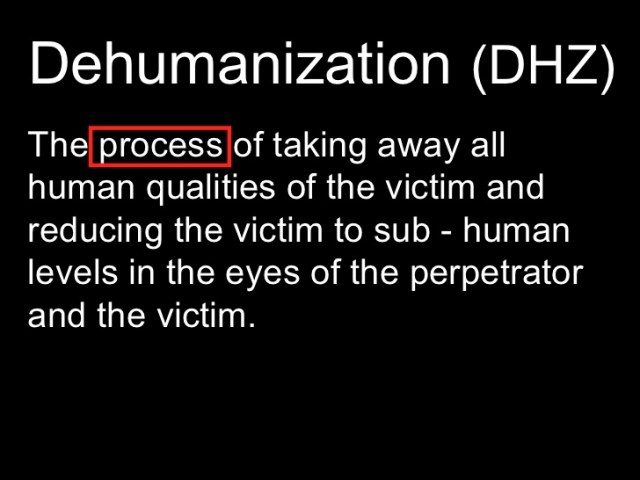
Isaiah 24:1-13 – Dehumanization Pollutes the Earth

The Lord is going to turn the earth into a desolate wasteland.
He will mar the face of the earth and scatter the people living on it.
The same will happen to people and priests,
male slaves and masters,
female slaves and masters,
buyers and sellers,
lenders and borrowers,
debtors and creditors.
The earth will be completely laid waste and stripped
because the Lord has spoken.

The earth dries up and withers.
The world wastes away and withers.
The great leaders of the earth waste away.

The earth is polluted by those who live on it
because they’ve disobeyed the Lord’s teachings,
violated his laws,
and rejected the everlasting promise.
That is why a curse devours the earth,
and its people are punished for their guilt.
That is why those who live on the earth are burned up,
and only a few people are left.

New wine dries up, and grapevines waste away.
All happy people groan.
Joyful tambourine music stops.
Noisy celebrations cease.
Joyful harp music stops.
People no longer drink wine when they sing.
Liquor tastes bad to its drinkers.
The ruined city lies desolate.
The entrance to every house is barred shut.
People in the streets call for wine.
All joy passes away,
and the earth’s happiness is banished.
The city is left in ruins.
Its gate is battered to pieces.

That is the way it will be on earth among the nations.
They will be like an olive tree which has been shaken
or like what’s left after the grape harvest. (God’s Word Translation)

A lot of people shy away from biblical passages, like today’s Old Testament lesson from Isaiah. Too negative, not enough positivity.

Like it, or not, Isaiah 24, along with many other texts of a similar vein, exist in Holy Scripture. And I insist we must pay attention to such texts of doom and gloom. For if we only choose to deal with the encouraging and inspirational texts of the Bible, we will have a severely truncated faith which will not stand in the hard times.

The voice I offer, however, isn’t a beat-you-up tone. I seek to have a pastoral voice that upholds the best of biblical ethics and human dignity. 

Because every person (and I do mean every person) on planet earth is created in the image and likeness of God, each individual human being is a person of worth and deserves respect and kindness.

People do and say terrible things every day. Because of that reality, it doesn’t mean God’s image has left or taken a vacation, or that someone deserves a pejorative label which stigmatizes and ostracizes them from the human family. 

For the Christian, the supreme ethic of life is love. We hold to the Great Commandment: Love God and love neighbor. All other commands of Holy Scripture hang on the commands to love, upheld by Jesus himself.

Jesus answered, “‘Love the Lord your God with all your heart, with all your soul, and with all your mind.’ This is the greatest and the most important commandment. The second most important commandment is like it: ‘Love your neighbor as you love yourself.’ The whole Law of Moses and the teachings of the prophets depend on these two commandments.” (Matthew 22:37-40, GNT)

It is because of the presence of God and Love that difficult biblical texts occur in Scripture. When people, in God’s image, defile that image through oppressing fellow image-bearers and turning from commands to live ethically and lovingly in the world, God has something to say about it. And we get texts like today’s from the prophet Isaiah.

Therefore, we must all ask ourselves if we are loving others in this world as intended by our Creator and Redeemer. 

We routinely hear, through social media posts, political pundits, religious prognosticators, and daily interactions around the water cooler, opinions laced with profound hate, disrespect, and misunderstanding.

Whenever disasters occur – whether yet another act of gun violence, a natural calamity, or economic ruin – there are a host of stories which surround them all. Some of those stories are heartwarming tales of people rushing in to bring comfort, solace, and support. And there are far too many stories of abject fear, ignorance, and calloused behavior directed at others, even victims, with selfish and misguided tools of wrath.

There is such a constellation of issues and problems to unpack and deal with in this world that I do not nor cannot even begin to try to do such a task. I only want to bring a small bit of light to the shadows of the human heart which inevitably tries to dehumanize others who do not agree with his/her opinion and group-think.

For example, there is no lack of people who persist in dehumanizing LGBTQ individuals and gay communities.  One man told me recently, in a matter-of-fact manner, that the Orlando, Florida shooting from 2016 was most likely a judgment from God upon homosexuals because of our government’s straying from godliness. 

Those in LGBTQ circles are quite familiar with this kind of speech. To label it correctly: It is hate speech – dehumanizing speech – the kind of attitude and talk which pollutes the world and raises the hackles of a holy and loving God. 

When people of any particular kind of group, whether gay or straight, Democrat or Republican, Christian or non-Christian, are verbally (and actually) mowed-down like animals, it is because they are being looked at as nothing but animals, or monsters, or anything but a human being.

The apple does not fall far from the tree of the knowledge of good and evil.

We must come to grips with the fact that every person killed on this planet is a destruction of God’s image. And we are not the judges of whether any loss of life is God’s judgment, or not. To make any sort of claim to knowing this is, at best, extreme hubris, and, at worst, germinating the seeds of a future holocaust of killing. 

Whenever any one person or group places a superimposed label upon another person or subculture of people of being monstrous, hateful, and undeserving of justice, then that person or group must come to grips with their own poverty of spirit and embrace the real love which Jesus has demonstrated and offers. And, if they don’t, they ought not be surprised when their tree gets shaken by God, or even cut down and thrown into the fire.

No matter what side one falls on, there is no biblical precedent or place to dehumanize another person or group of people, period. 

Christians and churches, especially, need to stop acting and reacting to the parts of culture and society they don’t like and start living and loving like Jesus by building relationships with a broad spectrum of groups and individuals.

It falls to the faith communities of this land to initiate love and to live above hate speech. And the onus is on Christians to model a supremely loving ethic toward all people.

I admit that many Christians do not have a good track record on this. And I further admit that I have observed an eerie silence from far too many of them in the face of great human tragedy, as if nothing of particular consequence has happened. 

This post is a very small and meager attempt on my part to offer something of the loving Christ to others. For, the church is nothing at all, if it isn’t all about Jesus and his gospel of grace.

Gracious Father, lead us from death to life, from falsehood to truth, from despair to hope, from fear to trust. Let peace fill our hearts and our world. Let us dream together, pray together and work together, to build one world of peace and justice for all, through the One who made peace possible, Jesus Christ, your Son, our Lord, who with you and the Holy Spirit reign as one God, now and forever. Amen.

Luke 10:25-37 – The Parable of the Good Samaritan

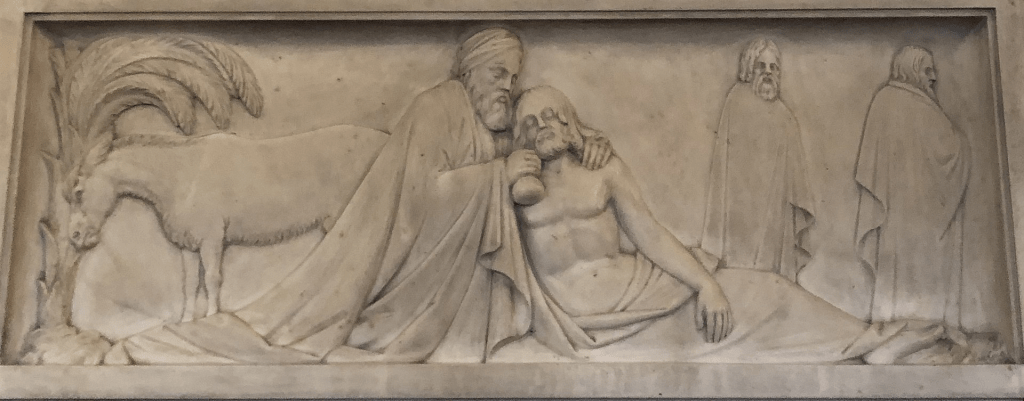
The Good Samaritan by Samuel Nixon. St. Paul’s Church, Halifax, Nova Scotia, Canada

 On one occasion an expert in the law stood up to test Jesus. “Teacher,” he asked, “what must I do to inherit eternal life?”

“What is written in the Law?” he replied. “How do you read it?”

He answered, “‘Love the Lord your God with all your heart and with all your soul and with all your strength and with all your mind’; and ‘Love your neighbor as yourself.”

“You have answered correctly,” Jesus replied. “Do this and you will live.”

But he wanted to justify himself, so he asked Jesus, “And who is my neighbor?”

In reply Jesus said: “A man was going down from Jerusalem to Jericho, when he was attacked by robbers. They stripped him of his clothes, beat him and went away, leaving him half dead. A priest happened to be going down the same road, and when he saw the man, he passed by on the other side. So too, a Levite, when he came to the place and saw him, passed by on the other side. 

But a Samaritan, as he traveled, came where the man was; and when he saw him, he took pity on him. He went to him and bandaged his wounds, pouring on oil and wine. Then he put the man on his own donkey, brought him to an inn and took care of him. The next day he took out two denarii and gave them to the innkeeper. ‘Look after him,’ he said, ‘and when I return, I will reimburse you for any extra expense you may have.’

“Which of these three do you think was a neighbor to the man who fell into the hands of robbers?”

The expert in the law replied, “The one who had mercy on him.”

Jesus told him, “Go and do likewise.” (New International Version)

Who do you relate to in the story? Which character most resonates with you in your life right now?

The Lawyer (an expert in the Old Testament Law)

The Gospel writer, Luke, gives us insight into the thought process of the person for whom Jesus told the parable to. That man sought to justify himself. In Christianity, no one justifies themselves. The kingdom of God turns on grace, and not with us working more or harder. 

Christ’s mercy is not dependent on what kind of people we are but is simply based on need. God graciously gives us the gift of faith and the mercy of deliverance. By Christ’s wounds we are healed. 

As Christians, we already possess justification by grace alone apart from human effort.

Each individual must realize they are in a theological ditch. We are all unable to get out of our predicament. Everyone needs the compassion of Christ.

But now God’s way of putting people right with himself has been revealed. It has nothing to do with law, even though the Law of Moses and the prophets gave their witness to it. God puts people right through their faith in Jesus Christ. God does this to all who believe in Christ, because there is no difference at all: everyone has sinned and is far away from God’s saving presence. But by the free gift of God’s grace all are put right with him through Christ Jesus, who sets them free. (Romans 3:21-24, GNT)

We do not need to justify ourselves.

The Priest and the Levite (experts in the Law)

The shock that hits closes to home, from Christ’s parable, is how frequently we are the ones who pass by and ignore the other. The command to “Go and do likewise,” extends about as far as the end of the story for modern hearers, landing us in the ditch between knowing the Samaritan and his compassionate generosity are set forth as an example and our tendency to ignore the cries of the downtrodden and disenfranchised.

Do not seek revenge or bear a grudge against anyone among your people but love your neighbor as yourself. I am the Lord…. When a foreigner resides among you in your land, do not mistreat them. The foreigner residing among you must be treated as your native-born. Love them as yourself, for you were foreigners in Egypt. I am the Lord your God. (Leviticus 19:18, 33-34, NIV)

The Lord defends the cause of the fatherless and the widow, and loves the foreigner residing among you, giving them food and clothing. And you are to love those who are foreigners, for you yourselves were foreigners in Egypt. (Deuteronomy 10:18-19, NIV)

We are to go and do likewise.

The Samaritan

The Samaritan, the Christ figure in the story, comes and shows the man mercy. This grace was free, lacked any sort of favoritism, and was full of sheer kindness. Without the Samaritan’s actions of binding up the man’s wounds and getting him to a safe place, the victim would have died.  

It is no coincidence that there are many hospitals throughout the country named “Good Samaritan.” Christians were at the forefront of establishing hospitals because of this very parable of Jesus. It was a significant way of living into the values of God’s kingdom.

Mercy is at the heart of all Christian ministry.

Jesus, responding to those who questioned his acts of mercy toward questionable people, said:

“Those who are well have no need of a physician, but those who are sick. Go and learn what this means, ‘I desire mercy, not sacrifice.’ For I have not come to call the righteous but sinners.” (Matthew 9:12-13, NRSV)

I appeal to you therefore, brothers and sisters, on the basis of God’s mercy, to present your bodies as a living sacrifice, holy and acceptable to God, which is your reasonable act of worship. (Romans 12:1, NRSV)

Do justice. Love mercy. Walk humbly. (Micah 6:8)

The Victim

The wounded hapless man was left for dead. In the story, we know he would die apart from help – the kind of help the man could not do for himself. He was completely dependent on someone to rescue him from his plight.

The victim in the ditch reminds us of what it feels like to be forgotten by others — and perhaps even by God. The feeling of loneliness and forsakenness invites compassion and empathy for all who experience it.

Victimization needs a voice and a champion. There are powerless people who either cannot speak or who are not heard by others. There are people, victims of abuse, who cannot get out of their traumatic ditch – overwhelmed by what another did to them.

God stands for the victim and against the robbers.

You will never again
    make victims of others
or send messengers to threaten
    everyone on this earth. (Nahum 2:13, CEV)

God will send help.

When the righteous cry out, the Lord listens;
    he delivers them from all their troubles.
The Lord is close to the brokenhearted;
    he saves those whose spirits are crushed.

The righteous have many problems,
    but the Lord delivers them from every one of them. (Psalm 34:17-19, CEB)

By his wounds we are healed.

Conclusion

The victim in the ditch is worthy of help because he carries the divine image of God.

The one who showed compassion and mercy, the Samaritan, reflected God’s likeness through his actions.

Those who passed by, the priest and the Levite, also bear the indelible mark of their Creator, yet chose to ignore their gut and got lost in their heads.

Maybe God — through Christ — comes to us as the one in the ditch or maybe as the one who shows compassion and mercy; perhaps God even comes to us as a reminder that the call to care for others frequently goes unheeded as we pass by the cries of those in need of help.

Lord God, heavenly Father, you did not spare your only Son, but gave him up for us all to be our Savior, and along with him you have graciously given us all things. We thank you for your precious, saving gospel, and we pray that you would help us to believe in the name of our Savior faithfully and steadfastly, for he alone is our righteousness and wisdom, our comfort and peace, so that we may stand on the day of his appearing, through Jesus Christ, your dear Son, our Lord. Amen.

Acts 13:16-25 – The Motivation of Ministry

Paul speaking in the synagogue, a 12th century Byzantine mosaic

Paul got up. He motioned with his hand and said:

People of Israel, and everyone else who worships God, listen! The God of Israel chose our ancestors, and he let our people prosper while they were living in Egypt. Then with his mighty power he led them out, and for about forty years he took care of them in the desert. He destroyed seven nations in the land of Canaan and gave their land to our people. All this happened in about 450 years.

Then God gave our people judges until the time of the prophet Samuel, but the people demanded a king. So, for forty years God gave them King Saul, the son of Kish from the tribe of Benjamin. Later, God removed Saul and let David rule in his place. God said about him, “David the son of Jesse is the kind of person who pleases me most! He does everything I want him to do.”

God promised that someone from David’s family would come to save the people of Israel, and that one is Jesus. But before Jesus came, John was telling everyone in Israel to turn back to God and be baptized. Then, when John’s work was almost done, he said, “Who do you people think I am? Do you think I am the Promised One? He will come later, and I am not good enough to untie his sandals.” (CEV)

In the Apostle Paul’s first missionary journey, he and Barnabas had the practice of traveling from city to city and attending the local synagogue services. It was customary to have a time in the worship when a word of encouragement could be offered from folks in the congregation. Paul consistently took those opportunities to talk of Jesus as the fulfillment of God’s promises to Israel.

“Life can only be understood backwards; but it must be lived forwards… Life is not a problem to be solved, but a reality to be experienced.” 

Søren Kierkegaard

Paul’s conversion to Christianity totally altered his motivation. Jesus was everything to him. Jesus is what got him up in the morning. Jesus is who sustained him through his days. Jesus was who Paul thought about when he went to sleep at night. Paul was unabashedly Christo-centric in all he said and did.

As for me, the spiritual care of others out of the overflow of my heart, full of Christ in the power of the Holy Spirit is the driving force of my life. As a Christian, I believe all spiritual care begins and ends with Jesus. The Christian tradition emphasizes that in the beginning, God created the heavens and the earth.  The apex of creation, the height of all God’s creative activity, is the formation of humanity upon the earth.  Human beings alone have been created in the image and likeness of God – reflecting the divine in their care for all creation (Genesis 1:26-27).

Therefore, all persons on the good earth which God created are inherently good creatures and deserve utmost respect and common decency. So, my identity as a person is firmly rooted and grounded in the soil of God’s grace in Jesus Christ. My Christianity has the practical effect of acknowledging that each person on planet earth is inherently worthy of love, support, concern, and care. 

What is more, everything in my life centers (ideally) around Jesus. As such, I take my cues for how to extend care to others from him. For me, Jesus is the consummate caregiver. Christ entered people’s lives and their great sea of need with the gift of listening; a focus on feelings; and the power of touch.  Christ was able to listen to others because he first listened to the Father. Jesus was present to others because he was present with the Father. Jesus Christ gave love to others with the love he enjoyed with the Father and the Spirit. 

By the wounds of Christ, we are healed. Paul knew this firsthand. He needed a boatload of emotional and spiritual healing from his guilt and shame as a persecutor of faith before his conversion. Paul discovered in Christ the grace of healing, both body and soul.  

People’s stories of joy and pain, laughter and sorrow, certainty and wondering, are sacred narratives – continuously being written and revised in the heart, trying to make sense of life and faith. The Apostle Paul had a doozy of a life story to tell. Coupled with his keen intellect and training, Paul could be very persuasive. Paul’s ministry, emulating the life of Christ, was not to force the gospel obnoxiously and belligerently onto others but to pastorally respond to everyone he encountered. Both Paul and Jesus confronted and confounded folks with incredible love.

The theologian who labors without joy is not a theologian at all. Sulky faces, morose thoughts and boring ways of speaking are intolerable in this field.

karl barth

Every person, without exception, is precious and carries within them the image of God. The personal journey and discovery of Godlikeness within each person is an emotional adventure worth taking. One of the great Christian theologians of the 20th century, the Protestant Swiss Karl Barth, believed that we are not fully human apart from mutual seeing and being seen, reciprocal speaking and listening, granting one another mutual assistance, and doing all of this with gratitude and gratefulness.

Only in relation to each other, including those in need, do we thrive as people – which is why Paul was intensely personal and relational in his missionary ministry. Christianity is a fellowship with God and one another, and not an isolated odyssey. Paul always traveled with others.

Christian ministry is a symbiotic relationship between the servant and the served, expressed with grace and hope given by Jesus in the power of the Holy Spirit. The person in need not be Christian for this to occur, since all share the common human experience of birth, life, and death as people distinct from all other creatures, worthy of compassionate support and spiritual uplift. This is the reason why I do what I do, as a believer in and minister for Jesus Christ, and I have a hunch it was the same for Paul.

Loving God, the One who cares and saves, enable me, like your servant Paul, to speak peace, be hospitable, heal the sick, proclaim that the kingdom of God has come near, not take rejection personally, and let you do your work of changing lives and bringing them into the dance of the Trinity with Christ and your Spirit. Amen.

Psalm 139:1-6, 13-18 – Specially Crafted by the Divine

Psalm 139 stained glass by Dutch artist Ted Felen (1931-2016)

Lord, you have examined me.
    You know me.
You know when I sit down and when I stand up.
    Even from far away, you comprehend my plans.
You study my traveling and resting.
    You are thoroughly familiar with all my ways.
There isn’t a word on my tongue, Lord,
    that you don’t already know completely.
You surround me—front and back.
    You put your hand on me.
That kind of knowledge is too much for me;
    it’s so high above me that I can’t reach it….

You are the one who created my innermost parts;
    you knit me together while I was still in my mother’s womb.
I give thanks to you that I was marvelously set apart.
    Your works are wonderful—I know that very well.
My bones weren’t hidden from you
    when I was being put together in a secret place,
    when I was being woven together in the deep parts of the earth.
Your eyes saw my embryo,
    and on your scroll every day was written that was being formed for me,
    before any one of them had yet happened.
God, your plans are incomprehensible to me!
    Their total number is countless!
If I tried to count them—they outnumber grains of sand!
    If I came to the very end—I’d still be with you. (CEB)

It is no wonder so many people struggle with their self-image. Beautiful people reign in television and movies; the rich and powerful are highlighted in the media; and people with perfect teeth and immaculate attire are splashed in front of us in the daily barrage of advertisements. Meanwhile, the rest of us 99% of the population quickly notice we do not measure up to such a standard. You don’t have to be a people watcher to know that less than perfect bodies are the norm and that most folks do not have a budget to live like the other 1% humanity.

If we make comparisons with others too much and for too long, it gets downright depressing. Yet, into this dark abyss of one’s self-image enters the biblical truth that each one of us, no matter our station in life, was personally hand-crafted by a heavenly Being who loves us dearly. We are indeed fearfully and wonderfully made.

The Creator God took great care to make us and form us just so. The psalmist, David, praised God for the way we were created. The real standard from which we ought to judge ourselves is this: God knows us intimately, inside-and-out, and neither condemns us nor shames us but loves us wholly.

Psalm 139 by Dutch painter Ellen Van Randeraat, 2013

So then, rather than wasting our emotional energy and mental faculties on wishing we looked different or were more like so-and-so who seems to always have it all together, try practicing what David did: Praise God. 

Whenever we have the notion that we do not measure up to our imposed arbitrary standard, keep in mind that the only real measurement is grace. No matter who we are, the entire race of humanity has been created in the image of God, and, on that basis alone, we have inherent value, worth, and majesty. Let us, then, treat ourselves and others with the yardstick of grace.

The inner critic, that is, the inner judgmental dialogue we have with ourselves, needs to be replaced with the truth of Psalm 139. Although we might be rather hard on ourselves and say things in the reclusive parts of our minds and hearts that we would never say to others, nor tolerate others saying about someone else – God speaks to us with tender words of grace. Perhaps you think that only you know the depth of your own sorrows, hurts, fears, insecurities, and worries.  Except….

God. The Lord knows it all intimately – and is not one bit repulsed. You see, God knows that the answer to all the self-doubts is Divine care and protection. You and I have the freedom to plumb the recesses of our hearts and souls – to bring out all that is inside the cluttered closet of our minds and lay it all on the table without fear of God calling you what you call yourself.

Therefore, please do not quickly pass over the inspired words from Holy Scripture contained in today’s psalm. Take the time to carefully digest each phrase slowly so that the message becomes internalized and believed in real-time experience.

One of the theories of human psychology is that people are driven by two primary needs: 

  1. To intimately know another person.
  2. To be intimately known by another person. 

God knows us even better than we know ourselves – and still loves us! There is nothing we learn about ourselves that God does not already know. No human relationship can even come close to the level of knowing that God has for us and about us.

To know God is perhaps the greatest and highest pursuit we could ever enjoy. God is so immense and infinite that we will spend an eternity getting to know the Lord and will never get to the end of it. That is the kind of God we serve. Be encouraged today and always with the reality that you are known and can know God – and even more, loved deeply as a specially fashioned creature.

O God, thank you that I am wonderfully made in your likeness.  I praise you that I am fully accepted, even when I do not accept myself.  In Jesus Christ you have demonstrated the height of your love and mercy.  May this grace be with me every day so that I will conduct myself in a manner worthy of being part of the human family.  Amen.