Luke 9:51-62 – The Cost of Following Jesus

As the time approached for him to be taken up to heaven, Jesus resolutely set out for Jerusalem. And he sent messengers on ahead, who went into a Samaritan village to get things ready for him; but the people there did not welcome him, because he was heading for Jerusalem. When the disciples James and John saw this, they asked, “Lord, do you want us to call fire down from heaven to destroy them?” But Jesus turned and rebuked them. Then he and his disciples went to another village.

As they were walking along the road, a man said to him, “I will follow you wherever you go.”

Jesus replied, “Foxes have dens and birds have nests, but the Son of Man has no place to lay his head.”

He said to another man, “Follow me.”

But he replied, “Lord, first let me go and bury my father.”

Jesus said to him, “Let the dead bury their own dead, but you go and proclaim the kingdom of God.”

Still another said, “I will follow you, Lord; but first let me go back and say goodbye to my family.”

Jesus replied, “No one who puts a hand to the plow and looks back is fit for service in the kingdom of God.” (New International Version)

“The will of God, to which the law gives expression, is that men and women should defeat their enemies by loving them.”

Dietrich Bonhoeffer, The Cost of Discipleship

In his earthly ministry, Jesus made it clear to the large crowds of people following him that the life of a disciple is of utmost importance. People are to discover what following Jesus truly entails. They are to count the cost of Christian discipleship.

Following Jesus in Christian discipleship requires radical obedience. 

Love of family must not stand in the way. Jesus insisted our primary loyalty must lie with following him over every earthly relationship. To follow Jesus means that we will not use family responsibilities to avoid obeying Christ or use other loyalties and commitments to work and/or school as a reason to lay down our cross. 

This talk of Christian discipleship might smack of being like a cult. I don’t believe it is. Whereas a cult typically requires a radical withdrawal from the world so that the leader has complete control over the group, Jesus requires a radical engagement with the world.

Following Jesus is meant to impact the world with grace and love. Jesus went out of his way to not be like other leaders who use power, control, and gaslighting as the means of ruling and leading. Instead, Jesus shares his power with others. Christians are to bless the world and be involved in it.

The call of Jesus to Christian discipleship not only takes precedence, but it also re-defines the other loyalties we have. 

This call involves some level of detachment in order to pursue following Jesus. All of life is to be infused with being a disciple of Jesus. If we insist on making other commitments and loyalties as high a priority as following Jesus, we will find ourselves torn between two masters. 

Several years ago, I took a trip with some other church leaders into the Canadian wilderness. We were so far out in the boonies that we needed special first aid training because, if someone got hurt, it would be hours before help could come. 

We canoed the lakes and carried our backpacks and canoes between lakes for an entire week. Whatever we took with us, we had to carry. Some people thought they needed all kinds of clothes and other accessories. Not far into the week, they quickly began to leave things along the trail and learned, over time, that what they thought was important in their life, wasn’t really important to what they were doing.

It’s good to get back to basics and do what is essential. And what is of most importance is following Jesus. 

An un-salty disciple is worthless. Making a profession of Christ, without counting the cost, is foolish. Christian discipleship was never designed to be easy; it was intended to be a public display that Jesus is Savior and Lord in every area of life. That means we will struggle with questions, such as: 

  • How do I be a faithful follower of Jesus in my family? 
  • How do I be a disciple, and do the work of discipleship at my job? 
  • How do I practice following Jesus in my neighborhood, and everywhere I go?

If we do not plan to follow Jesus at home, at work, in the neighborhood, and in the world, we won’t, because all kinds of competing loyalties will take over.

Christians need to be very intentional about being disciples who loyally follow the words and ways of Jesus.The going will get difficult. And that’s okay.

“Jesus has many who love his kingdom in heaven, but few who bear his cross. He has many who desire comfort, but few who desire suffering. He finds many to share his feast, but few his fasting. All desire to rejoice with him, but few are willing to suffer for his sake. Many follow Jesus to the breaking of bread, but few to the drinking of the cup of his passion. Many admire his miracles, but few follow him in the humiliation of the cross.”

Thomas à Kempis, The Imitation of Christ

“Anyone who does not carry his cross and follow me cannot be my disciple.”

Jesus (Luke 14:27)

Joy comes not by pursuing happiness; it comes through discovering that to live is to die to self. Until we come to grips with that reality, we will likely be frustrated with our circumstances and other people.  

So, rather than trying to fit Jesus into our calendar, we are to let our calendar fill-out around the center of following Jesus. If Christians feel too busy for prayer; or for daily reading of Holy Scripture; or for loving one another; or for making disciples, then they have lost their way and must listen to the call of Jesus to be his disciple.

How, then, shall we live? What shall we do?

“Jesus stands between us and God, and for that very reason he stands between us and all other people and things. Christ is the Mediator, not only between God and people, but between person to person, between humanity and reality.”

Dietrich Bonhoeffer, The Cost of Discipleship

Imagine that in our heart is a big conference room including a big table, leather chairs, coffee, bottled water, and a whiteboard. A committee sits around this table in your heart. There is the social self, the private self, the work self, the sexual self, the recreational self, the religious self, and others.

The committee is arguing, debating, and voting. They’re agitated and upset. Rarely can they come to a unanimous, wholehearted decision.

We tell ourselves we’re this way because of our many responsibilities or our high level of stress. Yet, the truth is that we are internally divided, unfocused, hesitant, and feeling trapped. 

One way of dealing with this situation is to invite Jesus to come sit as a committee member. Give him a vote, too. But then he becomes just one more complication.

A better way is to say to Jesus, “My life isn’t working. Please come in, become my CEO and fire my committee, every last one of them. I hand myself over to you. I am your responsibility now. Please run my whole life for me.” 

Being a disciple of Christ is not just adding Jesus; it is also subtracting the idols that are in my heart. 

Following Jesus is not for the faint of heart; it is for those who humbly acknowledge that Jesus is the way, the truth, and the life. This is the path of Christian discipleship. Let’s give Jesus his due: our very lives.

Gracious and almighty God, all hearts are open to you, all desires known, and no secrets are hid. Cleanse the thoughts of our hearts by the inspiration of your Holy Spirit so that we may perfectly love the Lord with all our hearts and magnify the holy Name of Jesus Christ our Lord. Amen.

Deuteronomy 9:15-24 – The Dark Underbelly of Sin

“Golden Calf” by John Bradford

Moses continued: “So, while the mountain was blazing with fire I turned and came down, holding in my hands the two stone tablets inscribed with the terms of the covenant. There below me I could see that you had sinned against the Lord your God. You had melted gold and made a calf idol for yourselves. How quickly you had turned away from the path the Lord had commanded you to follow! So, I took the stone tablets and threw them to the ground, smashing them before your eyes.

“Then, as before, I threw myself down before the Lord for forty days and nights. I ate no bread and drank no water because of the great sin you had committed by doing what the Lord hated, provoking him to anger. I feared that the furious anger of the Lord, which turned him against you, would drive him to destroy you. But again, he listened to me. The Lord was so angry with Aaron that he wanted to destroy him, too. But I prayed for Aaron, and the Lord spared him. I took your sin—the calf you had made—and I melted it down in the fire and ground it into fine dust. Then I threw the dust into the stream that flows down the mountain.

“You also made the Lord angry at Taberah, Massah, and Kibroth-hattaavah. And at Kadesh-barnea the Lord sent you out with this command: ‘Go up and take over the land I have given you.’ But you rebelled against the command of the Lord your God and refused to put your trust in him or obey him. Yes, you have been rebelling against the Lord as long as I have known you. (New Living Translation)

I’m really glad there was no social media back in the day when the Israelites made the golden calf idol. Most people tend to post flattering pictures of happy families and wonderful experiences. Somehow, methinks the ancient Israelites would have tried to make the whole thing at Mount Sinai look like some party we would envy going to.

But there’s always a dark underbelly to all the glitter and photoshopped pics. And God sees and knows it all.

God is full of grace, steadfast love, and covenant commitment. Yet, this does not mean that God is okay with disobedience and people doing whatever the heck they want to do. The Lord has anything but a shoulder-shrugging “meh” attitude toward hedonism. 

In fact, grace only exists because of sin. Where there is boundless grace and compassion there will be found bucket loads of self-absorbed behavior. And, oh my, was there a load of it among the ancient Israelites! They were characterized as stubborn, rebellious, and idolatrous. It’s the kind of stuff that evokes the ire of God.

Genuinely godly people share God’s heart and interests. That is, what upsets God, upsets them; and what makes God pleased, makes them pleased. Moses was in sync with God. So, he was visibly angered by the people’s idolatry. Moses confronted the people with going far astray from the Lord. And, what’s more, Moses showed that his heart reflects God’s heart by immediately engaging in an extended time of fasting and prayer on their behalf – forty days and forty nights.

Lackadaisical attitudes and approaches toward God are a dime-a-dozen with many so called believers. There is little to no sustained, prolonged, and focused times of prayer and fasting among both individuals and groups of people. Many folks are simply too busy indulging in revelry with their idols of money, sex, power, and perfectionist control. 

Until we are cut to the heart with this present darkness of empty souls and vacuous spirits, which run to everything and everyone but God, there will be no entering the Promised Land of peace, love, and joy in the Holy Spirit. 

The dark underbelly of sin needs to be turned over so that it can be exposed to the purifying light of God’s glory. The worms of guilt must be unearthed, spread before the heat of the Son, and destroyed. The heavy load of shame needs to be jettisoned and thrown into the fire of God’s wrath.

The glory of the Lord is almost upon us, and the season of Lent is nearly here. So, let us make a solid spiritual plan for the forty days leading up to Easter for prayer and fasting on behalf of our own wrongdoing and shortcomings, as well as for the sin of the world.

Holy God, idolatry brings about your wrath because you cannot stand the lack of love in the world. I bow before you and bend the knee to your sovereign reign in my life. Please lead me in your way of righteousness and have mercy on those trapped in darkness so that we might see you, through Jesus Christ, our Lord and Savior. Amen.

2 Chronicles 34:1-7 – Getting Rid of Idolatry

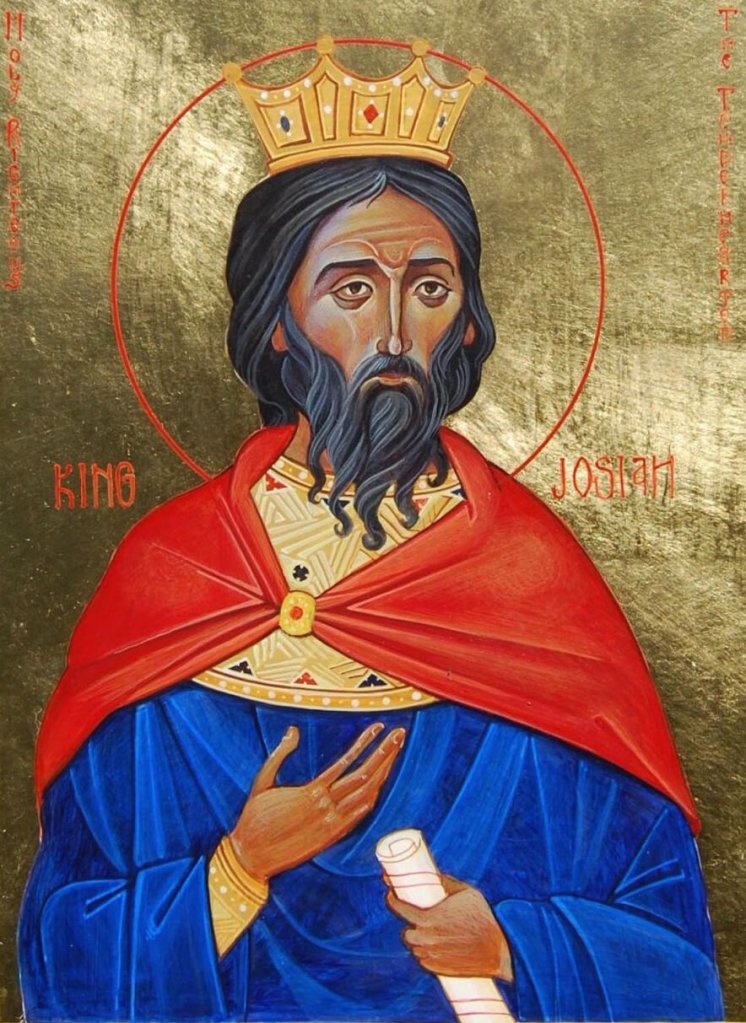
Russian Orthodox icon of Judah’s King Josiah (640-609 B.C.E.)

Josiah was eight years old when he became king of Judah, and he ruled thirty-one years from Jerusalem. He followed the example of his ancestor David and always obeyed the Lord.

When Josiah was only sixteen years old he began worshiping God, just as his ancestor David had done. Then, four years later, he decided to destroy the local shrines in Judah and Jerusalem, as well as the sacred poles for worshiping the goddess Asherah and the idols of foreign gods.He watched as the altars for the worship of the god Baal were torn down, and as the nearby incense altars were smashed. The Asherah poles, the idols, and the stone images were also smashed, and the pieces were scattered over the graves of their worshipers. Josiah then had the bones of the pagan priests burned on the altars.

And so, Josiah got rid of the worship of foreign gods in Judah and Jerusalem. He did the same things in the towns and ruined villages in the territories of West Manasseh, Ephraim, and Simeon, as far as the border of Naphtali. Everywhere in the northern kingdom of Israel, Josiah tore down pagan altars and Asherah poles; he crushed idols to dust and smashed incense altars.

Then Josiah went back to Jerusalem. (Contemporary English Version)

Josiah started out as a boy king. Evidently, he had some good training because by the time he became a teenager, Josiah was raring and ready to exercise his kingship in the best sense of leadership. 

After generations of kings before him who followed other gods and gave the stiff-arm to the Lord, as well as to justice and righteousness, Josiah committed himself fully to Israel’s one true God.  And, as a twenty-year old king, he showed the real muster of his reign.

Josiah took responsibility and initiative to do what was right in the eyes of God – no matter the consequences. 

King Josiah continually performed the dual action of worshiping God and aggressively taking active steps to rid the kingdom of all the ubiquitous false gods. 

The king did much more than simply stick his toe in the water to test what the response might be to removing a high place of Baal worship or an Asherah pole. Instead, Josiah jumped right in and put his entire kingship on the line. 

All of the power brokers who were dealing in false gods could not have been happy about this turn of events in Judah. But any kind of pushback did nothing to prevent Josiah from doing what was right in the eyes of the Lord by thoroughly eradicating idol worship.

“Let us all be the leaders we wish we had.”

Simon Sinek

Josiah had a clear sense of purpose. That sense of vocational direction ordered his kingly steps. It led him to do the things he did. Josiah was determined and devoted to leading the people back to God. 

This desire and determination for spiritual revival directed toward the worship of the Lord is not limited to the ancient world. God is still in the kingdom business of bringing all creation under a divine and benevolent rule. 

Therefore, there still remains an abiding purpose to lead others, caught in a web of unhealthy routines and habits of living through idolatrous practices, back to the one true God. 

Like the ancients before us, there is still a need to exercise courage and confidence in following the Lord by making disciples who will worship God with all their heart, soul, mind, and strength. 

So, reconnecting with our overarching purpose in life is imperative for taking bold steps of faith in this idolatrous world which worships at the altar of exorbitant eating, shopping, and drinking.

It is no wonder the current zeitgeist of so many of our communities is full of anxiety, discouragement, and anger. There is no justice in the public square. Competing voices, other than the merciful words and ways of Jesus, drown the divine regulations for living a good life of integrity, wholeness, peace, and joy in the Holy Spirit.

It is almost as if the collective efforts of idolatrous people have surgically removed the spiritual spine of society. We are now bereft of genuine support, spineless and unable to move toward a life of truth, justice, and a courageous concern for the common good of all persons.

King Josiah shows us a better way. We must radically remove all that is toxic and damaging to our souls. We need a clear purpose in life, to go hard after God and rediscover how the Divine fits into all of life and gives us meaning.

Any old fool can complain about how bad things are in the world. But the one determined to make a difference amidst all the surrounding crud and helps to make things better – that is the wise person who is in touch with their own spirit, who is able to see the spiritual within others.

So, how then will you live?

May your living be in a healthy spiritual groove of loving God and loving neighbor so that worshiping the banal becomes a thing of the past.

Holy God, you are the Sovereign of the universe. Expose the things in my life that I might be trusting in, other than you. Wean me away from evil and bend my heart and mind to truth, justice, and goodness. Help me to be aggressive in my Christian walk so that I steadfastly follow Jesus Christ in the power of the Holy Spirit, leading others to faith along the way. Amen.

Psalm 115 – The Living God Is Both Far and Near

Not to us, O Lord, not to us, but to your name give glory,
    for the sake of your steadfast love and your faithfulness.
Why should the nations say,
    “Where is their God?”

Our God is in the heavens;
    he does whatever he pleases.
Their idols are silver and gold,
    the work of human hands.
They have mouths, but do not speak;
    eyes, but do not see.
They have ears, but do not hear;
    noses, but do not smell.
They have hands, but do not feel;
    feet, but do not walk;
    they make no sound in their throats.
Those who make them are like them;
    so are all who trust in them.

O Israel, trust in the Lord!
    He is their help and their shield.
O house of Aaron, trust in the Lord!
    He is their help and their shield.
You who fear the Lord, trust in the Lord!
    He is their help and their shield.

The Lord has been mindful of us; he will bless us;
    he will bless the house of Israel;
    he will bless the house of Aaron;
he will bless those who fear the Lord,
    both small and great.

May the Lord give you increase,
    both you and your children.
May you be blessed by the Lord,
    who made heaven and earth.

The heavens are the Lord’s heavens,
    but the earth he has given to human beings.
The dead do not praise the Lord,
    nor do any that go down into silence.
But we will bless the Lord
    from this time on and forevermore.
Praise the Lord!
(New Revised Standard Version)

Theology 101 Syllabus:

  • The earth belongs to God, not us.
  • Humanity stewards the earth, not depletes it.
  • Glory belongs to God, not us.
  • Humanity gives glory, not seeks glory.
  • God is mindful of us with blessing, not cursing.
  • Humanity is mindful of God with praise, not idolatry.
  • God is eternal, not finite, alive, and not dead.
  • Humanity is finite, not infinite. Dead people don’t steward the earth and give glory and praise to God. Mortal humans have a privilege and responsibility on this earth while they are still alive.

Any questions?

When it comes to knowing God, we learn as much or more about Divine attributes and actions in the psalms as anywhere else in Holy Scripture. This is one reason why the Lectionary has a psalm for every day – and why the same psalm is repeated three days in a row. It is the consistent, repeated, and continual reading and recitation of the psalms which provides us with the robust theology we need for practical daily living.

God speaks. Idols do not. We have the privilege of God’s Word. There are no words from idols. People become like the objects of their worship. Worshiping a mute inanimate object leads to being silent on the great problems and issues of our day. Idol worship has nothing substantive to offer. It’s worthless.

Conversely, the worship of God (a deity who has words for the immense needs of the world) brings a sense and application of humility, justice, and mercy to the very real and present situations surrounding us.

“The believer trusts in the name of the Lord to show steadfast love – to put love where love is not.”

Mit Tdrahrhe

Evil will not be perpetrated with impunity. That is, the person of violent speech and/or actions will not be able to victimize continually and without consequence. Their wicked words and deeds are held accountable by a God who cares about such things. An idol is unable to hear the cries of victims. And an idol is neither able to proclaim justice nor words of assurance. Idolatry has no ability to stop the ravaging of the earth and its people.

The Lord is both far and near – far enough and high enough to see the big picture and act accordingly – yet near enough to bring true comfort and solace. I was once speaking with a friend about this, discussing the simultaneous transcendence and immanence of God. He listened and then said, “So, it sounds like God is a loving hard-ass!” Well, yes. Not quite the way I would frame it, but he certainly picked up on the spirit of what I was saying.

It is important to hold together and maintain both God’s intimacy and distance. Because they each work together to provide the worshiper with what is needed. The Lord both infinitely observes from afar as well as gets his hands dirty working on behalf of finite humanity. This is the view of God the psalms give us. A God who cares in the total sense of the word – caring with comforting words and confident action.

A vision of God in the psalms inevitably leads to prayer, trust, praise, and worship. The Lord might be invisible, yet the evidence of this immense deity is everywhere in the blessings we have, both big and small. Deep within our personhood is firm epistemic proof that we belong to God.

May the Lord who created heaven and earth give you divine blessing.

May all people everywhere praise the Lord now and forevermore! Amen.