
The Truth About You (John 8:21-30)

Once more Jesus said to them, “I am going away, and you will look for me, and you will die in your sin. Where I go, you cannot come.”

This made the Jews ask, “Will he kill himself? Is that why he says, ‘Where I go, you cannot come’?”

But he continued, “You are from below; I am from above. You are of this world; I am not of this world. I told you that you would die in your sins; if you do not believe that I am he, you will indeed die in your sins.”

“Who are you?” they asked.

“Just what I have been telling you from the beginning,” Jesus replied. “I have much to say in judgment of you. But he who sent me is trustworthy, and what I have heard from him I tell the world.”

They did not understand that he was telling them about his Father. So Jesus said, “When you have lifted up the Son of Man, then you will know that I am he and that I do nothing on my own but speak just what the Father has taught me. The one who sent me is with me; he has not left me alone, for I always do what pleases him.” Even as he spoke, many believed in him. (New International Version)

Jesus was an interesting guy – both cagey and confrontational at the same time. He had a way (the way, in fact) that left those who longed for mercy and encouragement to receive it, while also giving rebuke to those satisfied with being stuck in their misguided lives.

This made Christ one of those persons whom you either loved or hated. The people that loved him, adored him; and those that hated him, sought to kill him.
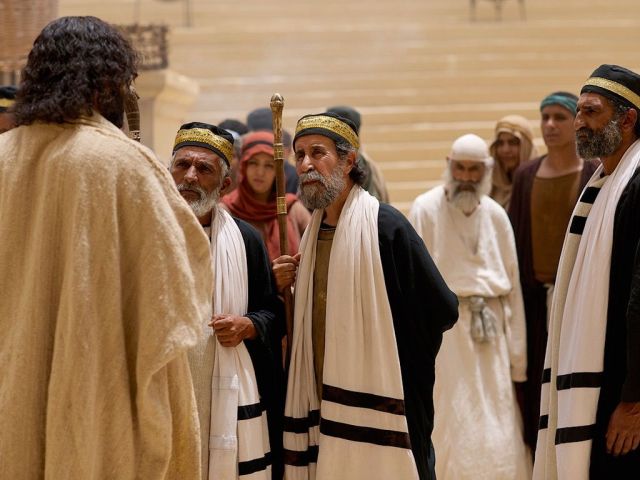
It’s really a matter of self-perception. The ones who tend to self-loathe and wonder if they’re accepted, or not, are the ones who feel on the outside. These are the folks who discover themselves on the inside, accepted by God. And Jesus made it happen for them.

On the other hand, the ones who are enamored with themselves and their superior religion, looking down at others and feeling secure as insiders, are the people who will find they’re actually on the outside looking in; indeed, they will die in their self-delusion.

Our self-identification matters. If identity is tied to what we’re able to do for God, and/or how pious we look for others to see, then our inflated egos will eventually be popped with the pinprick of divine judgment. But if identity is tethered to belonging to God by divine grace and mercy, then we shall know true acceptance.

We need to know the truth about ourselves. Both truth and error are powerful. If we have misguided notions of self, we are like empty wells with no water to draw from. Many of our problems, failures, and shame are largely due to a misunderstanding of the kind of person we are. 

A profound result of this misunderstanding is a lack of self-worth. When we are in error about who we really are, we are severely limited in what we can do in our lives. We can neither solve the problem by comparing ourselves with others nor by trying to generate good feelings about ourselves. Only through accepting what the Holy Scriptures say about us, and responding in faith, can we be truly helped.

So, here are some bedrock truths about us:

  1. We are created in the image and likeness of God. (Genesis 1:16-17)  We begin to understand ourselves by beginning with the creation of the world. Since God is a Person of infinite perfection and goodness, to be created in God’s image means we are persons of great potential and value.
  2. We are special to God. The Lord treats us as persons; therefore, we may not treat ourselves any less than that. To be a person means that we are self-conscious and can make decisions. We also have inherent rights to know, to be heard, to feel, to have an opinion, to be honored, to develop potential, to assume responsibility, and to enjoy life and all creation.
  3. We are loved by God (John 15:9; 17:23) God recognizes us as persons, gives us our rightful place in the divine life, and will do what is right by us. In other words, God has our back. The Lord will not gaslight us.
  4. We are called to a relationship with the loving God (1 Corinthians 1:9) No greater honor could be bestowed on us than to be invited to interact with the Living God. As we do, the door is open so God can minister to us and lead us into the knowledge and practice of a good life.
  5. We are the recipients of divine revelation (Hebrews 1:1-3) Having the Holy Scriptures available to us is the greatest possession we could ever receive. There is nothing more powerful than the truth about God and God’s design for our daily life. Therefore, we commit a profound sin when we neglect and disobey what God has so graciously given us.
  6. We are the objects of divine redemption (Romans 5:8-9) The great evidence of our human worth is the reality that Jesus Christ has secured our redemption from sin, death, and hell. Jesus, the Son of God, has loved us and gave himself for us. (Galatians 2:20)
  7. We are the temple of the Holy Spirit (1 Corinthians 6:19-20) The actual physical temple of the Old Testament was filled with the glory of God. Today, through Christ’s redeeming love on the cross, every believer in Jesus is God’s temple. Therefore, God wants to work in us and through us for to bless and serve the world.

The conclusion to the matter is that the only way we will know true self-worth is to accept what God says about us and respond by faith and love to this loving and redeeming message. You are a person of infinite worth to God, so live into this wonderful truth.

Gracious Creator, blessed all-knowing God, be merciful to upgrade my opinion of myself and my vision for the future so I never feel the need to protect and preserve the past. Show me how to be a faithful steward of the greatness you have placed within me.

Loving Lord, you know everything about me and love me anyway! As I accept and experience your grace and mercy, help me to grasp the depth and perfection of your love as demonstrated by the sacrifice of your only Son, Jesus Christ my Lord, who with you and the Holy Spirit are one God, now and forever. Amen.

Encouragement to Be Faithful (2 Timothy 1:3-7)

Orthodox icon of St. Timothy
Orthodox icon of St. Paul the Apostle

Timothy, I thank God for you—the God I serve with a clear conscience, just as my ancestors did. Night and day I constantly remember you in my prayers. I long to see you again, for I remember your tears as we parted. And I will be filled with joy when we are together again.

I remember your genuine faith, for you share the faith that first filled your grandmother Lois and your mother, Eunice. And I know that same faith continues strong in you. This is why I remind you to fan into flames the spiritual gift God gave you when I laid my hands on you. For God has not given us a spirit of fear and timidity, but of power, love, and self-discipline. (New Living Translation)

Every individual person I meet is interesting. Everyone has a story. Each person has values which are important to them.  

The Apostle Paul had quite the story of conversion to Christianity. And so, he understandably had a high value of passing on the faith to reliable and competent persons who would then do the same. Timothy was one of those persons, a protégé of his mentor Paul.

Paul reminded Timothy of his identity, rooted in a faithful family, and encouraged him to tap into that robust spirit which resides within him. The Apostle encouraged him to fully express that spirit without fear or timidity.

For example, I care about kids. Children are a high value to both me and my wife. When meeting and engaging a family for the first time, we will inevitably talk to the child before addressing the parents. We care about any issue in the world which has to do with children – and we have a strong sense of morality concerning children because we love kids.

Be faithful to your calling, and to the values and ethics which undergird it. Whatever is important to us is where our sense of morality and ministry lie.

“Wherever your treasure is, there the desires of your heart will also be.”

Jesus (Matthew 6:21, NLT)

Everyone is moralistic because everyone cares about something. And we will live and die by our code of ethics, grounded in the values we most cherish.

In Holy Scripture, although there are hundreds of laws in the Bible, the highest standard of ethics and morality is contained in just a few chapters: The Ten Words (Commandments) found in the Old Testament chapter of Exodus 20; and Christ’s Sermon on the Mount found in the New Testament chapters of Matthew 5-7. 

These few chapters can be distilled into a few short ethical phrases:

“Love God with all your heart, soul, mind, and strength.” And “Love your neighbor as yourself.” (Matthew 22:37-39)

This means that every teaching found in the Bible comes down to love. (Mark 12:30-31)

Throughout the history of the church, the highest ethical values have always had to do with knowing and loving the Creator, Sovereign, and triune God – Father, Son, and Spirit – and the majesty of people who are created in the divine image and likeness.

The movement and trajectory of Holy Scripture is that a good and benevolent God makes and keeps promises to people. Even when they fall and try to create small petty worlds of their own, a gracious God is active, wooing lost people to return to the spirit which resides within them.

Therefore, the Bible is an unfolding drama of redemption in which a loving God goes out of the way to bring back straying, hurting, helpless people. (Luke 15)

Which is why, for me, attending to the inner soul, teaching people the words and ways of Jesus, and providing spiritual care to others is a very high value. I love God, and I love people. It’s easy to understand, then, why I treasure the following:

  1. Practicing solitude, silence, and other spiritual disciplines.
  2. Connecting with God daily in contemplative prayer and meditative Bible reading.
  3. Paying attention to hurting people and bringing them grace, mercy, faith, hope, love, and gentleness.
  4. Seeking to act with civility and respect toward others I disagree with, or just don’t like very well.
  5. Engaging others who don’t share my values of faith in God.
  6. Praying and hoping for people to be healed and whole.
  7. Pursuing the common good of all people, no matter who they are.

My deep conviction is that the care of the soul is just as important as the care of the body; that attention to exercising the mind with Holy Scripture is just as important to overall health and well-being as cardio workouts and sensible eating; and that the hope of the world resides with knowing Jesus Christ (and not with a lesser hope that wishes things will work out in the end if I’m sincere to my personal ethical beliefs).

Paul wanted Christians to engage in the care of souls, to fan into flame the spiritual gifts which already lie within us, even if they may seem dormant or non-existent.

So, be faithful to who you are, to what you have been called to, and especially to the good news:

For there is one God and one Mediator who can reconcile God and humanity—the man Christ Jesus. He gave his life to purchase freedom for everyone. This is the message God gave to the world at just the right time. (1 Timothy 2:5-6, NLT)

Great God and Father of all, remember the multitudes who have been created in your image but have not known the redeeming work of our Savior Jesus Christ; and grant that, by the prayers and labors of your Church, they may be brought to know and worship you as you have been revealed in your Son, who lives and reigns with you and the Holy Spirit, one God, now and forever. Amen.

Crisis and Care (1 Kings 19:1-8)

Prophet Elijah by Mykhailo Boychuk, 1913

Now Ahab told Jezebel everything Elijah had done and how he had killed all the prophets with the sword. So Jezebel sent a messenger to Elijah to say, “May the gods deal with me, be it ever so severely, if by this time tomorrow I do not make your life like that of one of them.”

Elijah was afraid and ran for his life. When he came to Beersheba in Judah, he left his servant there, while he himself went a day’s journey into the wilderness. He came to a broom bush, sat down under it and prayed that he might die. “I have had enough, Lord,” he said. “Take my life; I am no better than my ancestors.” Then he lay down under the bush and fell asleep.

All at once an angel touched him and said, “Get up and eat.” He looked around, and there by his head was some bread baked over hot coals, and a jar of water. He ate and drank and then lay down again.

The angel of the Lord came back a second time and touched him and said, “Get up and eat, for the journey is too much for you.” So he got up and ate and drank. Strengthened by that food, he traveled forty days and forty nights until he reached Horeb, the mountain of God. (New International Version)

In a typical week, I see a variety of people. Here are just a few persons I’ve encountered recently:

  • A man who went for a routine doctor’s visit and was examined, then rushed to the hospital where he had his left leg amputated.
  • A woman who witnessed her son attempt to kill his wife by stabbing her multiple times.
  • A pastor’s spouse who is overwhelmed with the depth of human need and emotional trauma she sees every Sunday in her urban congregation.
  • A man who is bitter, refusing any sort of spiritual care or assistance at the end of his life.
  • A family who watches on, while their beloved mother and grandmother is slowly slipping into eternity.
  • A pregnant mother who is on total bed rest, downright frightened by not knowing what will happen, and if her baby will live or die.

We live in a fundamentally broken world. Everything is askew and awry, with people feeling the brunt of the things which are neither right, nor fair. The examples I highlighted are all, like the prophet Elijah of old, good people who have found themselves in the crosshairs of circumstances beyond their control. 

Their situations left them feeling a range of emotions: abject horror, terrible sorrow and sadness, shocking denial, sheer panic, and crippling shame. The sense of confusion, fragility, and powerlessness are palpable.

So, what in God’s name do we do when we are faced with trauma, either in ourselves or in people we care about? How do we keep going when it seems as if it takes far too much energy just to be myself and do the things I need to do?

A crisis or trauma turns our world upside-down. Things will never be the same again. Yet, it’s a unique opportunity for healing and growth. Whether you care for someone, or need care yourself, there are three questions that have arisen for me as I have gone through my own crises and talk with folks facing traumatic experiences.

Who are you?

It’s only human to question who we are whenever a crisis situation hits. Who is a man if he doesn’t have a literal leg to stand on? Who is a mother when her son commits an atrocity? Who is the pastor’s wife when she seems unable to meet needs? Who is the bitter man when his expectations are not met? Who is the family when their matriarch is gone? Who is a woman if she doesn’t have a child?

It’s not a simple question. And it can’t be quickly answered. Trauma throws doubt on who we thought we were before the crisis. It can expose the shadowy parts of our lives we didn’t know were there, or bring light to the reality that our lives were built on things which don’t last.

Suppose you are a caregiver, trying to offer help. If your goal is to make the person feel better, you’ll quickly find out that you are not God. You cannot fix people’s pain. Who are you if you can’t repair broken people and solve their problems? 

What do I do?

If you’re a caregiver, you take action – not by changing feelings – but through attending to the basic needs of the one in trauma. A crisis situation isn’t the time to explore emotions; it’s the time to feel them. 

While a person is experiencing grief on a monumental scale, offering thoughtful assistance with decision-making, organizing the mundane things of life, and handling necessary details, can be a loving way of bringing care and concern.

In our Old Testament lesson for today, God, the ultimate caregiver, was attentive to Elijah’s immediate needs by ensuring that he was able to rest and be well-fed.

For those facing a crisis or dealing with trauma, your task is to grieve. Allow compassionate people to do things for you. There’s no need of offering an apologetic for your emotions, tears, and troubles. If you’re the kind of person that’s been there for others, let them now be there for you.

How can I move on?

We move on through hope. We continue the journey of life with the confident expectation that it can be good again, even though it might not look like it now.

“Then I saw a new heaven and a new earth; for the first heaven and the first earth had passed away, and the sea was no more. And I saw the holy city, the new Jerusalem, coming down out of heaven from God, prepared as a bride adorned for her husband. And I heard a loud voice from the throne saying,

“See, the home of God is among mortals.
He will dwell with them;
they will be his peoples,
and God himself will be with them;
he will wipe every tear from their eyes.
Death will be no more;
mourning and crying and pain will be no more,
for the first things have passed away.”

And the one who was seated on the throne said, “See, I am making all things new.” Also he said, “Write this, for these words are trustworthy and true.” Then he said to me, “It is done! I am the Alpha and the Omega, the beginning and the end. To the thirsty I will give water as a gift from the spring of the water of life. Those who conquer will inherit these things, and I will be their God and they will be my children. (Revelation 21:1-7, NRSV)

Hope comes from a place of genuine care and not from the posture of trying to hurry yourself or another person along in their emotions because we are unsettled with such grinding grief.

Some people are uncomfortable with seeing their loved one or friend in a state of vulnerability. So they withdraw, or try and get them to short-circuit their grief and get over it sooner than they should. 

There is strength in weakness, and power in vulnerability. True love is a mystery. There are times when we must give up our analysis of events and people, and simply appreciate what is right in front of us. Letting go of control can open to us a whole new world of possibility, creativity, and hope.

Faith is the ability to look ahead and see hope on the horizon. When a community of people strengthen faith in one another through the spiritual means of listening, prayer, active compassion, thoughtful words, and healing presence, then that group of persons has discovered what it means to share the human condition and be a caring presence.

Spiritual Dementia (Deuteronomy 30:1-9)

Now, once all these things happen to you, the blessing and the curse that I’m setting before you, you must call them to mind as you sit among the various nations where the Lord your God has driven you; and you must return to the Lord your God, obeying his voice, in line with all that I’m commanding you right now—you and your children—with all your mind and with all your being. 

Then the Lord your God will restore you as you were before and will have compassion on you, gathering you up from all the peoples where the Lord your God scattered you. Even if he has driven you to the far end of heaven, the Lord your God will gather you up from there; he will take you back from there. 

The Lord your God will bring you home to the land that your ancestors possessed; you will possess it again. And he will do good things for you and multiply you—making you more numerous even than your ancestors!

Then the Lord your God will circumcise your hearts and the hearts of your descendants so that you love the Lord your God with all your mind and with all your being in order that you may live. 

The Lord your God will put all these curses on your enemies and on those who hate you and chase you. But you will change and obey the Lord’s voice and do all his commandments that I’m commanding you right now. 

The Lord your God will help you succeed in everything you do—in your own fertility, your livestock’s offspring, and your land’s produce—everything will be great! Because the Lord will once again enjoy doing good things for you just as he enjoyed doing them for your ancestors. (Common English Bible)

The mind is a vast, glorious, and (un)explored territory. Although there is much we know about it, there’s even more we don’t know about the human mind.

The mind can be both a blessing and a curse. Anyone with depression, anxiety, or other mental disorders and diseases can tell you that, especially family members who have loved ones with dementia.

Dementia is a general term for a decline in mental ability severe enough to interfere with daily life. Professionally, I visit patients with dementia nearly every day. Personally, I watched my own mother’s faculties slowly erode and decline in the last few years of her life. In her final months, my Mom rarely remembered my name, only knew me once in a while, and never recalled the conversation we had thirty seconds ago. It was difficult to watch, this woman who once cared for me, needing to be cared for.

The biblical book of Deuteronomy is the retelling of Israel’s story as they were about to enter the Promised Land. It’s a book completely dedicated to memory care. If the people were to forget who they are, they would not know what they’re supposed to be doing. The Israelites strayed from the blessings into the curses of God’s covenant life because their collective mind slowly slipped into spiritual dementia.

The mind’s need to remember is not a new issue; it’s endemic to the human condition. The constant refrain of the author of Deuteronomy is to recall and to remember where the people came from, where they are going, and why. 

Moses reiterated the covenant and the law for the people before they entered the land. It was a fresh re-hashing, nothing really new, of what God had already communicated to them. God’s people were to remember that they were once slaves in Egypt and that God had delivered to be a people for his name. They were not to forget that they had provoked the Lord in the desert – with the result of an entire generation of people being lost because they had neglected and forgotten what God told them.

Memory issues continue into the Gospels. Jesus miraculously fed a great crowd of people not once, but twice. The second time, he called his disciples to remember what had happened the first time in order to understand the second. 

In the New Testament Epistles, Paul kept reminding the Jews in the churches that they should remember the ancient covenant, and called the Gentiles to remember that they were once estranged from that very same covenant. Both Jew and Gentile together needed to collectively remember the death of Christ that united them into a new covenant community. Like them, we are to “Remember Jesus Christ, raised from the dead, descended from David.” (2 Timothy 2:8)

Like the ancient Israelites, Christians are to remember who they are and what they are about: blood-bought people of God, belonging to Christ, and given a mission to make disciples and participate with God in the redemption of all creation through remembering the poor, seeking justice, and being peacemakers in the church and the world. 

Think about where you have fallen from, and then turn back and do as you did at first. (Revelation 2:5, CEV)

There’s a difference between the disease of dementia and the church’s spiritual dementia. Folks inflicted with dementia will not recover but only worsen, whereas the church can recover its collective memory by listening again to the ancient Word of God and being constantly refreshed with the promises and covenant of God.

  • Why do you and the church exist? 
  • How do God’s words inform and influence your identity? 
  • Does the mission and practice of your church intentionally remember the risen and ascended Christ? 
  • Are disciples being formed around collective remembering of God’s covenant and promises? 
  • Are ministries, spiritual practices, and policies being established based on Christ and his commission, or on something else? 

Let’s continually work through answers to those questions so that we are not cursed but blessed, and continually built up in the faith.

May the Lord bless you and keep you.
May the Lord show you his kindness
    and have mercy on you.
May the Lord watch over you
    and give you peace. Amen.