I Am the Bread of Life (John 6:35, 41-51)

Ethiopian Orthodox depiction of Jesus sharing with the disciples

Jesus said to them, “I am the bread of life. Whoever comes to me will never be hungry, and whoever believes in me will never be thirsty…

Then the Jews began to complain about him because he said, “I am the bread that came down from heaven.” They were saying, “Is not this Jesus, the son of Joseph, whose father and mother we know? How can he now say, ‘I have come down from heaven’?” 

Jesus answered them, “Do not complain among yourselves. No one can come to me unless drawn by the Father who sent me, and I will raise that person up on the last day. It is written in the prophets, ‘And they shall all be taught by God.’ Everyone who has heard and learned from the Father comes to me. Not that anyone has seen the Father except the one who is from God; he has seen the Father. Very truly, I tell you, whoever believes has eternal life. I am the bread of life. Your ancestors ate the manna in the wilderness, and they died. This is the bread that comes down from heaven, so that one may eat of it and not die. I am the living bread that came down from heaven. Whoever eats of this bread will live forever, and the bread that I will give for the life of the world is my flesh.” (New Revised Standard Version)

The lesson for today begins with the first of seven “I am” statements in John’s Gospel from Jesus:

  1. “I am the bread of life. Whoever comes to me will never be hungry, and whoever believes in me will never be thirsty.” (John 6:35)
  2. “I am the light of the world. Whoever follows me will never walk in darkness but will have the light of life.” (John 8:12)
  3. “I am the gate. Whoever enters by me will be saved and will come in and go out and find pasture.” (John 10:9)
  4.  “I am the good shepherd. The good shepherd lays down his life for the sheep.” (John 10:11)
  5. “I am the resurrection and the life. Those who believe in me, even though they die, will live,and everyone who lives and believes in me will never die.” (John 11:25-26)
  6. “I am the way and the truth and the life. No one comes to the Father except through me.” (John 14:6)
  7. “I am the true vine, and my Father is the vine-grower. He removes every branch in me that bears no fruit. Every branch that bears fruit he prunes to make it bear more fruit. I am the vine.” (John 15:1-2)

Also, for the first time in the Gospel of John, the Jews are named and identified as the ones who cause conflict for Jesus. John, of course, did not mean every single Jew; he was referring chiefly to the Jewish religious establishment, the leaders. And even then, he, of course, was not making reference to every single rabbi or person in the ruling council.

It’s important to say that, because Jews throughout the centuries have had far too much persecution from Christians who think all Jews have it in for Jesus. So, please, exercise some plain common sense and basic human kindness when it comes to reading the New Testament Gospels; they are most definitely not anti-Semitic.

The religious leaders were taking issue with the claims of Jesus, his “I am” statement. They argued that Jesus was a plain ordinary Jew from a typical Jewish family. There’s no need, the authorities contended, for Jesus to think of himself any other way than a common Jew.

Instead of entertaining the complaint against him, Jesus pointed to God the Father. God initiated the action by sending Jesus; and takes action by drawing people to Jesus. And Christ does his part by raising those people up at the last day; and teaching them about God’s actions of deliverance.

When it comes to the earthly ministry of Jesus, seeing is believing, and hearing is learning. Trust what you see with Jesus; and believe it. Have faith in what you hear from Jesus; and learn from it.
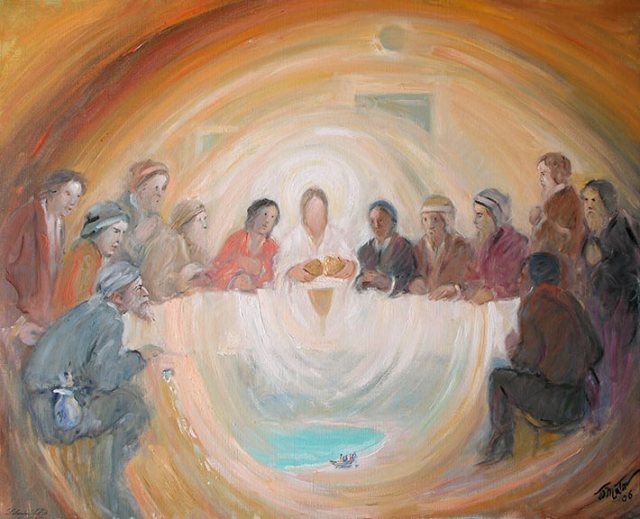
I Am the Bread of Life, by Joseph Matar

I like Jesus. I like metaphors. Jesus is a metaphor guy. I like that. Jesus said that he is the bread of life. Those who come to Jesus are satisfied. Those who eat him, live forever. This isn’t cannibalism, it’s a metaphor. The bread that Jesus gives for the life of the world is his flesh.

Metaphors help us relate to the concept, and grasp the message. If you’re hungry, just looking at a loaf of bread isn’t going to help you be satisfied. Obviously, you have to eat the bread and do more than see it, smell it, and touch it.

What’s more, people do more than eat once. We eat repeatedly, every day, at least a few times a day, in order to be healthy and alive.

Come and see Jesus. But do more than that. Ingest him. Take Jesus into your life. Let the bread of life come into you and thoroughly satisfy you. And do it every day. Do it several times a day. Make sure your soul is continually full of Jesus.

Then, you will have life to the full, an abundant life, filled with good things and right relationships.

Jesus is the bread of life. He is the great “I am.” And so much more.

Yet, perhaps at first glance, Jesus is just one person amongst a panoply of historical characters and religious figures. However, if we will but taste Jesus, we will come to see something very different about him. He’s more than a human being, more than a compelling teacher, and more than a miracle worker.

Jesus may appear, to many, as nothing more than a common person. But there’s really nothing ordinary about him, at all. Taking the time to have a good look at the Gospel of John, and watching Jesus move from village to village, and person to person will help us see a rather uncommon person who was no ordinary human being.

He moved to the beat of a different drum, and danced an alternative jig. And if we observe more closely, we can see the other two dance partners with him.

And with our two ears, when he says, “I am,” we can respond with an emphatic, “He is.”

Merciful Father, you heard the prayers of your people in the wilderness and fed them bread from heaven despite their sin. Graciously hear us today and feed us, too, with the Bread of Life from heaven, our Lord Jesus Christ, who lives and reigns with you and the Holy Spirit, one God, now and forever. Amen.


I Am the Gate (John 10:1-10)

“Very truly I tell you Pharisees, anyone who does not enter the sheep pen by the gate, but climbs in by some other way, is a thief and a robber. The one who enters by the gate is the shepherd of the sheep. The gatekeeper opens the gate for him, and the sheep listen to his voice. He calls his own sheep by name and leads them out. When he has brought out all his own, he goes on ahead of them, and his sheep follow him because they know his voice. But they will never follow a stranger; in fact, they will run away from him because they do not recognize a stranger’s voice.” Jesus used this figure of speech, but the Pharisees did not understand what he was telling them.

Therefore Jesus said again, “Very truly I tell you, I am the gate for the sheep. All who have come before me are thieves and robbers, but the sheep have not listened to them.I am the gate; whoever enters through me will be saved. They will come in and go out, and find pasture. The thief comes only to steal and kill and destroy; I have come that they may have life, and have it to the full. (New International Version)

In an idyllic world, we would never have to contend with thieves and interlopers within the flock of God. But, as you well know, we live in a less than perfect world. The spiritual robber-baron is the one who poses as a religious figure, yet is really around to fleece the sheep.

Obviously, anyone who has to jump the fence, instead of entering through the gate, has something nefarious up their dastardly sleeve. In fact, these interlopers feel they have a right to get in, by any means, because of their inflated sense of self-importance.

Jesus, of course, is using metaphor and figure of speech to communicate something important: The thieves are robbing God’s honor for themselves and bringing harm to God’s people. By trying to take away the way, the truth, and the life, the religious leaders were spiritual burglars attempting to be both gate and gatekeeper.

In short, the religious leaders believed they were more important than Jesus; and they tried to keep Christ and the people from connecting with each other.

And that is the insidious form of all religious quackery – to keep people separated from what can help them the most so that the charlatan can soak up all the attention, authority, and accolades.

But a faithful and true shepherd enters through the gate with confidence and care. Such a person has no other agenda and no other concern than Jesus and what Christ has said, has done, and will do.

The pastoral ministers amongst us help lead the flock through the gate so that they might enjoy safety, security, and succulence. The shepherd calls people by name, and doesn’t generically yell at nameless folk, to bring them alongside the Good Shepherd.

Thus, we are to have a faithful concentration and commitment to Christ; a voice which is discernibly oriented toward pointing people’s attention to Christ; and a teaching and leadership which moves into the world in order to bring Christian speech and action that blesses the world.

One of the problems many persons experience is that they listen to strange voices, instead of the familiar voice of their trusted pastor and the voice of Scripture, reason, and history. They follow a pet preacher’s or person’s interpretation of everything without reservation, rather than seeking to hear the voice of God in everything which is said.

Big churches, large ministries, and eloquent people are not necessarily the vocal chords of God. We must be discerning and wise. Not everyone who says, “Lord, Lord,” will enter the kingdom of heaven. It’s only the person and the faith community which does the will of God that’s able to get in.

Wolves in sheep’s clothing exist. So, we must beware.

Idioms, figures of speech, and metaphors get lost on some folk. That’s what happened for Christ’s original hearers. A lot of head-scratching was happening because they couldn’t figure out what in the world Jesus was talking about. “They” are the people who interpret all of life through personal agendas and selfish means. Their self-absorption prevented them from seeing the person right in front of them, who he really was, and what he was actually saying to them.

I Am the Gate of the Sheepfold, by Kathrin Burleson

So, Jesus plainly told them that he himself is the gate of the sheep. “I am” the gate. Deliverance, reconciliation, freedom, and protection all come together in Christ to provide a good life, a life of abundance that is worth living. We have peace with God through the Lord Jesus.

In today’s Gospel lesson, we learn from Jesus the following:

  • The key to being a good shepherd is being faithful to Jesus Christ
  • The concerns of a good shepherd are to attract, bring in, protect, free, feed, and lead God’s people into a good life through Jesus Christ
  • The way for a good shepherd is to love the sheep, care for them, and be with them through thick and thin, as Christ does
  • The preoccupations of those who ignore entering through the gate, which is Jesus, are to gain for themselves what rightly belongs to God: glory, honor, praise, power, authority, accolades, and devotion.

Everything hinges on Jesus as the gate of life. In centering ourselves completely around Christ, and by giving up the false self of keeping up appearances to others, we find our true self, connected to God in which all our needs are fully met and satisfied.

Merciful Father, you gave your Son Jesus Christ to be the Good Shepherd. In his love for us, he laid down his life and rose again. Keep us always under his protection, and give us grace to follow in his steps, in the strength and enablement of the Holy Spirit. Amen.

Before We Chose God, God Chose Us

living bread

“Just as the living Father sent me, and I live because of the Father, so whoever eats me will live because of me.  This is the bread that came down from heaven, not like that which your ancestors ate, and they died.  But the one who eats this bread will live forever….  For this reason, I have told you that no one can come to me unless it is granted by the Father.” –Jesus (John 6:57-59, 65, NRSV)

It would be weird if someone insisted that they chose to be born.  I think most of us would respond something like, “Um, wait here just a moment,” then go and call the local psych ward.  That’s because we have no problem understanding that well before any of us were born, the love of two people conceived us.  Our choices within our family of origin are ours to own.  Yet, the initial choice to be a person on this planet was not ours to make.  We, rather obviously, are delusional to think otherwise.

The same is true on the spiritual plane.  Just as life is a gift given to us, so to be born again and have eternal life is a gracious grant given to us by God.  Yes, if we are Christians somewhere along life’s journey we chose Jesus.  Yet, long before our own individual choices were made, before the foundation of the world, God himself conceived of us and decided to give us the gift of faith to believe.

Before we get in a huff about the perceived lack of control on our part, stop and consider what a crazy hot mess of an apocalypse there would be if you or I were in charge.  Whatever issues people might have with God, having someone else in the driver’s seat is a bit like putting Homer Simpson as the sentinel guarding the donuts.  Probably not the best of ideas.

I would rather stick with Jesus, even when his words seem edgy and scandalous.  After all, telling folks they need to “eat me” could really go sideways in a hurry.  It’s no wonder that the early church often got accused of practicing cannibalism at the Lord’s Table.

God in Christ chose us so that we could enjoy an incredible restored relationship with our Creator.  Jesus, the Jew that he was, often spoke with deep layers of meaning.  What on the surface might seem super-strange is meant to convey things in a much richer and fuller way.  If it confuses some people, then maybe we need to sit with Christ’s words for a bit before simplifying them into some mish-mash of blither that ends up having no real meaning at all.

Beyond the sheer literal description of eating the body of Christ and drinking his blood, and merely flattening it out to mean Christian communion with wine and wafers, it could just be that Jesus wanted us to grab hold the grace of discovering the following five realities of his merciful passion up close and personal.

  1. Participation

To ingest Jesus is to participate in him.  It is to have a close, intimate connection and union with him.  Jesus identifies with his people so closely that it is as if we have absorbed him into our very being as much as any food nutrients.

I once lived near an old fence line.  The fence was long gone but one lone fence post remained.  A tree had grown up alongside and then around the post.  The post remained because the tree assimilated and engulfed it.  The only way to remove the fence post would be to cut down the tree – they were that much a part of each other.

We are in union with the Lord Jesus.  No one is snatching us out of his clutches.  We participate in his life.  We live because he lives.  We make choices because he first chose us.

  1. Provision

When we eat, what we eat, how we eat, and whom we eat with are anything but ancillary issues to the ancient Near Eastern mind and practice.  Food is a gift, a gracious gift given to us by a merciful Father who has our best interests at mind.  At the very heart of God is a hospitable bent that invites the misfit person, the misunderstood, the misanthrope, the miscellaneous, and any other “mis-sed” person into his wonderful provision of food.

Eating meals for most people around the world isn’t just about food; it’s about offering the acceptance of hospitality and communicating encouragement and recognition through lively conversation with the dignity of listening to another.  We severely truncate the power of meals when food is just gobbled quickly down alone by ourselves to satiate our growling stomachs.

Christ’s words about himself being the living bread that comes from heaven is chocked full of meaning.  On the heels of just having fed the five-thousand with bread, Jesus not only connects himself with the manna God gave the Israelites in the desert, but also lets his followers know that he is the only provision that will truly satisfy the most intense hunger.  “Blessed are those that hunger and thirst for righteousness,” he explained in his greatest Sermon, “for they shall be filled” (Matthew 5:6, NIV).

Through the provision of food, God invites us into his life.  What’s more, we are ushered into the realm of those who are recognized, seen, and accepted – regardless of our glaring warts, quirky idiosyncratic ways, and shadowy sins.  That’s because when God creates, he provides.  And when he provides, he graciously gives his blessing.

  1. Protection

Maybe it goes without saying that, by now, God will protect those whom he engrafts into his very life.  Yet, it still needs to be said with deliberate unction: God protects his own.

Getting back to the food thing, God’s meal-deal includes a generous portion of protection.  To come under a person’s roof to enjoy a meal together is to come under the owner of that home’s protection.  God never intended to save us, feed us, and provide for us without giving us everything we need for life and godliness in this present evil age (2 Peter 1:3).

All the implements we need to both defend ourselves and move forward with offense are graciously given to us.  The helmet of salvation, the breastplate of righteousness, the belt of truth, the shield of faith, the shoes of peace, and the sword wielding Word of God are all for our protection.  We only need to put them on, pick them up, and use them (Ephesians 6:10-20).

  1. Profession

The nub and the rub of Christ’s discussion about being living bread is that people need to eat him, that is, him only.  In other words, you only get to God through Jesus.  Period.  No exceptions.  Understandably, this was a hard teaching.  It was so hard that, when his followers grasped what in the heck he was saying, a big chunk of them left.  They didn’t sign up for this kind of exclusive rhetoric and crap about only being one real bread.

It has always been the scandal of Christians throughout the ages to insist that Jesus is the way, the truth, and the life, and that no one can come to the Father except through him (John 14:6).  But there it is.  And no amount of watering it down makes it go away.

I love and adore a variety of people.  I have many friends from different faith traditions and belief structures.  I would die for every one of them.  I would come to their side at any time they call me.  And I believe they need Jesus.  I believe everyone needs Jesus.  I understand that not everyone wants Jesus, or acknowledges him, or believes he is who he claims to be.  Nevertheless, to try and mitigate or diffuse or minimize Christ’s very hard words is doing a disservice and an injustice to what Jesus was truly saying and claiming.

To profess Jesus as Lord and Savior is a gift that is being received from a gracious and merciful gift-giver, who is God.

  1. Perpetual

The simple observation about eating is that you don’t just eat once, never to eat again.  Nope, we continually eat every single day, most of us doing it multiple times in the day.  We in the West have refrigerators full of food, some of which ends up getting moldy and no good.  Maybe we stockpile food because we don’t connect it with Jesus.  If God is the One who truly gives the grace of a decent meal, perhaps we would feel less prone to buy food and eat it like it’s going out of style.

We are to eat Jesus.  Not once.  Not twice.  But continually.  Every day.  Christ is the perpetual feast.  We are to come to him day after day, receiving his gift of sustenance for us in every sense of the concept.

We can choose to come to Jesus because he has first given himself to us.  Before we chose God, God chose us by giving us deliverance from our misguided ways through the merciful work of Jesus.

Exodus 3:7-15

            Several years ago, when I attended seminary, I got to know several persons from around the world who came to study theology and ministry.  One of those people was a man from India whom I became good friends with.  His name was P.J.  I asked P.J. one day what the initials stood for.  He replied, “No one in the West is able to pronounce my real name, so I simply go by the initials P.J.”  
             When Moses asked God what his name is, God gave him an answer similar to my friend P.J.  He replied to Moses, “I Am Who I Am.”  Okay.  That was not exactly what Moses was looking for, but he did get an answer to his question.  It was as if God knew that his name was much too wonderful to ever pronounce, so he gave Moses a name that people could actually call him.  
             “Yahweh” is the name in Hebrew.  It is only one word, but is difficult to exactly translate; it certainly cannot be translated into one word in English which is why we need to have an entire phrase in order to even begin to make sense of the name “Yahweh.”  Other Bible translations (i.e. NIV) capitalize all the letters of “LORD” in order to cue the reader that the name “Yahweh” is being used.
             A phrase in vogue today to communicate something that is hard to make sense of but is nonetheless real is, “It is what it is.”  That perhaps is as close as we get to understanding “Yahweh.”  He is who he is; God will be who he will be.  The LORD is so far above us that he must communicate to us in a kind of baby language, much like a parent who simply bends down and utters coos over the crib of her infant.
             God has been gracious to stoop to us and reveal something of himself to us.  The fullest expression of this love is the sending of the Son, the Lord Jesus, to be with us so that we can know this God who is who he is.  The proper response to this grace from Yahweh is gratitude, praise, and trust.
             Yahweh, the great I AM, you have graciously entered my life especially through the person of Jesus Christ, your Son.  Guide me each day to explore and know you so that my faith will be strengthened and my path righteous, through the power of the Spirit.  Amen.