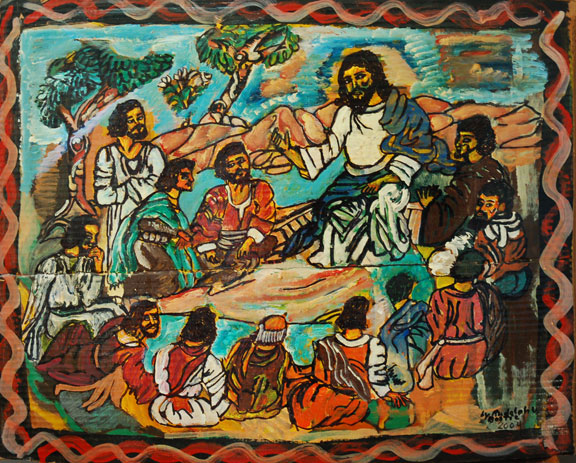
Luke 9:1-6 – On Power, Authority, and Mission

Jesus and the Disciples by Rudolph Bostic (1941-2021)

Jesus called the Twelve together and he gave them power and authority over all demons and to heal sicknesses. He sent them out to proclaim God’s kingdom and to heal the sick. He told them, “Take nothing for the journey—no walking stick, no bag, no bread, no money, not even an extra shirt. Whatever house you enter, remain there until you leave that place. Wherever they don’t welcome you, as you leave that city, shake the dust off your feet as a witness against them.” They departed and went through the villages proclaiming the good news and healing people everywhere. (Common English Bible)

You have likely heard the old nineteenth century adage from a member of the British Parliament, Lord Acton: “Power tends to corrupt, and absolute power corrupts absolutely.” The rest of the quote, which we seldom hear is this: “Great men are almost always bad men, even when they exercise influence and not authority.”

It’s almost as if Jesus knew this well before Lord Acton uttered it nearly two millennia later. Jesus Christ, in a truly wise and generous display of leadership, shared his power and authority with others. Rather than hoarding power and using authority to gain more authority, the Lord Jesus, rightful Ruler of the universe, delegated power and enabled those who ministered with him to share in carrying out his mission.

The only real Christian ministry is a bestowed ministry, granted to us by the delegation of Jesus. What this means for us, practically, is that believers minister as servants of God and stewards of the power and authority given to us. Grasping this basic accountability helps us to truly serve others with sensitivity and care – knowing we must give an account for the privilege of ministering in Christ’s name.

“There is no stronger test of a person’s character than power and authority, exciting as they do every passion, and discovering every latent vice.”

Plutarch (46-119, C.E.)

This has tremendous implications for us in all areas of life. Within the family, this means that parental authority can and ought to be delegated in wise increments, over time, as children grow and mature. The concept that a dad should be some sort of supreme leader who barks orders and demands fealty from mom and the kids is downright misguided, not to mention incredibly weird.

It also means that in the church and in faith communities, the wise use of power and authority will seek to identify and mentor younger disciples who will be given appropriate authority for expected ministry. Church leadership will listen to and equip those who have passions for particular service with the requisite authority to engage in effective ministry.

At the workplace, this involves forsaking a top-down approach of authority in favor of distributing power equitably amongst the workers with the greatest responsibilities.

In the political arena, this means Christians won’t tie their hopes in gaining power but rather in giving it away. They will seek equity and the common good of all citizens. And if that means deferring to a voice which isn’t being heard, then that is precisely what we do. Perhaps we see so little civility and concern for the other because Christians are much too enamored with dramatic miracles fueled by power.

Mosaic in the Papal Basilica, Rome, of Jesus and Disciples

Let’s not lose sight of the reality that healing sicknesses and suppressing the demonic is solely derived from Christ’s own authority, not ours. To press this reality home, Jesus instructed his disciples to take nothing with them. No staff, bread, bag, or money. Live among the locals, with them, on their turf and with their activities. Use the power and authority given to improve their lives and in so doing, lead them to greater spiritual truths.

If they don’t accept this gracious ministry, move on. No arm-twisting. No manipulation. No guilt-tripping. And definitely no using your given authority for grandstanding. A simple warning with shaking the dust off the feet is sufficient.

Every detail of the mission Christ gave to the disciples was a lesson in sheer and total dependence on God. Humble ministry and modest lifestyle will set the best table for a proper focus on benevolent and compassionate ministry. Just as increased knowledge ought to be used to love better and show us how much we actually don’t know, so increased authority ought to be used to serve others better and show us how much power we don’t have so that we might continually seek after the God who possesses all power and authority.

The good news is that God’s infinite and supreme power is given and focused in the person of Jesus Christ, who in turn, graciously bestows the authority to his followers so that they may proclaim forgiveness and new life. It’s a big message requiring large authority. And Jesus freely gives it:

And Jesus came and said to them, “All authority in heaven and on earth has been given to me. Go therefore and make disciples of all nations, baptizing them in the name of the Father and of the Son and of the Holy Spirit, and teaching them to obey everything that I have commanded you. And remember, I am with you always, to the end of the age.” (Matthew 28:18-20, NRSV)

It’s enough to make old Lord Acton smile in his grave.

Eternal God, you call us to live with faith in a world filled with so many challenges. Help us remember our mandate and our mission to use our given authority properly, lovingly, and confidently with obedience to our Lord.

Teach us by your Word, through our brothers and sisters in Christ, and in our prayers to learn and understand what you would have us to be and to do, so that we may fulfil our calling as Christ’s Body here on earth.

Draw your church together into one great company of disciples, together following our Lord Jesus Christ into every walk of life, together serving him in his mission to the world, and together witnessing to his love, in the strength of your Holy Spirit. Amen.


2 Kings 22:11-20 – Humble Yourself

The Scribe Shaphan Reading The Book Of Law To King Josiah by Leonaert Bramer (1596-1674)

When Josiah heard what was in The Book of God’s Law, he tore his clothes in sorrow. At once he called together Hilkiah, Shaphan, Ahikam son of Shaphan, Achbor son of Micaiah, and his own servant Asaiah. He said, “The Lord must be furious with me and everyone else in Judah, because our ancestors did not obey the laws written in this book. Go find out what the Lord wants us to do.”

The five men left right away and went to talk with Huldah the prophet. Her husband was Shallum, who was in charge of the king’s clothes. Huldah lived in the northern part of Jerusalem, and when they met in her home, she said:

You were sent here by King Josiah, and this is what the Lord God of Israel says to him: “Josiah, I am the Lord! And I will see to it that this country and everyone living in it will be destroyed. It will happen just as this book says. The people of Judah have rejected me. They have offered sacrifices to foreign gods and have worshiped their own idols. I cannot stand it any longer. I am furious.

“Josiah, listen to what I am going to do. I noticed how sad you were when you read that this country and its people would be completely wiped out. You even tore your clothes in sorrow, and I heard you cry. So, I will let you die in peace before I destroy this place.”

The men left and took Huldah’s answer back to Josiah. (Contemporary English Version)

It is hard to fathom that things spiritually degenerated so much in the kingdom of Judah that the Book of Law, God’s Word to Israel, was completely lost. The Law was tucked so far back in the temple, and had gathered so much dust, that everyone simply forgot it existed. 

Maybe we in the Western world can relate to this more than we think. When a plethora of Bibles and translations exist, yet they gather dust on the shelf, and we have not cracked it open since….?

We are approaching the end of the Christian Year which annually culminates in Christ the King Sunday. As we journey with Jesus and ascend his holy hill, we anticipate corporately acknowledging Christ’s lordship. A good and biblical way to do so is through penitent humility. 

King Josiah’s officials found the Book of the Law and brought it to him. After they read the words, which had not been uttered for a very long time, the king was completely undone with humble repentance. He realized the life of the nation did not revolve around the majesty and kingship of God, and it cut him to the core of his being.  

An appropriate response to the realization of God’s sovereignty and Christ’s lordship is humility. Without humility, there is no going forward; there is only the ghastly state of remaining stuck in one place with ancient dust accumulating on our static hearts. However, with humility there is repentance; and with repentance there opens up the grand vistas of hope, new life, and fresh beginnings.

“It was pride that changed angels into devils; it is humility that makes men as angels.”

St. Augustine

I (humbly) ask that you try something quite different from your regular experience today. Put on some old clothes then carefully read the words of today’s Old Testament Scripture lesson. Take the time to acknowledge a sin of omission in your life. Then, tear your clothes; yes, rip your shirt. 

Allow yourself to feel, like Josiah, the realization of missing the mark. Yet do not remain in this condition. Drink in the grace of God in Christ and receive the forgiveness that is yours in Christ. The trajectory of our Christian lives is determined by the depth of humility we experience and filling the hole with mercy.

It’s difficult to be submissive. To acknowledge, without denial, that we are in a bad place and will reorient our lives takes a lot of courage and humility. If pride and arrogance are the original sin, then the remedy to that malady is a meek and obedient spirit. 

No matter who we are, people are meant and designed by their Creator to live a humble life of submission to the moral and ethical will of God.

Humility is the cornerstone to every good thing in this life.  Jesus said:

“Blessed are the poor in spirit, for theirs is the kingdom of heaven… Blessed are the meek, for they will inherit the earth.” (Matthew 5:3, 5 NIV)

The door of God’s kingdom swings-open on the hinges of humility. The Apostle Paul, seeking to follow his Master Jesus in his teaching and humility said:

“Since God chose you to be the holy people he loves, you must clothe yourselves with tenderhearted mercy, kindness, humility, gentleness, and patience.” (Colossians 3:12, NLT)

Basic human relations are to be firmly grounded in humility. The old prophet made his expectations clear:

“He has told you, O mortal, what is good; and what does the Lord require of you but to do justice, and to love kindness, and to walk humbly with your God?” (Micah 6:8, NRSV)

Life is truly life when it is based in humility. We live with the confidence of the psalmist:

“God leads humble people to do what is right, and he teaches them his way.” (Psalm 25:9, GW)

In the end, we are to bow to the God of the Word, for the Word is life.

Awesome God, although I might not always perceive your majesty and sovereignty, you stand above all creation as the Lord whom I am to submit to in all things.  I come to you in great humility of heart and vow to obey everything I read in your Holy Word through Jesus Christ, my King. Amen.

Acts 7:54-8:1 – Humility and Hubris

A 10th century depiction of Stephen’s martyrdom

When the members of the Sanhedrin heard this, they were furious and gnashed their teeth at him. But Stephen, full of the Holy Spirit, looked up to heaven and saw the glory of God, and Jesus standing at the right hand of God. “Look,” he said, “I see heaven open and the Son of Man standing at the right hand of God.”

At this they covered their ears and, yelling at the top of their voices, they all rushed at him, dragged him out of the city and began to stone him. Meanwhile, the witnesses laid their coats at the feet of a young man named Saul.

While they were stoning him, Stephen prayed, “Lord Jesus, receive my spirit.” Then he fell on his knees and cried out, “Lord, do not hold this sin against them.” When he had said this, he fell asleep.

And Saul approved of their killing him.

On that day a great persecution broke out against the church in Jerusalem, and all except the apostles were scattered throughout Judea and Samaria. (New International Version)

Although I am a trained in biblical exegesis and hermeneutics (interpreting Scripture) I believe that most insights come from making simple observations about the text. So, I want to point out: Stephen was not martyred by the Romans, a religiously pagan group, or Gentile people; he was martyred by those of his own ethnicity, by the people of God.

They weren’t simply unhappy with Stephen. The Sanhedrin (the Jewish ruling council) were incensed with him, so mad that they were grinding their teeth at him. The council truly believed Stephen was a blasphemer of God, that what he was saying was so subversive and religiously radical, they could stone him to death with a clear conscience, as if it were upholding God and God’s Law.

The result was not only the death of a humble man; it also sparked an intense persecution against the church which caused a new Christian diaspora. Many believers in Jesus now found themselves as Christian refugees trying to eke out a living and worshiping Christ in foreign places.

I wish I could say the greatest opposition I’ve ever experienced as a Christian came from non-Christians who simply misunderstood and misinterpreted me. However, my most hurtful wounds have come from the hands of church folk, believing they were acting on God’s behalf by exacting an emotional martyrdom upon me with the stones of gossip, slander, backbiting, blame-shifting, and outright lying.

Never look down on anybody unless you’re helping them up.

Whenever I encounter persons who no longer attend church and have no intention of ever returning to any local congregation, I get it. I understand. I’ve been there. Yet, although the church is sometimes like a woman of disrepute, I still love her, and will do whatever I can to edify her and not repay evil with evil.

Stoning a believer, either actually with physical rocks or virtually with metaphorical stones, is akin to persecuting Jesus himself. That’s because Christ so closely identifies with his people that it is as if he is a head, and his followers are a body – joined together in a vital union.

So, when Christ’s Body is subjected to hermeneutical hubris in which one group of people insists there is only one way to interpret Scripture, and then uses it’s authority and structures of power to force compliance on another group, the result is persecution.

And that is precisely why Christians can abuse other Christians.

Rather than discerning that all Christians belong to God, one narrow-minded and small-hearted group excludes all other groups who disagree with them as blaspheming the name of Christ.

Insisting, for example, that a literal interpretation in the only means of understanding the Bible’s authority is to ignore and abuse the actual and real authority which exists with the Bible. I am in no way encouraging an “anything goes” type of approach to Holy Scripture that lets it say whatever you want it to say. 

What I am stating is that the biblical writers themselves employed different methods of interpretation, as well as the early church fathers (which is one reason I hold to the interpretive guides of the ancient Christian creeds, i.e. The Apostles’ Creed and Nicene Creed).

Far too often churches stick to a particular interpretation because they believe they are keeping biblical fidelity. This is many times born of a fear that Christendom will be lost, and society will sink into an abyss of egregious sin. The irony is that many churches are sinking into forms of abusive and ungracious behavior by fighting battles that Scripture itself never calls them to fight.

The binary thinking of “I’m right and you’re wrong” is not an approach you’ll find in God’s Holy Word.

Even if the Sanhedrin in Stephen’s day intended on upholding the holiness of their God and the rightness of their cause, the impact it had on the church was death and diaspora.

Unfortunately, throughout Christian history, the tables have too often turned with Christians persecuting Jews. I myself would like to avoid being the persecutor. If I kill anything, may it be putting to death my own sin.

Gracious God, as your Son humbled himself on this earth, so may your church walk continually in such humility that believers everywhere work together in unity for the sake of gospel of grace as a blessing to the world in the power of your Holy Spirit. Amen.

James 3:13-4:3, 7-8a – A Spiritual Diagnosis and Treatment Plan

Byzantine icon of the Apostle James, the brother of Jesus

Who is wise and understanding among you? Let them show it by their good life, by deeds done in the humility that comes from wisdom. But if you harbor bitter envy and selfish ambition in your hearts, do not boast about it or deny the truth. Such “wisdom” does not come down from heaven but is earthly, unspiritual, demonic. For where you have envy and selfish ambition, there you find disorder and every evil practice.

But the wisdom that comes from heaven is first of all pure; then peace-loving, considerate, submissive, full of mercy and good fruit, impartial and sincere. Peacemakers who sow in peace reap a harvest of righteousness.

What causes fights and quarrels among you? Don’t they come from your desires that battle within you? You desire but do not have, so you kill. You covet but you cannot get what you want, so you quarrel and fight. You do not have because you do not ask God. When you ask, you do not receive, because you ask with wrong motives, that you may spend what you get on your pleasures….

Submit yourselves, then, to God. Resist the devil, and he will flee from you. Come near to God and he will come near to you. Wash your hands, you sinners, and purify your hearts, you double-minded.

The Apostle James wrote to a church facing all kinds of challenging adversity in their daily lives. Some of the believers responded wisely to their troublesome circumstances. Yet others dealt with their trials and tribulations by being troublesome people themselves. 

It was this breakdown in the church fellowship which spurred James to write his letter. The surface problem was infighting. But James wanted to get down to the root issues below the surface. Like a doctor understanding the pathology of the body, James diagnosed the real problems, and gave a clear treatment plan on how to proceed together in the Christian life. 

His prescription for spiritual health in the Body of Christ was not medication but a lifestyle change. Today’s New Testament lesson answers three diagnostic questions which ailed this ancient church.

First diagnostic question:  Who is wise and understanding among you?

Wise persons live a good life, demonstrated by their humble actions. They have trained themselves in the ways of God through the Scriptures.

Wisdom in the Bible is much like driving a car. You try to keep your eyes on the road and drive defensively while often making quick decisions on the road. You don’t fret about why there is a tight curve or an upcoming stop sign. You don’t try and determine the philosophy behind the mechanics of a stop light. You just try to do what needs to be done on the road to get where you need to go. And as you drive you respond to the road conditions and pay attention to the other drivers. 

Wisdom in the Christian life is more than knowledge; it is also being attentive to the other people around us as we seek to live for God. We respond to every adverse road condition that comes along with a mind dependent on God and a humble heart willing to be directed and re-directed by God’s Holy Spirit.

The unwise person sits and harbors selfish resentment in his heart when he has to wait ten minutes on a train to slowly rumble by on the tracks. The same person then desires to take off like a bat out of hell, freely expressing his road rage at another slow driver in his way.

In his lack of wisdom, the person justifies himself as wise because he believes his destination warrants his way of driving. He has convinced himself that he must drive the way he does. And if pulled over by a police officer, he deludes himself in thinking the officer has a problem for standing in the way of him getting where he wants to go.

Conversely, wise people are characterized by a different set of motivations and practices:

  • Humility and attentive consideration of another’s need.
  • Moral purity and being set apart for Christian service.
  • Peace and harmony, championing the common good of all. 
  • Empathy and an understanding spirit that does not retreat into judgmental criticism or attacking others – putting themselves in another’s shoes and to first understand before trying to be understood. 
  • Submissive to the truth with a teachable spirit and deliberately implement necessary changes to their lives. 
  • Merciful, seeking compassion in action. 
  • Impartial, steady and consistent, with a predictable godly character. Adverse road conditions and selfish drivers do not throw them off. 
  • Sincere, genuine, and vulnerable with a willingness to face their own dark shadows and have no ulterior motives.

God cares as much about why we do what we do and how we go about it, as he does the actual action and its end result. God desires true wisdom, not false wisdom. In diagnosing false wisdom, there is jealous bitter envy and plain old selfishness. The source of the problem is the devil. And if the problem goes unchecked and no lifestyle changes are made, the body will breakdown into disorder and evil destructive behavior.

In diagnosing true wisdom, there is evidence of good deeds done from a good heart devoted to God. The source of the good actions is humility. This results in the good spiritual health of righteousness (right relationships with both God and others) and peace (harmonious relations with both God and others).

Second diagnostic question:  What causes fights and quarrels among you?

After examination, the problem comes from certain desires that act like a disease.  The presenting symptoms are verbal battles and animosities. The cause is “desire” or “pleasure” (Greek: ἡδονῶν) from which we get our English word “hedonism.” 

Hedonism is the belief and practice that pleasure is the chief good in life. It is a consuming passion to satisfy personal wants, and the willingness to do whatever it takes to obtain those wants. The cause of all the in-fighting was hedonism. Certain people wanted what they wanted, and they would do whatever it took to get it.

Hedonism twists our perspective. It skews our judgment. Hedonism calls 911 from the drive through at McDonalds when they run out of chicken nuggets (true story!). Hedonism is a cancer in the Body of Christ. It makes small things big and big things small. Hedonistic desires will do anything it takes to gain satisfaction. A passage in the Screwtape Letters by C.S. Lewis has the Senior Devil giving his understudy, Wormwood, some advice: 

“Never forget that when we are dealing with any pleasure in its healthy and normal and satisfying form, we are, in a sense, on the Enemy’s [God’s] ground.  I know we have won many a soul through pleasure.  All the same, it is God’s invention, not ours.  He made the desires; all our research so far has not enabled us to produce one.  All we can do is to encourage the humans to take the pleasures which our Enemy has produced and get them to go after them in ways in which He has forbidden.  An ever increasing craving for an ever diminishing pleasure is the formula.”

C.S. Lewis, Screwtape Letters

There is an alternative to the no-holds-bar pursuit of hedonism: You do not have because you do not ask God…. And even then, if still holding onto the hedonistic stance through prayer, there will be no answer because of asking with wrong motives. 

Prayer as a cloak for seeking hedonistic pleasure is nothing but spiritual adultery; it is talking to God with a spiritual mistress on the side to meet the needs that God does not seem to care about.

Third diagnostic question:  What does God want?

God wants prayer from a humble heart that seeks to engage the real enemy. Our fight is with our own pride, not with each other. If we have good and godly desires for prayer but find that we do not seek God as we ought; and come to the Scriptures discovering there is a sickness in our soul; then, the prescription is humble submission to God, resistance to evil ways, and drawing near to God.

God wants people to turn from the pride of radical independence and clandestine desires to openly and humbly seeking divine help.

The Apostle James was not trying to be a killjoy when he said to grieve, mourn, and wail; and to change your joy to gloom. He was speaking directly toward the propensity for people to slide into hedonistic attitudes and practices. He was directly accessing the Beatitudes of our Lord Jesus.  Blessed are the poor in spirit for theirs is the kingdom of God.  Blessed are those who mourn for they shall be comforted. 

In other words, true joy and happiness comes through humility. When we realize our great need for God and humbly approach as a spiritual beggar, cut to the heart over our own hedonistic pleasure-seeking, as well as all the filth existing around us, then we discover the prayer that God longs to hear.

God’s prescription for us is:

  • Learn and rely on divine promises in daily life.
  • Do the work of peacemaking and expect a harvest of righteousness.
  • Be humble and let grace and lift us up.
  • Put significant effort into resisting the devil so that he will flee from us.
  • Draw near to God; God will come near to you.

So, let us maintain our therapy appointments for developing humility. Let us admit our wrongs and ask for forgiveness. Let go of bitter envy and selfish ambition. Obey the Scriptures. Bank on God’s promises. For in doing so, we will discover the life that is truly life.

O Lamb of God, by both your example and teaching you instructed us to be meek and humble. Give us grace so that in every thought, word, and deed, we will imitate your meekness and humility. Put to death in us all pride. Keep us from falling prey to the many temptations in our path. Teach us your ways and show us how to clothe ourselves in godly humility. Thank you for your Word and help us to see the beautiful truth about humility. Do the good work of making us more and more like your Son, our Lord, Jesus Christ. Amen.