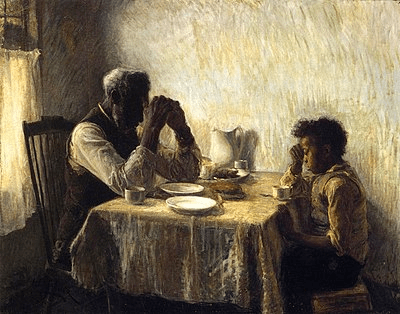
Psalm 82 – Help Others, Without Prejudice

“The Thankful Poor” by Henry Ossawa Tanner, 1894

God takes his place in his own assembly.
He pronounces judgment among the gods:
“How long are you going to judge unfairly?
How long are you going to side with wicked people?”

Defend weak people and orphans.
Protect the rights of the oppressed and the poor.
Rescue weak and needy people.
Help them escape the power of wicked people.

Wicked people do not know or understand anything.
As they walk around in the dark,
all the foundations of the earth shake.
I said, “You are gods.
You are all sons of the Most High.
You will certainly die like humans
and fall like any prince.”

Arise, O God!
Judge the earth, because all the nations belong to you. (God’s Word Translation)

“My dear friends, pay attention. God has given a lot of faith to the poor people in this world. He has also promised them a share in his kingdom that he will give to everyone who loves him.”

James 2:5, CEV

God’s mercy and grace is what makes the world go round. God’s attention to people who possess little to nothing is what upholds the earth from being consumed with judgment.

An absence of grace in people is offensive to God. An uncharitable spirit, indifferent to those in need, will eventually face the crushing weight of God’s glory upon them.

The psalmist is uncompromisingly clear on divine imperatives for humanity: defend the weak; protect the rights of the poor; rescue the needy; and deliver them from unjust power. That’s what God does. And that is what we are to do, without prejudice.

When I was growing up, our family dog was named “Sam.” Sam loved being on the farm. One time he tussled with a skunk. I could barely get close enough to clean him up because he stunk so badly. 

Favoritism toward those with means over those who don’t, stinks, and God has a hard time getting close to us when we show partiality to others. And the Lord is going to clean us up when he smells the stench of discrimination on us. 

Showing favoritism to some over others is evidence that the dog is running away from the bath of grace. In order to develop relationships and interact with people the way God wants us to, we must be free from prejudice.

No matter how you slice the Bible, God cares about persons trapped in poverty. The poor are important to the Lord. 

When Jesus began his earthly ministry, he pointed people to the words of the prophet Isaiah.

“The Spirit of the Lord is upon me, because he has chosen me to bring good news to the poor.” (Isaiah 61:1; Luke 4:18) 

In the Old Testament, there are seven different words for the “poor” because poverty was such a pervasive reality (and still is across the world!). The range of meanings includes those who are poor because of laziness; those born into poverty; being poor because of inhuman oppression or slavery; simple beggars; and the pious humble poor. 

These spiritual poor persons are the Hebrew “anawim.” (pronounced “on-a-wheem”) The anawim are humble persons caught in grinding poverty, having no choice but to put their trust in God.

God has a lot to say about such persons because they are near and dear to the divine heart. Old Testament law was quite clear about how to treat the poor. 

Poor persons will never disappear from the earth. That’s why I’m giving you this command: you must open your hand generously to your fellow Israelites, to the needy among you, and to the poor who live with you in your land. (Deuteronomy 15:11, CEB)

Do not cheat poor and needy hired servants, whether they are Israelites or foreigners living in one of your towns. Each day before sunset pay them for that day’s work; they need the money and have counted on getting it. If you do not pay them, they will cry out against you to the Lord, and you will be guilty of sin. (Deuteronomy 24:14-15, GNT) 

The mistreatment, exploitation, and inattention to the poor, the anawim, was the chief reason God sent prophets to Israel. 

Listen to this, you who rob the poor
    and trample down the needy!
You can’t wait for the Sabbath day to be over
    and the religious festivals to end
    so you can get back to cheating the helpless.
You measure out grain with dishonest measures
    and cheat the buyer with dishonest scales.
And you mix the grain you sell
    with chaff swept from the floor.
Then you enslave poor people
    for one piece of silver or a pair of sandals.

Now the Lord has sworn this oath
    by his own name, the Pride of Israel:
“I will never forget
    the wicked things you have done! (Amos 8:4-7, NLT)

Instead of being generous to the poor and allowing them to forage for grain at harvest behind the harvesters, they kept “those people” away from the fields so that they could turn a profit at every little bit they could. And God thought it all stunk to high heaven.

Bear in mind, only the poor in spirit will enter the kingdom of heaven. The real issue is humility that demonstrates grace to people who cannot offer you something in return. 

It’s easy to be merciful to people who will turn around later and scratch your back. It’s altogether a different thing to be humble, gracious, and generous to those you know cannot give anything back to you.

God cares about the condition of our souls and not the balance of our bank accounts. 

Inattention to the needy only betrays a heart far from the Lord. God does not judge people on face value and the state of their finances, and neither should we.

The only way to rid ourselves of the stench of showing favoritism is to receive the cleansing bath of God’s mercy in Jesus Christ. The shampoo of grace is available, that is, if we will let God apply it. God is the expert in:

  • Turning people from only associating with those they are comfortable with, to lovingly reaching out to people very different from themselves
  • Changing people from the stinking thinking about what they can continually obtain and consume, to people who are loving and generous with their words and their physical resources
  • Putting to death a proud spirit that looks to get ahead and accomplish an agenda by any means possible, to giving new life through humble repentance.

Ministry to the poor is a non-negotiable for the Christian and Christ’s Church. 

Beyond mere dispensing of benevolent funds, the poor also need relationships, connections, resources, and a chance to give back in ways they can contribute. That’s just part of being attentive to them and extending basic human respect and dignity. 

How do you or your church show their concern for the poor in your city and/or region?

Almighty and most merciful God, we remember before you all the poor and neglected persons whom it would be easy for us to forget: the homeless and the destitute, the old and the sick, and all who have none to care for them. Help us to heal those who are broken in body or spirit, and to turn their sorrow into joy. Grant this, gracious Father, for the love of your Son, who for our sake became poor, Jesus Christ our Lord. Amen.

Daniel 1:1-21 – Cultural Humility

In the third year of the reign of Jehoiakim king of Judah, Nebuchadnezzar king of Babylon came to Jerusalem and besieged it. And the Lord delivered Jehoiakim king of Judah into his hand, along with some of the articles from the temple of God. These he carried off to the temple of his god in Babylonia and put in the treasure house of his god.

Then the king ordered Ashpenaz, chief of his court officials, to bring into the king’s service some of the Israelites from the royal family and the nobility—young men without any physical defect, handsome, showing aptitude for every kind of learning, well informed, quick to understand, and qualified to serve in the king’s palace. He was to teach them the language and literature of the Babylonians. The king assigned them a daily amount of food and wine from the king’s table. They were to be trained for three years, and after that they were to enter the king’s service.

Among those who were chosen were some from Judah: Daniel, Hananiah, Mishael and Azariah. The chief official gave them new names: to Daniel, the name Belteshazzar; to Hananiah, Shadrach; to Mishael, Meshach; and to Azariah, Abednego.

But Daniel resolved not to defile himself with the royal food and wine, and he asked the chief official for permission not to defile himself this way.Now God had caused the official to show favor and compassion to Daniel, but the official told Daniel, “I am afraid of my lord the king, who has assigned your food and drink. Why should he see you looking worse than the other young men your age? The king would then have my head because of you.”

Daniel then said to the guard whom the chief official had appointed over Daniel, Hananiah, Mishael and Azariah, “Please test your servants for ten days: Give us nothing but vegetables to eat and water to drink. Then compare our appearance with that of the young men who eat the royal food and treat your servants in accordance with what you see.” So, he agreed to this and tested them for ten days.

At the end of the ten days, they looked healthier and better nourished than any of the young men who ate the royal food. So, the guard took away their choice food and the wine they were to drink and gave them vegetables instead.

To these four young men God gave knowledge and understanding of all kinds of literature and learning. And Daniel could understand visions and dreams of all kinds.

At the end of the time set by the king to bring them into his service, the chief official presented them to Nebuchadnezzar. The king talked with them, and he found no one equal to Daniel, Hananiah, Mishael and Azariah; so, they entered the king’s service. In every matter of wisdom and understanding about which the king questioned them, he found them ten times better than all the magicians and enchanters in his whole kingdom.

And Daniel remained there until the first year of King Cyrus. (New International Version)

Cultural humility is a humble and respectful attitude toward individuals of other cultures that pushes one to challenge their own cultural biases, realize they cannot possibly know everything about other cultures, and approach learning about other cultures as a lifelong goal and process.

Daniel is a much revered biblical figure. And for good reason. He exhibits the best qualities of humanity.

The mighty Babylonian Empire invaded Judah, tore down the wall of Jerusalem, seized the Temple, and carried off the best and the brightest Jews to Babylonia for service to the powerful King Nebuchadnezzar.

By the king’s orders, the young men were given to Ashpenaz, the head official, to be trained in the cultural ways of the Babylonians. And this is where it gets interesting. The interaction between Daniel and Ashpenaz is a master class in cultural competence and cultural humility.

Cultural competence emphasizes the knowledge of the person in the majority. Cultural humility, however, allows other people to share their own experiences.

Cultural humility is about curiosity. The real discovery, and real competence, is in knowing there’s something you may not understand about another individual or group. Being open to finding out or figuring out what that difference is, is the humble curiosity which can lead to new and good possibilities.

Daniel and the others were forcibly taken from their home. They are in a strange place and are not about to acquiesce in becoming Babylonians instead of a Jews.

Ashpenaz was given a clear task by the king, which was essentially to make Babylonians out of them. This could be an explosive situation. Yet, it wasn’t, because both Ashpenaz and Daniel were willing to have some cultural humility about their situation.

The humility of Daniel, his way of being civil and present, opened the way for Ashpenaz to listen. The young men did not want to go against their religious convictions. At this point, Ashpenaz took the way of humility. He learned something about these Jewish men under his charge. Instead of filing that information away in his head or in some papyrus library, Ashpenaz became open to Daniel’s suggestion.

And, as it turns out, both Ashpenaz and the Babylonians were much better off because of two men’s interactions based in humility. Furthermore, Daniel and the others navigated a dicey situation and came out holding to their integrity, not to mention their lives.

Ashpenaz was not only willing to learn about another culture (cultural competence) but took the next necessary step in letting that knowledge affect how he went about his job. The open discussion about differences is what led to belonging.

Today, we must realize that the idea you can arm yourself with a body of knowledge about a culture and believe that’s all you need to do, doesn’t give anyone or any culture much space to change. In other words, knowledge by itself isn’t being inclusive of another’s perspective or ways. Knowledge alone doesn’t bring connection between differing people.

We need people (you and me!) who are willing to be curious and take the understanding we have about another culture and pursue changing something that isn’t right in our own culture. We must have people who are humble enough to discern that our own cultures have their good practices and their bad approaches.

Daniel wasn’t obnoxious about what he wanted and didn’t decry or verbally attack Ashpenaz and the Babylonian culture. And Ashpenaz didn’t simply ignore Daniel and force cultural colonization on him and the others.

This interaction between two people was the seed which eventually led to the Jews leaving exile and returning to Jerusalem. I doubt that ever would have happened, had Daniel and Ashpenaz held tightly to cultural pride.

Holy God, who sent your only Son Jesus Christ to be crucified for our sins, have mercy upon me. May I follow in his example, leading and loving in great humility, for you oppose the proud but raise up the humble. Help me to be gracious, patient, loving, and kind in every interaction, especially with those who are very different than myself. Amen.

Proverbs 4:1-9 – Pay Attention to Wisdom

Listen, children, to a father’s instruction,
and pay attention so that you may gain discernment.
Because I hereby give you good instruction,
do not forsake my teaching.

When I was a son to my father,
a tender, only child before my mother,
he taught me, and he said to me:
“Let your heart lay hold of my words;
keep my commands so that you will live.
Acquire wisdom, acquire understanding;
do not forget and do not turn aside from the words I speak.
Do not forsake wisdom, and she will protect you;
love her, and she will guard you.
Wisdom is supreme—so acquire wisdom,
and whatever you acquire, acquire understanding!
Esteem her highly and she will exalt you;
she will honor you if you embrace her.
She will place a fair garland on your head;
she will bestow a beautiful crown on you.” (New English Translation)

Pay Attention to Instruction

Once, when I was a kid growing up on the farm, I was playing hide-and-seek with my brother and got lost in a cornfield. The stalks were taller than me, and I couldn’t jump up and try to see over them. I started to panic.

Then, I got my wits about me and looked straight up into the sky. Even though I was only seven or eight years old, I had looked up at the sky a bajillion times in my short lifetime. My dad had taught me how to read the sky and the weather above us. Fortunately, I had listened well and paid attention to all those times we looked up together.

I knew that the position of the sun in the bright blue sky would give me a fixed point of direction. Once I did that, I walked in the direction I was certain would take me out of the cornfield, trying not to let fear take hold of me. In no time at all, I was out. I lost the game of hide-and-seek. But I didn’t care.

Wisdom is personified in the book of Proverbs as a sage woman and a discerning counselor for whom we must hear and heed her advice. 

In the Old Testament, wisdom is the practical daily application of knowledge and understanding. It’s the ability to take the knowledge of God and use it in everyday life in a way that leads to human peace, contentment, and flourishing. There are two important aspects to wisdom. 

Pay Attention to Knowledge

First, the individual must possess some body of knowledge. If we are ignorant (without knowledge) then we have no ability to exercise wisdom. More than once, I rescued cousins and friends from the cornfield while playing hide-and-seek, because they didn’t have the same understanding of the sky that I did.

So, it’s absolutely imperative for us to actively seek understanding. It’s not going to simply drop into our lap. We must purposely strive to look up and see the Son, to view life from God’s perspective, and to put ourselves in another person’s shoes. 

To gain wisdom, we must become readers, listeners, and devoted learners. Why? Because without books to read, without spiritual directors to consult and listen to, and without adopting the humble posture of learning from others, we will never realize wisdom.

The telltale sign of one who fails to read, listen, and learn, is that they continually opine on everything with no evidence to back up their opinions, no insight into the human condition, and no grace in their language. In the book of Proverbs, such as a person is labeled the “fool.”

Pay Attention to Behavior

The second aspect to wisdom is that the individual must use the acquired knowledge to have good behavior and to live well. 

Knowledge by itself, apart from actual practical use, only produces puffed-up pride (1 Corinthians 8:1). The reason for accumulating understanding is to use it for the welfare of others, for the benefit of the common good. 

We have quite enough preening peacocks in this world who have answers for every earthly problem under the sun. This world needs much less of them, and more of those who seek the humility that comes from biblical wisdom. As the Apostle James in the New Testament once put it, we must be doers of the Word and not hearers only (James 1:22).

Wisdom is realized whenever there is learning that has come through both the head and the hands. Proverbs is a very good place to begin constructing a life of wisdom. Reading one chapter a day, for one month, will get you through the entire book. 

Make a wise plan to carefully go through Proverbs sometime this spring or summer. You’ll be glad you did. And so will those around you.

Pay Attention to Prayer

God of all wisdom, save me from pride and arrogance, and take me to the place where Christ’s humility is center stage, where I’m lifting up clean hands and a pure heart to you.

Spirit of discernment, take me to the place where I’m no longer looking with panic or anxiety at the cornfields and situations I face, but look up to you, where I can see clearly, and my decisions are flooded with your bright light, truth, and justice.

Jesus, teacher of all that is right and good, I submit to your instruction and humbly seek to live into your words and ways. I keep my ears open to receive your counsel, my heart open to receive your eternal wisdom, and my eyes open to see your risen and ascended glory.

Just, right, and wise God – Father, Son, and Spirit, the God whom I serve – know that I love wisdom. I desire it more than money, fame, or power. Help me to use biblical common sense, spiritual savvy, and Scriptural discernment so that I might learn the good and the beautiful. Amen.

Ephesians 4:1-6 – Realizing Unity and Peace through Humility

As a prisoner for the Lord, then, I urge you to live a life worthy of the calling you have received. Be completely humble and gentle; be patient, bearing with one another in love. Make every effort to keep the unity of the Spirit through the bond of peace. There is one body and one Spirit, just as you were called to one hope when you were called; one Lord, one faith, one baptism; one God and Father of all, who is over all and through all and in all. (New International Version)

In the economy of God, unity isn’t a privilege but a necessity. Unity is not an ancillary or side issue to the real work of the Church and the Christian life; it is very much at the center of Christianity. 

Christians have been fashioned through the Holy Spirit into a single harmonious religious community of redeemed people, called to exemplify a counter-cultural presence in the world. 

There is a solid theological reason for this: God is one. Just as the triune God exists as one deity in three persons, so the church is to reflect God’s image through its unified oneness.

Although unity has been accomplished through the finished work of Jesus on the cross, the practical implications must be daily worked out. This is why we are to strive, or to put significant effort into, having unity. 

Simply getting along outwardly with someone or some group, while inwardly harboring animosity toward them, is not unity. Just because two people are not at each other’s throats does not mean there is peaceful unity. 

Unity only occurs when the Body of Christ works together in its diverse gifts toward a common goal of knowing Christ and making him known… with humility.  

In yesterday’s blog post on Ephesians 1:17-19, I laid down the challenge of praying chapter one’s prayer daily for two weeks. To up the ante on the prayer, try doing it with another person in the church. Having a common unity of purpose in mind and heart through prayer is a beautiful thing. 

In fact, if there is to be any sort of church revitalization, personal renewal, and national revival, it will begin in the prayer rooms of unified believers who share a common love for God and neighbor, a similar attitude of humility and gentleness, and a shared commitment of showing patience toward others.

This is the way of unity and peace. And it requires a great deal of effort to unpack these gracious spiritual gifts which have been mercifully given to us.

Unity is at the center of the earliest ecumenical creeds of the Church. The early church fathers (and mothers) wisely discerned the great importance of a unified faith and striving toward peace with all believers.

We believe in one God,

            the Father, the Almighty,

            maker of heaven and earth,

            of all that is, seen and unseen.

We believe in one Lord, Jesus Christ,

            the only Son of God,

            eternally begotten of the Father….

We believe in the Holy Spirit, the Lord, the giver of life,

            who proceeds from the Father and the Son….

We believe in one holy catholic and apostolic Church.

            We acknowledge one baptism for the forgiveness of sins. – The Nicene Creed

There is one Father, not three fathers; one Son, not three sons; one Holy Spirit, not three spirits.

And in this Trinity, no one is before or after, greater or less than the other; but all three persons are in themselves, coeternal and coequal; and so, we must worship the Trinity in unity and the one God in three persons….

Although he is God and man, he is not divided, but is one Christ.

He is united because God has taken humanity into himself; he does not transform deity into humanity.

He is completely one in the unity of his person, without confusing his natures.

For as the rational soul and body are one person, so the one Christ is God and man. – The Athanasian Creed

Since God is one, we are to be one people. This is the path of peace. One God. One people. There cannot be unity and peace apart from humility.

Invalidating a person’s feelings or thoughts does no one any good. It happens because of pride and a profound lack of humility.

Imagine going to see a doctor who turns out to be arrogant. He doesn’t really listen to you. He just gives a quick exam and offers his diagnosis with a regimen of more pills to take. You’re left sitting there while he’s off to another patient, colonizing another person’s mind and emotions with his expertise.

I’m not giving doctors a hard knock. I know many physicians, and they do wonderful compassionate work. Yet, it’s likely that you, like me, have had that occasional experience of the doctor, all full of themselves, having all the right answers on your pain and situation.

You may have also had the unfortunate experience of having a pastor, therapist, or counselor assess your situation with little information and even smaller compassion. Like writing a script for pills, they give you a few Bible verses and tell you to quit sinning and live obediently.

If pride and arrogance are the original sin, then the remedy to that malady is humility. No matter who we are – whether doctors, pastors, laypersons, patients, or whomever – we are meant and designed by our Creator God to live a humble life.

Humility is the cornerstone to the unity and peace we desire. Jesus said:

“Blessed are the poor in spirit, for theirs is the kingdom of heaven.” (Matthew 5:3, NIV)

The door of God’s kingdom swings-open on the hinges of humility. The Apostle Paul, seeking to follow his Master Jesus in his teaching and humility said:

“Since God chose you to be the holy people he loves, you must clothe yourselves with tenderhearted mercy, kindness, humility, gentleness, and patience.” (Colossians 3:12, NLT)

Basic human kindness with one another is grounded in humility.

The beauty of a humility-based existence is that multiple people discover together how to grow, thrive, and flourish in a situation where it isn’t currently happening. Breakthroughs occur in the soil of humility when all voices are heard and given weight.

We live with the confidence of the Psalmist:

“God leads humble people to do what is right and teaches them the way.” (Psalm 25:9, GW)

In the end, it’s a common commitment to exercise humility which realizes unity and enjoys peace.

May it be so, to the glory of God and for the sake of the world.

Blessed Holy Trinity, the God whom I serve, may your church on earth be one as you are one. I pray our unity of love and purpose will transform individuals, churches, organizations, systems, and the entire world for the glory of the Father, and of the Son, and of the Holy Spirit, one God, now and forever. Amen.