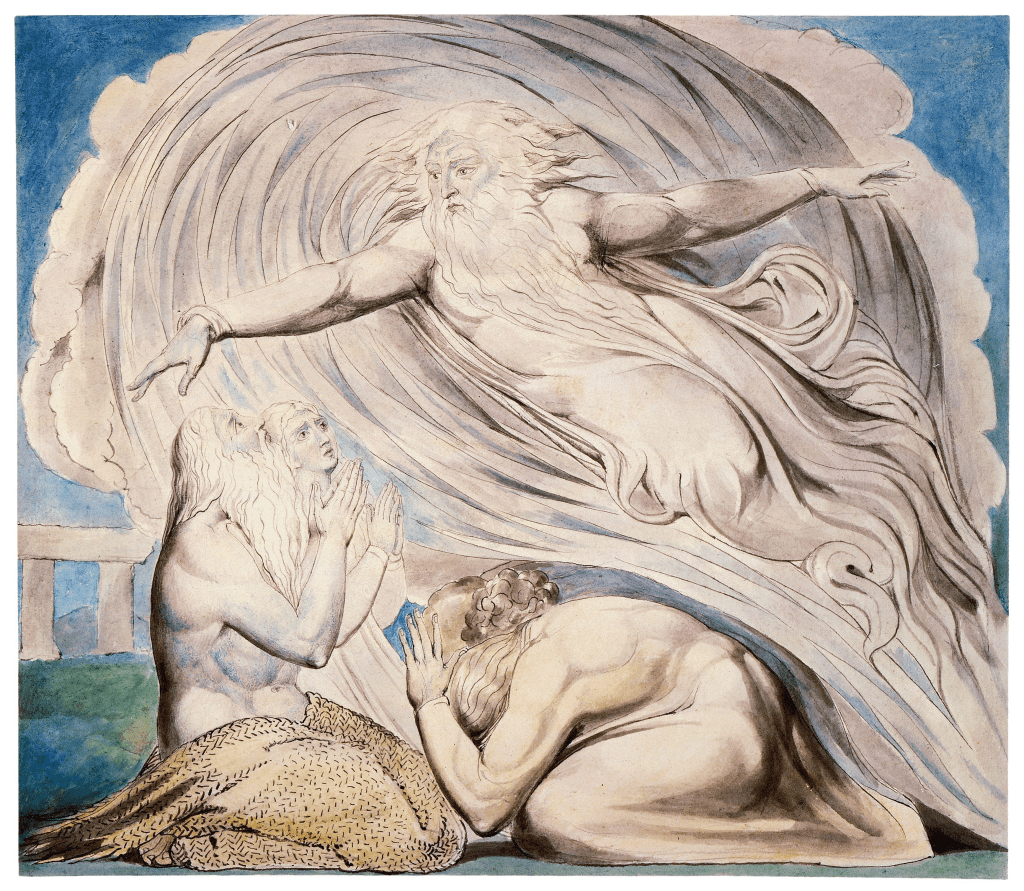
Do You Really Know? Probably Not (Job 38:22-38)

God Answers Job Out of the Whirlwind, by William Blake, 1826

“Have you entered the storehouses of the snow
    or seen the storehouses of the hail,
which I reserve for times of trouble,
    for days of war and battle?
What is the way to the place where the lightning is dispersed,
    or the place where the east winds are scattered over the earth?
Who cuts a channel for the torrents of rain,
    and a path for the thunderstorm,
to water a land where no one lives,
    an uninhabited desert,
to satisfy a desolate wasteland
    and make it sprout with grass?
Does the rain have a father?
    Who fathers the drops of dew?
From whose womb comes the ice?
    Who gives birth to the frost from the heavens
when the waters become hard as stone,
    when the surface of the deep is frozen?

“Can you bind the chains of the Pleiades?
    Can you loosen Orion’s belt?
Can you bring forth the constellations in their seasons
    or lead out the Bear with its cubs?
Do you know the laws of the heavens?
    Can you set up God’s dominion over the earth?

“Can you raise your voice to the clouds
    and cover yourself with a flood of water?
Do you send the lightning bolts on their way?
    Do they report to you, ‘Here we are’?
Who gives the ibis wisdom
    or gives the rooster understanding?
Who has the wisdom to count the clouds?
    Who can tip over the water jars of the heavens
when the dust becomes hard
    and the clods of earth stick together? (New International Version)

The older I get, and the more understanding I gain, the more I realize how little knowledge I truly possess.

When I was eighteen years old, I thought I had the world pretty much figured out. Since then, it’s all been downhill. With each passing year, my ignorance seems to grow. I suppose this all really makes some sense when talking about God’s upside-down kingdom.

There’s so much of life that is a mystery; and as we accumulate our life experiences, it seems all, not just some, of life is a mystical encounter. In other words, the more discernment I gain, I discover I know a lot less than I thought I did.

God Answers Job from the Whirlwind, by William Blake, c.1804

It seems as if the biblical character of Job found this out the hard way. If there is any person in Holy Scripture that would be wise and understanding, its him. God speaks highly of Job in the Bible.

Regarding the upcoming destruction of Jerusalem, God said, “even if these three men—Noah, Daniel and Job—were in it, they could save only themselves by their righteousness, declares the Sovereign Lord.” (Ezekiel 14:14)

Job is held up as the model of patience under suffering: “As you know, we count as blessed those who have persevered. You have heard of Job’s perseverance and have seen what the Lord finally brought about. The Lord is full of compassion and mercy.” (James 5:11)

Yet, with all of Job’s integrity, patience, and righteousness, his understanding barely moves the Richter Scale of God’s expansive knowledge.

We might be somewhat familiar with the story of Job. Being a conscientious follower of God, Job is careful to live uprightly. He acknowledges God in all things and worships him alone. Yet, suffering befell him – for no other reason than that God allowed it. Job knew fully well that there was no personal sin behind his awful ordeal of grief and grinding pain.

So, Job contended with God. For an agonizing thirty-five chapters (Job 3:1-37:24) Job questions God and respectfully takes him to task – as Job’s supposed friends questioned him and assume his guilt. Through it all God is there… silent… saying nothing.

The Desperation of Job, by William Blake, 1821

Then, just when we think God is paying no attention whatsoever, the Lord suddenly speaks.

And what is so remarkable about God’s speech is that for four chapters (Job 38:1-41:34) the Lord gives no answers. It’s all rhetorical questions. God said, “Brace yourself like a man; I will question you and you shall answer me.” (Job 38:3)

It becomes abundantly clear after just a few questions that it would be impossible for any human being to even come close to having the understanding God has. And that was the whole point.

God is God, and we are not. Our questions, however legitimate, real, and raw they are, come from a very puny perspective. Turns out, we just don’t know as much as we think we do.

To Job’s credit, he keeps his mouth shut and listens. At the end of the questioning, Job responds in the only wise way one could, after such an encounter: “Surely I spoke of things I did not understand, things too wonderful for me to know.” (Job 42:3)

None of this means that, for us, we need to face our hardships and our sufferings with a stoic keep-a-stiff-upper-lip approach. Trapped grief will inevitably come out sideways and only cause more hurt. I believe God allowed Job to express his terrible physical, emotional, and spiritual pain for chapter after chapter because he needed to.

Only when God sensed it was the proper timing did he jump in and bring the perspective Job then needed. And even after being challenged by God about his vantage point, Job still did not receive answers as to why he had to endure the awfulness of loss beyond what most of us could comprehend.

Maybe we lack being able to understand, even if God directly answered all our questions. Most likely, God protects us from knowing things that might bring irreparable damage to our human psyches. Again, this is all pure conjecture. Which leaves us with perhaps one of our greatest challenges as human beings:

We must eventually come to the place of being comfortable with mystery – and even embracing it. We simply will not have all things revealed to us that we want to know. And that’s okay.

There is yet one more comment to observe about God’s questioning of Job: God is sarcastic. Sarcasm often gets a bad rap, much like anger does, because it is so often associated with unacknowledged emotions and/or expressing our feelings in an unhelpful way.

Yet, there the sarcasm is, with the God of the universe. I take some odd comfort in knowing that God can be snarky at times – in a good way.

Anytime we try to pin God down to some tidy understandable categories, the Lord typically colors outside our human contrived lines and demonstrates to us that the divine cannot be contained in our ramshackle box.

I like it that God is playful, wild, and free to be God – even if there are times it may bug me.

God is unbound by any human knowledge, understanding, ideas, or plans. God will do what God will do. God will be who God will be. “I AM who I AM.” Now that’s a God I can put my trust in.

O Lamb of God that takes away the sins of the world, have mercy upon me.

O Lamb of God that takes away the sins of the world, have mercy upon me.

O Lamb of God that takes away the sins of the world, grant me your peace. Amen.

Humble Leadership (Numbers 11:24-30)

So Moses went out and told the people what the Lord had said. He brought together seventy of their elders and had them stand around the tent. Then the Lord came down in the cloud and spoke with him, and he took some of the power of the Spirit that was on him and put it on the seventy elders. When the Spirit rested on them, they prophesied—but did not do so again.

However, two men, whose names were Eldad and Medad, had remained in the camp. They were listed among the elders, but did not go out to the tent. Yet the Spirit also rested on them, and they prophesied in the camp. A young man ran and told Moses, “Eldad and Medad are prophesying in the camp.”

Joshua son of Nun, who had been Moses’ aide since youth, spoke up and said, “Moses, my lord, stop them!”

But Moses replied, “Are you jealous for my sake? I wish that all the Lord’s people were prophets and that the Lord would put his Spirit on them!” Then Moses and the elders of Israel returned to the camp. (New International Version)

“Blessed are the meek, for they will inherit the earth.”

Jesus (Matthew 5:5)

My dad was on the local schoolboard for many years when I was a kid. I remember him telling me that he could predict was the Superintendent of Schools was going to do. Dad would introduce a motion (an idea or action to take) knowing that it would be struck down by the Superintendent, who then would introduce the same motion months later as if it were his own idea.

We all have likely had the experience of other people taking credit for our work, or at least spinning a situation to make it appear like the person was more responsible or in charge of something good than they actually were. After all, most of us want to look good in the eyes of others. So, leaders sometimes (most of the time?) reinterpret and bend situations to make their leadership shine, especially when it isn’t shining at all.

But Moses was a different sort of leader. He is described in Holy Scripture as “a very humble man, more humble than anyone else on the face of the earth.” (Numbers 12:3, NIV)

Today’s Old Testament lesson illustrates for us what humility and meekness truly look like. And the leadership of Moses had an authentic shine to it which resulted from being close to God. (Exodus 34:29-34; 2 Corinthians 3:12-18)

What is a meek and humble leader?

In a world enamored with issues of power and authority, Moses was a counter-cultural leader who understood his position and embodied the true nature of service to both God and people.

Humility acknowledges that the leader is not the one who is truly in charge. Ultimately, God is, and not any of us. The Holy Spirit is totally sovereign and acts in whatever way the Lord wills. The Spirit will not be stereotyped, nor can anyone really discern or predict what the Spirit will do or not do.

For sure, a life of prayer, faith, and holiness are necessary for the Christian life. Yet, we must not therefore assume that our spiritual disciplines somehow guarantee particular outcomes. It’s plain arrogance to suppose that somehow we can maneuver or manipulate God for our own purposes – which is why we need to cultivate a life of humility and meekness.

The reply of Moses to Joshua’s concern about the Spirit being manifested in an unexpected way illustrates a gentle and generous spirit of heart. Far from silencing the two men prophesying apart from the others, Moses instead longed for such a blessing to be extended to all the people.

Good and godly leaders are such because their sole passion is to honor and glorify the Lord. For them, it doesn’t really matter whether they’re personally involved in the great and spiritual thing happening, or not. That’s humility, my friends.

If there’s a distinction between humility and meekness, it is this: The humble person is self-aware enough to know they can only do anything by the hand of God operating within them; and the meek person is socially aware enough to understand that, in their lowliness, they are unable to look down on anyone else. Therefore, pride, arrogance, and hubris are nowhere to be found.

To have divine validation is all that’s needed for the godly leader; and when one is content with what they need and want most, there’s no need for human accolades and constant attention.

Far too often, we equate meek with weak. If someone is meek, some folks wrongly reason they must be a washrag, or overly introverted, and maybe not taking proper initiative in life. Of all the leadership qualities we may aspire to, I doubt that meekness would make any leader’s top ten list of desired character traits.

Why would I want to be meek?

Jesus, an unquestioned leader, described himself as meek. Yet, many English translations steer clear of the word. For example, “Come to me,” the New International Version of the Bible says, “all you who are weary and burdened, and I will give you rest. Take my yoke upon you and learn from me, for I am gentle and humble in heart, and you will find rest for your souls. For my yoke is easy and my burden is light.” Only the King James Version translates the word as “meek,” instead of “gentle.”

What does it mean to be meek?

“Meek” is a word used in other ancient Greek literature for breaking a horse. It’s the change from being a wild stallion who wants to go his own way, to a broken horse who is able to be guided and used, allowing others on his back without bucking.

At the crucifixion, Jesus was naked, exposed, and vulnerable to the idle curiosity of the crowd and the vulgar frivolity of the soldiers who were having a party around his suffering. “If you are the king of the Jews,”they taunted,“save yourself.” (Luke 23:35-36)

The extraordinary thing is there was no spirit of revenge with Jesus. Christ did not curse his tormentors, but instead prayed, “Father forgive them, for they don’t know what they’re doing.” (Luke 23:34)

What characterizes a meek person?

  • The meek have a desire to put other’s interests ahead of their own, because they know it is not all about them. They practice healthy rhythms of giving and receiving with others, without prejudice or favoritism.
  • The meek are more concerned with edifying and building up their brothers and sisters than justifying themselves. They don’t care who gets the credit. And they receive criticism well.
  • The meek are truly egalitarian and do all things with equity and inclusion. They make no distinctions between rich and poor, beautiful and ugly, intelligent and cognitive deficits, black and white, gay and straight, Democrat and Republican, or insider and outsider. In the meek person’s mind, every person is created in the image of God and therefore deserves respect, attention, and justice.

How do I live as a meek person?

Perhaps repentance is in order. It could be that too many people have made much more of themselves than what they truly are. Maybe we have adopted a stance of shaming others, believing that some people need a bit of guilt from a leader in order to change their obnoxious ways.

Moses did not retaliate against the prophesying men or squelch what the Spirit was doing. Non-retaliation happens whenever we understand that we’re flat on our backs before God, and there is no place to look but up. And it also means there is no ability to look down on others. It is to be broken and moldable before God. 

Most importantly for the spiritual person, Moses had regular and extended times of meeting with God. It’s what kept him humble and maintaining a perspective on life that is healthy and helpful.

This day, almighty and holy God, be within and without me, lowly and meek, yet all-powerful. Christ as a light; Christ as a shield; Christ beside me, on my left and my right, I walk with you in humility of heart in the strength of the Holy Spirit. Amen.

Put To Death (Acts 7:55-60)

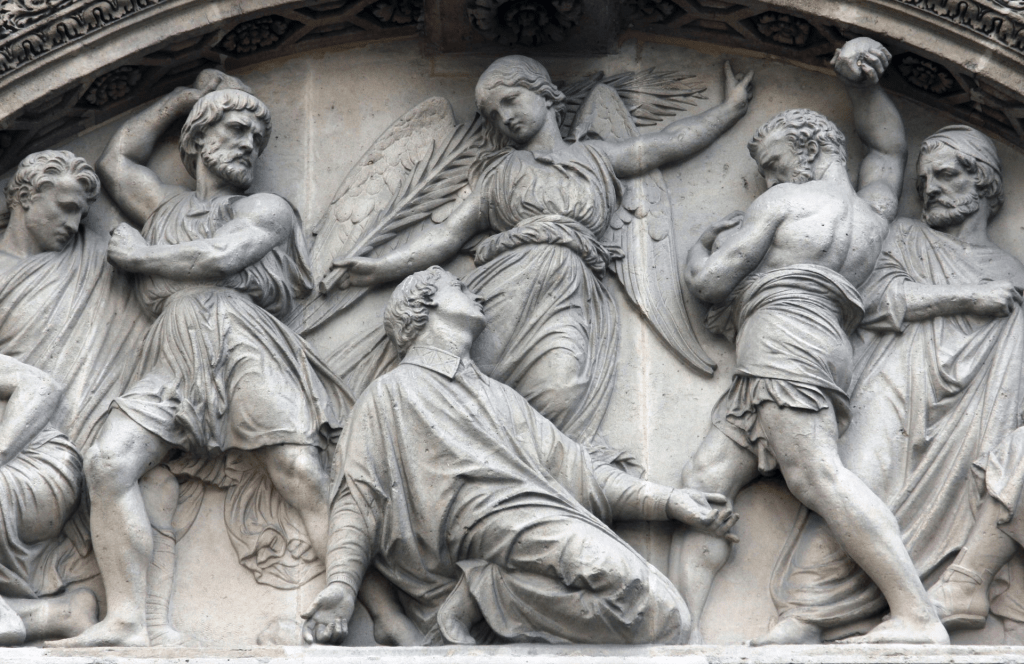
The Martyrdom of Stephen, by sculptor Gabriel-Jules Thomas (1824-1905)

But Stephen, full of the Holy Spirit, looked up to heaven and saw the glory of God, and Jesus standing at the right hand of God. “Look,” he said, “I see heaven open and the Son of Man standing at the right hand of God.”

At this they covered their ears and, yelling at the top of their voices, they all rushed at him, dragged him out of the city and began to stone him. Meanwhile, the witnesses laid their coats at the feet of a young man named Saul.

While they were stoning him, Stephen prayed, “Lord Jesus, receive my spirit.” Then he fell on his knees and cried out, “Lord, do not hold this sin against them.” When he had said this, he fell asleep. (New International Version)

Although I am a trained in biblical exegesis and hermeneutics (interpreting Scripture) I believe that most insights come from making simple observations about the text. So, I want to point out: Stephen was not martyred by the Romans, a religiously pagan group, nor Gentile people; he was martyred by those of his own ethnicity, by “God’s people.”

The religious authorities were more than just unhappy with Stephen. The Sanhedrin (the Jewish ruling council) were incensed with him, so mad that they were grinding their teeth at him. The council sincerely believed Stephen was a blasphemer of God, that what he was saying was so subversive and religiously radical, they could stone him to death with a clear conscience, as if this act were upholding God’s honor and God’s Law.

The result was not only the death of a humble man; it also sparked an intense persecution against the church which caused a new Christian diaspora (Acts 8:1-3). Many believers in Jesus found themselves as Christian refugees trying to eke out a living and worshiping Christ in foreign places.

I wish I could say the greatest opposition I’ve ever experienced as a Christian came from non-Christians who simply misunderstood and misinterpreted me. However, my most hurtful wounds have come from the hands of church folk, believing they were acting on God’s behalf by exacting an emotional martyrdom upon me with the stones of gossip, slander, backbiting, blame-shifting, and outright lying (and a few threats of violence).

Whenever I encounter persons who no longer attend church and have no intention of ever returning to any local congregation, I get it. I understand. Yet, although the church is sometimes like a woman of disrepute, I still love her, and will do whatever I can to edify her and not repay evil with evil.

Stoning a believer, either actually with physical rocks or virtually with verbal stones, is akin to persecuting Jesus himself. That’s because Christ so closely identifies with his people that it is as if he is a head, and his followers are a body – joined together in a vital union.

So, when Christ’s Body is subjected to what I call, “hermeneutical hubris,” in which one group of people insists there is only one way to interpret Scripture, and then uses their authority and structures of power to force compliance on another group, the result is persecution.

And that is precisely why Christians can abuse other Christians.

Rather than discerning that all Christians belong to God, one narrow-minded and small-hearted group excludes all other groups who disagree with them as blaspheming the name of Christ.

For example, insisting that a literal interpretation in the only means of understanding the Bible’s authority is to ignore and abuse the actual and real authority which exists with the Bible. I am in no way encouraging an “anything goes” type of approach to Holy Scripture that lets it say whatever you want it to say. 

What I am saying is that the biblical writers themselves employed different methods of interpretation, as well as the early church fathers (which is one reason I hold to the interpretive guides of the ancient Christian creeds, i.e. The Apostles’ Creed and Nicene Creed).

Far too often, churches stick to a particular interpretation because they believe they are keeping biblical fidelity. This is many times born of a fear that Christendom will be lost, and society will sink into an abyss of egregious sin. The irony is that many churches are sinking into forms of abusive and ungracious behavior by fighting battles that Scripture does not call them to fight.

The binary thinking of “I’m right and you’re wrong” is not an approach you’ll find in God’s Holy Word.

Even if the Sanhedrin in Stephen’s day intended on upholding the holiness of their God and the rightness of their cause, the impact it had on the church was martyrdom, death, and diaspora.

Unfortunately, throughout Christian history, the tables have too often turned with Christians persecuting Jews. I myself would like to avoid being the persecutor. If I kill anything, may it be putting to death my own sin – because that is what the Bible calls me to do.

Dear brothers and sisters, you have no obligation to do what your sinful nature urges you to do. For if you live by its dictates, you will die. But if through the power of the Spirit you put to death the deeds of your sinful nature, you will live.

The Apostle Paul (Romans 8:12-13, NLT)

Since, then, you have been raised with Christ, set your hearts on things above, where Christ is, seated at the right hand of God. Set your minds on things above, not on earthly things. For you died, and your life is now hidden with Christ in God. When Christ, who is your life, appears, then you also will appear with him in glory.

Put to death, therefore, whatever belongs to your earthly nature: sexual immorality, impurity, lust, evil desires and greed, which is idolatry. Because of these, the wrath of God is coming.You used to walk in these ways, in the life you once lived. But now you must also rid yourselves of all such things as these: anger, rage, malice, slander, and filthy language from your lips. 

Do not lie to each other, since you have taken off your old self with its practices and have put on the new self, which is being renewed in knowledge in the image of its Creator. Here there is no Gentile or Jew, circumcised or uncircumcised, barbarian, Scythian, slave or free, but Christ is all, and is in all.

Therefore, as God’s chosen people, holy and dearly loved, clothe yourselves with compassion, kindness, humility, gentleness and patience. Bear with each other and forgive one another if any of you has a grievance against someone. Forgive as the Lord forgave you. And over all these virtues put on love, which binds them all together in perfect unity.

Let the peace of Christ rule in your hearts, since as members of one body you were called to peace. And be thankful. Let the message of Christ dwell among you richly as you teach and admonish one another with all wisdom through psalms, hymns, and songs from the Spirit, singing to God with gratitude in your hearts. And whatever you do, whether in word or deed, do it all in the name of the Lord Jesus, giving thanks to God the Father through him. (Colossians 3:1-17, NIV)

Gracious God, as your Son humbled himself on this earth, so may your church walk continually in such humility that believers everywhere work together in unity for the sake of gospel of grace as a blessing to the world in the power of your Holy Spirit. Amen.

Submission Is an Attitude (1 Peter 2:13-17)

For the sake of the Lord submit yourselves to every human authority: to the Emperor, who is the supreme authority, and to the governors, who have been appointed by him to punish the evildoers and to praise those who do good. For God wants you to silence the ignorant talk of foolish people by the good things you do. Live as free people; do not, however, use your freedom to cover up any evil, but live as God’s slaves. Respect everyone, love other believers, honor God, and respect the Emperor. (Good News Translation)

Submission is a word a lot of people would like to do without. And that’s understandable. We’ve all likely had the experience of being under the authority of someone who either didn’t know what they were doing, or who gaslighted us, took advantage of us, and maybe was even downright mean and nasty toward us. What’s more, it’s hard to obey someone or some institution who we aren’t quite sure has our best interests at mind.

And then there’s an association with the word “submission” as being forced to do something you don’t want to do. That sort of understanding of submission is actually slavery and oppression, not submission.

Simply put, to submit is the informed and willing choice to place oneself under the authority of another. If it isn’t a willing and informed choice, then it’s either manipulation or coercion by another.

The Apostle Peter was referring to submitting to human authority by a volitional choice of our will. And what he was encouraging believers to do was no small thing.

The Roman Empire was an ancient behemoth. At the time of Peter’s writing, the Romans were firmly in charge of Palestine – Gentile rule in a Jewish land – and they did not take kindly to any ideas of rebellion. The Jews wanted their own autonomy and rule. To be subject to the Romans was, for many, humiliating and unacceptable.

So, why in the world should anyone willingly choose to submit to an empire that doesn’t align with their values, aspirations, and goals in life?

Peter made it clear why: Submission helps clear away the obstacles to freedom (both personal and corporate) and doesn’t give the persons in authority a reason to speak or act foolishly.

It’s hard to submit; it’s not an easy thing to do. Yet, if we will continually connect submission with why we are doing it, this helps us persevere, especially under leadership which is less than stellar.

The real issue is how we deal with unwanted circumstances in our lives. Although we didn’t ask for many of the unfortunate situations in life, our response to them is critical, and makes all the difference.

“Evil is changed into good when it is received in patience through the love of God; while good is changed into evil when we become attached to it through the love of self. True good lies only in detachment, and abandonment to God. You are now in the trial; put yourself confidently and without reserve into his hand.”

François Fénelon, Let Go: To Get Peace and Real Joy

Admittedly, it is maddening when an injustice is done to us, or we observe someone else experiencing something they don’t deserve. Unjust actions and words perpetrated against us are out of our control. What is, however, within our control is our response. We can choose how to react in each and every situation we face.

“Forces beyond your control can take away everything you possess except one thing, your freedom to choose how you will respond to the situation.”

Viktor Frankl, Man’s Search for Meaning

We, indeed, have a range of responses we may choose from: We can react in passive-aggressive anger, become sullen and morose, stuff all our emotions down and ignore them, lash out and verbally attack; or we can choose to accept the situation for what it is (and not what we want it to be) and submit ourselves to God.

All of you must put on the apron of humility, to serve one another; for the scripture says, “God resists the proud, but shows favor to the humble.” Humble yourselves, then, under God’s mighty hand, so that he will lift you up in his own good time. Leave all your worries with him, because he cares for you. (1 Peter 5:5-7, GNT)

Submission to God often comes in the form of submitting to the human authorities in our lives – even when those persons and institutions over us are imperfect. Systemic evil isn’t changed by our response of perpetrating even more evil back upon them. Rather, unjust structures are transformed through godly persons choosing to work within the system to do good, not harm, and to love, not hate.

Christian freedom is never a matter of simply doing whatever the heck you want to do, regardless of how it impacts anyone else. Our freedom is in the ability to make choices about what sort of attitude we are going to have in all the circumstances of life we encounter.

Don’t do anything from selfish ambition or from a cheap desire to boast, but be humble toward one another, always considering others better than yourselves. And look out for one another’s interests, not just for your own. The attitude you should have is the one that Christ Jesus had:

He always had the nature of God,
    but he did not think that by force he should try to remain equal with God.
Instead of this, of his own free will he gave up all he had,
    and took the nature of a servant.
He became like a human being
    and appeared in human likeness.
He was humble and walked the path of obedience all the way to death—
    his death on the cross. (Philippians 2:3-8, GNT)

Therefore, what we’re left with is the willing choice to alter our own life, instead of continually trying to make everyone else change. It comes down to showing respect for all humanity, honoring God with our attitudes, and loving our sisters and brothers in the faith who face the same sorts of challenges we do.

“When we are no longer able to change a situation, we are challenged to change ourselves.”

Viktor Frankl

Be safe. Be strong. Be spiritual. We are all in this life together.