Be Careful How You Judge (2 Samuel 10:6-12)

Hanun humiliates David’s ambassadors, c.1240 C.E.

When the Ammonites realized that they had become obnoxious to David, they hired twenty thousand Aramean foot soldiers from Beth Rehob and Zobah, as well as the king of Maakah with a thousand men, and also twelve thousand men from Tob.

On hearing this, David sent Joab out with the entire army of fighting men. The Ammonites came out and drew up in battle formation at the entrance of their city gate, while the Arameans of Zobah and Rehob and the men of Tob and Maakah were by themselves in the open country.

Joab saw that there were battle lines in front of him and behind him; so he selected some of the best troops in Israel and deployed them against the Arameans. He put the rest of the men under the command of Abishai his brother and deployed them against the Ammonites. 

Joab said, “If the Arameans are too strong for me, then you are to come to my rescue; but if the Ammonites are too strong for you, then I will come to rescue you. Be strong, and let us fight bravely for our people and the cities of our God. The Lord will do what is good in his sight.” (New International Version)

Cockiness can get you into a lot of trouble. It’s one thing to exude confidence; and it’s another thing to act like a puffed up peacock and do stupid stuff because of arrogance. The Israelite general Joab had the former; the Ammonites the latter.

King David had sent envoys to Ammon in the event of a new Ammonite king taking the throne after his father’s death. David was in the groove of extending kindness and establishing himself as the sort of ruler who has a heart, as well as a head.

However, Hanun the Ammonite king, viewed the Israelite delegation of people in a negative light, believing they had malevolent motives for coming. So, the king’s officials “seized David’s envoys, shaved off half of each man’s beard, cut off their garments at the buttocks, and sent them away.” (2 Samuel 10:4)

Not the smartest move on the planet. Humiliating a group of Israelites sent by David was a bad idea. The Ammonites, understandably, were put immediately on King David’s naughty list. And they then responded by recruiting mercenaries to their side, getting the clue that David wasn’t about to stand for the offense against Israel.

So, the Ammonites hired the Arameans to help fight Israel. But they were no match for the shrewd and seasoned Jewish general Joab. The mercenaries were soundly defeated, really because of God’s sovereign intervention over the much larger force put together by the Ammonites.

This ancient animosity and relational haggling tends to reflect the human condition, even to this day. It’s easy to fall into misinterpretations and misunderstandings that lead to conflict.

A lot of biblical interpreters read between the lines of the story, and see less than altruistic motives on David’s part. That may or may not be true. The story simply has David sending a delegation to Ammon in the event of the Ammonite king’s death – with the reason stated that David wanted to show kindness, just as the previous king had done with him.

It’s characteristic of judgmental spirits to look for people who agree with them – whether those people are Ammonite royalty or Bible interpreters. We tend to see what we are familiar with and know – which is why the interpretive process can and does vary widely amongst scholars and readers alike.

The Ammonite court bought into a perception of King David. And based upon that view, they believed a course of action which included humiliating others and finding mercenaries was the proper way to proceed.

But those sorts of methods themselves ought to raise a red flag with us, and cause us to question the perceptions and judgments behind them.

The king of Ammon believed he was acting in the right, and the Ammonites sought to justify themselves as legitimately acting with violence because of an Israelite threat.

By taking a Christian perspective, I believe we can be encouraged, rather than react with questionable tactics toward others who humiliate us and spout verbal violence upon us. A theological worldview discerns that righteousness will prevail. Justice and righteousness may not happen soon, and maybe not even in our lifetime; yet, it will eventually overcome any and all evil.

Jesus was unjustly judged by others who believed he was in league with the devil and was opposed to the law of Moses. Righteousness did prevail, but not after a great deal of suffering, which included a cross and a death.

King David himself did not withdraw from the situation, nor did he ignore it. David faced his accusers and entrusted himself and his nation to the God who is right and just.

We need not withdraw or ignore others in the face of judgmentalism. And we also need not resort to the same methods and tactics of judgmental people.

Showing kindness is important, and it must not be dependent upon whether one will respond favorably to us, or not. Sometimes you will experience judgmental spirits, no matter what.

Furthermore, be careful of the way you interpret another’s words and actions, and also how you respond to others. Jesus said:

“Do not judge, or you too will be judged. For in the same way you judge others, you will be judged, and with the measure you use, it will be measured to you.” (Matthew 7:1-2, NIV)

Those who love truth will tend to avoid snap judgments. God always makes a right judgment, and is the ultimate Judge of the universe. It is the Lord we need to please, and not any group of people.

A prayer of Thomas à Kempis (1380-1471):

Grant me, O Lord, to know what I ought to know,
To love what I ought to love,
To praise what delights You most,
To value what is precious in Your sight,
To hate what is offensive to You.
Do not suffer me to judge according to the sight of my eyes,
Nor to pass sentence according to the hearing of the ears of ignorant persons;
But to discern with a true judgment between things visible and spiritual,
And above all, always to inquire what is the good pleasure of Your will. Amen.


The “Fool’s” Speech (2 Corinthians 11:16-33)

I repeat: Let no one take me for a fool. But if you do, then tolerate me just as you would a fool, so that I may do a little boasting. In this self-confident boasting I am not talking as the Lord would, but as a fool. Since many are boasting in the way the world does, I too will boast. You gladly put up with fools since you are so wise! In fact, you even put up with anyone who enslaves you or exploits you or takes advantage of you or puts on airs or slaps you in the face. To my shame I admit that we were too weak for that!

Whatever anyone else dares to boast about—I am speaking as a fool—I also dare to boast about. Are they Hebrews? So am I. Are they Israelites? So am I. Are they Abraham’s descendants? So am I. Are they servants of Christ? (I am out of my mind to talk like this.) I am more. I have worked much harder, been in prison more frequently, been flogged more severely, and been exposed to death again and again. 

Five times I received from the Jews the forty lashes minus one. Three times I was beaten with rods, once I was pelted with stones, three times I was shipwrecked, I spent a night and a day in the open sea, I have been constantly on the move. I have been in danger from rivers, in danger from bandits, in danger from my fellow Jews, in danger from Gentiles; in danger in the city, in danger in the country, in danger at sea; and in danger from false believers. I have labored and toiled and have often gone without sleep; I have known hunger and thirst and have often gone without food; I have been cold and naked. Besides everything else, I face daily the pressure of my concern for all the churches. Who is weak, and I do not feel weak? Who is led into sin, and I do not inwardly burn?

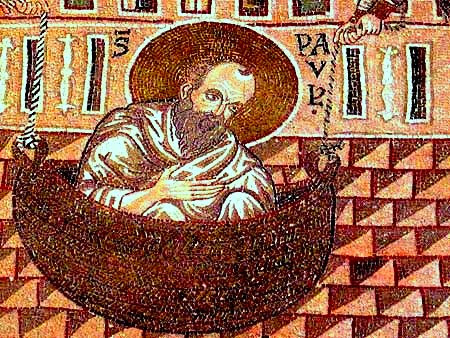
If I must boast, I will boast of the things that show my weakness. The God and Father of the Lord Jesus, who is to be praised forever, knows that I am not lying. In Damascus the governor under King Aretas had the city of the Damascenes guarded in order to arrest me. But I was lowered in a basket from a window in the wall and slipped through his hands. (New International Version)

Paul escaped the city of Damascus by being lowered in a basket at night (Acts 9: 23-25)

At this point in the Apostle Paul’s second letter to the Corinthian Church, he levels a direct and devastating attack on his proud, arrogant, and boastful opponents in the church. He points out the foolishness of their boasting, by means of playing the fool himself.

The gist of Paul’s argument was to boast of his humiliating experiences. In truth, Paul had plenty of glorious accomplishments he could have droned on about. Instead, he sought to expose the wide gulf that separated his understanding of apostolic ministry, and theirs.

With some rather hefty sarcasm behind his words, Paul offered some foolish boasting according to the human standards of his opponents. The Corinthians believed themselves to have superior strength and wisdom. Surely, they’re able to put up with these pathetic apostolic weaklings!

In reality, it is Paul’s weakness – and not humanly contrived understandings of strength – which establish his credibility and superiority as a minister of Christ’s gospel. The evidence is his hardships and trials – not his many triumphs. Paul intended for this irony to be felt by the Corinthians.

The Apostle’s litany of woes and adversities wasn’t meant to one-up the Corinthians. Rather, it was intended to be a parody of the Corinthians’ claims to superior wisdom and spiritual power.

While the church boasted of all the things that showed their strength, Paul boasted of his weaknesses – because it’s truly in weakness that the transcendent power of God is made known and manifested in this world.

Paul’s experience in Damascus not only illustrated the extreme danger he was in, but it served as an example of his weakness in contrast to the mighty strength of the Roman Empire.

In the Roman army, the soldier with the greatest strength and valor was the one who scaled the enemy wall first. The courageous ascent of the Roman soldier is viewed alongside the inglorious descent of Paul along the wall in escaping.

Christianity grew, flourished, and thrived not because of superior earthly strength, but because of humiliating weakness which allowed the power of heaven to work through it.

In light of Paul’s view of leadership and ministry, I find that many contemporary leadership theories are woefully lacking in an understanding of how people tick.

For example, some philosophies treat humans as if they were machines, and treat workers as cogs or parts in a larger mechanistic worldview, as if they could be replaceable.

Yet, leadership that relies on the factory system will inevitably demean a person’s basic humanity and see nothing of their inherent uniqueness and deserving of respect.

Instead, a more biblical, compassionate, and practical leadership style discerns that relationships are key; and that individual persons bring something special to their work, even if they are doing the same job as others.

In this understanding of leadership, every single person does their work or ministry in a way that isn’t fully reproducible by others. Our individual human uniqueness ensures that our place in the world is needed, and that what we bring to every endeavor we do is a special one-of-a-kind offering that no one else can do.

What’s more, in this view of leadership, there’s no room for boasting, at all. And no place for arrogant pride, because boasting is based upon comparison.

If every person is a unique creation of God, and everyone brings something individually special to their efforts, then comparison is a foolish waste of time, and boasting is nothing more than a fool’s game.

You can always tell the fool by how they keep talking and cannot keep their mouth shut about all of their accomplishments and everything they know. If they believe they’re right, and try and prove it with their comparative superiority to others, then you can bet that what you have in front of you is a card-carrying honest-to-goodness genuine Fool, with a capital “F.”

We can do better. And we can be better leaders and offer better leadership philosophies which are based in humility, the value of each person, sound relationships, and effective peacemaking.

Anything less than that will likely get a sarcastic comment from the Apostle Paul in heaven.

Give us, O God,
leaders whose hearts are large enough
to match the breadth of our own souls;
and give us souls strong enough
to follow leaders of vision and wisdom. Amen.

We’ve Had Our Fill of the Arrogant (Psalm 123)

I look up toward you,
the one enthroned in heaven.
Look, as the eyes of servants look to the hand of their master,
as the eyes of a female servant look to the hand of her mistress,
so our eyes will look to the Lord, our God, until he shows us favor.
Show us favor, O Lord, show us favor!
For we have had our fill of humiliation, and then some.
We have had our fill
of the taunts of the self-assured,
of the contempt of the proud. (New English Translation)

The patriarch of the Hebrews, Abraham, lived 4,000 years ago. Moses, the lawgiver and leader of the Israelites out of Egyptian slavery, lived 3,500 years ago. By the time the psalmist wrote today’s psalm, there had already been at least between 1,000 and 1,500 years of Jewish history. And, from the point the psalm was written until now, nearly 3,000 years of history have come to pass.

For all these millennia, the Jewish people have had to endure the contempt and hatred of all kinds of non-Jewish groups and nations. Their suffering has been continual and constant. They have endured multiple attempts of others trying to rid the earth of them. Jews have been mercilessly mocked, violently beaten, religiously persecuted, arrogantly humiliated, callously abused, and perennially shamed, just for being Jews.

The Jewish people know about generational trauma and suffering. They’ve experienced endless heartache and soul damage. And yet, the Jews are still here. They survive, despite so many intentions to wipe them off the map. There are few people groups that can say they still exist after 4,000 years of history.

I submit to you that one of the many reasons the Jewish people have survived, even thrived, for so long is that they have a rich heritage of Hebrew poetry and working out their emotions and their musings before God – and put it down on paper.

The Jewish people acknowledge their emotional and spiritual pain to God, lament it before God, and trust in God to handle their oppressors.

For the one who remains silent, and never sets pen to paper, will fade away and be forgotten. But the one who brings their shame to the light, and contends with the Lord about their suffering, shall see generation after generation continuing to struggle onward and upward.

Trusting God

The controlling image of today’s psalm has to do with the eyes looking. The psalmist looks up to heaven where God is enthroned as Creator and Sovereign over all the earth. Specifically, the eyes look toward the throne room of God.

Underlying the trust and faith of the people is the confession that God is the rightful and powerful Ruler of all. Just as servants look to their masters for provision, so the praying community of people looks to God for their every need – whether it be physical, mental, emotional, or spiritual.

Ultimately, this community looks for a sign of God’s inexhaustible and divine mercy. The worshiper prays, sings, and looks longingly with eyes wide open to the heavens. They look up in confident anticipation, searching for hope and a glimpse of divine mercy.

Here you will not find any sort of rugged individualism, prideful struggling alone, or refusals to ask for help. No! There is a refreshing realism and vulnerability of knowing who you are, where you are, and what you need – without any apology.

Complaining to God

The community of worshipers repeated their heartfelt and strong prayer for mercy from God. The people were facing a relentless stream of contempt from others, and they had more than enough of receiving this.

Those who mocked the Jews are identified as the proud and arrogant. In contrast to the worshipers, the mockers do not look up to the heavenly king, but instead look down on those different from themselves.

The arrogant look only to themselves, not to any master, and certainly not to the sovereign King of the universe. But the followers of the Lord look to their God for mercy because its absent from their experience of being and living on this earth.

Conclusion

The psalm begins with an affirmation of trust, and then, moves to the people’s plea for help from the God whom they place their trust and faith. This psalm was not only befitting of the ancient crisis of Israel’s exile to Babylon and all that happened afterwards in history; the psalm befits us today, as well.

Today, the Jewish people, along with many other religious communities around the world, are experiencing genocidal behavior from mockers who detest them and want to be rid of them altogether.

For all of us who seek the Lord and desire to truly live a pious and penitent life, our eyes look to the divine king for hope. In the midst of oppression by arrogant mockers who operate out of autonomy and independence from the God of mercy, we lift our eyes to the heavens and search God’s heavenly throne room for a glimpse of hope.

In every age – whether ancient, medieval, or modern – the faithful have always needed each other in the community. We have always had to embrace an interdependent dynamic of relating to one another, rather than operate as a mere collection of individuals who happen to be in the same place at the same time.

The faithful understand that life is not something they have earned or made, but is a gift from the Creator and Sovereign who is enthroned in the heavens. And without this perspective, we will continue to see hateful groups of people try to annihilate those different from themselves.

Merciful and loving God, when we are overwhelmed with fear and uncertainty, undermined by the distress of mockery, please love us and grant us patience under suffering.

Help us to love others as you love us; to accept others without judgment; to see difference as your gift of creation; and to remember that love is our greatest calling.

Generous God, you give freely of your love and mercy and grace. Prompt us to share our blessings and respond to the cries of the world.

Encourage us to help those facing the pain of discrimination and prejudice. May they experience healing of both body and soul.

Nurture us in faith, so that we will reach those in need, both near and far.

Inspire us to love all your children equally, without exception; and let us give and receive love, through the One whose name is Love, Jesus Christ, your Son, our Lord. Amen.

2 Samuel 10:1-5 – Misunderstood

Sometime later, King Nahash of Ammon died, and his son Hanun became king. David said, “Nahash was kind to me, and I will be kind to his son.” So, he sent some officials to the country of Ammon to tell Hanun how sorry he was that his father had died.

But Hanun’s officials told him, “Do you really believe David is honoring your father by sending these people to comfort you? He probably sent them to spy on our city, so he can destroy it.” Hanun arrested David’s officials and had their beards shaved off on one side of their faces. He had their robes cut off just below the waist, and then he sent them away. They were terribly ashamed.

When David found out what had happened to his officials, he sent a message and told them, “Stay in Jericho until your beards grow back. Then you can come home.” (Contemporary English Version)

Showing mercy, grace, and good faith doesn’t always have a happy ending.

Sometimes people get burned for their genuine gracious overtures. Not only do some folks not return or reciprocate with grace. There are times when someone refuses it and even responds with criticism and judgment.

King David was at the pinnacle of his rule. All Israel and Judah were under his gracious authority. David acted as a godly sovereign when he sought to use his power to show kindness and grace to those in his kingdom, even to those who were related to his former enemy, Saul. (2 Samuel 9:1-12)

Yet when David kept up his gracious ways and sent a delegation to the Ammonites in order to bring compassion to a grieving nation, they not only spurned the kindness but attributed evil intent to it.

Why in the world would they do such a thing? Why did Hanun, the new ruler of Ammon, reject David’s kindness? Because he severely misinterpreted David’s motives, and completely misjudged David’s intentions.

It is important to make wise assessments of others, and not quick judgments about people or their situations.

Being misunderstood is downright difficult to swallow. Yet we can avoid sinful reactions and respond with grace, even if grace isn’t being shown to us:

  • We can be gracious by not always needing to have the last word. Any fool can get easily get sucked into an argument. Know when to stop talking.

Too much talk leads to sin. Be sensible and keep your mouth shut. (Proverbs 10:19, NLT)

Even fools may be thought wise and intelligent if they stay quiet and keep their mouths shut. (Proverbs 17:28, GNT)

  • We can be gracious through cultivating a humble spirit. Pride assumes that another can be silenced with the power of words. What’s more, wounded pride typically manifests itself by gossiping to others about our hurt.

Destructive people produce conflict; gossips alienate close friends. (Proverbs 16:28, CEB)

Pride leads to destruction; humility leads to honor. (Proverbs 18:12, CEV)

God opposes arrogant people, but he is kind to humble people. (James 4:6, GW)

  • We can be gracious by developing our capacity for civility and empathy. Often when someone spews their off-base judgments and criticisms upon us, they have a world of their own past personal hurt behind the angry diatribe. We can choose to be gently curious about this, discovering why there is such a visceral reaction to our kindness.

“I tell you, love your enemies and pray for those who persecute you, that you may be children of your Father in heaven. He causes his sun to rise on the evil and the good and sends rain on the righteous and the unrighteous.” (Matthew 5:44-45, NIV)

Show respect for all people. Love your brothers and sisters in God’s family. Respect God and honor the king. (1 Peter 2:17, ERV)

  • We can be gracious through tapping into an inner storehouse of wisdom. Knowledge puffs up. Love builds up. Wisdom is insight into reality. For the believer, it is the ability to take God’s Word and lovingly apply it to the lived experience we are enduring.

Hold on to wisdom, and it will take care of you. Love it, and it will keep you safe. Wisdom is the most important thing; so, get wisdom. If it costs everything you have, get understanding. (Proverbs 4:6-7, NCV)

It is true, of course, that “all of us have knowledge,” as they say. Such knowledge, however, puffs a person up with pride; but love builds up. (1 Corinthians, 8:1, GNT)

One of life’s hard lessons is that bestowing grace and mercy to others does not necessarily mean they will receive it and respond in kind. 

In fact, there are some individuals who refuse grace and give back only scorn and derision. Even the Lord Jesus experienced this like no other before or after him. Christ endured all the foulness and degradation of a cruel cross because there were people who refused to see that he was extending God’s grace to them. He turned scorn on its head by despising shame and enduring pain so that we would be spared of such ignominy. (Hebrews 12:2-3)

In those times when we, at best, scratch our heads, and, at worst, weep uncontrollably over having our genuine love paid back with harsh misunderstanding, it is a good reminder that we are imitating the life of our precious Lord Jesus who knows exactly what shame is and what a profound lack of mercy can do. 

It is in the seasons and events of life which produce frustration that we understand this: Perfect peace will not be found in this life. So, we more fully attach ourselves to Jesus and find genuine grace and the solidarity of faith and love.

Consider what Christ went through; how he put up with so much hatred from those misinterpreting and misjudging him. Do not let yourselves become discouraged and give up from gross misunderstanding.

Loving God, I give you thanks for sending your Son, the Lord Jesus. Christ is the pioneer of my faith. Just as he endured the cross, scorning its shame, and sat down at your right hand, so help me to live into the grace you offer through Christ’s redemptive events so that I might persevere with grace through all the unmerciful acts of this world. Amen.