Healing the Outsiders (Matthew 8:1-13)

Jesus Healing, by Arthur Robins, 2020

When Jesus came down from the mountainside, large crowds followed him. A man with leprosy came and knelt before him and said, “Lord, if you are willing, you can make me clean.”

Jesus reached out his hand and touched the man. “I am willing,” he said. “Be clean!” Immediately he was cleansed of his leprosy. Then Jesus said to him, “See that you don’t tell anyone. But go, show yourself to the priest and offer the gift Moses commanded, as a testimony to them.”

When Jesus had entered Capernaum, a centurion came to him, asking for help. “Lord,” he said, “my servant lies at home paralyzed, suffering terribly.”

Jesus said to him, “Shall I come and heal him?”

The centurion replied, “Lord, I do not deserve to have you come under my roof. But just say the word, and my servant will be healed. For I myself am a man under authority, with soldiers under me. I tell this one, ‘Go,’ and he goes; and that one, ‘Come,’ and he comes. I say to my servant, ‘Do this,’ and he does it.”

When Jesus heard this, he was amazed and said to those following him, “Truly I tell you, I have not found anyone in Israel with such great faith. I say to you that many will come from the east and the west, and will take their places at the feast with Abraham, Isaac and Jacob in the kingdom of heaven. But the subjects of the kingdom will be thrown outside, into the darkness, where there will be weeping and gnashing of teeth.”

Then Jesus said to the centurion, “Go! Let it be done just as you believed it would.” And his servant was healed at that moment. (New International Version)

On a few occasions, my computer picked up a nasty virus that hijacked every file and function I have. The most frustrating thing about those events is that there was nothing I could do by myself to fix it or make it better.

I had to humble myself and ask a computer geek to get into my system and take care of the problem. It’s a weird feeling to look at my screen and have a stranger work inside my personal computer. But if I failed to get help, my computer was worthless – unless I let someone with authority fix the blasted thing.

Kingdom Values

Jesus is Lord of all. Since Christ has authority over everything, we are to live our lives in submission to his will and way. Only through humble resignation to Christ can we experience the healing and deliverance we seek.

Jesus preached his famous Sermon on the Mount (Matthew 5-7) and taught the people as one who had authority. In that Sermon, Jesus laid out the values of God’s kingdom: humility, sorrow over sin, meekness, purity, mercy, and peacemaking. In today’s Gospel lesson, we see the power of those values evidenced and expressed in two stories of healing and deliverance. 

The world needs saving, and that’s exactly what Jesus is up to. Christ’s authority is total – coming from his moral authority – as the very embodiment of the Beatitudes he taught. Grace always has the last word, as Jesus healed showing neither favoritism nor discrimination.  

Healing a Leper
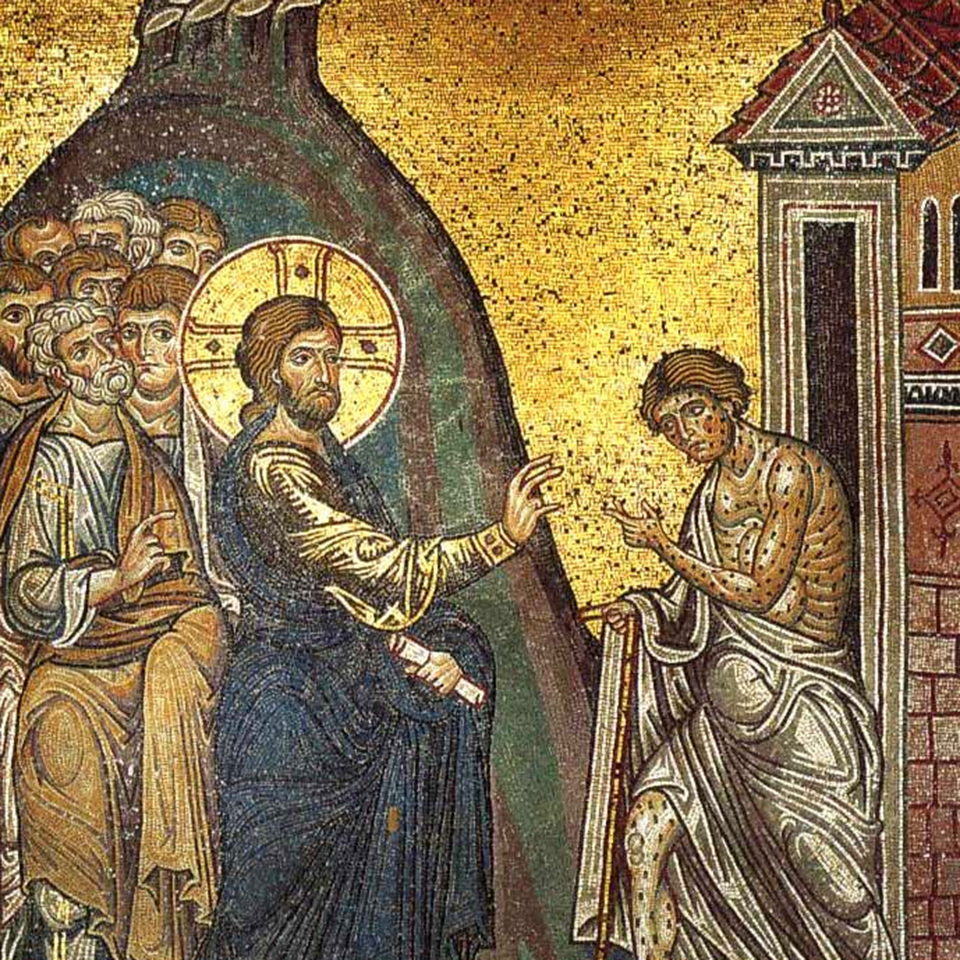
Jesus healing a leper, Cathedral of Santa Maria Nuova, Florence, Italy

In the first story, Jesus used his authority to heal and transform a leper. Leprosy was a feared disease in the ancient world. There was no known cure, and lepers were forced to live apart from everyone else. The Old Testament book of Leviticus says that a leper must wear torn clothes, let his hair be unkempt, cover the lower part of his face and cry out “unclean! unclean!” (Leviticus 13:45-46).  Lepers were the ultimate outsiders.

A leper came to Jesus with a humble profession of faith: “Lord, if you want to, you can make me clean.” It was a clear case of genuine need, and poverty of spirit. Jesus responded by doing the unthinkable: He touched him.  In a great and wonderful reversal, Jesus did not become unclean by touching the leper; but instead, the leper was made clean. 

Still today, the world needs to be touched. It’s an important way of following Jesus and changing the world. This requires us, God’s people, to get up-close and personal with outsiders and marginalized persons and groups. Christian service requires Christian touch.

Authentic Christian ministry communicates love through contact and identification with others. A thousand years after Christ’s earthly ministry, St. Francis of Assisi met a leper on the road:

“Though the leper caused him no small disgust and horror, he nonetheless, got off the horse and prepared to kiss the leper. But when the leper put out his hand as though to receive something, he received money along with a kiss”

Life of St. Francis, by Thomas of Celano

Francis did what seemed humanly impossible because he was filled with the love and compassion of Christ. The love of Jesus allows us to touch others with compassionate care, especially to those who have been rejected and mistreated.

Healing a Roman Officer’s Servant
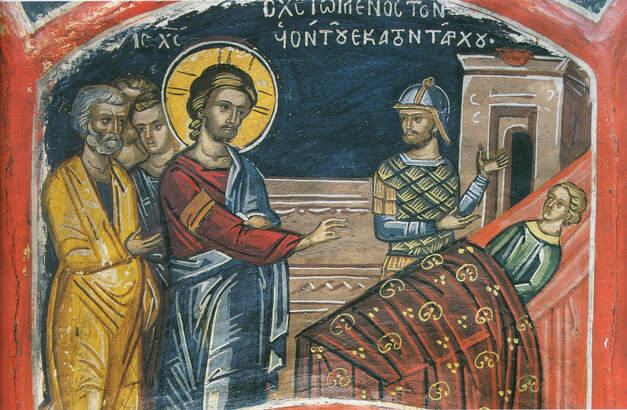
Fresco of Jesus healing the Centurion’s servant, Dionysiou Monastery, Mount Athos, Greece

The second story was equally eye-popping and unbelievable to the people in Christ’s day. Jesus used his authority to heal and transform a Gentile – and what’s more – a hated Roman army officer.

We see the values of the Beatitudes expressed in a Roman Centurion who felt unworthy to even have the Lord Jesus come into his house. The Centurion’s profession of faith amazed even Jesus: “Just say the word,” he said in recognition of Christ’s authority, which is big enough to heal without even being present. 

Although Centurions were the backbone of the Roman military machine and hated by the Jews, yet Jesus responded to the Centurion’s request, and he also affirmed his faith as greater than any Jew.

Grace answers to need, and not to smug self-confidence.

The Roman Centurion requested healing. Jesus listened and answered. The Centurion did not use his position to order Jesus or demand healing; he came in a spirit of humility and asked with confidence that Jesus could heal his servant if he wanted to. The Centurion threw himself on God’s mercy. So, Jesus upheld the Centurion as a model of faith for us all.

Healing Doesn’t Happen with the Independent

In affirming the Roman officer’s faith, Jesus also gave a solemn warning to the self-righteous: Their lack of humility and genuine faith would land them outside the kingdom. In another great reversal, the insiders will become the outsiders, and the outsiders become the insiders.

Independently proud folk do not experience healing and transformation because they don’t even know they are sin sick. They see no need for an intervention by Jesus because they already have their righteous deeds to boast about. Such persons are more concerned about looking good and saving face, than perceiving their own unworthiness. 

The self-righteous and self-sufficient approach to handling problems and difficult situations is to come up with good ideas and clever strategies, relying on sheer personal effort and willpower. Prayer may or may not happen; there is no honest beseeching of God. 

Delusional thoughts of personal autonomy only separate us from the grace of God that we so desperately need. 

There is a spiritual dimension to every situation and trouble we face – including sickness. If we only examine the medical and biological end of physical problems, we may be dealing with symptoms instead of the root issue that plagues us.

Are you hurting? Pray. Do you feel great? Sing. Are you sick? Call the church leaders together to pray and anoint you with oil in the name of the Master. Believing-prayer will heal you, and Jesus will put you on your feet. And if you have sinned, you will be forgiven—healed inside and out. Make this your common practice: Confess your sins to each other and pray for each other so that you can live together whole and healed. (James 5:13-16, MSG)

Conclusion

Jesus healed and transformed outsiders. Followers of Christ, dependent upon God, ask themselves:

  • Who are the outsiders among us?
  • Where are the strangers? 
  • How can we get close enough to touch aliens and immigrants? 
  • Will you help us intercede in prayer for foreigners? 
  • When can we search for and pursue those on the periphery of society? 

Believe that the risen and ascended Jesus can and will heal, deliver, and transform people of all kinds.

Jesus cannot be domesticated into some figurehead that suits our desires and conforms to our ideas about how things ought to be. Jesus is portrayed in these stories as eager to heal, wanting to show grace to the least and the lowly among society.

So, let us participate in the world’s healing, beginning with the Lord’s Prayer:

Our Father in heaven,
    may your name be kept holy.
May your Kingdom come soon.
May your will be done on earth,
    as it is in heaven.
Give us today the food we need,
and forgive us our sins,
    as we have forgiven those who sin against us.
And don’t let us yield to temptation,
    but rescue us from the evil one. Amen. (Matthew 6:9-13, NLT)

Have a Piece of Humble Pie (Romans 9:14-29)

What can we say—that God is unfair? That’s unthinkable! For example, God said to Moses, “I will be kind to anyone I want to. I will be merciful to anyone I want to.” Therefore, God’s choice does not depend on a person’s desire or effort, but on God’s mercy.

For example, Scripture says to Pharaoh, “I put you here for this reason: to demonstrate my power through you and to spread my name throughout the earth.” Therefore, if God wants to be kind to anyone, he will be. If he wants to make someone stubborn, he will.

You may ask me, “Why does God still find fault with anyone? Who can resist whatever God wants to do?”

Who do you think you are to talk back to God like that? Can an object that was made say to its maker, “Why did you make me like this?” A potter has the right to do whatever he wants with his clay. He can make something for a special occasion or something for everyday use from the same lump of clay.

If God wants to demonstrate his anger and reveal his power, he can do it. But can’t he be extremely patient with people who are objects of his anger because they are headed for destruction? Can’t God also reveal the riches of his glory to people who are objects of his mercy and who he had already prepared for glory? This is what God did for us whom he called—whether we are Jews or not.

As God says in Hosea:

“Those who are not my people
I will call my people.
Those who are not loved
I will call my loved ones.
Wherever they were told,
‘You are not my people,’
they will be called children of the living God.”

Isaiah also says about Israel:

“Although the descendants of Israel are
as numerous as the grains of sand on the seashore,
only a few will be saved.
The Lord will carry out his sentence on the land,
completely and decisively.”

This is what Isaiah predicted:

“If the Lord of Armies hadn’t left us some descendants,
we would have been like Sodom and Gomorrah.” (God’s Word Translation)

In Christianity, humility is a virtue. Yet, sometimes Christians forget this, and they have to eat some humble pie.

In other words, there are times we need to be put in our place. It would go a lot better for us if we could just cultivate a humble spirit, rather than have humility forced upon us under embarrassing conditions.

The Apostle Paul realized he needed to make the Roman Church eat some humble pie. They were acting arrogant. The Jewish Christians and the Gentile Christians each thought they were better than the other. So, Paul reminded them both who was really in charge of things.

The proud person’s cry, when things don’t go their way, is “It’s not fair!” That’s because they believe they deserve to have something, to be on top, to call the shots on how things ought to go.

Paul was particularly hard on his fellow Jewish Christians, probably because he was quite familiar with their mindset about Gentiles (non-Jewish persons). The Jews tended to feel superior over Gentiles, and thus, to believe that they have the high ground and the right to trump Gentile thinking.

But Paul also took the Gentile Christians to task. They had a nasty habit of rolling their eyes whenever their Jewish sisters and brothers talked. The Gentiles mostly saw the Jews as hopelessly stuck in their old traditions and ways of doing things. And so, they believed new leadership was needed, wanting those crusty old guys out.

Therefore, each group – both the Jewish Christians and the Gentile Christians – had some major hang up’s about who should be in the Church and heading things up, and who should be out.

The Apostle (bless his exasperated heart) didn’t take sides. That’s because he knew that both groups were being knuckleheads. Each of them needed to get out of their pride. So, Paul cut them each some humble pie and dished it out.

Who is in and who is out is none of their concern. And what’s more, you’re never going to really know why some are in and some are out. The reason is that God is going to do what God is going to do. None of the petty posturing amongst each other means anything. In truth, everything is based on God’s call, and not on human decision, race, ethnicity, gender, politics, or anything else. It all comes down to God, not us.

God makes decisions and extends calls to people, all the time, that we don’t like. And Paul knew this. It is, in fact, what kept him humble. Paul understood he didn’t deserve a thing from God; everything good thing he had came from the Lord.

In his conversion from Jewish Saul to Christian Paul, the Apostle felt the sting of rejection from both groups. The Jews saw him as a traitor, a turncoat. The Gentiles didn’t trust him and wouldn’t accept him. But Paul, having had to eat humble pie himself – dished out by Jesus himself – learned to be patient and gentle. (Acts 9:1-5)

Yet, Paul had his boundaries and his limits. And the Roman Church crossed them. It was time for the entire church to hear a “suck it up, buttercup,” speech.

For the Jewish Christians, they were never “in” just because they were Abraham’s descendants. Abraham was called by God; therefore, everyone is called by God and not the other way around – and God calls whomever God chooses to call. There was nothing in Abraham to warrant a good choice. But God chose him anyway. And if God wants to take some of the Jews, the “chosen” people out, God will do it, because God isn’t accountable to us.

For the Gentile Christians, they weren’t brought “in” because of their own choice. Before they ever had a chance to choose God, God chose them. They were lost in darkness, far from God. But God, by sheer mercy and grace, called the Gentiles. And now that the Gentiles are “in” they can just as easily be “out” if God so chooses.

“The wonder is not that some are saved and others not, but that anybody is saved at all. If we receive what we deserve (judgment) or if we receive what we do not deserve (mercy), then in neither case is God unjust.”

John R.W. Stott

All of this is more than a bunch of power politics from the ancient world; these same dynamics impact us today in quite similar ways.

Any group of people who enjoy privilege over another group needs a slice of humble pie. Any group who continually disparages those in authority also needs a slice of humble pie.

In reality, there are times when every single one of us – including every community, institution, organization, corporation, and nation – needs a stiff reminder of who we really are, why we are really here, and what we are really supposed to be doing.

To eat humble pie means to acknowledge one’s mistake or wrongdoing and accept the humiliation that goes with that acknowledgement. We need to confess our sins and complicity in a host of the world’s ills. And we need to acknowledge that our awful predicaments aren’t just somebody else’s fault; we caused the crud.

We need the humility to ask for help; the humility to work with others very different from ourselves; and the humility to realize we could make the same mistakes again, if not for the grace of God.

Amongst us humans, we are all a community of equals. Yet, amongst God, none of humanity is equal to divinity. A clay pot has neither the right nor the ability to question the potter; they aren’t on the same level.

To enjoy divine privileges never gives us the right to show human prejudice. So let us be people who help one another live according to justice, mercy, and humility – for these are the very things which God calls us to embrace. (Micah 6:8)

Disturb us, Lord, when we are too well pleased with ourselves, and so, disparage others.
Disturb us, Lord, when with the abundance of things we possess, we lose our perspective and believe we are the masters of our own fate.

Disturb us, Lord, to dare more boldly by doing justice, loving mercy, and walking humbly with Jesus, in the enablement of the Holy Spirit. Amen.

Humble Leadership (Numbers 11:24-30)

So Moses went out and told the people what the Lord had said. He brought together seventy of their elders and had them stand around the tent. Then the Lord came down in the cloud and spoke with him, and he took some of the power of the Spirit that was on him and put it on the seventy elders. When the Spirit rested on them, they prophesied—but did not do so again.

However, two men, whose names were Eldad and Medad, had remained in the camp. They were listed among the elders, but did not go out to the tent. Yet the Spirit also rested on them, and they prophesied in the camp. A young man ran and told Moses, “Eldad and Medad are prophesying in the camp.”

Joshua son of Nun, who had been Moses’ aide since youth, spoke up and said, “Moses, my lord, stop them!”

But Moses replied, “Are you jealous for my sake? I wish that all the Lord’s people were prophets and that the Lord would put his Spirit on them!” Then Moses and the elders of Israel returned to the camp. (New International Version)

“Blessed are the meek, for they will inherit the earth.”

Jesus (Matthew 5:5)

My dad was on the local schoolboard for many years when I was a kid. I remember him telling me that he could predict was the Superintendent of Schools was going to do. Dad would introduce a motion (an idea or action to take) knowing that it would be struck down by the Superintendent, who then would introduce the same motion months later as if it were his own idea.

We all have likely had the experience of other people taking credit for our work, or at least spinning a situation to make it appear like the person was more responsible or in charge of something good than they actually were. After all, most of us want to look good in the eyes of others. So, leaders sometimes (most of the time?) reinterpret and bend situations to make their leadership shine, especially when it isn’t shining at all.

But Moses was a different sort of leader. He is described in Holy Scripture as “a very humble man, more humble than anyone else on the face of the earth.” (Numbers 12:3, NIV)

Today’s Old Testament lesson illustrates for us what humility and meekness truly look like. And the leadership of Moses had an authentic shine to it which resulted from being close to God. (Exodus 34:29-34; 2 Corinthians 3:12-18)

What is a meek and humble leader?

In a world enamored with issues of power and authority, Moses was a counter-cultural leader who understood his position and embodied the true nature of service to both God and people.

Humility acknowledges that the leader is not the one who is truly in charge. Ultimately, God is, and not any of us. The Holy Spirit is totally sovereign and acts in whatever way the Lord wills. The Spirit will not be stereotyped, nor can anyone really discern or predict what the Spirit will do or not do.

For sure, a life of prayer, faith, and holiness are necessary for the Christian life. Yet, we must not therefore assume that our spiritual disciplines somehow guarantee particular outcomes. It’s plain arrogance to suppose that somehow we can maneuver or manipulate God for our own purposes – which is why we need to cultivate a life of humility and meekness.

The reply of Moses to Joshua’s concern about the Spirit being manifested in an unexpected way illustrates a gentle and generous spirit of heart. Far from silencing the two men prophesying apart from the others, Moses instead longed for such a blessing to be extended to all the people.

Good and godly leaders are such because their sole passion is to honor and glorify the Lord. For them, it doesn’t really matter whether they’re personally involved in the great and spiritual thing happening, or not. That’s humility, my friends.

If there’s a distinction between humility and meekness, it is this: The humble person is self-aware enough to know they can only do anything by the hand of God operating within them; and the meek person is socially aware enough to understand that, in their lowliness, they are unable to look down on anyone else. Therefore, pride, arrogance, and hubris are nowhere to be found.

To have divine validation is all that’s needed for the godly leader; and when one is content with what they need and want most, there’s no need for human accolades and constant attention.

Far too often, we equate meek with weak. If someone is meek, some folks wrongly reason they must be a washrag, or overly introverted, and maybe not taking proper initiative in life. Of all the leadership qualities we may aspire to, I doubt that meekness would make any leader’s top ten list of desired character traits.

Why would I want to be meek?

Jesus, an unquestioned leader, described himself as meek. Yet, many English translations steer clear of the word. For example, “Come to me,” the New International Version of the Bible says, “all you who are weary and burdened, and I will give you rest. Take my yoke upon you and learn from me, for I am gentle and humble in heart, and you will find rest for your souls. For my yoke is easy and my burden is light.” Only the King James Version translates the word as “meek,” instead of “gentle.”

What does it mean to be meek?

“Meek” is a word used in other ancient Greek literature for breaking a horse. It’s the change from being a wild stallion who wants to go his own way, to a broken horse who is able to be guided and used, allowing others on his back without bucking.

At the crucifixion, Jesus was naked, exposed, and vulnerable to the idle curiosity of the crowd and the vulgar frivolity of the soldiers who were having a party around his suffering. “If you are the king of the Jews,”they taunted,“save yourself.” (Luke 23:35-36)

The extraordinary thing is there was no spirit of revenge with Jesus. Christ did not curse his tormentors, but instead prayed, “Father forgive them, for they don’t know what they’re doing.” (Luke 23:34)

What characterizes a meek person?

  • The meek have a desire to put other’s interests ahead of their own, because they know it is not all about them. They practice healthy rhythms of giving and receiving with others, without prejudice or favoritism.
  • The meek are more concerned with edifying and building up their brothers and sisters than justifying themselves. They don’t care who gets the credit. And they receive criticism well.
  • The meek are truly egalitarian and do all things with equity and inclusion. They make no distinctions between rich and poor, beautiful and ugly, intelligent and cognitive deficits, black and white, gay and straight, Democrat and Republican, or insider and outsider. In the meek person’s mind, every person is created in the image of God and therefore deserves respect, attention, and justice.

How do I live as a meek person?

Perhaps repentance is in order. It could be that too many people have made much more of themselves than what they truly are. Maybe we have adopted a stance of shaming others, believing that some people need a bit of guilt from a leader in order to change their obnoxious ways.

Moses did not retaliate against the prophesying men or squelch what the Spirit was doing. Non-retaliation happens whenever we understand that we’re flat on our backs before God, and there is no place to look but up. And it also means there is no ability to look down on others. It is to be broken and moldable before God. 

Most importantly for the spiritual person, Moses had regular and extended times of meeting with God. It’s what kept him humble and maintaining a perspective on life that is healthy and helpful.

This day, almighty and holy God, be within and without me, lowly and meek, yet all-powerful. Christ as a light; Christ as a shield; Christ beside me, on my left and my right, I walk with you in humility of heart in the strength of the Holy Spirit. Amen.

The Gentle King (Matthew 21:1-11)

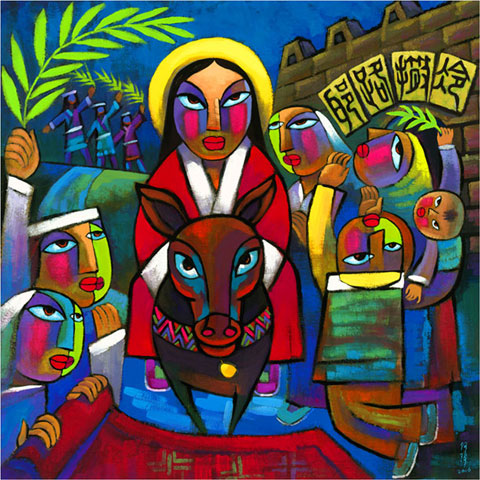
The Triumphal Entry, by He Qi

As they approached Jerusalem and came to Bethphage on the Mount of Olives, Jesus sent two disciples, saying to them, “Go to the village ahead of you, and at once you will find a donkey tied there, with her colt by her. Untie them and bring them to me. If anyone says anything to you, say that the Lord needs them, and he will send them right away.”

This took place to fulfill what was spoken through the prophet:

“Say to Daughter Zion,
    ‘See, your king comes to you,
gentle and riding on a donkey,
    and on a colt, the foal of a donkey.’”

The disciples went and did as Jesus had instructed them. They brought the donkey and the colt and placed their cloaks on them for Jesus to sit on. A very large crowd spread their cloaks on the road, while others cut branches from the trees and spread them on the road. The crowds that went ahead of him and those that followed shouted,

“Hosanna to the Son of David!”

“Blessed is he who comes in the name of the Lord!”

“Hosanna in the highest heaven!”

When Jesus entered Jerusalem, the whole city was stirred and asked, “Who is this?”

The crowds answered, “This is Jesus, the prophet from Nazareth in Galilee.” (New International Version)

A Humble Leader

Gentle humility and strong leadership are not mutually exclusive concepts. They can and should co-exist together.

Los Angeles County traffic cops receive plenty of complaints about their work. After all, most motorists don’t think they deserve a ticket. Each complaint gets documented and placed in the officer’s personnel file. One officer, however, Deputy Sheriff Elton Simmons, made 25,000 traffic stops over a span of 20 years, without a single complaint on his record.

When his supervisor started looking through Simmons’ file, he was stunned to find plenty of commendations, but not a single complaint. It was so unusual, that a CBS News crew was assigned to follow Simmons in an attempt to learn his secret. They described Deputy Simmons as having a “pitch-perfect mix of authority and diplomacy” without a trace of arrogance or self-righteousness.

Although handing out plenty of tickets, they never came with a guilt trip.  Deputy Simmons described his mentality: “I’m here with you. I won’t look down at you.” 

One driver who got a ticket from Simmons said, “It’s his smile. How could you be mad at that guy?”  “Apparently, you can’t,” concluded the CBS News team. “Time after time, ticket after ticket, we saw Officer Simmons melt away a polar ice cap of preconceptions.”

A Meek Celebrity

As Jesus entered Jerusalem for the last week of his life, he was at the height of his fame. Christ’s teaching and healing ministry touched thousands of people. Jesus was the most famous celebrity to come into town since David captured the city a thousand years before. 

But Jesus did not ride into Jerusalem as a great and mighty warrior who conquered Jerusalem in a military battle. There is coming a time, at the end of the age, when Jesus will take on this role, but that was not his purpose on this occasion. 

Hosanna in the Highest, by Malaysian artist Hanna-Cheriyan Varghese

One of the challenges for people in every era is to properly balance scriptural truth. Many Jews emphasized King David’s victories in battle, and his great political dynasty, and so, tended to overlook that David was also a humble servant. 

King David showed steadfast love and kindness to his subjects and submitted himself to God in such a way that, even with opportunities to seize the kingship from Saul who was trying to take his life, he left vengeance to God alone.

Christ’s triumphal entry portrays Jesus as King, the Son of David, but as a gentle king. He embodied both powerful authority and gentle humility. Jesus wanted the crowd to understand that he was not like most kings – he was a lowly king. 

Jesus as a meek celebrity seemed so odd that many people saw that combination of gentle authority as being wishy-washy. Jesus didn’t fit any of the typical labels that people expected. They wondered, “Is he a Pharisee? Or a Zealot? What’s his position on the Romans?  How is he going to lead us out from under Gentile rule?” There was lots of anxiety and concern over Jesus; the people could not nail down exactly what kind of guy he was.

A Servant Pastor

Over the years, as a Pastor, many people have wanted to label me as something, but have had a hard time doing it. Am I liberal or conservative? liturgical or non-liturgical? open or closed to particular people or groups? e.g. LGBTQ folks, Black Lives Matter, etc.

The problem with all this is that it assumes you cannot be both, as if life is all either/or, instead of both/and. It makes ministry about choosing sides, instead of breaking down barriers.

Meekness and strength, gentleness and authority, humility and leadership, grace and truth, love and anger, are all meant to be together – not compartmentalized in sequestered ghettos of the mind.

Jesus sought to hold kingly authority and divine righteousness together, at the same time, all the time. Christ came into Jerusalem to face the cross and take upon himself the sin of the whole world. He came as a gentle king.

Yet, many people do not want this kind of leader because they think leadership is all about power – taking charge with strong authority, telling people what to do, and controlling every aspect of the realm.  

Jesus, at times, acts like a decisive and absolute authority. He knocks over the tables of the money changers in the temple, curses fig trees, and refuses to answer direct questions. But then he turns around and goes against the people’s expectations of him as a leader by riding on a lowly donkey, inviting tax collectors and prostitutes to join him, going after the lost, and embracing the least persons in society.

A Donkey Lord

Jesus displayed a combination that seemed confusing and wishy-washy to many. Christ is both sovereign lord, and humble servant. Jesus riding on a donkey seemed a strange fusion of authority and humility. 

On the one hand, a donkey was the beast of burden for most working class poor people. Donkeys are ordinary, and not like war horses. Kings didn’t ride into conquered cities on donkeys. But, on the other hand, the donkey is also linked to Messiah’s power and authority.

Rejoice, rejoice, people of Zion!
    Shout for joy, you people of Jerusalem!
    Look, your king is coming to you!
He comes triumphant and victorious,
    but humble and riding on a donkey—
    on a colt, the foal of a donkey.

The Lord says,

“I will remove the war chariots from Israel
    and take the horses from Jerusalem;
    the bows used in battle will be destroyed.
Your king will make peace among the nations;
    he will rule from sea to sea,
    from the Euphrates River to the ends of the earth.” (Zechariah 9:9-10, GNT)

Jesus is the ultimate leader who uses his authority for the benefit of others, to bring peace. Jesus did not use his authority to consolidate power and squish enemies, but instead, gave his life so that others might live. 

Gentle and meek does not mean being a washrag or a limp noodle. Rather, it means to have power under control, e.g. a broke horse; it is power for useful purposes to serve people, not like other kings who were concerned with getting, consolidating, and keeping power, at all costs.

Jesus is the crucified Messiah; the modest leader; the lowly Lord; the God Man. We must hold it all, not emphasizing one aspect above another, so that we have the complete picture of Christ.

A Gracious Royal

Believers and followers of Jesus are royal children of the King. That means we live in the way of Jesus by bestowing grace to others. What does this “look like?”

  • In our families, Christian parents do not merely bark orders at kids, but love and support them by humbly and gently coming alongside and helping. 
  • In our neighborhoods, Christian citizens pray for the welfare of their neighbors, even and especially the ones who we may not like very well.   
  • In our work, Christian workers use their skills and abilities to serve others, transforming what we do from a secular job to a sacred vocation. 
  • In our daily life, Christians scan the horizon to seek people whom we might show God’s kindness, instead of just waiting for something to fall into our laps, if it ever does.

A Talking Donkey

From the Old Testament, we know that donkeys can talk (Numbers 22:21-38). If Christ’s donkey could speak, I imagine him saying: 

“King Jesus, why did you choose a lowly donkey like me to carry you to ride in your parade? Didn’t you have a friend who owned a horse – a spirited royal mount, fit for a king to ride? Why choose me, a small unassuming beast of burden, trained to plow and not to carry kings?”

It is a privilege to be a Christian. Perhaps you will say: 

“King Jesus, why did you choose me, a lowly unimportant person to bear you in my world today? I am poor and unimportant, trained to work, and not to carry kings – let alone the King of kings; and yet, you’ve chosen me to carry you in triumph in this world’s parade. King Jesus, keep me humble, so everyone may say, ‘Blessed is he who comes in the name of the Lord,’ and not ‘what a great Christian he is.’”

God of all, you gave your only begotten Son to take the form of a servant, and to be obedient, even to death on a cross: give us the same mind that was in Christ Jesus that, sharing in his humility, we may come to be with him in his glory, who lives and reigns with you and the Holy Spirit, one God, now and forever. Amen.