Handling a Stressful Situation (Daniel 2:24-49)

Daniel Interprets Nebuchadnezzar’s Dream, by David Martin (1639-1721)

So Daniel went to Arioch, the man the king had appointed to wipe out Babylon’s sages. Daniel said to him, “Don’t wipe out the sages of Babylon! Bring me before the king, and I will explain the dream’s meaning to him.”Wasting no time, Arioch brought Daniel before the king, telling him, “I have found someone from the Judean exiles who will tell the dream’s meaning to the king.”

In reply the king said to Daniel (whose name was Belteshazzar), “Can you really tell me the dream that I saw, as well as its meaning?”

Daniel answered the king, “Sages, enchanters, dream interpreters, and diviners can’t explain to the king the mystery he seeks.But there is a God in heaven, a revealer of mysteries, who has shown King Nebuchadnezzar what will happen in the days to come! Now this was your dream—this was the vision in your head as you lay in your bed:

“As you lay in bed, Your Majesty, your thoughts turned to what will happen in the future. The revealer of mysteries has revealed to you what will happen. Now this mystery was revealed to me, not because I have more wisdom than any other living person but so that the dream’s meaning might be made known to the king, and so that you might know the thoughts of your own mind.

“Your Majesty, you were looking, and there, rising before you, was a single, massive statue. This statue was huge, shining with dazzling light, and was awesome to see.The statue’s head was made of pure gold; its chest and arms were made from silver; its abdomen and hips were made of bronze.Its legs were of iron, and its feet were a mixture of iron and clay.You observed this until a stone was cut, but not by hands; and it smashed the statue’s feet of iron and clay and shattered them.Then all the parts shattered simultaneously—iron, clay, bronze, silver, and gold. They became like chaff, left on summer threshing floors. The wind lifted them away until no trace of them remained. But the stone that smashed the statue became a mighty mountain, and it filled the entire earth.

“This was the dream. Now we will tell the king its meaning:You, Your Majesty, are the king of kings. The God of heaven has given kingship, power, might, and glory to you!God has delivered into your care human beings, wild creatures, and birds in the sky—wherever they live—and has made you ruler of all of them. You are the gold head.But in your place, another kingdom will arise, one inferior to yours, and then a third, bronze kingdom will rule over all the earth.Then will come a fourth kingdom, mighty like iron. Just as iron shatters and crushes everything; so like an iron that smashes, it will shatter and crush all these others.As for the feet and toes that you saw, which were a mixture of potter’s clay and iron, that signifies a divided kingdom; but it will possess some of the unyielding strength of iron. Even so, you saw the iron mixed with earthy clayso that the toes were made from a mixture of iron and clay. Part of the kingdom will be mighty, but part of it will be fragile.Just as you saw the iron mixed with earthy clay, they will join together by intermarrying, but they will not bond to each other, just as iron does not fuse with clay.

“But in the days of those kings, the God of heaven will raise up an everlasting kingdom that will be indestructible. Its rule will never pass to another people. It will shatter other kingdoms. It will put an end to all of them. It will stand firm forever, just like you saw when the stone, which was cut from the mountain, but not by hands, shattered the iron, bronze, clay, silver, and gold. A great God has revealed to the king what will happen in the future. The dream is certain. Its meaning can be trusted.”
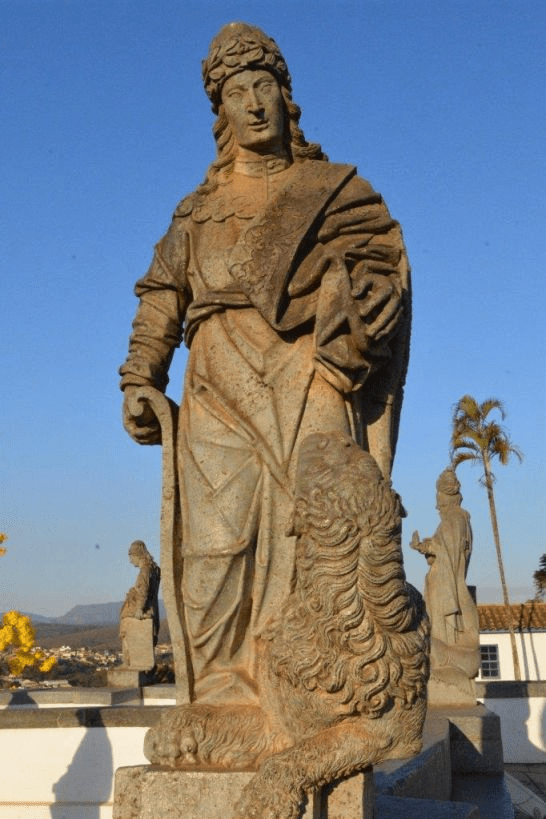
The Prophet Daniel, by Brazilian sculptor Aleijadinho (1738-1814)

Then King Nebuchadnezzar bowed low and honored Daniel. The king ordered that grain and incense offerings be made to Daniel. The king declared to Daniel, “No doubt about it: your God is God of gods, Lord of kings, and a revealer of mysteries because you were able to reveal this mystery!” Then the king exalted Daniel and lavished gifts on him, making him ruler over all the province of Babylon and chief minister over all Babylon’s sages. At Daniel’s urging, the king appointed Shadrach, Meshach, and Abednego to administer the province of Babylon, but Daniel himself remained at the royal court. (Common English Bible)

That was a close one. All the wise men of Babylon, along with Daniel and his three companions, were nearly snuffed out by the rage of a powerful king. Good thing God is the One who is really in charge of things!

King Nebuchadnezzar demanded that his court sages tell him the troubling dream he had, along with an interpretation. Daniel alone was able to provide both the dream’s content and its meaning, precisely because he immediately went to prayer and beseeched God to reveal the mystery. A lot of lives were on the line. And God answered him.

Daniel calmly and confidently handled the life-or-death situation with some deft wisdom. There are likely two reasons for his ability to step into a situation fraught with such heavy stress: 1) he was already a consistent person of prayer; and, 2) he was truly doing this for the benefit of everyone, not just himself. In other words, Daniel was humble, full of faith, and concerned for the common good of all.

It’s interesting to me that Daniel didn’t get all caught up in the specifics of the dream. What was most important to him was communicating to the king that it was the Lord who provided the dream and its interpretation; and doing his very best to ensure something like this wasn’t going to happen again.

After being made the acting ruler over the province of Babylon, Daniel’s first act was encouraging the king to put his three companions in charge of the province. Daniel himself remained at the royal court, close to King Nebuchadnezzar. Not only was Daniel wise in how he handled the potential debacle, but he was also quite wise in discerning that he was needed courtside. I picture Daniel becoming something of Nebuchadnezzar’s handler – maintaining a significant position in order to check the ego and the arrogance of the king.

What stands out to me most about today’s story is not the particulars about ancient history, with the empires coming and going. It’s about Daniel doing what needed to be done, being willing to step into a stress-filled situation and take it on. Then, when things settled down and he was recognized and awarded, Daniel didn’t get caught up in the hoopla near as much as diligently worked behind the scenes for stability in the royal court. Such humility is worth emulating, and is much needed in today’s world.

Gracious God, have mercy on me. As the day unfolds, please grant me humility, kindness, and courage to move toward the situations you have in front of me. Bring glory to yourself, gentleness to my heart, and a good and just outcome. Amen.

The Question of Authority (Mark 11:27-33)

The Pharisees Question Jesus, by James Tissot (1836-1902)

Again they entered Jerusalem. As Jesus was walking through the Temple area, the leading priests, the teachers of religious law, and the elders came up to him. They demanded, “By what authority are you doing all these things? Who gave you the right to do them?”

“I’ll tell you by what authority I do these things if you answer one question,” Jesus replied. “Did John’s authority to baptize come from heaven, or was it merely human? Answer me!”

They talked it over among themselves. “If we say it was from heaven, he will ask why we didn’t believe John. But do we dare say it was merely human?” For they were afraid of what the people would do because everyone believed that John was a prophet. So they finally replied, “We don’t know.”

And Jesus responded, “Then I won’t tell you by what authority I do these things.” (New Living Translation)

Jesus was an outsider. During his earthly ministry, he was viewed, at best, as an avant-garde leader; and, at worst, a flat out heretic. It may be easy to overlook that reality, because we typically think of Christ as Lord and always on the inside of things.

Although Jesus was a teacher and a rabbi – and was neither a priest nor a member of any Jewish religious sect – he nevertheless walked around as if he owned the place (which he did). That gave the established religious leadership of the day no end of consternation and frustration.

Jesus made significant inroads into people’s lives, especially with outsiders like himself. And this situation created anger and jealousy with many of the religious ruling class. Since Jesus was not a card-carrying member, the leaders wanted to hear from him why he kept acting confidently and deliberately on their religious turf.

“What gives you the right? Who authorized you to act this way?” was their cry.

The established authorities are depicted in today’s Gospel lesson as a craven bunch who did not want to alienate the crowds, and yet were eager to get the upstart Jesus out the way. This appears to be an age-old situation of leaders putting their fingers to the wind to go with whatever will keep them popular and in power.

Since Jesus consistently refused to play such games, the authorities believed he needed to go. They, however, had no intention of risking an outright confrontation and showing their shadow motives.

Jesus clearly connected himself with John the Baptist, as both coming from the same authority. John was yet another figure for whom the established leaders could not control.

We ought never to underestimate both perceived and actual threats to status quo leadership. Such leaders have no inkling of being public servants when true moral authority comes along. The lack of conformity from John and Jesus would cost them both their very lives.

Speaking truth to power while not becoming defensive doing so is a tricky art. Yet, Jesus did it. Continual challenges to his authority left him unfazed as to his mission and purpose on this earth. Christ was assertive without becoming despotic; forward without taking the bait of useless arguments; confident with no hint of arrogance.

For me, the contrast between Jesus and the religious authorities is trenchant. The confident, wise, and calm authority of Christ is in direct opposition to the fear, anxiety, and worry of the ruling leaders. Whereas they kept anxiously ruminating about what to do about this threat to their established authority, Jesus exhibited a non-anxious presence which maintained a steadfast focus on God’s righteous, holy, and benevolent rule and reign.

Sometimes, continual fear is a big red flag that the leader is so worried about losing their place or position, that the will of God gets pushed aside as merely a secondary concern.

Questioning Christ’s credentials was the giveaway that the existing religious authorities were concerned about their power and privilege, and not the people. The wise person will see such queries for what they are.

Wherever we observe those who refuse to share power, have a xenophobic bent toward outsiders, and seem to do just about anything to maintain the status quo, there we will find the abuse of authority.

Conversely, where we observe a deep concern for equity, justice, and the common good of all persons, there we see compassionate leadership who will champion ethical leadership and espouse moral authority.

In any democratic society, we must choose our leaders wisely.

Great God of hope, in these times of change and uncertainty, unite your people and guide our leaders with your wisdom. Give us courage to overcome our fears and help us to build a future in which all may prosper and share together through Jesus Christ our Lord in the strength of your Holy Spirit. Amen.

Have a Piece of Humble Pie (Romans 9:14-29)

What can we say—that God is unfair? That’s unthinkable! For example, God said to Moses, “I will be kind to anyone I want to. I will be merciful to anyone I want to.” Therefore, God’s choice does not depend on a person’s desire or effort, but on God’s mercy.

For example, Scripture says to Pharaoh, “I put you here for this reason: to demonstrate my power through you and to spread my name throughout the earth.” Therefore, if God wants to be kind to anyone, he will be. If he wants to make someone stubborn, he will.

You may ask me, “Why does God still find fault with anyone? Who can resist whatever God wants to do?”

Who do you think you are to talk back to God like that? Can an object that was made say to its maker, “Why did you make me like this?” A potter has the right to do whatever he wants with his clay. He can make something for a special occasion or something for everyday use from the same lump of clay.

If God wants to demonstrate his anger and reveal his power, he can do it. But can’t he be extremely patient with people who are objects of his anger because they are headed for destruction? Can’t God also reveal the riches of his glory to people who are objects of his mercy and who he had already prepared for glory? This is what God did for us whom he called—whether we are Jews or not.

As God says in Hosea:

“Those who are not my people
I will call my people.
Those who are not loved
I will call my loved ones.
Wherever they were told,
‘You are not my people,’
they will be called children of the living God.”

Isaiah also says about Israel:

“Although the descendants of Israel are
as numerous as the grains of sand on the seashore,
only a few will be saved.
The Lord will carry out his sentence on the land,
completely and decisively.”

This is what Isaiah predicted:

“If the Lord of Armies hadn’t left us some descendants,
we would have been like Sodom and Gomorrah.” (God’s Word Translation)

In Christianity, humility is a virtue. Yet, sometimes Christians forget this, and they have to eat some humble pie.

In other words, there are times we need to be put in our place. It would go a lot better for us if we could just cultivate a humble spirit, rather than have humility forced upon us under embarrassing conditions.

The Apostle Paul realized he needed to make the Roman Church eat some humble pie. They were acting arrogant. The Jewish Christians and the Gentile Christians each thought they were better than the other. So, Paul reminded them both who was really in charge of things.

The proud person’s cry, when things don’t go their way, is “It’s not fair!” That’s because they believe they deserve to have something, to be on top, to call the shots on how things ought to go.

Paul was particularly hard on his fellow Jewish Christians, probably because he was quite familiar with their mindset about Gentiles (non-Jewish persons). The Jews tended to feel superior over Gentiles, and thus, to believe that they have the high ground and the right to trump Gentile thinking.

But Paul also took the Gentile Christians to task. They had a nasty habit of rolling their eyes whenever their Jewish sisters and brothers talked. The Gentiles mostly saw the Jews as hopelessly stuck in their old traditions and ways of doing things. And so, they believed new leadership was needed, wanting those crusty old guys out.

Therefore, each group – both the Jewish Christians and the Gentile Christians – had some major hang up’s about who should be in the Church and heading things up, and who should be out.

The Apostle (bless his exasperated heart) didn’t take sides. That’s because he knew that both groups were being knuckleheads. Each of them needed to get out of their pride. So, Paul cut them each some humble pie and dished it out.

Who is in and who is out is none of their concern. And what’s more, you’re never going to really know why some are in and some are out. The reason is that God is going to do what God is going to do. None of the petty posturing amongst each other means anything. In truth, everything is based on God’s call, and not on human decision, race, ethnicity, gender, politics, or anything else. It all comes down to God, not us.

God makes decisions and extends calls to people, all the time, that we don’t like. And Paul knew this. It is, in fact, what kept him humble. Paul understood he didn’t deserve a thing from God; everything good thing he had came from the Lord.

In his conversion from Jewish Saul to Christian Paul, the Apostle felt the sting of rejection from both groups. The Jews saw him as a traitor, a turncoat. The Gentiles didn’t trust him and wouldn’t accept him. But Paul, having had to eat humble pie himself – dished out by Jesus himself – learned to be patient and gentle. (Acts 9:1-5)

Yet, Paul had his boundaries and his limits. And the Roman Church crossed them. It was time for the entire church to hear a “suck it up, buttercup,” speech.

For the Jewish Christians, they were never “in” just because they were Abraham’s descendants. Abraham was called by God; therefore, everyone is called by God and not the other way around – and God calls whomever God chooses to call. There was nothing in Abraham to warrant a good choice. But God chose him anyway. And if God wants to take some of the Jews, the “chosen” people out, God will do it, because God isn’t accountable to us.

For the Gentile Christians, they weren’t brought “in” because of their own choice. Before they ever had a chance to choose God, God chose them. They were lost in darkness, far from God. But God, by sheer mercy and grace, called the Gentiles. And now that the Gentiles are “in” they can just as easily be “out” if God so chooses.

“The wonder is not that some are saved and others not, but that anybody is saved at all. If we receive what we deserve (judgment) or if we receive what we do not deserve (mercy), then in neither case is God unjust.”

John R.W. Stott

All of this is more than a bunch of power politics from the ancient world; these same dynamics impact us today in quite similar ways.

Any group of people who enjoy privilege over another group needs a slice of humble pie. Any group who continually disparages those in authority also needs a slice of humble pie.

In reality, there are times when every single one of us – including every community, institution, organization, corporation, and nation – needs a stiff reminder of who we really are, why we are really here, and what we are really supposed to be doing.

To eat humble pie means to acknowledge one’s mistake or wrongdoing and accept the humiliation that goes with that acknowledgement. We need to confess our sins and complicity in a host of the world’s ills. And we need to acknowledge that our awful predicaments aren’t just somebody else’s fault; we caused the crud.

We need the humility to ask for help; the humility to work with others very different from ourselves; and the humility to realize we could make the same mistakes again, if not for the grace of God.

Amongst us humans, we are all a community of equals. Yet, amongst God, none of humanity is equal to divinity. A clay pot has neither the right nor the ability to question the potter; they aren’t on the same level.

To enjoy divine privileges never gives us the right to show human prejudice. So let us be people who help one another live according to justice, mercy, and humility – for these are the very things which God calls us to embrace. (Micah 6:8)

Disturb us, Lord, when we are too well pleased with ourselves, and so, disparage others.
Disturb us, Lord, when with the abundance of things we possess, we lose our perspective and believe we are the masters of our own fate.

Disturb us, Lord, to dare more boldly by doing justice, loving mercy, and walking humbly with Jesus, in the enablement of the Holy Spirit. Amen.

Humble Leadership (Numbers 11:24-30)

So Moses went out and told the people what the Lord had said. He brought together seventy of their elders and had them stand around the tent. Then the Lord came down in the cloud and spoke with him, and he took some of the power of the Spirit that was on him and put it on the seventy elders. When the Spirit rested on them, they prophesied—but did not do so again.

However, two men, whose names were Eldad and Medad, had remained in the camp. They were listed among the elders, but did not go out to the tent. Yet the Spirit also rested on them, and they prophesied in the camp. A young man ran and told Moses, “Eldad and Medad are prophesying in the camp.”

Joshua son of Nun, who had been Moses’ aide since youth, spoke up and said, “Moses, my lord, stop them!”

But Moses replied, “Are you jealous for my sake? I wish that all the Lord’s people were prophets and that the Lord would put his Spirit on them!” Then Moses and the elders of Israel returned to the camp. (New International Version)

“Blessed are the meek, for they will inherit the earth.”

Jesus (Matthew 5:5)

My dad was on the local schoolboard for many years when I was a kid. I remember him telling me that he could predict was the Superintendent of Schools was going to do. Dad would introduce a motion (an idea or action to take) knowing that it would be struck down by the Superintendent, who then would introduce the same motion months later as if it were his own idea.

We all have likely had the experience of other people taking credit for our work, or at least spinning a situation to make it appear like the person was more responsible or in charge of something good than they actually were. After all, most of us want to look good in the eyes of others. So, leaders sometimes (most of the time?) reinterpret and bend situations to make their leadership shine, especially when it isn’t shining at all.

But Moses was a different sort of leader. He is described in Holy Scripture as “a very humble man, more humble than anyone else on the face of the earth.” (Numbers 12:3, NIV)

Today’s Old Testament lesson illustrates for us what humility and meekness truly look like. And the leadership of Moses had an authentic shine to it which resulted from being close to God. (Exodus 34:29-34; 2 Corinthians 3:12-18)

What is a meek and humble leader?

In a world enamored with issues of power and authority, Moses was a counter-cultural leader who understood his position and embodied the true nature of service to both God and people.

Humility acknowledges that the leader is not the one who is truly in charge. Ultimately, God is, and not any of us. The Holy Spirit is totally sovereign and acts in whatever way the Lord wills. The Spirit will not be stereotyped, nor can anyone really discern or predict what the Spirit will do or not do.

For sure, a life of prayer, faith, and holiness are necessary for the Christian life. Yet, we must not therefore assume that our spiritual disciplines somehow guarantee particular outcomes. It’s plain arrogance to suppose that somehow we can maneuver or manipulate God for our own purposes – which is why we need to cultivate a life of humility and meekness.

The reply of Moses to Joshua’s concern about the Spirit being manifested in an unexpected way illustrates a gentle and generous spirit of heart. Far from silencing the two men prophesying apart from the others, Moses instead longed for such a blessing to be extended to all the people.

Good and godly leaders are such because their sole passion is to honor and glorify the Lord. For them, it doesn’t really matter whether they’re personally involved in the great and spiritual thing happening, or not. That’s humility, my friends.

If there’s a distinction between humility and meekness, it is this: The humble person is self-aware enough to know they can only do anything by the hand of God operating within them; and the meek person is socially aware enough to understand that, in their lowliness, they are unable to look down on anyone else. Therefore, pride, arrogance, and hubris are nowhere to be found.

To have divine validation is all that’s needed for the godly leader; and when one is content with what they need and want most, there’s no need for human accolades and constant attention.

Far too often, we equate meek with weak. If someone is meek, some folks wrongly reason they must be a washrag, or overly introverted, and maybe not taking proper initiative in life. Of all the leadership qualities we may aspire to, I doubt that meekness would make any leader’s top ten list of desired character traits.

Why would I want to be meek?

Jesus, an unquestioned leader, described himself as meek. Yet, many English translations steer clear of the word. For example, “Come to me,” the New International Version of the Bible says, “all you who are weary and burdened, and I will give you rest. Take my yoke upon you and learn from me, for I am gentle and humble in heart, and you will find rest for your souls. For my yoke is easy and my burden is light.” Only the King James Version translates the word as “meek,” instead of “gentle.”

What does it mean to be meek?

“Meek” is a word used in other ancient Greek literature for breaking a horse. It’s the change from being a wild stallion who wants to go his own way, to a broken horse who is able to be guided and used, allowing others on his back without bucking.

At the crucifixion, Jesus was naked, exposed, and vulnerable to the idle curiosity of the crowd and the vulgar frivolity of the soldiers who were having a party around his suffering. “If you are the king of the Jews,”they taunted,“save yourself.” (Luke 23:35-36)

The extraordinary thing is there was no spirit of revenge with Jesus. Christ did not curse his tormentors, but instead prayed, “Father forgive them, for they don’t know what they’re doing.” (Luke 23:34)

What characterizes a meek person?

  • The meek have a desire to put other’s interests ahead of their own, because they know it is not all about them. They practice healthy rhythms of giving and receiving with others, without prejudice or favoritism.
  • The meek are more concerned with edifying and building up their brothers and sisters than justifying themselves. They don’t care who gets the credit. And they receive criticism well.
  • The meek are truly egalitarian and do all things with equity and inclusion. They make no distinctions between rich and poor, beautiful and ugly, intelligent and cognitive deficits, black and white, gay and straight, Democrat and Republican, or insider and outsider. In the meek person’s mind, every person is created in the image of God and therefore deserves respect, attention, and justice.

How do I live as a meek person?

Perhaps repentance is in order. It could be that too many people have made much more of themselves than what they truly are. Maybe we have adopted a stance of shaming others, believing that some people need a bit of guilt from a leader in order to change their obnoxious ways.

Moses did not retaliate against the prophesying men or squelch what the Spirit was doing. Non-retaliation happens whenever we understand that we’re flat on our backs before God, and there is no place to look but up. And it also means there is no ability to look down on others. It is to be broken and moldable before God. 

Most importantly for the spiritual person, Moses had regular and extended times of meeting with God. It’s what kept him humble and maintaining a perspective on life that is healthy and helpful.

This day, almighty and holy God, be within and without me, lowly and meek, yet all-powerful. Christ as a light; Christ as a shield; Christ beside me, on my left and my right, I walk with you in humility of heart in the strength of the Holy Spirit. Amen.